How Much Does a CDL Cost? Full Fee and Training Breakdown

How much does a CDL cost? A Commercial Driver’s License (CDL) costs the sum of Entry-Level Driver Training (ELDT) tuition, state permit, test and license fees, a Department of Transportation (DOT) physical and any endorsements. The total runs from near zero with company-sponsored training to full private-school tuition. No verified national dollar figure exists.
Key Takeaways

- A CDL’s total cost combines training tuition, state fees, a DOT physical and optional endorsement fees.
- Since February 7, 2022, federal ELDT rules have required first-time Class A and Class B applicants to train with a provider listed on the Training Provider Registry (TPR).
- Company-sponsored CDL training has the lowest upfront cost. It usually comes with a work commitment, plus repayment if the driver leaves early.
- Workforce Innovation and Opportunity Act (WIOA) funding can cover CDL tuition for eligible adults, and the GI Bill can cover it for eligible veterans.
- Each state Department of Motor Vehicles (DMV) sets its own permit, test and license fees. The state’s official website is the only reliable source for those amounts.
What Is a CDL and What Drives Its Cost
A Commercial Driver’s License (CDL) is a state-issued credential that authorizes a driver to operate commercial motor vehicles such as tractor-trailers, buses and heavy straight trucks. The Federal Motor Carrier Safety Administration (FMCSA) writes the national standards. States do the rest. Each state DMV or Bureau of Motor Vehicles (BMV) issues the license and sets its own fees.
A CDL’s cost isn’t one bill. It’s a mix of training charges and outside fees, with the government and a medical examiner each taking a cut, and a driver pays all of it before earning a commercial license. For anyone paying out of pocket, tuition is usually the largest single expense.
Five factors set the final price, and they are license class, training path, state of residence, endorsements and whatever the medical examiner charges. Location alone matters. Two drivers earning the same license in neighboring states can pay different permit and test fees.
This table compares the five main cost factors by what each one changes and who sets its price.
| Cost Factor | What It Changes | Who Sets the Price |
|---|---|---|
| License Class | Training length and equipment needs | Training provider |
| Training Path | Upfront tuition versus contract terms | School, college or carrier |
| State of Residence | Permit, test and license fees | State DMV or BMV |
| Endorsements | Extra tests and background checks | State DMV and TSA |
| Medical Exam | DOT physical price | Certified medical examiner |
Each of the five factors moves the final CDL license cost, but the training path matters most. It’s the biggest single decision. That one choice decides whether tuition gets paid upfront, financed, covered by a grant or picked up by a carrier.

How Much Does a CDL Cost in Total?
How much does a CDL cost in total depends on six items: ELDT tuition, the Commercial Learner’s Permit (CLP) fee, the DOT physical, the skills test fee, the license issuance fee and any endorsement fees. No verified national total exists. That leaves drivers to price each item themselves, checking state fees with the DMV and tuition with the training provider they pick.
This table lists each CDL cost item alongside who gets paid and whether a verified national figure exists.
| Cost Item | Paid To | Typical Range (2026) |
|---|---|---|
| ELDT Tuition | Training provider | $1,500–$4,000 at community colleges; $3,000–$8,000 at private schools |
| CLP Fee | State DMV or BMV | $3–$125 (most states $10–$40) |
| DOT Physical | Certified medical examiner | $75–$185 (about $115 national average) |
| Skills Test Fee | State DMV or third-party examiner | $0–$250, sometimes included in tuition |
| License Issuance Fee | State DMV or BMV | About $50–$150 |
| Endorsement Fees | State DMV and TSA | About $10–$100 per test; plus $85.25 TSA fee for Hazmat |
Training Tuition
CDL training cost is the price a provider charges to deliver the federally required ELDT theory and behind-the-wheel instruction a new driver needs. License class drives it. Program length and the equipment used also push the number up or down.
Extras change the price as well. Some programs bundle job placement, lodging, meals and use of a truck on test day, while others leave those out of the quoted tuition.
No verified national tuition figure is available. Ask every provider for a written, itemized quote that spells out each included fee and each excluded one, so nothing surprises you after enrollment.
Private schools and carriers often offer financing or payment plans, and some carriers add tuition reimbursement on top of those options. Each one shifts the effective price. Compare the full amount repaid, not the advertised tuition.
State Permit, Test and License Fees
State fees are the government portion of CDL cost, paid to the DMV or BMV of the driver’s home state. They’re mostly predictable. A typical fee schedule covers the CLP, the knowledge tests, the skills test, the license issuance and any endorsements.
Some states let third-party examiners give the skills test, and those examiners can set and charge their own separate fees for it. Retakes can cost extra. Many states bill a retake fee whenever a driver fails a knowledge or skills test.
Medical, Background and Screening Costs
The DOT physical comes out of your pocket unless a school or carrier covers it. Hazmat adds another bill. Applicants for that endorsement pay for a Transportation Security Administration (TSA) Security Threat Assessment, which includes fingerprinting and a background check.
Before hiring a CDL driver, an employer must query the FMCSA Drug and Alcohol Clearinghouse. Drivers register there to give electronic consent. The employer pays for its own query plan, and whoever does the hiring usually arranges the pre-employment drug test before the driver’s first day.
Hidden Costs Most Drivers Miss
Hidden costs are expenses outside tuition and government fees that still raise the total price of a CDL, and they’re easy to overlook. Watch for these:
- Travel to the training site
- Lodging during out-of-town programs
- Lost wages during full-time training
- Study materials
- Test retakes
Anyone asking how much does it cost to get a CDL should budget for travel, lodging, lost wages, study materials and retakes before comparing programs.
Drivers who train with a provider that doesn’t supply a test truck must arrange a qualifying vehicle for the skills test. That vehicle sets license restrictions. Test in an automatic truck, for example, and the license carries a manual transmission restriction.
Which CDL Fees Are Paid to the State?
State CDL fees cover the Commercial Learner’s Permit, the knowledge tests, the skills test, the license issuance and any endorsements, and each state DMV or BMV sets those amounts independently. Fee schedules change. The official state government website is the only reliable source for current prices.
Anyone researching how much does it cost to get a CDL license in a specific state can find the exact fees with these steps:
- Open the official DMV or BMV website for the state that issues your driver’s license.
- Search the site for “commercial driver license fees” or “CDL fee schedule.”
- Record the fees for the CLP, each knowledge test, the skills test, the license issuance and each endorsement.
- Check whether the state charges retake fees and how many attempts each fee covers.
- Confirm whether the DMV or a third-party examiner gives the skills test, since third-party examiners may price it separately.
Not every state uses a DMV. In Texas, the Texas Department of Public Safety issues CDLs, so Texas drivers asking how much does it cost for a CDL should check that agency’s fee page.
How Much Does a CDL Permit Cost?
A Commercial Learner’s Permit (CLP) costs whatever the issuing state charges for the permit and its knowledge tests, and no verified national figure is available because every state publishes its own fees. The CLP is the first paid government step toward a CDL. You need it early. A driver must hold the permit before any behind-the-wheel training on public roads.
To get a CLP, an applicant typically needs:
- A valid Medical Examiner’s Certificate from a DOT physical
- Proof of identity and state residency
- Passing scores on the general knowledge test and any class or endorsement tests
- A self-certification of the type of commercial driving planned
Validity rules differ by state. Each DMV page shows how long the CLP lasts and how renewal works, along with the minimum time a driver must hold the permit before taking the skills test.

How Much Does a DOT Physical Cost?
A DOT physical costs whatever the certified medical examiner charges, and no verified national figure is available because clinics set their own prices. Not every doctor qualifies. Only examiners listed on the FMCSA National Registry of Certified Medical Examiners can issue the Medical Examiner’s Certificate that every CDL applicant needs.
Ask your provider first. Some schools and carriers fold the DOT physical into their programs, so booking an exam on your own could mean paying for something already included.
Follow these steps to find and price a certified examiner:
- Visit the National Registry at nationalregistry.fmcsa.dot.gov.
- Search by ZIP code for certified medical examiners near you.
- Call two or three examiners and ask each for the exam price.
- Bring your medical records, a list of medications, and any glasses or hearing aids you use.
- Submit the Medical Examiner’s Certificate to your state DMV in the format the state requires.
Is a Class a CDL More Expensive Than a Class B CDL?
Yes, a Class A CDL usually costs more than a Class B CDL because Class A training covers combination vehicles such as tractor-trailers, which require more behind-the-wheel instruction, larger equipment and a more demanding skills test. Class B is narrower. It covers heavy single vehicles such as dump trucks, buses and box trucks.
This table compares Class A and Class B CDLs by vehicle type, common jobs and training scope.
| CDL Class | Typical Vehicles | Common Jobs | Training Scope |
|---|---|---|---|
| Class A | Tractor-trailers, tankers, flatbeds | Over-the-road and regional freight | Combination vehicle coupling and control |
| Class B | Dump trucks, buses, box trucks | Local delivery, transit, construction | Single heavy vehicle control |
Drivers comparing how much does a CDL license cost by class should weigh one more fact. Class A reaches further down. A Class A license also covers Class B and Class C vehicles, as long as the driver holds the required endorsements.
Pay gaps between classes vary locally. No verified pay comparison exists in the provided material. For official wage data on heavy and tractor-trailer truck drivers, check the U.S. Bureau of Labor Statistics (BLS), the federal agency that tracks those figures.
How Much Do CDL Endorsements Cost?
CDL endorsements cost whatever the state DMV charges for each extra knowledge or skills test, and the Hazmat endorsement also requires a separate TSA Security Threat Assessment fee. No verified national figure exists for any endorsement. Skip what you won’t use. Price only the endorsements your target jobs actually require, since each extra test adds its own fee to the total.
This table compares common CDL endorsements by letter code, extra requirement and who receives the payment.
| Endorsement | Code | Extra Requirement | Paid To |
|---|---|---|---|
| Hazardous Materials | H | Knowledge test, TSA threat assessment | State DMV and TSA |
| Tank Vehicle | N | Knowledge test | State DMV |
| Doubles and Triples | T | Knowledge test | State DMV |
| Passenger | P | Knowledge and skills tests | State DMV |
| School Bus | S | Knowledge and skills tests | State DMV |
| Tank and Hazmat Combined | X | Both tests, TSA threat assessment | State DMV and TSA |
ELDT rules reach some endorsements too. Hazmat applicants must finish ELDT theory training first, while Passenger and School Bus applicants have to complete the matching ELDT program.
Four Ways to Pay for CDL Training Compared
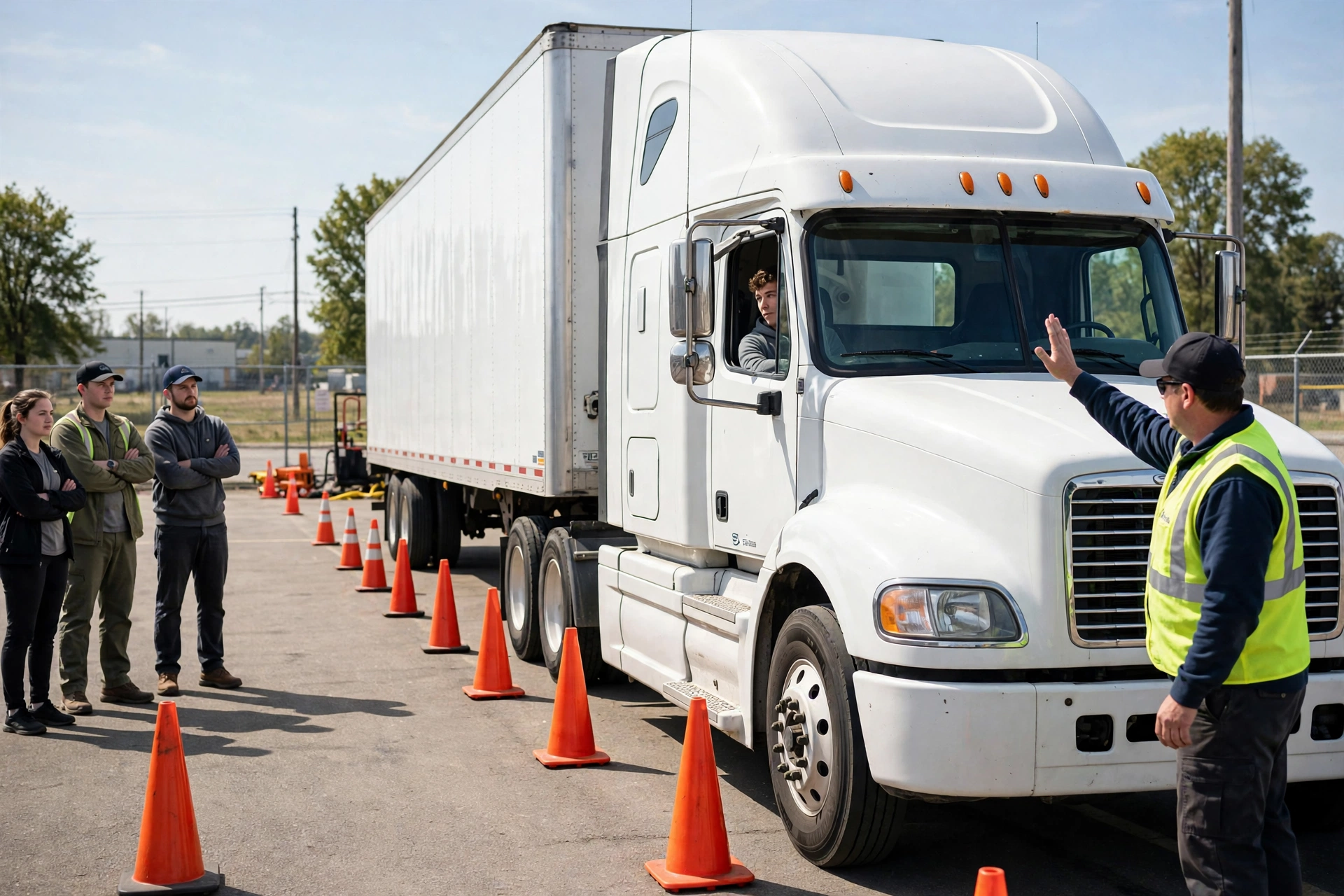
The four main ways to pay for CDL training are private CDL school, community college, company-sponsored training and public funding through WIOA or the GI Bill, and each trades upfront cost against time and contract obligations. Company-sponsored training has the lowest upfront cost. Private school offers the most freedom to choose an employer.
This table compares each CDL training path by upfront cost, contract obligation and freedom to choose an employer.
| Training Path | Upfront Cost | Contract Obligation | Employer Choice |
|---|---|---|---|
| Private CDL School | Full tuition, financing often available | None with the school | Full |
| Community College | Tuition, financial aid may apply | None | Full |
| Company-Sponsored | Low or none | Work commitment, repayment clause | Limited to sponsor |
| WIOA Funding | Low or none if eligible | Program participation rules | Usually full |
| GI Bill | Covered for eligible veterans | None | Full |
Private CDL School
A private CDL school charges tuition directly and often offers financing or payment plans. No work contract comes attached. Drivers keep full freedom to apply to any carrier after graduation, which suits people with savings or local job offers lined up.
Registry status comes first. Before paying anything, confirm the school appears on the FMCSA Training Provider Registry and get tuition and financing terms in writing, plus the refund policy.
Community College CDL Program
A community college CDL program delivers ELDT through an accredited public institution. Aid sometimes helps. Some programs qualify for federal student aid through the Free Application for Federal Student Aid (FAFSA), along with state grants or employer tuition benefits.
Expect academic calendars at some colleges. Before enrolling, check start dates and class sizes, and ask exactly how much behind-the-wheel time each student receives over the course of the program.
Company-Sponsored CDL Training
Company-sponsored CDL training is a carrier-run or carrier-funded program that trains new drivers at low or no upfront cost. There’s a catch, though. In exchange, the driver agrees to work for the carrier for a set period.
Some carriers pay trainees while they learn, a model often called paid CDL training. Others go another route. Under tuition reimbursement, the carrier repays a driver’s school tuition in installments over time, starting after the driver is hired.
WIOA and GI Bill Funding
WIOA funding is federal workforce money that local American Job Centers can use to cover CDL tuition for eligible adults and dislocated workers. Some youth qualify too. Eligibility and approved schools vary by local workforce area. To find yours, contact the nearest American Job Center through CareerOneStop.
The GI Bill covers approved CDL programs for eligible veterans. Approval is the key word. To see which truck driving schools the Department of Veterans Affairs (VA) has approved, check its GI Bill Comparison Tool.
Can You Get a CDL for Free?
Yes, a driver can get a CDL for free through company-sponsored training, WIOA funding or the GI Bill, but company-sponsored programs usually require a work commitment with the sponsoring carrier. Free training still costs time. Some sponsored programs also require repayment when the driver leaves before the commitment ends.
This table compares each free CDL option by who qualifies and its main tradeoff.
| Free Option | Who Qualifies | Main Tradeoff |
|---|---|---|
| Company-Sponsored Training | Applicants the carrier accepts | Work commitment, repayment if leaving early |
| Tuition Reimbursement | Graduates hired by a participating carrier | Upfront tuition, repaid over time |
| WIOA Funding | Eligible adults and dislocated workers | Application process, approved schools only |
| GI Bill | Eligible veterans and some dependents | Approved programs only |
The cheapest legitimate path for most drivers comes down to two questions. Does the driver qualify for public funding? And would committing to a single carrier for a set work period be acceptable in exchange for training at low or no upfront cost?
Do You Have to Pay Back Company-Sponsored CDL Training?
Yes, company-sponsored CDL training contracts commonly require repayment if the driver leaves before the agreed work period ends, and many contracts prorate the balance so the amount owed shrinks with each month worked. Drivers who complete the full commitment typically owe nothing for their training. Finishing pays off.
The training contract is the true price tag of a free CDL. Every clause matters. Go through every page as carefully as you’d go through a loan agreement, since the repayment terms decide what an early exit will cost.
Questions to Ask Before Signing a Training Contract
Ask the carrier these questions and get each answer in writing:
- What is the total training value the contract assigns?
- How long is the required work commitment?
- Does the balance prorate, and on what schedule?
- What happens if the carrier terminates the driver?
- Does the contract charge interest or collection fees on unpaid balances?
- Are trainees paid during training, and at what rate?
- Who pays for the DOT physical, permit and test fees?
Can You Get a CDL Without Going to School?
No, first-time Class A and Class B applicants cannot get a CDL without formal training, because FMCSA has required Entry-Level Driver Training (ELDT) from a Training Provider Registry (TPR) listed provider since February 7, 2022. Reporting matters as well. The provider must report completion to the TPR before the driver can take the skills test.
ELDT providers include private schools, community colleges, carriers and other registered entities. Coverage is broad. The rule also applies to drivers upgrading from Class B to Class A and to first-time Hazmat, Passenger and School Bus applicants.
Veterans get one possible shortcut. Those with qualifying heavy-vehicle military experience may be eligible for a state skills test waiver, so check your state DMV for current waiver rules.
How to Get a CDL Step by Step
How to get a CDL follows a set federal sequence: pass a DOT physical, earn a Commercial Learner’s Permit, complete ELDT with a TPR-listed provider, pass the skills test and pay the license fee. Each step carries its own cost. Budgeting one step at a time keeps surprise expenses out of the picture.
Anyone wondering how much does it cost to get your CDL license can price each of these steps:
- Choose a license class and endorsements that match the trucking jobs you want.
- Pass a DOT physical with an examiner listed on the National Registry.
- Study the state CDL manual and pass the knowledge tests to earn a CLP.
- Enroll with a TPR-listed provider and complete ELDT theory and behind-the-wheel training.
- Hold the CLP for the minimum period your state requires.
- Pass the skills test, which covers the pre-trip inspection, basic vehicle control and an on-road drive.
- Pay the license issuance fee and any endorsement fees at the state DMV.
- Register with the FMCSA Drug and Alcohol Clearinghouse so employers can run the required pre-employment query.
Is CDL School Worth the Money?
Yes, CDL school is worth the money for drivers who confirm the school is TPR-listed, compare tuition against local job offers and value freedom to choose an employer over a sponsored contract. Value still varies. It hinges on available cash and local hiring demand, plus how much contract obligation a driver can tolerate.
How fast a driver earns back tuition has no verified figure in the provided material, and the answer changes from one local job market to the next. Estimate it yourself:
- Collect written CDL training cost quotes from at least two TPR-listed providers.
- Gather written pay offers from carriers hiring new drivers in your area.
- Divide the total training cost by your expected monthly take-home pay to estimate the payback period.
- Compare that payback period against the commitment length in any sponsored training contract.
- Check BLS wage data for heavy and tractor-trailer truck drivers to test whether job offers match official figures.
Conclusion
Drivers who want to know how much does a CDL cost will get the most accurate answer by pricing each fee with their state DMV and each TPR-listed provider, then choosing the training path that fits their budget and goals. Prices move. State fee schedules and training offers change, so check current numbers before enrolling.
A personal cost sheet comes next. Put tuition quotes, state fees, the DOT physical price and any endorsement costs side by side on one page, then add them up. That total is what gets weighed against public funding eligibility and sponsored contract terms.
Federal training rules now make the TPR the starting point for every new driver. Verification comes first. A driver who also reads every contract and budgets for hidden costs enters trucking with a clear price and no surprise debt.
Frequently Asked Questions
Sources
- Federal Motor Carrier Safety Administration, Commercial Driver’s License: https://www.fmcsa.dot.gov/registration/commercial-drivers-license
- FMCSA Training Provider Registry: https://tpr.fmcsa.dot.gov
- Electronic Code of Federal Regulations, 49 CFR Part 380: https://www.ecfr.gov/current/title-49/subtitle-B/chapter-III/subchapter-B/part-380
- FMCSA National Registry of Certified Medical Examiners: https://nationalregistry.fmcsa.dot.gov
- FMCSA Drug and Alcohol Clearinghouse: https://clearinghouse.fmcsa.dot.gov

Esther Howard
Esther Howard leads trucking and commercial driving content at TruckingHow, covering CDL training, trucking regulations, fleet operations, and truck maintenance. With over a decade of experience researching the transportation industry, she brings a practical, research-driven approach to driver education and safety standards. Her guides help drivers, fleet owners, and trucking professionals make informed decisions on and off the road.
Related Posts