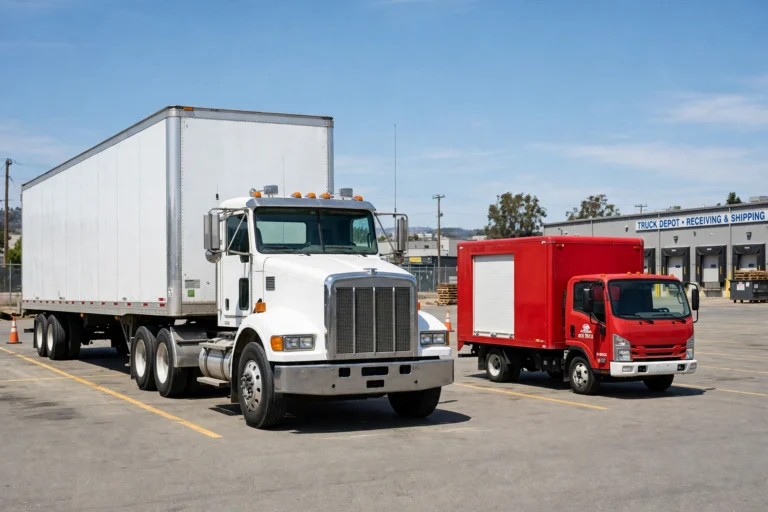
How Long Can a Truck Driver Drive in a Day and a Week?

A property-carrying truck driver can drive a maximum of 11 hours after 10 consecutive hours off duty, and all of that driving must fit inside a 14-hour on-duty window. Two more limits apply. A 30-minute break is due after 8 cumulative hours of driving, and on-duty time can’t pass 60 hours in 7 days or 70 hours in 8 days.
Hours of service (HOS) is a set of U.S. Department of Transportation (DOT) safety rules that limits how long commercial truck and bus drivers can drive and work before they must rest. Drivers call them DOT hours of service. The Federal Motor Carrier Safety Administration (FMCSA) writes and enforces the rules in Title 49 of the Code of Federal Regulations (CFR), Part 395.
Key Takeaways
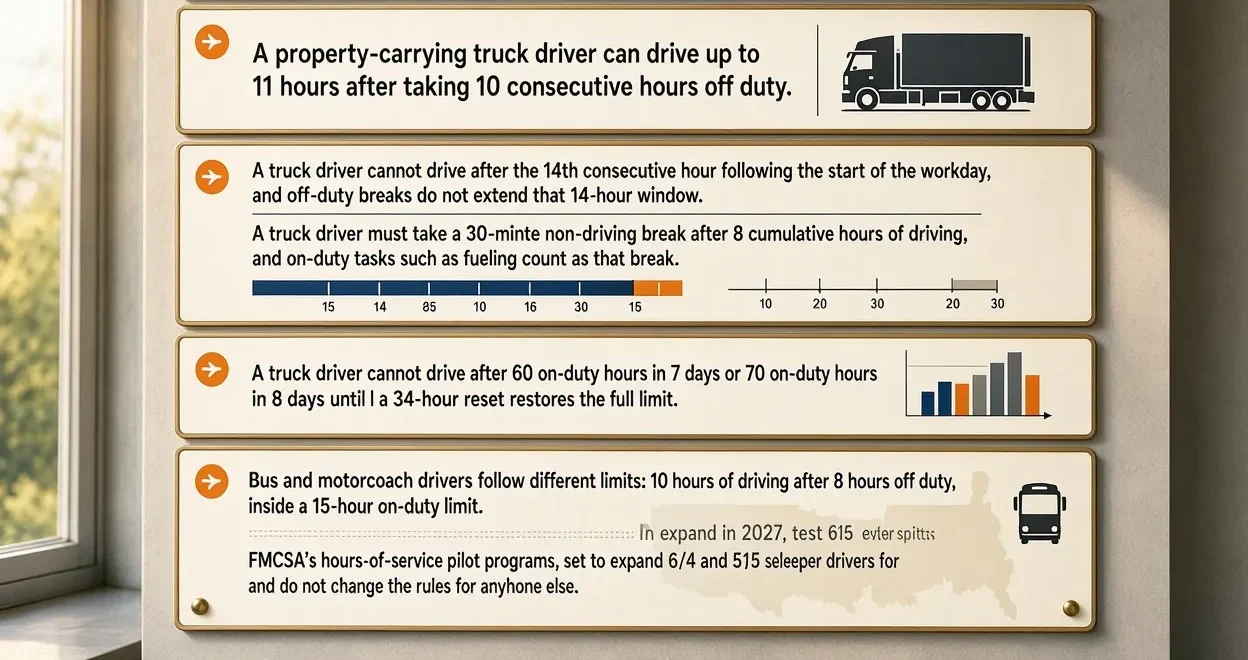
- A property-carrying truck driver can drive up to 11 hours after taking 10 consecutive hours off duty.
- A truck driver cannot drive after the 14th consecutive hour following the start of the workday, and off-duty breaks do not extend that 14-hour window.
- A truck driver must take a 30-minute non-driving break after 8 cumulative hours of driving, and on-duty tasks such as fueling count as that break.
- A truck driver cannot drive after 60 on-duty hours in 7 days or 70 on-duty hours in 8 days until a 34-hour reset restores the full limit.
- Bus and motorcoach drivers follow different limits: 10 hours of driving after 8 hours off duty, inside a 15-hour on-duty limit.
- FMCSA’s hours-of-service pilot programs, set to expand in 2027, test 6/4 and 5/5 sleeper splits for 512 selected drivers and do not change the rules for anyone else.
How Long Can a Truck Driver Drive in a Day?
A truck driver can drive 11 hours in a day, but only within 14 consecutive hours of starting work and only after 10 straight hours off duty. FMCSA writes that ceiling into 49 CFR 395.3 for property carriers. So how long can a truck driver drive in one day? It’s 11 hours, not 14.
Three separate clocks control how long a truck driver can drive a day, and whichever runs out first ends the driving.
| Clock | Limit | What starts it | What resets it |
| Driving clock | 11 hours of driving | The first driving after 10 hours off | 10 consecutive hours off duty, or a qualifying sleeper split |
| Duty window | No driving after the 14th hour | The first on-duty activity of the day | 10 consecutive hours off duty, or a qualifying sleeper split |
| Break clock | 30-minute break after 8 hours of driving | The first driving of the day | Any 30 consecutive minutes not driving |
What Is the 11-Hour Driving Limit?
The 11-hour driving limit means a truck driver can spend no more than 11 hours behind the wheel after 10 consecutive hours off duty. Paperwork isn’t driving. Neither are pre-trip inspections, which are on-duty tasks, so they eat into the 14-hour window instead.
How many hours a day can a truck driver drive under this limit? Eleven is the ceiling. Only time behind the wheel counts toward it, so even a long wait at a loading dock leaves the 11-hour clock untouched.
What Is the 14-Hour Rule for Truck Drivers?
The 14-hour rule means a truck driver cannot drive after the 14th consecutive hour following the start of the workday. Each workday’s 14-hour clock opens with the first on-duty task, such as a pre-trip inspection, and it keeps running through naps and shipper waits alike. It doesn’t stop. A driver who starts at 6:00 a.m. can’t drive after 8:00 p.m.
Work can continue past the 14th hour. A driver can still unload the trailer or finish paperwork, though every minute of that work counts toward the weekly 60-hour or 70-hour limit.
When Do Truck Drivers Have to Take a 30-Minute Break?
A truck driver must take a 30-minute break before driving again once the driver has driven 8 cumulative hours without a 30-minute interruption. Since September 29, 2020, any 30 consecutive minutes of non-driving time qualifies. Fueling counts. So does time off duty, time in the sleeper berth, or time spent loading at a dock.
So how long can a truck driver drive a day before stopping? The limit is 8 cumulative hours, followed by a 30-minute break. That break doesn’t freeze the 14-hour window, which means a 30-minute lunch at hour 6 still burns 30 minutes of the 14 available hours. Plan for it.
What Are DOT Hours of Service?
DOT hours of service are the federal rules that limit how long a commercial driver can drive and work before resting, enforced by the FMCSA under 49 CFR Part 395. Weight decides most cases. The rules reach interstate drivers of commercial motor vehicles (CMVs), including any truck rated at 10,001 pounds (4,536 kilograms) or more.
Cargo matters too. Any vehicle hauling hazardous materials in amounts that require placards falls under the rules, whatever its weight. FMCSA sits inside DOT, but drivers who never cross a state line answer to state rules instead, and most states copy the federal limits closely.
How Many Hours Can a Truck Driver Drive in a Week?
A truck driver cannot drive after reaching 60 on-duty hours in 7 consecutive days, or 70 on-duty hours in 8 consecutive days, depending on the motor carrier’s schedule. The 60/70-hour limit counts every on-duty hour, from driving and loading to inspections and paid work for other employers. Weekly driving time always runs lower.
Carriers that don’t run trucks every day of the week use the 60-hour/7-day schedule. If the fleet operates daily, the 70-hour/8-day schedule applies. Neither one resets on Sunday. Both roll forward one day at a time, so the oldest day’s hours drop off at each midnight rather than all at once.
| Schedule | On-duty limit | Period | Who uses it |
| 60/7 | 60 hours | Any 7 consecutive days | Carriers that do not run every day |
| 70/8 | 70 hours | Any 8 consecutive days | Carriers that run every day |
How Does the 34-Hour Reset Work in Trucking?
The 34-hour reset lets a truck driver restart the 60-hour or 70-hour weekly clock at zero by taking 34 or more consecutive hours off duty. Nobody has to use it. Skip the 34-hour reset trucking rule, and hours come back only as old days roll off the 7-day or 8-day period.
Picture a driver on the 70/8 schedule who works 14 hours a day for 5 days and hits 70 hours. That driver can’t drive. Without a reset, the only fix is waiting for older days to drop off, while a 34-hour reset puts the full 70 hours back the moment the 34th consecutive off-duty hour ends.
A driver can mix off-duty time and sleeper berth time to reach the 34 hours, as long as the hours run consecutively. Passenger carriers are another story. FMCSA’s summary lists the 34-hour restart only under the property-carrying rules.
How Does the Split Sleeper Berth Change Driving Time?
The split sleeper berth rule lets a truck driver divide the required 10 hours off duty into 2 periods: at least 7 consecutive hours in the sleeper berth and at least 2 hours off duty or in the berth. When paired, neither period counts against the 14-hour window. That’s the payoff.
Order doesn’t matter. The 2 periods just have to total at least 10 hours, and once the second one ends, the driver recalculates available hours starting from the end of the first period.
| Split | Long period | Short period | Common use |
| 8/2 | 8 hours in the sleeper berth | 2 hours off duty or in the berth | Drivers who want the longest single sleep |
| 7/3 | 7 hours in the sleeper berth | 3 hours off duty or in the berth | Drivers who face a 3-hour wait at a shipper or receiver |
The better split depends on the load. A driver who already expects a 3-hour detention period gets the most out of 7/3, while 8/2 suits anyone who’d rather bank a longer, unbroken sleep.
What Does a Legal 11-Hour Driving Day Look Like?
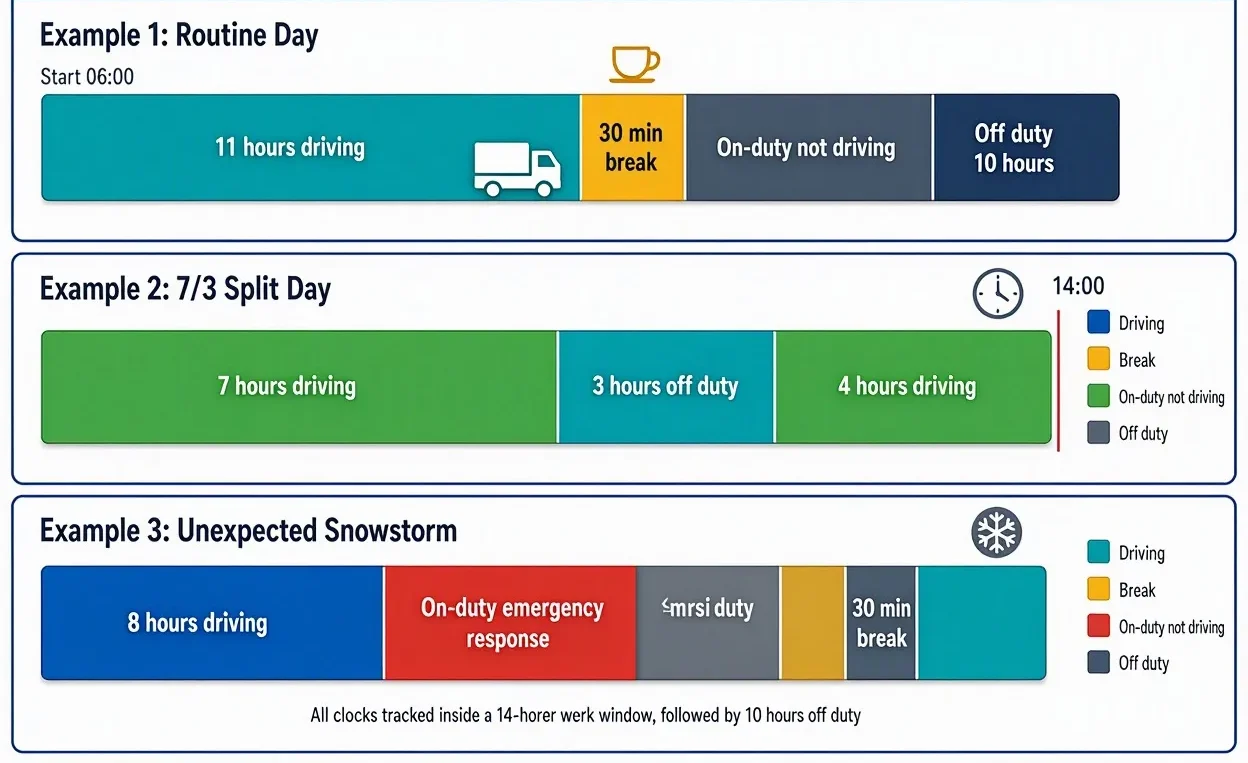
A legal driving day fits 11 hours of driving, a 30-minute break, and all on-duty work inside 14 hours, then ends with 10 hours off duty. Below are 3 examples. They run from a routine day to an unexpected snowstorm, with a 7/3 split day in the middle, and each one tracks every clock under current FMCSA rules.
Example 1: A Standard 11-Hour Day
| Time | Duty status | Driving used | 14-hour window used |
| 6:00 a.m. to 6:30 a.m. | On duty: pre-trip inspection | 0 hours | 0.5 hours |
| 6:30 a.m. to 2:30 p.m. | Driving | 8 hours | 8.5 hours |
| 2:30 p.m. to 3:00 p.m. | On duty: fueling (counts as the 30-minute break) | 8 hours | 9 hours |
| 3:00 p.m. to 6:00 p.m. | Driving | 11 hours | 12 hours |
| 6:00 p.m. to 7:00 p.m. | On duty: unloading and post-trip | 11 hours | 13 hours |
| 7:00 p.m. to 5:00 a.m. | Off duty: 10-hour reset | Reset | Reset |
By 6:00 p.m., the 11-hour driving limit is used up, even though 2 hours still remain on the driver’s 14-hour window for the day. That leftover window doesn’t help. Only the 10-hour break starting at 7:00 p.m. restores both clocks, and it ends at 5:00 a.m.
Example 2: A 7/3 Split Sleeper Day
| Time | Duty status | Driving used |
| 6:00 a.m. to 6:30 a.m. | On duty: pre-trip inspection | 0 hours |
| 6:30 a.m. to 11:30 a.m. | Driving | 5 hours |
| 11:30 a.m. to 2:30 p.m. | Off duty: 3-hour wait at the shipper (first period) | 5 hours |
| 2:30 p.m. to 8:00 p.m. | Driving | 10.5 hours |
| 8:00 p.m. to 3:00 a.m. | Sleeper berth: 7 hours (second period) | Recalculated |
| 3:00 a.m. to 8:30 a.m. | Driving | 11 hours on the new calculation |
Driving stops at 8:00 p.m., right where the original 14-hour window closes. Together, the 3-hour wait and the 7-hour sleep equal 10 hours, so the driver recalculates from 2:30 p.m., the end of the first period. The math is simple. Since 2:30 p.m., the driver has used 5.5 hours of driving, which leaves 5.5 driving hours and an 8.5-hour window starting at 3:00 a.m.
That’s a 3:00 a.m. start, not 6:00 a.m. One catch applies, though: the 3-hour wait counts as off duty only when the motor carrier relieves the driver of all duties for the full stretch.
Example 3: A Day With Unexpected Snow
| Time | Duty status | Driving used | Window used |
| 6:00 a.m. to 6:30 a.m. | On duty: pre-trip inspection | 0 hours | 0.5 hours |
| 6:30 a.m. to 2:30 p.m. | Driving | 8 hours | 8.5 hours |
| 2:30 p.m. to 3:00 p.m. | Off duty: 30-minute break | 8 hours | 9 hours |
| 3:00 p.m. to 8:00 p.m. | Driving through snow not forecast at dispatch | 13 hours | 14 hours |
| 8:00 p.m. | Off duty: 10-hour reset begins | Reset | Reset |
Snow that wasn’t in the forecast slows the run, so the driver turns to the adverse driving conditions exception. It adds 2 hours to the 11-hour driving limit and 2 hours to the 14-hour window, allowing 13 hours of driving inside a 16-hour window. The snow goes in the log remarks.
Can Truck Drivers Drive Extra Hours in Bad Weather?
Yes, a truck driver can drive up to 2 extra hours when unexpected adverse driving conditions slow a trip, which extends the 11-hour limit to 13 hours and the 14-hour window to 16 hours. Timing is the catch. Under 49 CFR 395.1(b), the adverse-conditions exception covers only conditions nobody knew about when the trip started.
Fog qualifies, and so does a highway shut down by a crash. Unforecast snow counts too. Rush-hour traffic doesn’t, because any driver should plan for it, and the extra time exists only to finish a run that would’ve been legal in normal conditions.
Do Local and Short-Haul Drivers Follow Different Rules?
Yes, short-haul drivers who stay within 150 air miles of their work reporting location and finish within 14 hours do not need to keep logs or use an electronic logging device (ELD). Logs go, but limits stay. The 11-hour driving limit and 10-hour off-duty rule still apply, and 150 air miles equals 172.6 road miles (277.8 kilometers).
The exception used to be tighter. On September 29, 2020, FMCSA widened it from a 100 air-mile radius and a 12-hour day to a 150 air-mile radius and a 14-hour day. Whether the truck requires a commercial driver’s license (CDL) still changes some details, and the table below compares how long a truck driver can drive under each schedule type.
| Driver type | Daily driving limit | Daily duty limit | Logs required | CFR section |
| Long-haul property carrier | 11 hours | 14-hour window | Yes, on an ELD | 395.3 |
| Short-haul (CDL or non-CDL) | 11 hours | Return within 14 hours | No, time records only | 395.1(e)(1) |
| Non-CDL short-haul | 11 hours | 14 hours on 5 days, 16 hours on 2 days per 7 days | No, time records only | 395.1(e)(2) |
| 16-hour short-haul exception | 11 hours | 16 hours once every 7 days | Yes, on the day used | 395.1(o) |
| Passenger carrier (bus, motorcoach) | 10 hours | 15 hours on duty | Yes, on an ELD | 395.5 |
To use the 16-hour short-haul exception, the driver has to return to the work reporting location that day and on the previous 5 duty tours. Stacking isn’t allowed. The 150 air-mile exception and the 16-hour exception can’t share the same day.
How Many Hours Can a Commercial Driver Drive a Bus or Motorcoach?
A bus or motorcoach driver can drive a maximum of 10 hours after 8 consecutive hours off duty and cannot drive after 15 hours on duty. Driving time is tighter than for trucks. Breaks work differently, though: the 15-hour limit excludes off-duty time, so off-duty breaks pause a passenger-carrier driver’s clock.
So how many hours can a commercial driver drive? Cargo decides. Freight haulers and passenger drivers work under separate core limits, and the table below lines them up side by side.
| Rule | Property-carrying driver | Passenger-carrying driver |
| Driving limit | 11 hours | 10 hours |
| Off duty before driving | 10 consecutive hours | 8 consecutive hours |
| Duty limit | 14-hour window, breaks included | 15 hours on duty, breaks excluded |
| 30-minute break | Required after 8 hours of driving | Not required |
| Sleeper berth split | 7/3 or 8/2, totaling 10 hours | 8 hours, split into 2 periods of at least 2 hours |
| Bad weather extension | Up to 2 hours | Up to 2 hours |
How Are Truck Driver Hours Tracked?
Truck driver hours are tracked by an ELD, an electronic logging device connected to the truck’s engine that automatically records driving time. Paper logs are mostly gone. Most drivers needed an ELD or an older automatic on-board recording device by December 18, 2017, and every covered driver needed a registered ELD by December 16, 2019.
Every ELD record shows 4 duty statuses: off duty, sleeper berth, driving, and on duty not driving. Inspectors see all of it. At a roadside stop, an inspector reads that record straight off the ELD display or from a printout the driver hands over.
When an ELD malfunctions, the driver must notify the motor carrier in writing within 24 hours and switch to paper logs. Then comes the paperwork. The driver rebuilds logs for the current day and the previous 7 days, and under 49 CFR 395.34 the carrier gets 8 days to repair or replace the ELD.
What Happens If a Truck Driver Drives Over the Limit?
A truck driver who drives past the 11-hour or 14-hour limit faces an out-of-service order at a roadside inspection, a recorded violation, and possible civil fines for both the driver and the motor carrier. The truck stays put. Under an out-of-service order, the truck can’t move until the driver completes enough off-duty time to drive legally again.
Each hours-of-service violation also lands on the carrier’s safety record in FMCSA’s Compliance, Safety, Accountability (CSA) program, and a weak CSA record brings more inspections and audits along with higher insurance costs. Big overruns cost more. FMCSA treats driving more than 3 hours past the driving limit as an egregious violation that can draw the maximum penalty, currently per hours-of-service violation.
5 Common Myths About DOT Hours of Service
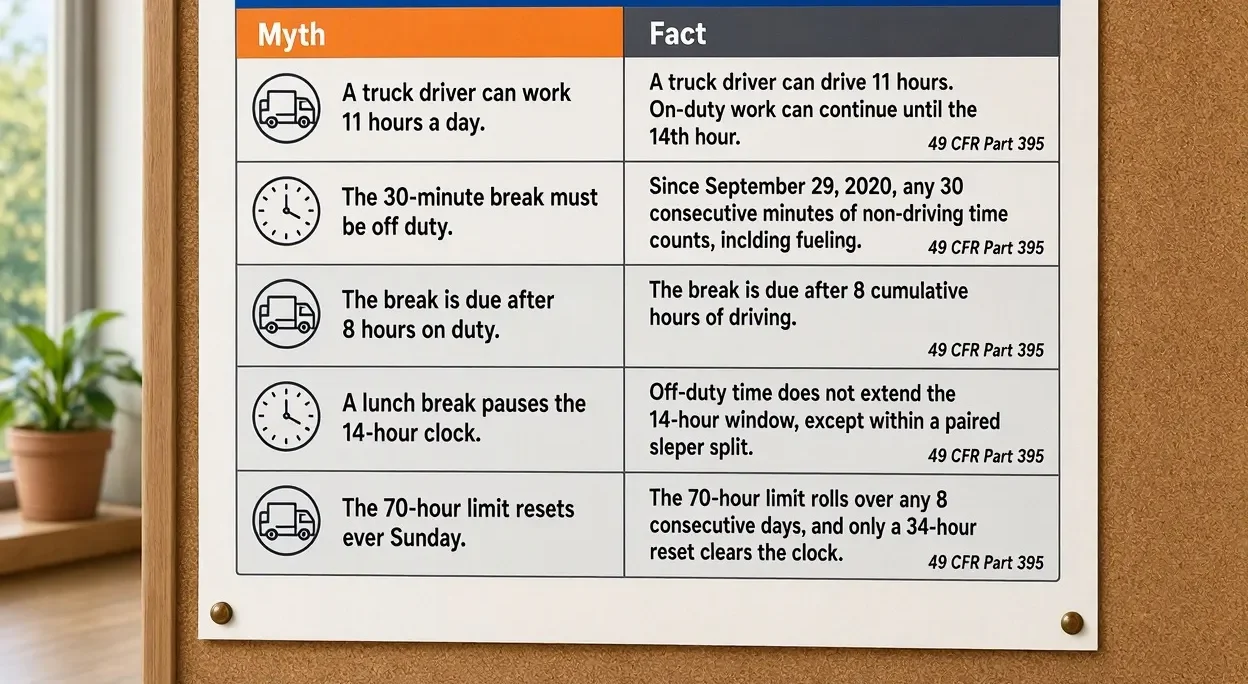
The 5 most common hours-of-service myths confuse driving time with work time, treat breaks as pauses, and repeat rules that changed in 2020. Below, the table sets each one straight. Every row pairs a myth with the current FMCSA rule from 49 CFR Part 395, so drivers can check a claim before planning a trip.
| Myth | Fact |
| A truck driver can work 11 hours a day. | A truck driver can drive 11 hours. On-duty work can continue until the 14th hour. |
| The 30-minute break must be off duty. | Since September 29, 2020, any 30 consecutive minutes of non-driving time counts, including fueling. |
| The break is due after 8 hours on duty. | The break is due after 8 cumulative hours of driving. |
| A lunch break pauses the 14-hour clock. | Off-duty time does not extend the 14-hour window, except within a paired sleeper split. |
| The 70-hour limit resets every Sunday. | The 70-hour limit rolls over any 8 consecutive days, and only a 34-hour reset clears the clock. |
Are the Hours-of-Service Rules Changing in 2026?
No, the national hours-of-service rules did not change in 2026, but FMCSA is preparing 2 pilot programs that will test more flexible schedules with 512 selected drivers. On August 27, 2026, FMCSA announced completed pre-tests and plans to open both pilot programs to more drivers in 2027. Everyone else stays on current rules.
| Rule | Current rule for all drivers | Pilot program rule (selected drivers only) |
| Sleeper berth split | 7/3 or 8/2, totaling at least 10 hours | Any split totaling 10 hours with at least 5 consecutive hours in the berth, such as 6/4 or 5/5 |
| 14-hour window | Cannot pause, except within a paired sleeper split | Can pause for 30 minutes to 3 hours a day for qualifying non-driving time |
| Participants | All property-carrying drivers | 256 drivers in each pilot, 512 in total |
U.S. Transportation Secretary Sean P. Duffy announced the pilot programs. Each participating driver provides 4 months of data, and once a pilot ends, FMCSA has to report its findings to Congress. Even then, nothing changes automatically. A permanent change needs its own rulemaking.
Conclusion
How long can a truck driver drive once the pilots begin? For every driver outside the FMCSA pilot programs, the limit stays at 11 hours of driving inside a 14-hour window. That’s the law today. Data from the 2027 pilots will show whether flexible splits and a pausable 14-hour window keep drivers rested and roads safe.
How long can a trucker drive after the pilots end? It stays 11 hours. Only a new FMCSA rulemaking can change that. Learn the 3 daily clocks now, and every load gets easier to plan around detention delays and weekly limits.
Frequently Asked Questions

Esther Howard
Esther Howard leads trucking and commercial driving content at TruckingHow, covering CDL training, trucking regulations, fleet operations, and truck maintenance. With over a decade of experience researching the transportation industry, she brings a practical, research-driven approach to driver education and safety standards. Her guides help drivers, fleet owners, and trucking professionals make informed decisions on and off the road.
Related Posts