Top 10 Trucking Companies in USA (Ranked by Revenue and Fleet Size)
The top 10 trucking companies in the USA are UPS, FedEx, J.B. Hunt Transport Services, Knight-Swift Transportation, Ryder System, TFI International, XPO, Old Dominion Freight Line, Schneider National, and Estes Express Lines. These carriers lead the industry on a mix of annual revenue, tractor and trailer count, and terminal network density, based on the Transport Topics Top 100 For-Hire Carriers report and each company’s own SEC filings and investor disclosures.
Quick reference:
| Rank | Carrier | Revenue (latest reported) | Primary model | Headquarters |
| 1 | UPS | ~$88.6B (FY2025, TTM) | Parcel + freight, less-than-truckload (LTL) | Atlanta, GA |
| 2 | FedEx | ~$87.9B (FY2025) | Parcel + express; LTL now spun off separately | Memphis, TN |
| 3 | J.B. Hunt | ~$12.0B (FY2025) | Intermodal, dedicated contract carriage, truckload | Lowell, AR |
| 4 | Ryder System | ~$12.6B (FY2024) | Fleet management, dedicated contract carriage | Miami, FL |
| 5 | Knight-Swift | Revenue lower; largest fleet | Truckload (TL), asset-based | Phoenix, AZ |
| 6 | TFI International | ~$8.4–9.0B | LTL, truckload, package (multi-brand) | Montreal, QC |
| 7 | XPO | ~$7.5–8.0B | LTL, technology-driven freight matching | Greenwich, CT |
| 8 | Old Dominion | Mid-tier revenue, high margin | LTL | Thomasville, NC |
| 9 | Schneider National | Mid-tier revenue | Truckload, intermodal, dedicated | Green Bay, WI |
| 10 | Estes Express Lines | $5B+ | LTL, privately held | Richmond, VA |
Freight moves differently depending on the carrier you choose — a furniture retailer shipping pallets from Ohio to Florida needs a different network than an e-commerce brand shipping nationwide parcels. Some carriers run massive over-the-road (OTR) truckload fleets. Others specialize in less-than-truckload (LTL) freight, where multiple shippers’ goods share trailer space. Several combine truckload, LTL, intermodal (pairing truck transport with rail for long-haul lanes), and dedicated contract carriage, where trucks and drivers are assigned permanently to one customer’s routes.
Quick Glossary
- LTL (less-than-truckload): Multiple shippers’ freight consolidated in one trailer, priced by weight and freight class.
- Truckload (TL): One shipper’s freight fills an entire trailer.
- Intermodal: Freight moves by both truck and rail, typically cheaper on long hauls.
- Dedicated contract carriage: A carrier permanently assigns trucks/drivers to one customer’s routes.
- Asset-based carrier: Owns its own trucks and trailers (most of this list).
- Non-asset / asset-light carrier: Brokers freight to other carriers rather than owning the fleet (e.g., freight brokers, some 3PLs).
- 3PL (third-party logistics): A company that manages freight, warehousing, or fulfillment on a shipper’s behalf without necessarily owning trucks.
How This Ranking Was Built
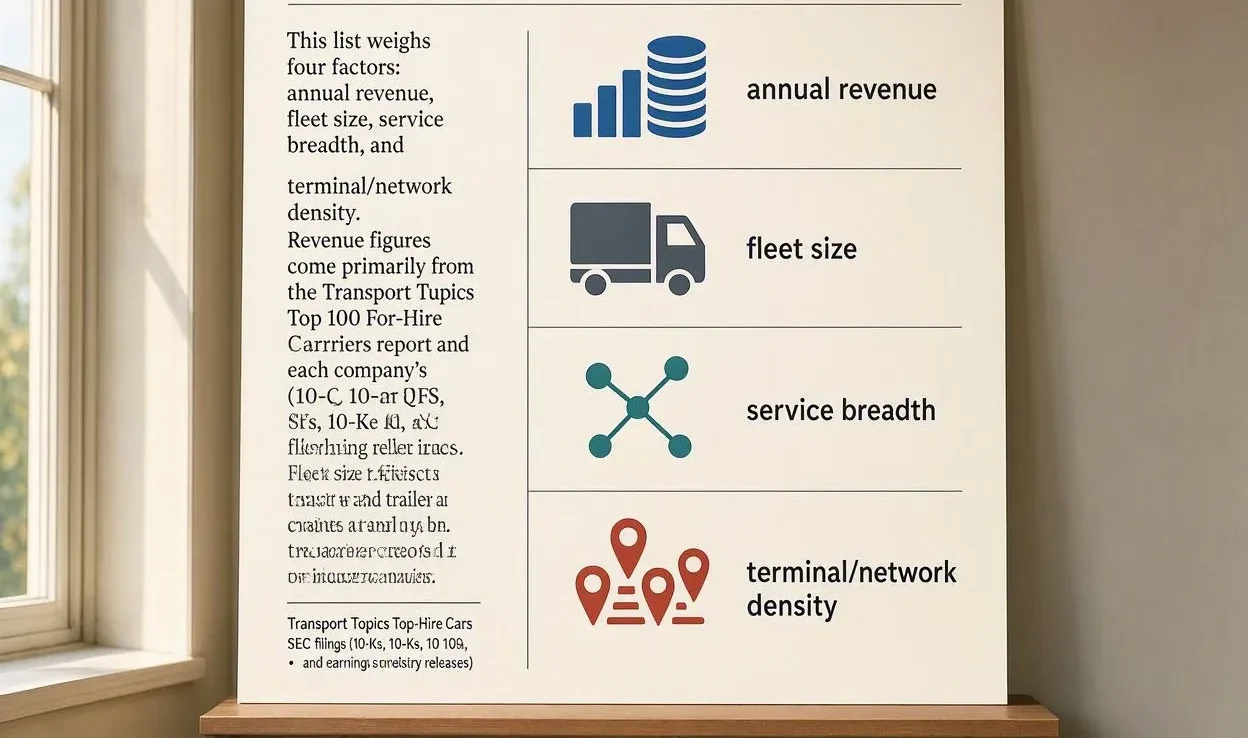
This list weighs four factors: annual revenue, fleet size, service breadth, and terminal/network density. Revenue figures come primarily from the Transport Topics Top 100 For-Hire Carriers report and each company’s SEC filings (10-Ks, 10-Qs, and earnings releases). Fleet size reflects tractor and trailer counts as reported by the carriers or tracked by industry analysts.
Two rankings run side by side in trucking, and conflating them produces the wrong shortlist. UPS ranks first by revenue but isn’t necessarily the carrier with the most trucks on the road — its revenue includes air freight, international parcel, and package delivery that never touches a semi-truck. Knight-Swift runs a larger dedicated truckload fleet than UPS despite far lower total revenue. This list separates the two metrics where the gap matters.
The U.S. trucking industry generated $906 billion in gross freight revenue and moved 11.27 billion tons of freight in 2024, per the American Trucking Associations’ data cited in Transport Topics’ 2024 fiscal-year report. More than 750,000 active motor carriers operate in the U.S., though most run fleets under 20 trucks. The top 10 account for a disproportionate share of freight volume despite representing a tiny fraction of registered carriers.
The Top 10 Trucking Companies in the USA, Ranked
1. UPS
UPS leads with roughly $88–89 billion in annual revenue (fiscal 2025). Founded in 1907 and headquartered in Atlanta, UPS built its ground network around UPS Ground — brown delivery vans — but also runs thousands of tractors and trailers on interstate highways daily. Package delivery still drives most of UPS’s revenue; freight is a smaller share than the top-line number suggests. UPS has also been actively restructuring: in 2025 it closed dozens of facilities and reduced Amazon-related volume as part of a stated shift toward higher-margin business.
2. FedEx
FedEx reported $87.9 billion in revenue for fiscal year 2025. Memphis-based FedEx competes with UPS in both parcel and freight. Important update: FedEx Freight, long run as FedEx’s LTL division, was spun off into a fully independent, separately traded public company — FedEx Freight Holding Company (NYSE: FDXF) — completing the separation in June 2026. FedEx retained a minority (19.9%) stake but no longer operates FedEx Freight as a business segment. FedEx’s remaining business is now built around Federal Express (air/ground parcel) and FedEx Logistics, without an in-house LTL division. Shippers who relied on FedEx for both parcel and LTL freight now deal with two separate companies with separate management, pricing, and contracts.
3. J.B. Hunt Transport Services
J.B. Hunt leads dedicated and intermodal trucking by revenue, reporting $12.0 billion in fiscal year 2025. The Lowell, Arkansas carrier processes roughly 2 million intermodal loads annually through its J.B. Hunt 360° digital freight-matching platform. Intermodal routing is typically cheaper than over-the-road truckload on high-volume long-haul lanes (e.g., moving containers inland from the Port of Los Angeles), which is why J.B. Hunt built its growth strategy around rail partnerships, dedicated contract carriage, and standard truckload service.
4. Knight-Swift Transportation
Knight-Swift is the largest standalone truckload (TL) carrier in North America, with a fleet reported in the tens of thousands of tractors following a string of acquisitions between 2017 and 2025. Phoenix-based Knight-Swift formed through the 2017 merger of Knight Transportation and Swift Transportation, then expanded by acquiring U.S. Xpress and absorbing terminal leases freed up by Yellow Corporation’s 2023 bankruptcy liquidation — which eliminated an estimated 30,000 jobs industry-wide and opened terminal real estate across the western U.S. Those acquisitions gave Knight-Swift its first foothold in LTL, a segment it hadn’t operated in before 2021, with a stated goal of building 48-state LTL coverage.
5. Ryder System
Ryder generates roughly $12.6 billion in annual revenue, primarily through fleet management and dedicated contract carriage rather than standard freight hauling. Miami-based Ryder is a non-traditional carrier: it manages large numbers of commercial vehicles on behalf of other companies, handling maintenance, leasing, and logistics so clients avoid owning fleets outright. Dedicated contract carriage — assigning trucks and drivers permanently to one customer’s routes — is a growing share of its business, appealing to shippers like grocery chains that need guaranteed recurring delivery without an in-house fleet.
6. TFI International
TFI International operates across the U.S. and Canada, with revenue estimated between $8.4 and $9.0 billion. Montreal-based TFI owns multiple transportation brands, including TForce Freight, a major U.S. LTL carrier. TFI grew mainly through acquisition rather than organic fleet growth, folding smaller regional carriers into its network — which gives shippers flexibility to consolidate multiple freight types under one vendor, though service quality can vary between TFI’s individual subsidiary brands. TFI’s cross-border density is a differentiator for shippers moving freight between the U.S. and Canada under USMCA trade rules.
7. XPO
XPO is among the largest LTL carriers in the U.S., with revenue estimated between $7.5 and $8.0 billion, built on a terminal network and technology-driven freight optimization. Greenwich, Connecticut-based XPO invests heavily in routing software and load-matching algorithms. Terminal density matters more in LTL than truckload, since LTL freight consolidates multiple shippers’ goods and requires transfers between hubs — fewer transfers mean lower damage risk and faster transit.
8. Old Dominion Freight Line
Old Dominion is widely cited as the most consistently profitable LTL carrier in the U.S., running 250+ service centers from its headquarters in Thomasville, North Carolina. Its damage ratios and operating efficiency have consistently outperformed LTL industry benchmarks, which supports a pricing premium — lower damage rates mean fewer claims and less disruption for shippers. Analysts frequently point to Old Dominion as a growth outlier in a period when several competitors’ revenue has been flat.
9. Schneider National
Schneider provides truckload, intermodal, and logistics services, running one of the industry’s most recognizable fleets (its orange trucks). Green Bay-based Schneider expanded its dedicated fleet business in 2024 by acquiring Cowan Systems, an East Coast truckload carrier, for a reported ~$390 million — adding to earlier acquisitions of Midwest Logistics Systems and M&M Transport Services. Dedicated contract carriage is a growing share of Schneider’s revenue, alongside standard truckload and spot-market freight.
10. Estes Express Lines
Estes is the largest privately held trucking company in the U.S., with revenue exceeding $5 billion and no corporate debt, per company disclosures. The Richmond, Virginia carrier operates 270+ terminals across the U.S., Canada, Mexico, and Puerto Rico, and reports a fleet in the range of 10,000+ tractors and 42,000+ trailers, moving billions of pounds of freight annually across millions of shipments. Family-owned since 1931, Estes has avoided the shareholder pressure that pushes some public carriers toward short-term cost cutting, and has begun converting part of its fleet to compressed natural gas (CNG) and renewable natural gas (RNG).
What the FedEx Freight Spin-Off Means for Shippers
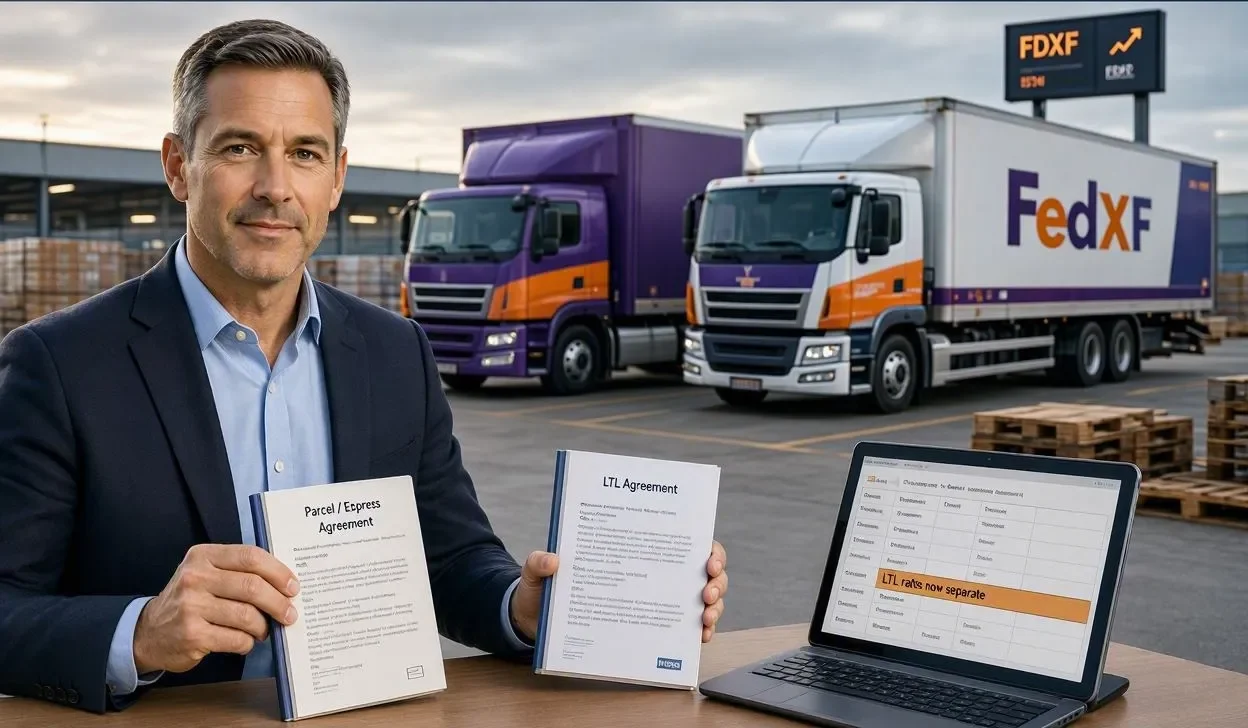
This is worth calling out on its own, since it’s a live, industry-reshaping change most “top 10” lists haven’t caught up with yet. As of June 2026, FedEx Freight Holding Company trades independently (FDXF) and is no longer a FedEx business segment. For shippers, that means:
- Separate contracts and pricing — FedEx parcel/express agreements no longer bundle with LTL freight rates.
- A new large independent LTL competitor — FedEx Freight now competes directly with Old Dominion, XPO, and TForce Freight on its own balance sheet and strategic priorities, rather than as part of a diversified parcel giant.
- Potential service changes — as an independent company, FedEx Freight may make different investment decisions on terminal density, technology, and pricing than it did under FedEx’s umbrella.
Revenue Leaders vs. Fleet-Size Leaders
Ranking by revenue and ranking by fleet size produce different lists. UPS and FedEx report tens of billions from parcel delivery and international logistics that never touch a semi-truck. Knight-Swift reports far less total revenue but runs a larger dedicated truckload fleet than either parcel giant — fleet size measures physical hauling capacity in a way blended revenue can’t. Shippers evaluating capacity for something like seasonal retail peak-season freight should check current tractor counts, not last year’s revenue, since some carriers shrink fleets through outsourcing and brokerage partnerships even as revenue grows.
What Separates the Top Carriers From Smaller Fleets
- Financial stability — operating ratios and debt levels matter more since Yellow Corporation’s 2023 bankruptcy showed how quickly a large asset-based carrier can collapse.
- Technology infrastructure — carriers with strong API and EDI (electronic data interchange) integration let shippers pull real-time tracking directly into their own transportation management systems (TMS); smaller carriers often lack the engineering resources to build this.
- Service breadth — one vendor covering truckload, LTL, intermodal, and dedicated freight beats juggling separate contracts, which is why TFI and J.B. Hunt built scale partly by acquiring capability in segments they didn’t originally serve.
- Terminal density — fewer transfers between hubs means lower damage risk and faster LTL transit.
- FMCSA safety rating — a “Satisfactory” rating from the Federal Motor Carrier Safety Administration signals compliance with hours-of-service (HOS) rules, electronic logging device (ELD) requirements, vehicle maintenance standards, and drug testing — not every smaller carrier meets this bar consistently.
- Driver retention — turnover directly affects service reliability and claims frequency; carriers with better driver pay and retention programs tend to show up in lower damage/on-time-performance stats, though this is harder for shippers to verify directly than a safety score.
How to Choose the Right Carrier for Your Shipment
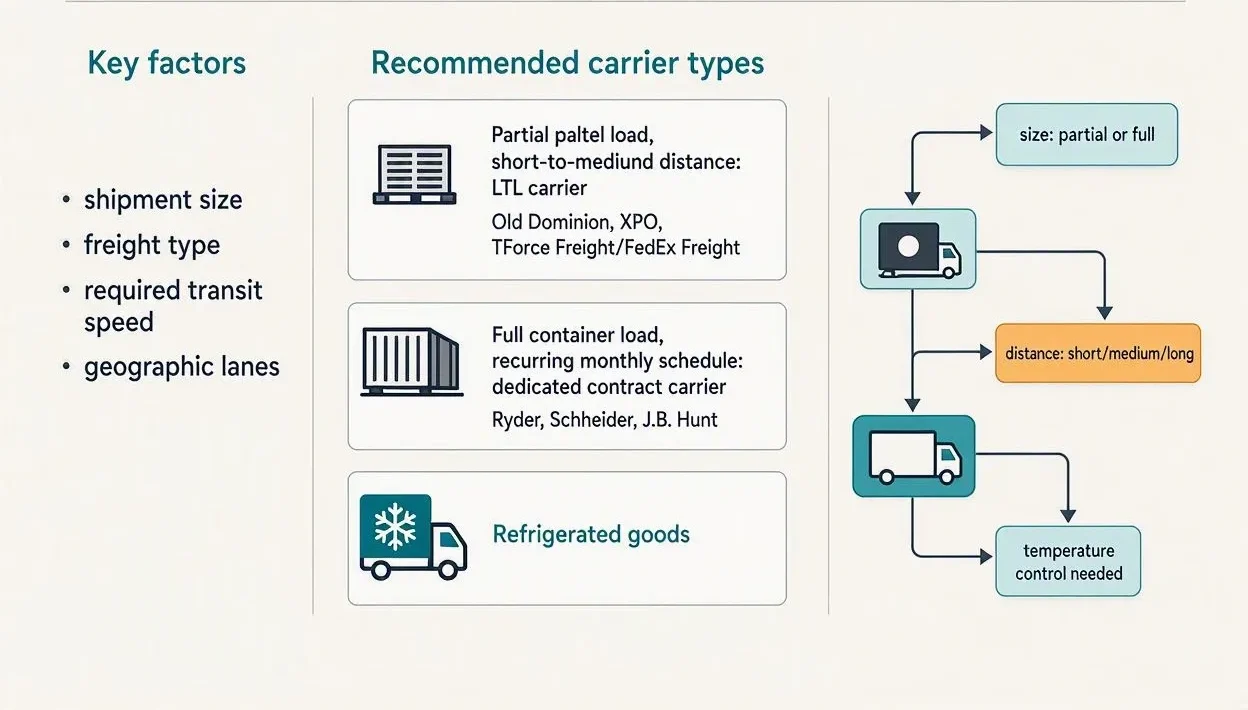
Carrier choice depends on shipment size, freight type, required transit speed, and geographic lanes — not simply on overall rank.
- Partial pallet load, short-to-medium distance: LTL carrier (Old Dominion, XPO, TForce Freight/FedEx Freight) — full truckload would waste capacity and cost more per pound.
- Full container load, recurring monthly schedule: dedicated contract carrier (Ryder, Schneider, J.B. Hunt).
- Refrigerated goods: confirm reefer-equipped trailer capacity — not every carrier here operates refrigerated freight at scale.
- Hazardous materials: confirm the carrier holds specific FMCSA hazmat endorsements; insurance minimums run higher for this freight class.
- Cross-border U.S.–Canada or U.S.–Mexico freight: TFI International’s network density and customs documentation handling is a differentiator here.
- Low shipping volume (a few loads per week or less): a freight broker or 3PL may get better rates than negotiating directly with a major carrier, trading some direct control for lower administrative overhead.
Also worth checking before you commit: the carrier’s FMCSA safety rating, whether pricing is contract or spot-market based (spot rates fluctuate with fuel prices and capacity), and whether the quoted rate includes fuel surcharges.
Conclusion
Revenue and fleet size tell two different stories about the same industry, and shippers who look at only one number risk picking the wrong carrier. UPS and FedEx dominate by total revenue because parcel delivery dwarfs pure freight hauling in dollar terms, while Knight-Swift and J.B. Hunt lead on physical capacity and intermodal reach. Ryder’s dedicated-fleet model, TFI’s cross-border density, and Estes’s debt-free stability each solve a different shipping problem no single “best” carrier covers alone — and the industry’s structure keeps shifting, as the FedEx Freight spin-off shows. The top 10 earned their positions through decades of acquisitions, terminal buildouts, and technology investment that smaller regional carriers can’t easily replicate, and that gap is widening as consolidation continues.
FAQs

Esther Howard
Esther Howard leads TruckingHow’s trucking, commercial driving, and transportation content division. She specializes in CDL training, trucking regulations, fleet operations, truck maintenance, and logistics best practices. With over a decade of experience researching the commercial transportation industry, Esther brings a practical, research-driven approach to driver education, safety standards, and industry regulations. She is the primary author of TruckingHow’s CDL guides, trucking career resources, maintenance tips, and transportation content, helping drivers, fleet owners, and trucking professionals make informed decisions on and off the road
Related Posts