
Freight Broker Requirements: Licensing, Bonds, and Costs
Two facts surprise most people entering brokerage: the federal government charges $300 for broker authority, and that $300 is the cheapest part of the process. A $75,000 bond, process agents in 51 jurisdictions, and annual registrations carry the real cost and the real deadlines. Federal rules shifted twice this year, so most published guides on freight broker requirements describe forms and screens that no longer exist. Below is the current checklist, with the fees, forms, and dates that apply now.
What Are the Freight Broker Requirements in the United States?
Every freight broker operating in interstate commerce must hold property broker authority from the Federal Motor Carrier Safety Administration (FMCSA), carry a $75,000 surety bond or trust fund, and designate process agents in every state where the broker writes contracts. No commercial driver’s license, degree, or state broker license is required at the federal level.
Six items make up the full federal checklist. Each one carries its own fee, form, and deadline:
| Requirement | Form or system | Cost | Deadline |
| USDOT number | Motus (motus.dot.gov) | Free | Filed with application |
| Property broker authority | Motus | $300 per authority | Non-refundable at filing |
| Financial security | BMC-84 or BMC-85 | $75,000 coverage | 90 days from application |
| Process agents | BOC-3 | $20 to $50 typical | 90 days from application |
| Unified Carrier Registration (UCR) | ucr.gov | $46 per year | December 31 annually |
| Biennial update | MCS-150 in Motus | Free | Every 24 months |
Miss the 90-day window on either the bond or the BOC-3 and FMCSA dismisses the application outright. The $300 doesn’t come back.
What Does a Freight Broker Actually Do?

A freight broker arranges transportation between shippers and motor carriers without taking possession of the cargo or operating trucks. The broker sources capacity, negotiates the rate, issues the rate confirmation, and collects from the shipper before paying the carrier.
Non-possession drives the regulatory structure. Because brokers hold other parties’ money between payment and settlement, Congress set the $75,000 financial security floor through MAP-21 in 2012. A produce broker in McAllen, Texas running 40 reefer loads a week never touches a pallet, yet carries exposure on roughly $120,000 in unpaid freight charges, and an unpaid carrier claims against the bond, not against trucks the broker doesn’t own.
How Is a Freight Broker Different From a Freight Forwarder?
A freight forwarder takes physical possession of goods and consolidates shipments; a broker does neither. If your business plan involves warehousing, cross-docking, or issuing your own bill of lading, you need freight forwarder authority instead of, or in addition to, broker authority.
The distinction costs money. Applying for both property broker and freight forwarder authority means two separate $300 fees, since 49 CFR §360.3T(d)(1) charges the fee per authority type rather than per application. (Verify this citation against the current CFR text before publishing.) Companies running both models, such as a Miami operation handling ocean import consolidation plus domestic truckload brokerage, pay $600 and file two sets of financial security.
Do You Need Authority to Work as a Freight Broker Agent?
No. A freight broker agent sells and books freight under someone else’s operating authority, which means no $300 fee, no bond, and no BOC-3 filing.
Agents split commission with the licensed brokerage, typically 50/50 to 70/30 in the agent’s favor once a book of business matures. According to Truckstop’s salary data, a W-2 broker earns roughly $62,000 in base pay plus $28,000 in commission. Anyone testing whether the work suits them should spend 12 to 18 months as an agent before spending $2,000 on their own authority.
How Do You Apply for Broker Operating Authority Now That URS Is Gone?
You apply through Motus at motus.dot.gov using a Login.gov account with verified identity, then select property broker authority and pay the $300 fee. The Unified Registration System (URS) went permanently offline on May 14, 2026 at 8:00 PM Eastern.
Motus folds three legacy platforms into one dashboard: URS, the registration functions of the FMCSA Portal, and the Licensing and Insurance system. FMCSA announced the switch in a Federal Register notice at 91 FR 23144. (Verify this citation resolves before publishing — Federal Register volume/page numbers are easy to mistype and hard for readers to catch.)
Any guide walking you through a downloadable Form OP-1 describes a process new applicants no longer use. That paper form now covers one case only: an existing registrant with a USDOT number adding an authority it doesn’t hold, such as a motor carrier with two years of MC authority that starts brokering its overflow loads.
Who Can Claim the Motus Company Account?
Only the owner, an official partner, or an authorized corporate officer can claim a company account in Motus. Filing services can prepare your paperwork, but they can’t be the verified account holder anymore. This applies to co-owned businesses too: identity verification runs through IDEMIA for biometrics and CLEAR for business verification, and one named human completes both checks and owns the login, even in a husband-and-wife brokerage. FMCSA built the requirement to attack registration fraud and MC-number identity theft, which have driven a wave of double-brokering scams in recent years.
What Happens After You File?
FMCSA publishes your application and runs a protest period before granting authority. FMCSA’s standard protest period runs 10 days, and brokers report the full gap between filing and active status landing around 18 to 21 days in practice, assuming the bond and BOC-3 are already on file. (Confirm this range against current FMCSA processing data or a named source before publishing.)
Your authority won’t activate until your surety files the BMC-84 and your process agent files the BOC-3. Both sit outside your control, which is why experienced filers line up the surety before touching the application. Applications commonly stall for three reasons: an unverified Login.gov identity, a bond filed under a slightly different legal name than the application, and a BOC-3 blanket company that never submitted the form.
What Are the Bond Requirements for Freight Brokers?
Every property broker must maintain $75,000 in financial security, filed either as a BMC-84 surety bond or a BMC-85 trust fund. The $75,000 is coverage available to claimants, not cash you hand over.
Most brokers choose the BMC-84 over the trust fund. (The original “roughly 90%” figure needs a source — either attach one or keep the softer “most brokers” framing.) Tying up $75,000 in liquid assets is impossible for most new operations, and the Broker Financial Responsibility rule that took effect January 16, 2026 — covered in detail below — narrowed what a trust can even hold.
BMC-84 Surety Bond vs. BMC-85 Trust Fund
| Factor | BMC-84 surety bond | BMC-85 trust fund |
| Upfront capital | Annual premium only | Full $75,000 in qualifying assets |
| Acceptable assets | Not applicable | Cash, irrevocable letters of credit from federally insured depository institutions, U.S. Treasury bonds |
| Who can issue | Treasury-listed surety company | Federally insured depository institution; loan and finance companies barred as of the January 2026 rule change |
| Credit check | Yes, drives premium | No |
| Repayment after a claim | Broker reimburses the surety in full | Drawn directly from the broker’s own assets |
| Best fit | Brokers without $75,000 in idle cash | Brokers with poor credit but strong liquidity |
Neither instrument protects the broker. A surety that pays a $12,000 carrier claim on your behalf will pursue you for the full $12,000 under the indemnity agreement you signed.
How Much Does a $75,000 Surety Bond Cost Per Year?
Premiums start near $938 per year for brokers with strong credit and climb past $7,500 for applicants with credit scores below 600, as of current market rates. Rates run roughly 1.25% to 10% of the bond amount, set by credit score, time in business, and personal financial history.
A first-time applicant with a 720 credit score and no brokerage history typically lands between $1,500 and $2,500 for year one, then drops after two clean renewal cycles. Brokers with a prior bond claim or a bankruptcy on file often can’t get a BMC-84 at any price and must fund a BMC-85 instead.
What Changed Under the Broker Financial Responsibility Rule?
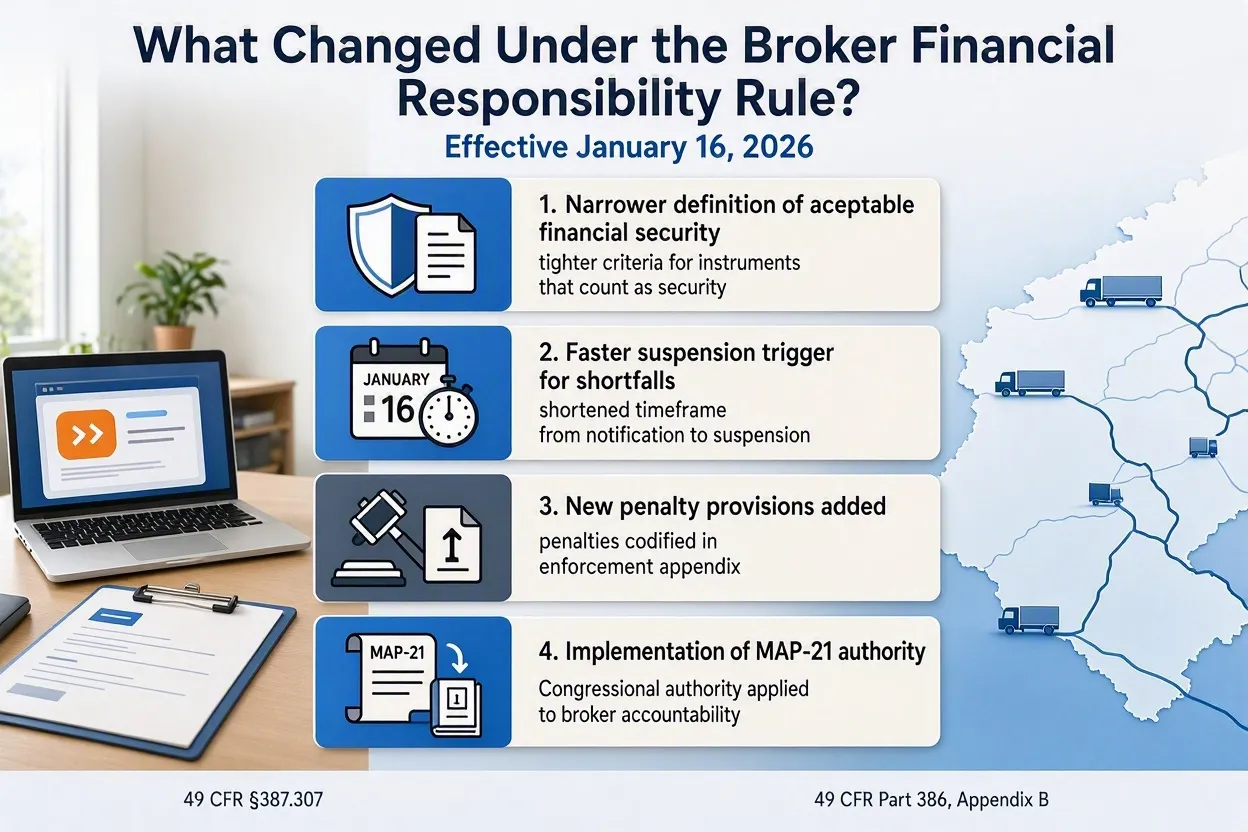
FMCSA’s Broker and Freight Forwarder Financial Responsibility rule took effect January 16, 2026, tightening what counts as financial security and how fast a shortfall triggers suspension. The rule implements authority Congress granted under MAP-21 and sits in 49 CFR §387.307, with penalties added at 49 CFR Part 386, Appendix B. (Verify both citations before publishing.)
Four changes matter to working brokers:
- Trust assets are restricted to cash, irrevocable letters of credit from federally insured depository institutions, and U.S. Treasury bonds. This is the change referenced in the trust fund table above.
- Sureties and trustees must notify FMCSA when available security drops below $75,000 and isn’t restored.
- Providers face a three-year ban from the market if found in violation of 49 U.S.C. 13906 or §387.307, alongside a monetary penalty.
- Bankruptcy alone no longer counts as insolvency under the rule, closing an argument providers previously used to delay claim handling.
What Is the Seven-Day Replenishment Window?
FMCSA suspends a broker’s operating authority if available financial security falls below $75,000 and isn’t replenished within seven calendar days. One week, including weekends, because the rule counts calendar days rather than business days.
The mechanic catches brokers off guard because a claim doesn’t have to be legitimate to reduce your available security. A carrier files a $9,000 claim on Friday afternoon, the surety reserves against it, and your clock starts. Brokers who intend to contest a claim still need to restore the shortfall while they fight it.
Is Your BMC-85 Trustee Still Eligible?
Loan and finance companies can no longer serve as BMC-85 trustees. If your trust sits with a finance company rather than a federally insured depository institution, your filing no longer satisfies the rule.
Switching requires your new provider to submit the correct form through its own FMCSA E-filer account, which replaces the existing filing. Providers without an E-filer account must register with FMCSA before they can file anything. Start the switch six to eight weeks out, because the provider-side registration is the slow part.
What Is a BOC-3 Process Agent Filing?
Form BOC-3 designates a legal representative in every state where you write broker contracts, authorized to accept court papers on your behalf. Because brokers arrange freight nationally, virtually every brokerage needs coverage in all 50 states plus the District of Columbia.
Blanket filing companies handle all 51 jurisdictions for a single fee, commonly $20 to $50 one time. Paying $150 for a “premium” BOC-3 package buys nothing the $20 filing doesn’t already provide. Only the process agent can submit the form, so you can’t file your own BOC-3.
Do Freight Brokers Need UCR Registration?
Yes. Brokers arranging interstate shipments must register annually under the Unified Carrier Registration (UCR) Agreement, created by the Unified Carrier Registration Act of 2005.
Brokers pay $46 per year, the lowest bracket, because the fee schedule keys to power units and brokers operate none. The UCR Board held that rate flat for the 2026 registration year and recommended an increase for 2027 — check ucr.gov for the finalized 2027 rate once the registration window opens. Registration opens October 1, payment is due December 31, and brokers based in one of the non-participating states file through a neighboring state rather than skipping the obligation.
What Insurance Do Freight Brokers Need Beyond the Bond?
FMCSA requires no insurance beyond the $75,000 financial security, but shippers routinely require contingent cargo and contingent liability coverage before signing. The bond protects carriers from non-payment; it does nothing for a shipper whose freight arrives damaged.
Three policies show up in most shipper contracts:
- Contingent cargo insurance pays when a carrier’s own cargo policy denies a claim, typically written at $100,000 per occurrence.
- Contingent auto liability responds when a carrier’s liability coverage fails, usually at $1,000,000.
- Errors and omissions coverage handles broker mistakes such as booking an unqualified carrier on a hazmat load.
Expect $2,500 to $5,000 annually for a package covering all three at a startup brokerage. Large shippers like Walmart and Target set higher limits in their standard broker agreements, non-negotiable.
What Does It Cost to Start a Freight Brokerage?
Budget $4,000 to $8,000 for the first year, with the $300 FMCSA fee accounting for less than 10% of the total. Filing services add $375 to $499 for work you can do yourself in under an hour.
| Line item | Low | High | Frequency |
| FMCSA authority fee | $300 | $300 | One time |
| BMC-84 bond premium | $938 | $7,500 | Annual |
| BOC-3 blanket filing | $20 | $50 | One time |
| UCR registration | $46 | $46 | Annual |
| Contingent insurance package | $2,500 | $5,000 | Annual |
| LLC formation and EIN | $50 | $500 | One time |
| Load board subscription | $420 | $1,800 | Annual |
| Transportation management system | $0 | $2,400 | Annual |
Brokers pay carriers in 15 to 30 days and collect from shippers in 30 to 60 days. That gap is the real capital requirement: a brokerage running $50,000 in monthly revenue needs roughly $40,000 in float or a factoring arrangement to bridge it.
Which Requirements Continue After You Are Licensed?
Three obligations recur for as long as your authority stays active: the biennial MCS-150 update, annual UCR renewal, and the record-keeping duty under 49 CFR §371.3. Missing any one of them can deactivate your USDOT number or expose you to civil penalties.
- File the MCS-150 every 24 months in Motus, even when nothing about your business has changed.
- Renew UCR by December 31 each year, regardless of how many loads you moved.
- Keep a record of every transaction showing the shipper, the carrier, the amount you received, and the amount you paid, and let either party inspect that record on request.
Section 371.3 is the requirement brokers forget. A carrier who suspects it was underpaid has a regulatory right to see what the shipper paid you on that specific load, and refusing the request is a violation. Brokers who write the disclosure waiver into their carrier agreements, standard practice at large brokerages, still must produce records when a carrier declines to waive.
Are There Training or Certification Requirements?
No federal training, exam, or certification is required to hold broker authority. Voluntary credentials carry weight with shippers, particularly the Certified Transportation Broker (CTB) designation issued by the Transportation Intermediaries Association (TIA).
Courses run $600 to $3,000 and cover rate negotiation, carrier vetting, and claims handling. No license tests the skill that decides year one, which is carrier vetting. Pull the FMCSA Company Snapshot at safer.fmcsa.dot.gov before booking any carrier to confirm active authority and insurance on file, then verify the phone number against the registered contact rather than the emailed carrier packet. Skipping that 90-second SAFER check is how brokers lose full loads to double-brokering.
Credentials are optional. Geography isn’t, and that’s where the remaining gaps show up.
What Are the Freight Broker Requirements by State?
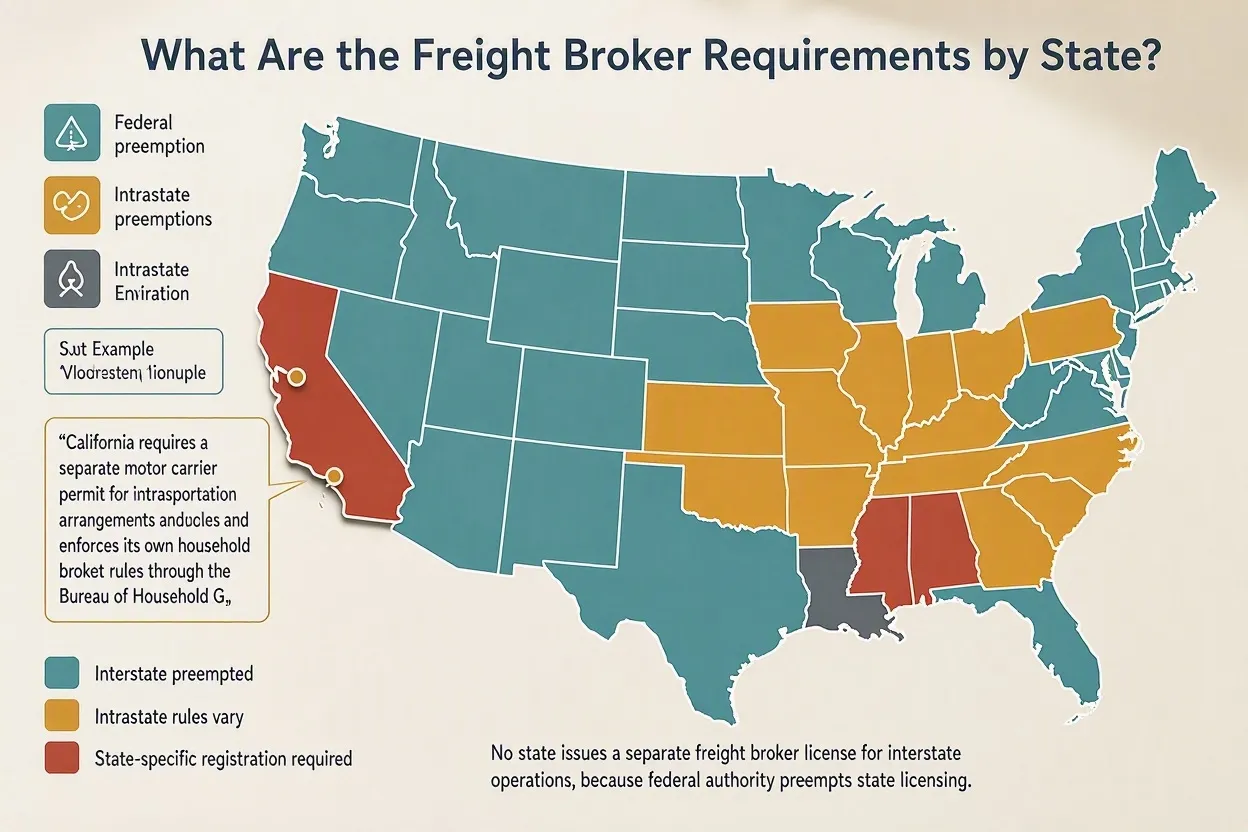
No state issues a separate freight broker license for interstate operations, because federal authority preempts state licensing. Intrastate brokerage, meaning freight that starts and ends inside one state, follows different rules in several states.
- California requires a separate motor carrier permit for intrastate transportation arrangements and enforces its own household goods broker rules through the Bureau of Household Goods and Services.
- Texas regulates intrastate household goods brokers through the Texas Department of Motor Vehicles with a separate registration.
- New York imposes a Highway Use Tax that catches brokers who also hold carrier authority.
Every state requires the ordinary business filings: entity registration with the Secretary of State, an EIN from the IRS, and state tax registration. A Georgia LLC brokering freight from Atlanta to Phoenix answers to FMCSA for the brokerage and to Georgia for the business, and the two don’t overlap.
Conclusion
Freight broker requirements changed twice in 2026, and most published guides haven’t caught up with either change. The application moved to Motus on May 14, retiring URS permanently, and the financial responsibility rule took effect January 16 with a seven-calendar-day suspension trigger that didn’t exist before. Verify three things this week: that your Login.gov identity verification is complete, that your BMC-85 trustee isn’t a loan or finance company, and that your UCR payment is scheduled before December 31. The $300 filing fee is the smallest number in this entire process.
Frequently Asked Questions

Esther Howard
Esther Howard leads TruckingHow’s trucking, commercial driving, and transportation content division. She specializes in CDL training, trucking regulations, fleet operations, truck maintenance, and logistics best practices. With over a decade of experience researching the commercial transportation industry, Esther brings a practical, research-driven approach to driver education, safety standards, and industry regulations. She is the primary author of TruckingHow’s CDL guides, trucking career resources, maintenance tips, and transportation content, helping drivers, fleet owners, and trucking professionals make informed decisions on and off the road
Related Posts