
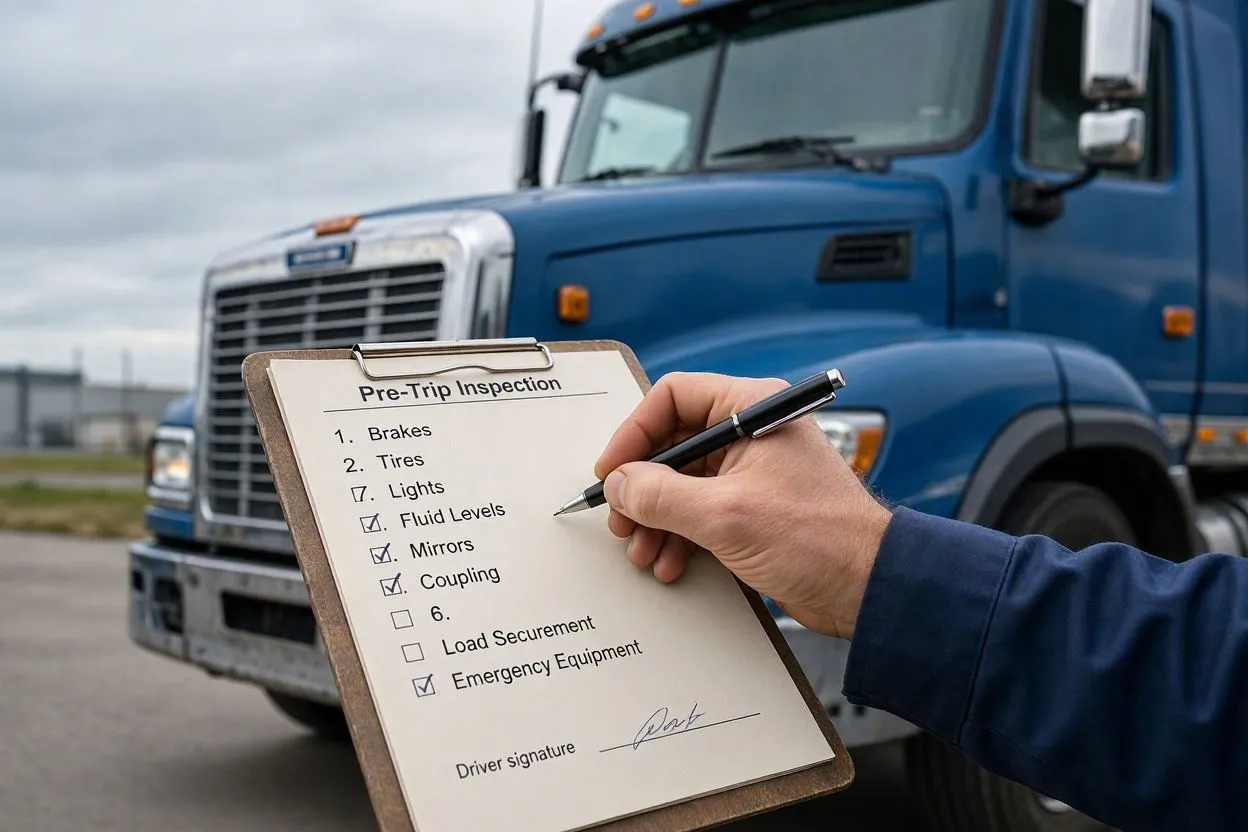
Pre-Trip Inspection Checklist: The Complete Step-by-Step Guide for CDL Drivers
A pre-trip inspection checklist walks a commercial driver through every safety system on a truck, from the engine compartment to the trailer doors, before the vehicle ever leaves the yard. Federal law requires it. Skipping it isn’t just risky, it’s a violation that can carry a fine up to $19,277 for an out-of-service vehicle. This guide breaks the checklist into six vehicle zones, explains the Federal Motor Carrier Safety Administration (FMCSA) rules behind each step, and shows how the results feed directly into a truck’s ongoing repair and maintenance schedule, by season, by vehicle type, and by who’s holding the keys.
What Is a Pre-Trip Inspection?
A pre-trip inspection is a driver-performed safety check completed before operating a commercial motor vehicle (CMV), covering the engine compartment, cab controls, brake system, and the full exterior of the truck and trailer. Under FMCSA rules, the driver alone has to be satisfied the vehicle is roadworthy, not a mechanic’s word from last week. Real drivers run the same walk-around every morning, and it doubles as an early-warning system for the shop: a hairline crack in a brake hose caught here becomes a routine repair instead of a roadside breakdown three hours into a route.
Why Does a Pre-Trip Inspection Checklist Matter for Safety and Vehicle Maintenance?
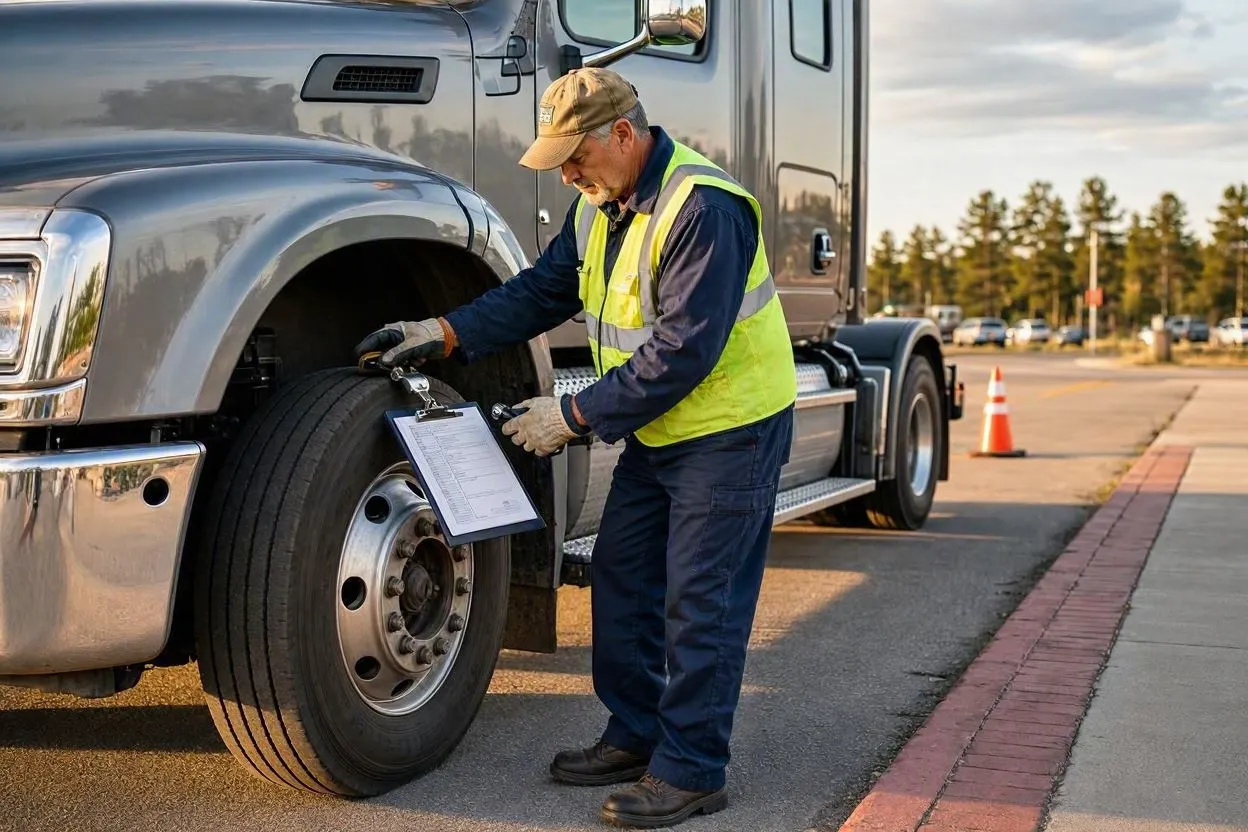
A pre-trip inspection checklist matters because it prevents the exact defects that cause roadside breakdowns, crashes, and expensive unplanned repairs. The Federal Motor Carrier Safety Administration (FMCSA) estimates thorough pre-trip inspections prevent close to 14,000 accidents every year. Brakes factor into nearly 30% of truck crashes, and tire failures cause more than half of all roadside breakdowns industry-wide.
A consistent checklist protects a fleet on four fronts:
- Safety: Catches brake, tire, lighting, and coupling defects, the leading causes of commercial motor vehicle (CMV) crashes, before the truck ever leaves the yard.
- Compliance: Satisfies the inspection requirement under 49 CFR §392.7 and keeps a clean Driver Vehicle Inspection Report (DVIR) history on file for any Commercial Vehicle Safety Alliance (CVSA) roadside inspection.
- Cost control: A single out-of-service (OOS) violation averages $2,500 to $5,000 in total cost once the fine, the downtime, and the tow are all counted.
- CSA score protection: Consistent inspections keep a carrier’s CSA (Compliance, Safety, Accountability) BASIC scores low, and insurers and shippers both check those scores before doing business with a fleet. Skip enough inspections, and premiums climb long before any accident happens.
Catching a defect during a pre-trip inspection is almost always cheaper than catching it on the road. A brake pad replacement scheduled at a repair shop during routine maintenance costs a fraction of an emergency roadside service call, and a technician working from a written defect report fixes the problem faster than one diagnosing a breakdown cold. Building the inspection into a broader vehicle maintenance schedule, alongside oil changes, tire rotations, and fluid top-offs, keeps repair costs predictable instead of catching a fleet off guard.
How Do Pre-Trip Inspections Fit Into DOT Compliance and Vehicle Maintenance?
Pre-trip inspections fit into DOT compliance and vehicle maintenance through three sections of Title 49 of the Code of Federal Regulations (CFR), and each one covers something different.
- 49 CFR §392.7 requires the driver to confirm that brakes, lighting, tires, the horn, windshield wipers, mirrors, coupling devices, wheels, and emergency equipment all work before driving. No paperwork is required for this step alone.
- 49 CFR §396.11 requires a written Driver Vehicle Inspection Report (DVIR) at the end of the day, but only when a defect turns up. This rule changed in 2014; carriers keep these reports on file for three months.
- 49 CFR §396.13 requires the driver to review the prior DVIR before driving and sign off that any noted repairs actually happened. Skip this step, and you’ve broken what auditors call the chain of custody.
Miss a documented defect and the fines stack fast: up to $1,270 per day for a missing DVIR, and $12,700 for falsifying one. A vehicle placed out of service can draw a maximum penalty of $19,277.
The Complete Pre-Trip Inspection and Maintenance Checklist by Vehicle Zone
A complete pre-trip inspection and maintenance checklist covers six vehicle zones in sequence, roughly 45 checkpoints on the power unit and another 15 on the trailer. Work the same route every time. Drivers who vary their pattern miss items and end up backtracking, which wastes more time than it saves.
Engine Compartment
Pop the hood before starting the engine, the same way a mechanic would before a service visit. Check these items:
| Component | What to Check |
| Engine oil | Level and condition on the dipstick |
| Coolant | Level in the overflow tank, no leaks at hoses or the radiator |
| Power steering fluid | Level within the marked range |
| Belts | No cracks or fraying, no more than 3/4 inch (19 mm) of deflection when pressed |
| Hoses | No bulges, soft spots, or leaks |
| Battery terminals | Secure and free of corrosion |
A belt that feels soft or brittle under your thumb is already failing, even if it looks fine from three feet away.
Cab Interior and Controls
Once you’re in the seat, three points of contact matter here too, since a rushed entry is one of the most common automatic-fail triggers on a CDL skills test. Inside the cab, verify:
| Component | What to Check |
| Seatbelt | Locks properly, no fraying in the webbing |
| Mirrors | Adjusted, clean, and crack-free |
| Windshield | No cracks in the driver’s direct line of sight |
| Wipers and washer fluid | Both function on activation |
| Horn | Audible from at least 200 feet (61 meters) |
| Gauges | Oil pressure rising, coolant temp climbing, air pressure building, voltmeter steady |
| Warning lights | ABS light cycles on at key-on and turns off after the self-test |
Air Brake System Test
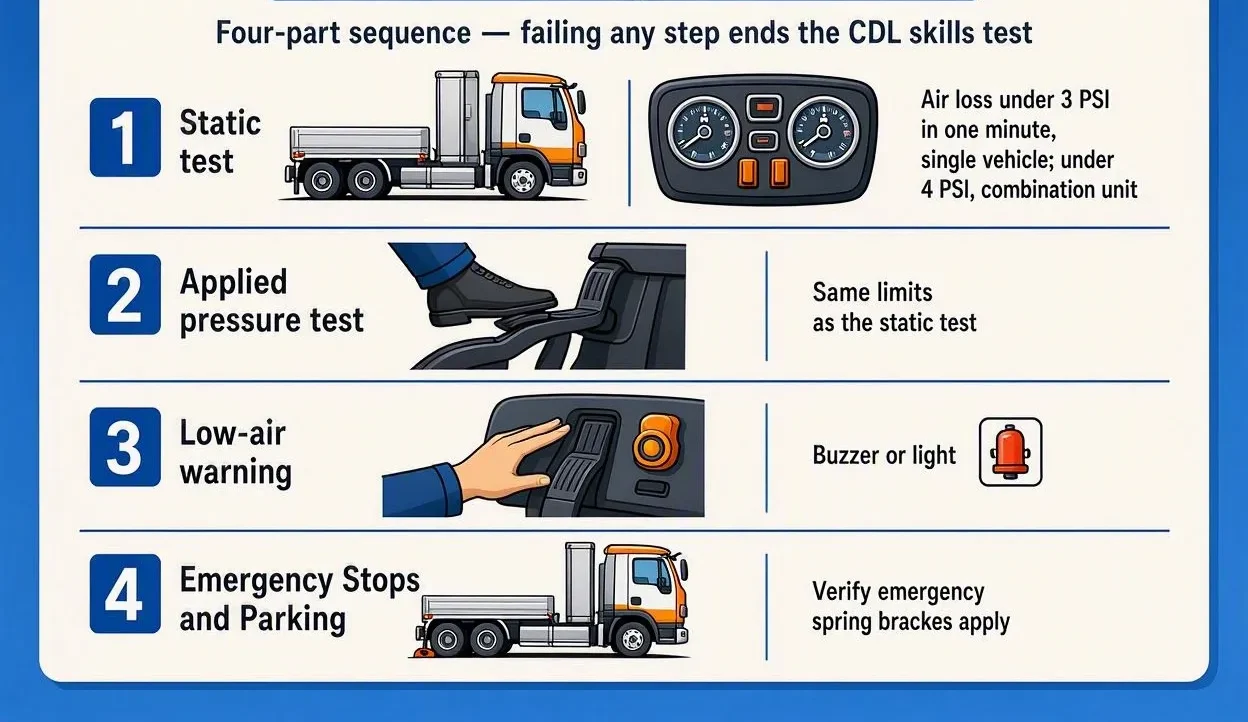
The air brake test is a four-part sequence, and failing it ends a CDL skills test on the spot regardless of how well the rest of the inspection went.
| Step | Test | Pass Standard |
| 1 | Static test (engine off, no brakes applied) | Air loss under 3 PSI (0.21 bar) in one minute, single vehicle; under 4 PSI (0.28 bar), combination unit |
| 2 | Applied pressure test (brake pedal held down) | Same limits as the static test |
| 3 | Low-air warning (fan the pedal, engine off) | Buzzer or light triggers before pressure drops below 60 PSI (4.1 bar) |
| 4 | Spring brake pop-out (continue fanning) | Parking brake knob pops out between 20 and 45 PSI (1.4 to 3.1 bar) |
Follow that with the tug test. Once the fifth wheel is locked around the kingpin, raise the landing gear a few inches, apply the trailer brakes, ease off the tractor brakes, and pull forward gently. If the rig holds steady, the coupling’s solid.
Exterior Walk-Around
Work one side of the truck at a time. At each point, check tires, lights, and structural components together rather than doubling back, since these are the parts most prone to everyday wear and tear:
| Component | What to Check |
| Tires | Steer axle tread at least 4/32 inch (3.2 mm), drive and trailer axles at least 2/32 inch (1.6 mm); no cuts, bulges, or exposed cord; dual tires not touching |
| Wheels and rims | No cracks or bends; lug nuts tight, no rust trails indicating movement |
| Lights | Headlights, brake lights, turn signals, clearance lamps, and reflectors all functional (a single dead bulb can trigger a full roadside inspection) |
| Steering and suspension | Steering wheel free play under 2 inches (5 cm) on a 20-inch wheel; leaf springs intact, no more than 25% of leaves broken or missing per axle |
| Frame and brakes | No cracks in the frame rails; brake linings above minimum thickness; drums free of heat damage |
Coupling System
For combination vehicles, the coupling connects two independently moving pieces of equipment, and a failure here separates them at highway speed. Confirm:
| Component | What to Check |
| Fifth wheel | Jaws fully closed around the kingpin |
| Glad hands | Sealed, no audible air leaks |
| Electrical cord | Connected, not dragging |
| Landing gear | Fully raised, crank handle stowed |
| Safety chains | Attached with enough slack to turn but not enough to drag |
Trailer and Cargo Securement
Cargo securement issues account for roughly 12% of OOS violations nationally, yet plenty of pre-trip checklists skip this step entirely. Before pulling out, check that:
| Component | What to Check |
| Trailer doors and seals | Latch securely, no damage to seals |
| Crossmembers and floor | No structural damage |
| Tie-downs | Meet minimum count for load length (generally one strap or chain per 10 feet of cargo, plus one) |
| Straps and chains | Undamaged, edge protection in place wherever cargo could cut into a strap |
| Load recheck | Re-inspected after the first 50 miles (80 km), since cargo settles |
How Long Does a Pre-Trip Inspection Take?
A thorough pre-trip inspection takes 15 to 30 minutes using a paper checklist, or 5 to 10 minutes with a digital guided inspection. New drivers should plan on the longer end until the route becomes second nature. After about two weeks of running the same walk-around pattern, most drivers complete a full inspection in under 10 minutes without cutting a single step.
Digital inspection apps cut that time by 40 to 67% compared to paper, according to fleet data from carriers that made the switch, while also improving defect detection. That gap matters more the bigger the fleet gets.
What Is the Three-Points-of-Contact Rule?
The three-points-of-contact rule means keeping two hands and one foot, or two feet and one hand, in contact with the truck at all times when entering or exiting the cab. Grab the handhold, not the steering wheel, and never jump down from the last step. Examiners flag this one immediately on a CDL skills test, and it’s just as relevant for a driver climbing in and out a dozen times a shift over a 20-year career.
Who’s Responsible for the Inspection: Company Drivers or Owner-Operators?
Both company drivers and owner-operators carry the same personal legal responsibility for the pre-trip inspection, though the paperwork trail differs. A company driver reviews the prior driver’s DVIR and reports defects to the fleet’s maintenance team, who then handle the repair. An owner-operator wears both hats: they’re the driver conducting the inspection and the business owner accountable for fixing whatever it finds.
That dual role changes the incentive structure. A company driver who spots worn brake pads files a report and moves on to the next stop, letting the fleet’s maintenance department schedule the repair. An owner-operator has to weigh the repair cost against the OOS risk personally, which is exactly why independent haulers tend to build stronger habits around catching small issues early, before they become $3,000 repair bills at a truck repair shop.
How Does Weather Change a Pre-Trip Inspection?
Cold and hot weather each add specific items to a standard pre-trip inspection. In winter, drain air tanks daily to clear moisture that can freeze glad hand seals and brake lines overnight; check that windshield washer fluid is rated for sub-freezing temperatures, and inspect block heater cords if the truck sat outside below 0°F (-18°C). Batteries lose roughly 35% of their cranking power at 0°F compared to 80°F (27°C), so a slow crank in January isn’t always a dying battery, it might just be the cold.
In summer, tire pressure needs a second check mid-afternoon, since hot asphalt can push inflation up by several PSI from the morning reading. Coolant levels deserve extra attention too, given how much harder an engine works pulling a loaded trailer through 95°F (35°C) heat on a grade, and a technician logging seasonal wear patterns can adjust the vehicle’s maintenance schedule accordingly.
What Are the Most Common Pre-Trip Violations and Maintenance Failures?
Brake system defects top the list, showing up in roughly 29% of all out-of-service violations at roadside inspections, and they’re also the single most common maintenance failure fleets track. Tires and wheels follow at 21.4%, driven mostly by tread depth and sidewall damage. Lighting and reflector issues account for about 15%, steering and suspension problems for close to 30% of all DOT violations broadly, and cargo securement failures for another 12%.
Falsified logs and DVIRs make up roughly 10% of driver-related OOS violations during CVSA (Commercial Vehicle Safety Alliance) Roadcheck events, a category enforcement officers call pencil whipping. A driver who signs off on an inspection without actually performing it risks a $12,700 fine and a mark against their CDL that follows them to the next job application.
Digital vs. Paper Pre-Trip Forms: Which One Better Supports Vehicle Maintenance?
Digital pre-trip forms better support vehicle maintenance because they detect defects at a 95 to 99% accuracy rate, compared to 70 to 80% for paper, and route those defects straight into a maintenance workflow. Paper checklists still work, and plenty of small operators run on them without issue, but they carry real limitations: no timestamp, no GPS confirmation of location, and a completion rate that hovers around 60 to 75% in fleet audits. A driver can technically mark a paper form “OK” from inside the cab without walking around the truck at all.
Digital tools close that gap with photo requirements, GPS verification, and automatic work orders the moment a defect gets flagged for the maintenance shop. For a solo owner-operator running one truck, a laminated paper form clipped to a clipboard might be all that’s needed. For a fleet running 50 trucks across three terminals, digital inspection software tied into a repair and maintenance workflow isn’t optional anymore.
How Does a Pre-Trip Inspection Connect to Vehicle Maintenance and Repair?

A pre-trip inspection functions as the first diagnostic step in a vehicle’s maintenance and repair cycle. Every defect a driver logs, a worn brake lining, a leaking hose, a tire below minimum tread, becomes a work order for a repair shop or in-house mechanic, and wear items like brake pads, belts, and tires follow a predictable curve a technician can track over time. Fleets that feed inspection data into maintenance software turn reactive fixes into planned maintenance, stocking replacement parts ahead of need and cutting parts-and-labor costs across the truck’s service life.
What Happens If You Skip a Pre-Trip Inspection?
Skipping a pre-trip inspection violates 49 CFR §392.7 directly and increases the odds of a roadside breakdown, a fine, or a crash caused by a defect that would’ve been caught in five minutes. Beyond the immediate FMCSA penalty, a driver who skips inspections regularly builds a pattern that shows up in CSA scores, which carriers and insurers both review before hiring or renewing coverage.
There’s a human cost too, separate from the paperwork. A brake hose that fails at highway speed doesn’t care whether the driver was running late that morning.
Conclusion
A pre-trip inspection checklist isn’t paperwork for its own sake, it’s the fastest, cheapest defect-catching tool a driver has, full stop, and the front door to every repair and maintenance decision a fleet makes. Run the same six zones every time: engine compartment, cab controls, air brakes, the exterior walk-around, coupling, and trailer. Fifteen minutes at the start of a shift beats a roadside OOS order that costs thousands and a day of downtime. Build the habit early, keep it consistent regardless of weather or how tight the schedule looks, and the checklist stops feeling like a chore and starts feeling like muscle memory.
FAQs

Esther Howard
Esther Howard leads TruckingHow’s trucking, commercial driving, and transportation content division. She specializes in CDL training, trucking regulations, fleet operations, truck maintenance, and logistics best practices. With over a decade of experience researching the commercial transportation industry, Esther brings a practical, research-driven approach to driver education, safety standards, and industry regulations. She is the primary author of TruckingHow’s CDL guides, trucking career resources, maintenance tips, and transportation content, helping drivers, fleet owners, and trucking professionals make informed decisions on and off the road
Related Posts