Supply Chain vs Logistics: The Real Difference Explained
Ask ten people in a warehouse to define the two terms and you’ll get ten answers, most of them wrong in the same direction. The words get swapped in job postings, vendor pitches, and budget meetings until nobody’s sure who owns which problem. That’s fine right up until a cost overrun needs an owner and three departments each assume it belongs to someone else. Here’s where the line actually falls in a US freight operation, along with the roles, metrics, software, and federal driving limits that sit on each side of it.
Supply Chain vs Logistics
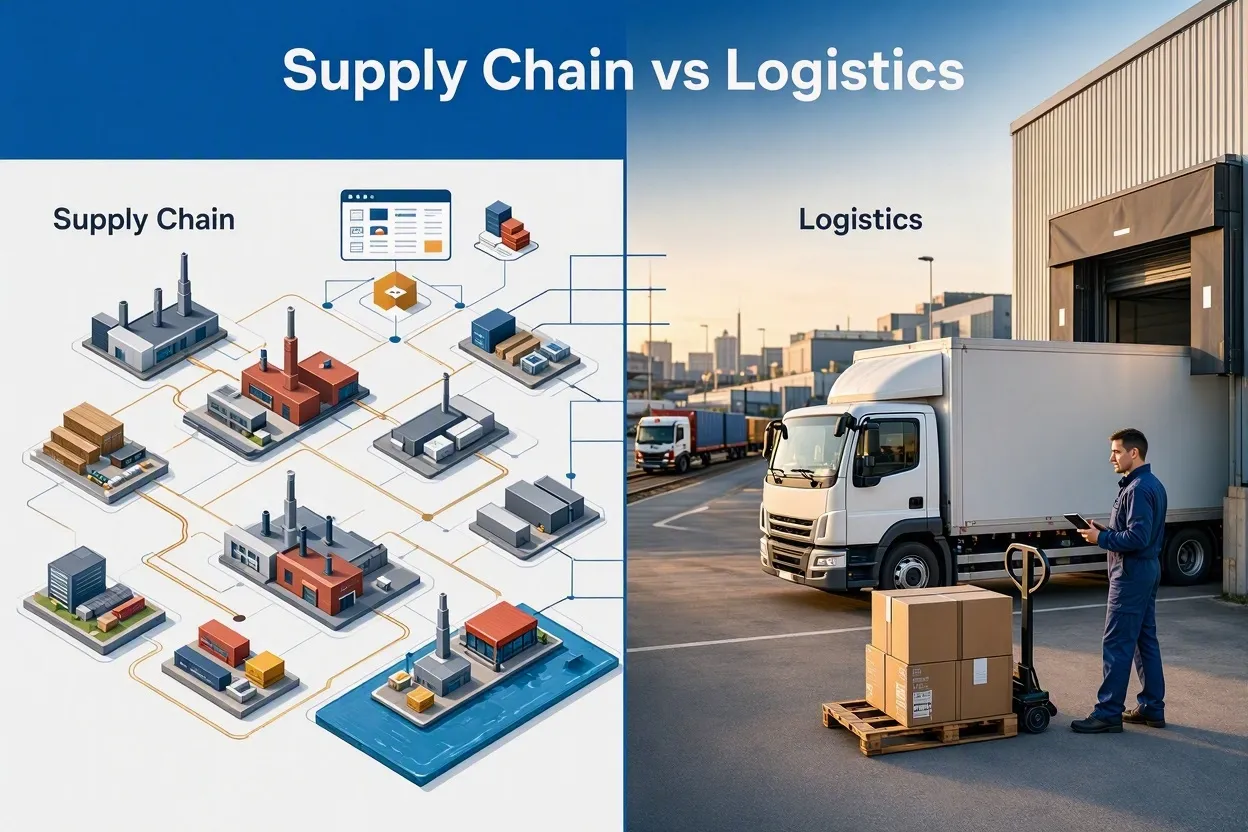
Logistics is one function inside supply chain management, not a parallel discipline. Supply chain management covers the full network that turns raw materials into a delivered product: sourcing, supplier selection, demand planning, manufacturing, procurement, logistics, and returns. Logistics covers a narrower slice of that network, moving and storing goods.
Put the distinction in operational terms. A supply chain decision determines that a distribution center should open in Dallas and that a specific mill should supply the lumber. Logistics decides which carrier pulls the pallets out of that Dallas building on Tuesday, and what it costs per mile to do it.
| Supply chain management | Logistics | |
| Scope | The entire network, spanning multiple companies: suppliers, manufacturers, carriers, distributors, retailers | One function, usually run inside a single company or outsourced to one provider |
| Time horizon | Quarters to years, covering network design, supplier contracts, and capacity planning | Hours to weeks, covering load planning, dispatch, and dock scheduling |
| Core question | What should we make, buy, and build, and where? | How do we move and store what was already decided? |
| Typical activities | Sourcing, procurement, demand planning, supplier management, network design, returns strategy | Transportation, warehousing, inventory control, order fulfillment, freight audit |
| Primary goal | Competitive advantage and margin across the network | On-time, in-full delivery at the lowest defensible cost |
| Fails when | Demand forecasts miss, a supplier defaults, or the network is designed wrong | A truck runs late, a dock backs up, or a warehouse runs out of slots |
That table is the whole argument, compressed. Everything below applies it to freight operations, job titles, software, metrics, and federal rules.
What Is Supply Chain Management?
Supply chain management is the coordination of every activity that turns raw materials into a product a customer receives, across every company involved. It spans supplier selection, sourcing, procurement, production planning, demand planning, inventory policy, network design, logistics, and reverse logistics. A single consumer product routinely passes through a raw-material supplier, a component manufacturer, a contract assembler, an ocean carrier, a port, a drayage operator, a distribution center, and a retail chain. Those eight organizations carry four flows at once: physical goods moving downstream, informational forecasts and order status moving both ways, financial payment moving upstream, and administrative customs records traveling alongside the freight.
Visibility is the problem that never quite goes away. Geodis surveyed 623 companies for its 2017 Supply Chain Worldwide Survey and found only 6% reporting complete end-to-end visibility, while 77% called their view restricted or nonexistent. McKinsey put transparency beyond tier-one suppliers at 30% in 2024, down seven points from the year before. Without that view, planners can’t qualify suppliers, forecast demand, set safety stock across nodes, or site a distribution center on numbers they actually trust.
What Is Logistics?
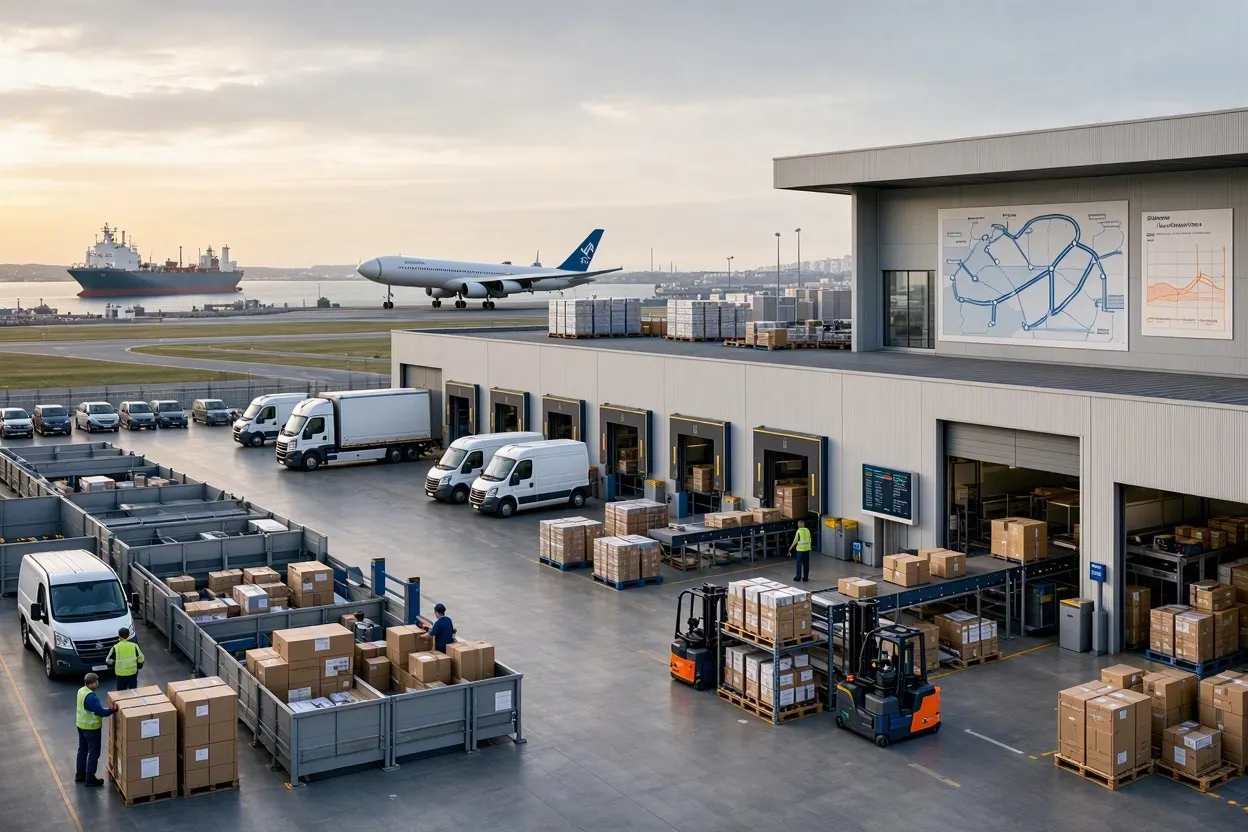
Logistics is the function responsible for the physical movement and storage of goods inside the supply chain: transportation, warehousing, inventory control, materials handling, packaging, order fulfillment. Logistics executes. It doesn’t decide what gets made or who supplies it.
That scope is narrower on purpose. Once network design has fixed the lanes and a demand plan has fixed the volumes, logistics moves the freight through constraints someone else already set. A dispatcher can reroute a load around a closure on I-40. That same dispatcher can’t change which mill the lumber came from.
Logistics organizations show up in a few different forms:
- In-house logistics: a company plans and runs its own transportation and warehousing with its own people and equipment.
- Third-party logistics (3PL): an outside provider takes over one logistics function, commonly warehousing or transportation management.
- Logistics service provider (LSP): an outside provider takes over several logistics functions at once, often bundling warehousing, freight forwarding, and inventory management.
- Reverse logistics: recovery of goods from their final destination for resale, refurbishment, recycling, or disposal.
- Courier and parcel: small-package movement, usually under 150 lbs (68 kg) per piece.
Logistics also carries its own financial control layer. Freight audit checks that what a carrier bills matches what the contract specified, catching accessorial charges, reweighs, and rate misapplications before payment clears. That function lives inside the transportation piece of logistics specifically, not in warehousing or fulfillment.
Why Do the Two Terms Get Confused So Often?
Logistics is the visible, physical layer of the supply chain, so it gets used as shorthand for the entire system. A truck arriving four hours late is something the whole building notices. Supplier qualification, demand planning, and network design happened months earlier and several states away, so nobody sees them go wrong in real time. The shorthand isn’t free, though: assigning a rising landed cost per unit to a transportation manager wastes a quarter if the 12% increase actually traces to renegotiated raw-material pricing, because a transportation manager controls carrier rates and mode selection, not supplier contracts.
The age gap doesn’t help. Alexander the Great’s campaigns, starting around 336 B.C., are a standard reference point in military-logistics history for supplying an army across long distances without modern transport. Consultant Keith Oliver coined “supply chain management” in a 1982 Financial Times interview, defining it as planning, implementing, and controlling supply chain operations to meet customer requirements efficiently. Logistics had roughly a 2,300-year head start as a word.
Where Does a Trucking Company Sit on the Map?
A trucking company is a logistics provider that participates in supply chains it doesn’t control. That matters because carriers absorb the consequences of supply chain decisions without holding any authority to make them.
Asset-based carrier. Owns tractors, trailers, and terminals, and employs or contracts the drivers. Pure logistics execution: hauling freight from origin to destination under a rate agreement. A dry-van fleet running 53-ft (16.2 m) trailers on regional lanes has no say in which supplier the shipper chose or how much inventory the shipper decided to hold.
Freight broker. Arranges transportation without owning equipment, matching shipper loads to carrier capacity and taking a margin on the spread. Still a logistics function, still on the transportation side. Brokers hold FMCSA operating authority as property brokers and have to maintain a $75,000 surety bond or trust fund under federal requirements.
Third-party logistics (3PL). Takes over a defined logistics function on the shipper’s behalf, whether that’s running the warehouse, managing the carrier base, or both. A 3PL operating a 400,000 sq ft (37,000 m²) distribution center and tendering freight to a carrier panel is doing logistics work at scale. The shipper keeps sourcing, demand planning, and network strategy, which stay on the supply chain side.
Fourth-party logistics (4PL) and control towers. This is where the boundary genuinely gets fuzzy. A 4PL manages multiple 3PLs and carriers on the shipper’s behalf, and a 4PL running a control tower makes network-level calls that reach into supply chain territory: which nodes to use, how to reroute around disruption, where to hold buffer inventory. Even so, the distinction holds. A 4PL optimizes inside the network its client designed. It rarely picks that client’s raw-material suppliers.
Who Owns Which Decision?
Job titles map cleanly onto the split once you look at decision rights instead of department names.
| Role | Discipline | Owns | Does not own |
| VP of Supply Chain | Supply chain | Network design, make-or-buy calls, supplier strategy, inventory policy | Daily dispatch, dock scheduling |
| Procurement / Sourcing Manager | Supply chain | Supplier selection, contract terms, raw-material pricing | Carrier selection, route planning |
| Demand Planner | Supply chain | Forecasts, production volumes, safety-stock levels | Load tendering, warehouse labor |
| Logistics Manager | Logistics | Mode selection, carrier mix, warehouse throughput, fulfillment SLAs | Supplier contracts, production volumes |
| Transportation Manager | Logistics | Lane pricing, carrier scorecards, fleet or 3PL performance | Network node locations, inventory policy |
| Dispatcher | Logistics | Driver assignment, daily routing, appointment compliance | Rate negotiation, facility strategy |
| Warehouse Manager | Logistics | Receiving, put-away, picking, packing, shipping, slotting | Demand forecasts, supplier qualification |
| Freight Broker / Brokerage Ops | Logistics | Capacity sourcing, spot pricing, load coverage | Anything upstream of the shipper’s tender |
Use this as a routing tool. When a cost or service problem lands on the wrong desk, the fix stalls until someone with the matching authority picks it up.
Which Software Belongs to Which Discipline?
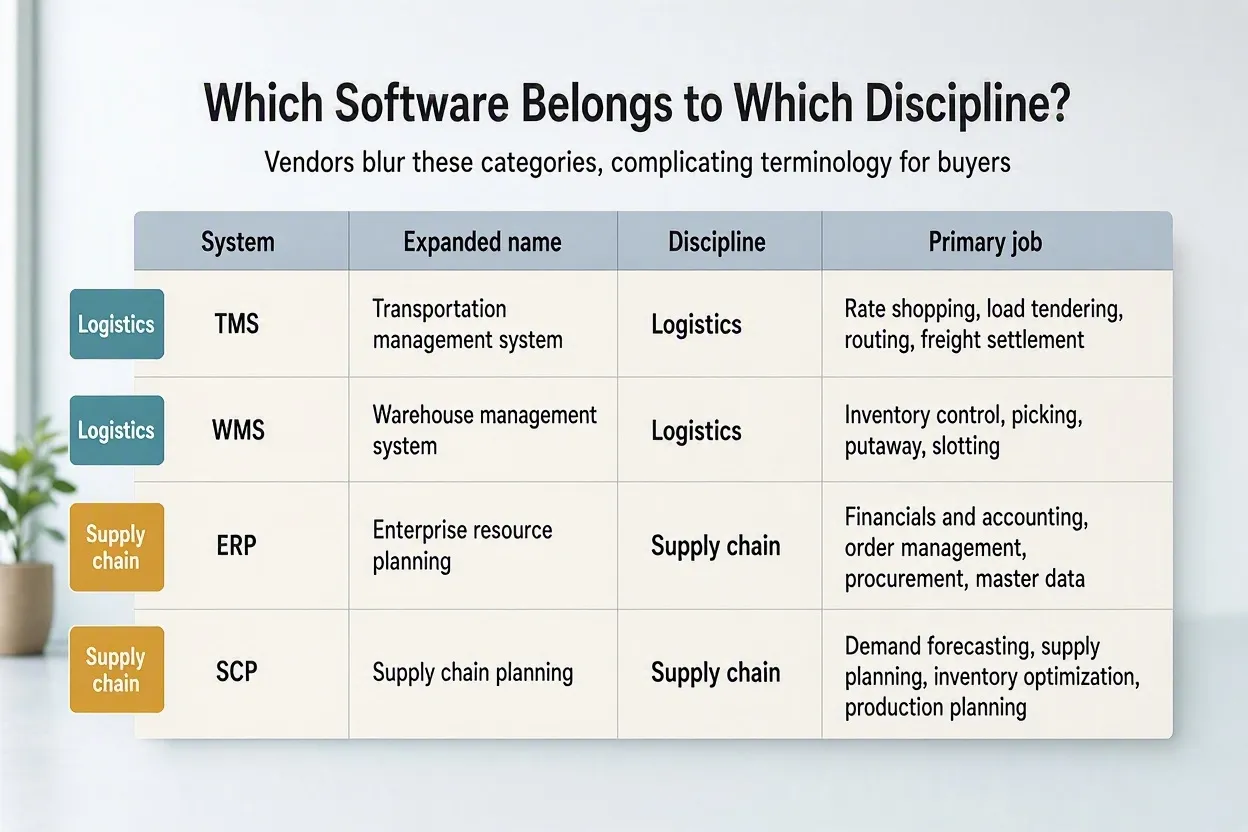
Transportation management systems and warehouse management systems are logistics tools. Enterprise resource planning and supply chain planning platforms are supply chain tools. Vendors blur these categories constantly in their marketing, which only makes the terminology problem worse for buyers.
| System | Expanded name | Discipline | Primary job |
| TMS | Transportation management system | Logistics | Rate shopping, load tendering, routing, freight settlement, carrier scorecarding |
| WMS | Warehouse management system | Logistics | Receiving, slotting, picking, packing, cycle counting, labor management |
| YMS | Yard management system | Logistics | Trailer tracking, dock door assignment, gate check-in and detention timing |
| ERP | Enterprise resource planning | Supply chain | Orders, inventory records, financials, procurement, production records |
| SCP | Supply chain planning | Supply chain | Demand forecasting, S&OP, inventory optimization, capacity planning |
| SRM | Supplier relationship management | Supply chain | Supplier qualification, scorecards, contract lifecycle |
A practical buying rule follows from all this. A company complaining that freight costs run 18% over budget needs a TMS and a freight audit process, not a new ERP module. A company that keeps stocking out on fast-moving SKUs has a forecasting problem, and no TMS on earth will fix a forecast.
Which KPIs Tell You Who Owns a Problem?
Logistics metrics measure execution against a plan. Supply chain metrics measure whether the plan and the network were right in the first place. Splitting the metric set this way is the fastest route to figuring out who owns a bad number.
| Metric | Discipline | What it measures | Typical benchmark direction |
| On-time in-full (OTIF) | Logistics | Deliveries arriving complete and on schedule | Retail programs commonly demand 95%+ |
| Cost per mile | Logistics | Total cost to move a truck one mile (USD/mile, also tracked as USD/km) | Track by lane and equipment type |
| Dwell time | Logistics | Hours a driver or trailer waits at a facility | Detention typically bills after 2 free hours |
| Dock-to-stock time | Logistics | Hours from receipt to put-away and availability | Under 24 hours in a well-run DC |
| Load factor / cube utilization | Logistics | Percentage of trailer capacity actually used | Higher reduces cost per unit shipped |
| Perfect order rate | Both | Orders delivered complete, on time, damage-free, correctly documented | Compound metric; diagnose by component |
| Inventory turns | Supply chain | How many times inventory cycles per year | Varies widely by sector |
| Cash-to-cash cycle time | Supply chain | Days between paying suppliers and collecting from customers | Lower frees working capital |
| Supplier lead-time variance | Supply chain | Consistency of supplier delivery timing | High variance forces higher safety stock |
| Forecast accuracy (MAPE) | Supply chain | Mean absolute percentage error in demand forecasts | Drives every downstream inventory decision |
Read the metrics together and ownership tends to resolve itself. A fleet holding 96% OTIF while inventory turns collapse has a planning problem, not a trucking problem.
How Do FMCSA Rules Turn Logistics Into a Planning Constraint?
Federal Motor Carrier Safety Administration (FMCSA) hours-of-service rules cap what logistics can physically execute, which forces supply chain planners to design networks around driver time rather than distance alone. Nothing in this whole discussion matters more to a US trucking operation, and it’s the part most general business articles skip entirely.
Under 49 CFR Part 395, a property-carrying commercial driver operates under four limits at once:
- 11-hour driving limit: maximum 11 hours of driving after 10 consecutive hours off duty.
- 14-hour window: driving must finish within 14 consecutive hours of coming on duty, and the window doesn’t pause for breaks, meals, or detention.
- 30-minute break: required after 8 cumulative hours of driving.
- 60/70-hour limit: maximum 60 on-duty hours in 7 days or 70 in 8 days, resettable with 34 consecutive hours off duty.
Most drivers log duty status on an electronic logging device (ELD), and the planning consequence is concrete: a driver starting at 6:00 AM can’t legally drive after 8:00 PM regardless of hours actually spent behind the wheel, because the 14-hour window runs on elapsed time, and detention at a receiver burns that clock without moving a single mile. Two hours of dock delay turns a one-day run into a two-day run. A distribution center sited 620 miles (998 km) from its customer cluster runs as a two-day lane once loading, fueling, and the mandatory 30-minute break eat into the window. Facility placement is a supply chain decision, so planners have to check that placement against hours-of-service math before anyone signs a lease.
Which Career Path Pays More, and Which Certification Proves It?
Logisticians earned a median annual wage of $82,320 in May 2025 according to the Bureau of Labor Statistics, with the top 10% above $133,160 and the bottom 10% below $50,890. The Bureau projects 18% employment growth for logisticians from 2025 to 2035, against roughly 3% for all occupations, with about 26,600 openings a year.
Industry placement moves that number quite a bit. As of the most recent BLS breakdown, federal government logisticians posted a median of $101,110, manufacturing $83,720, and wholesale trade $73,090, a spread of roughly $28,000 between the top and bottom industries for the exact same occupational code.
Two certifications, both from the Association for Supply Chain Management (ASCM), encode the split directly:
| CSCP | CLTD | |
| Full name | Certified Supply Chain Professional | Certified in Logistics, Transportation and Distribution |
| Covers | End-to-end supply chain: supplier relationships, sourcing, demand, global networks, risk, technology | Logistics strategy, transportation management, warehouse and order management, global logistics, reverse logistics |
| Choose if | You work in planning, procurement, supplier strategy, or network design | You work in transportation, warehousing, distribution, or fleet operations |
| Exam format | 150 questions, 3.5 hours | 150 questions, 3.5 hours |
Both exam formats are current as of ASCM’s latest published exam guide, but ASCM ties content to specific “learning system versions” that sunset and get replaced on a schedule, so confirm the format on ASCM’s site before you book a test date.
Pick the credential that closes your actual capability gap, not the one that sounds broader. A transportation manager moving toward a VP of Supply Chain role takes CLTD first and adds CSCP later. A planner who needs to understand freight execution runs that sequence in reverse.
A Three-Question Test for Which Term to Use
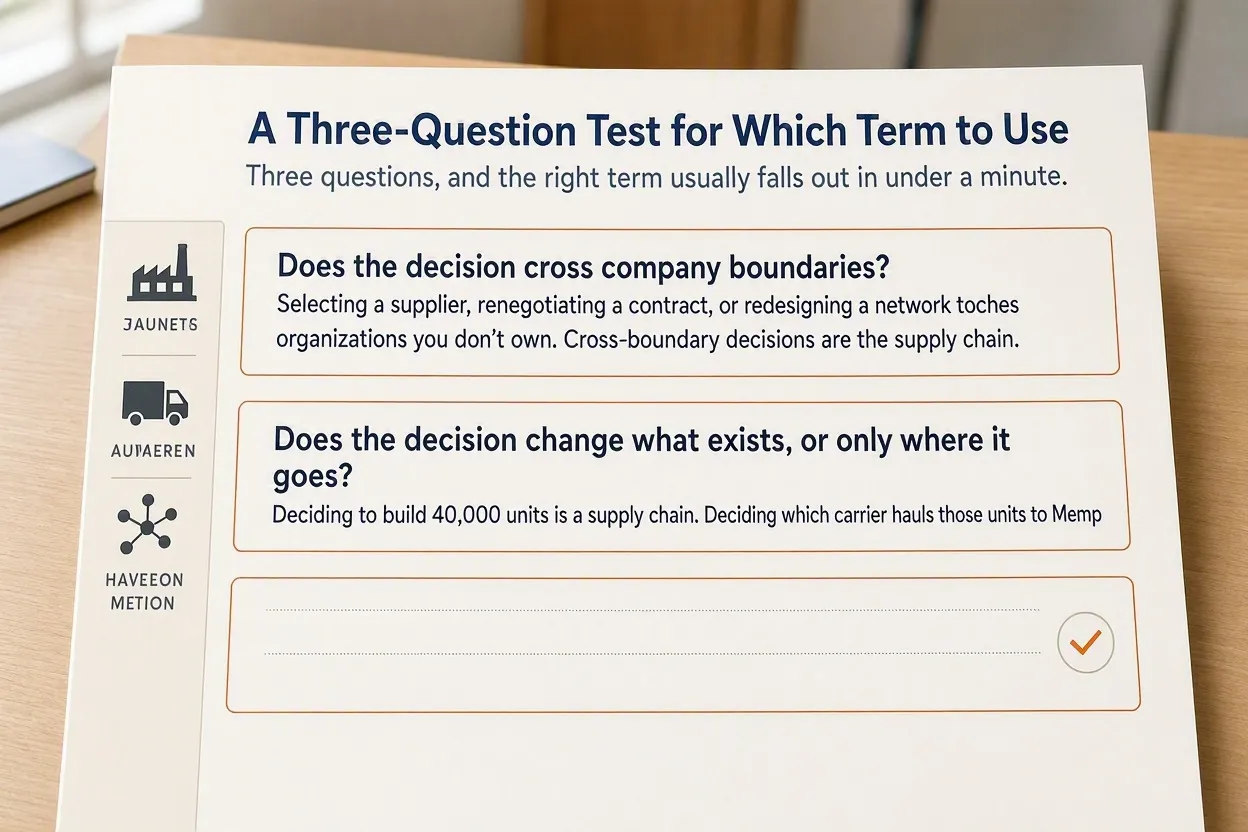
Three questions, and the right term usually falls out in under a minute.
- Does the decision cross company boundaries? Selecting a supplier, renegotiating a contract, or redesigning a network touches organizations you don’t own. Cross-boundary decisions are the supply chain.
- Does the decision change what exists, or only where it goes? Deciding to build 40,000 units is a supply chain. Deciding which carrier hauls those units to Memphis is logistics.
- What’s the time horizon? Decisions measured in quarters are supply chain. Decisions measured in hours or days are logistics.
Two “supply chain” answers out of three means the issue sits upstream. The test only breaks down at the 4PL and control-tower boundary described earlier, where a provider legitimately operates in both territories at once.
Conclusion
The supply chain vs logistics distinction earns its keep the moment a number goes wrong and somebody has to own the fix. Freight costs climbing 18% over budget belong to a transportation manager with a TMS and a freight audit process. Inventory collapses while OTIF holds at 96% belongs to a demand planner, and no carrier change is going to touch that problem.
For US trucking operations, the sharpest version of this distinction runs through the hours-of-service clock. A supply chain team picks the distribution center location. FMCSA decides whether a driver can legally serve that location within an 11-hour driving limit inside a 14-hour window that detention doesn’t pause for. Both facts have to hold at the same time, and a lane that works fine on a map can fail on an ELD the moment the two get planned separately.
Frequently Asked Questions

Esther Howard
Esther Howard leads TruckingHow’s trucking, commercial driving, and transportation content division. She specializes in CDL training, trucking regulations, fleet operations, truck maintenance, and logistics best practices. With over a decade of experience researching the commercial transportation industry, Esther brings a practical, research-driven approach to driver education, safety standards, and industry regulations. She is the primary author of TruckingHow’s CDL guides, trucking career resources, maintenance tips, and transportation content, helping drivers, fleet owners, and trucking professionals make informed decisions on and off the road
Related Posts