
How Much Do Truck Drivers Earn in 2026? Pay by State, Type and Mile
Truck drivers earn a mean annual wage of $55,990, or $26.92 an hour, according to the Bureau of Labor Statistics (BLS). That’s just the average, though. Pay ranges from $37,440 for the bottom 10% of earners to $76,780 for the top 10%, and the number moves hard once you factor in state, freight type, motor carrier size, and years behind the wheel. Driver wages sit at the center of freight transport costs across the U.S. supply chain, so this guide breaks down every variable that changes a driver’s paycheck, with real dollar ranges instead of vague estimates.
What Does the Average Truck Driver Make?
The average truck driver in the United States makes between $50,000 and $75,000 a year, depending on experience, route type, and freight specialty. Entry-level drivers start closer to $37,000 to $45,000. Experienced over-the-road (OTR) drivers and specialized haulers often clear $65,000 to $85,000, and owner-operators, who own or lease their own trucks, report gross earnings of $100,000 to $200,000 before expenses like fuel, insurance, and maintenance eat into that number.
Three things drive most of the variation: how the driver gets paid (salary, hourly, or per mile), what type of freight they haul, and which state they work in. Each one moves the number by thousands of dollars a year. Treating “truck driver salary” as one flat figure misses most of the story.
National Average Pay: The BLS Numbers
The BLS pulls its truck driver salary data from a survey of over 3.5 million U.S. drivers, and the American Trucking Associations (ATA) tracks similar employment trends across the industry. Here’s how the national wage distribution breaks down:
- Bottom 10% of drivers: $37,440 a year, or $18.00 an hour
- Bottom 25% of drivers: $45,920 a year, or $22.08 an hour
- Median (50th percentile): $54,320 a year, or $26.12 an hour
- Top 25% of drivers: $63,010 a year, or $30.29 an hour
- Top 10% of drivers: $76,780 a year, or $36.91 an hour
A driver sitting at the median earns roughly $1,044 a week before overtime, bonuses, or per diem pay. That number climbs fast once a driver picks up a specialty endorsement or switches from local routes to long-haul work, both covered below.
A shortage of qualified drivers keeps upward pressure on every figure above. The Federal Motor Carrier Safety Administration (FMCSA) tightened entry requirements in recent years through the Entry-Level Driver Training (ELDT) mandate, raising the training bar for new CDL holders and thinning the pipeline of fresh drivers entering the industry. Fewer new entrants, steady freight demand: that combination is the main reason trucking wages have outpaced average U.S. wage growth for several years running, as carriers compete on pay just to keep the drivers they already have.
Pay by Experience Level
Experience builds earning power steadily rather than in one jump. Most carriers structure raises around mileage milestones or years of clean driving record instead of flat annual reviews.
New drivers typically start at $37,000 to $45,000 a year. Most complete Commercial Driver’s License (CDL) training in four to six weeks and begin on local or regional routes while they build a safety record. Carriers rarely hand a brand-new driver a cross-country route on day one; insurance requirements and liability concerns keep rookies closer to home for the first six to twelve months.
Two to five years in, pay generally lands at $50,000 to $65,000. This is where per-mile rates start climbing and drivers become eligible for better routes, sign-on bonuses at new carriers, and first-time endorsements like hazardous materials (HazMat) or tanker certification.
Veterans with ten or more years on the road often reach $65,000 to $85,000, and specialized veterans (HazMat, oversized load, or team driving) push past $90,000. Pay increases in trucking run 8% to 12% a year during periods of driver shortage, well above the 2% to 3% average raise in most other industries, because carriers compete hard to retain drivers who already have a clean record and years of experience.
Pay by Driver Type
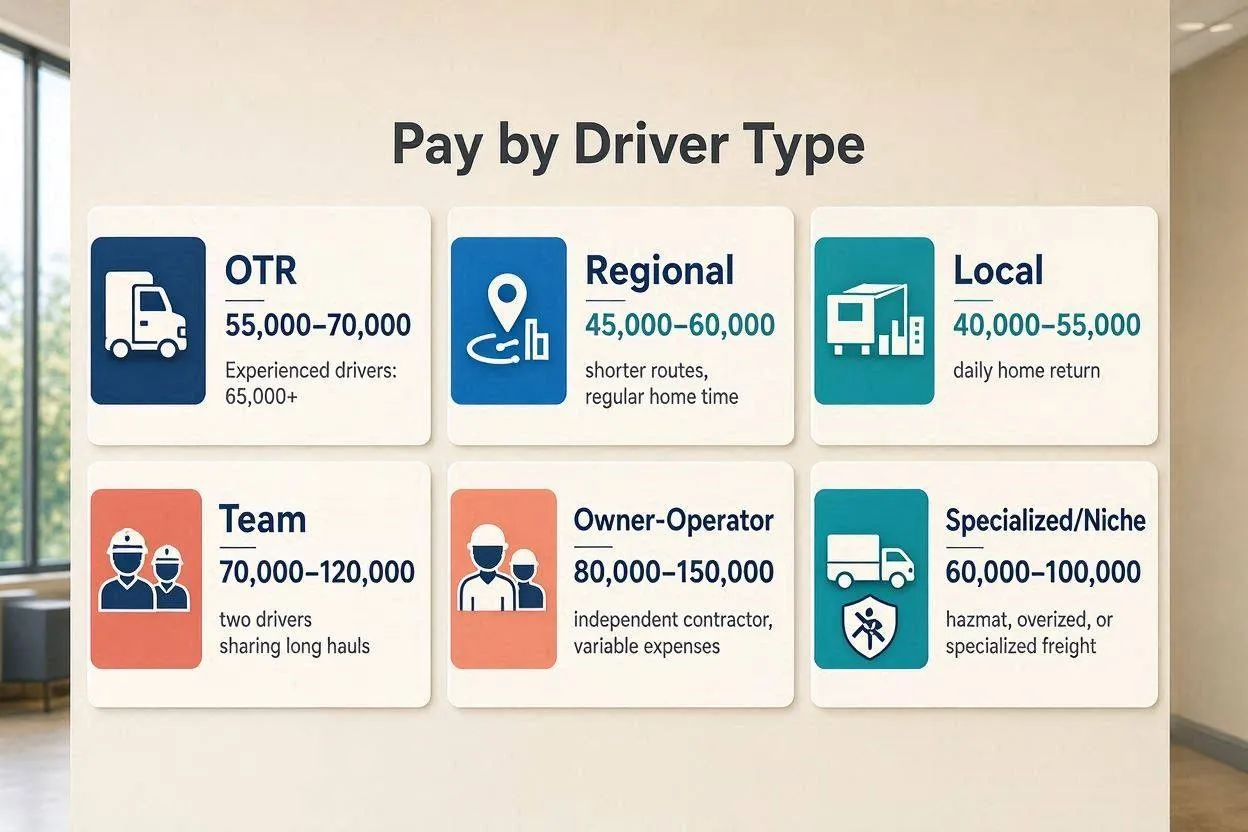
Driver type changes pay more than almost any other factor, since it changes both the pay structure and the risk profile of the job. Six main categories cover most of the trucking workforce: OTR, regional, local, team, owner-operator, and specialized/niche drivers.
OTR drivers earn $55,000 to $70,000 a year, and experienced ones running consistent miles can clear $65,000 or more. OTR work means extended time away from home, often three to six weeks at a stretch, which is why carriers pay a premium over local routes.
Regional work pays $60,000 to $80,000. These routes stay within a defined multi-state area, so drivers get home more often than OTR drivers while still logging enough miles to match or beat that wage.
Local delivery lands at $45,000 to $60,000. It trades a lower per-mile rate for a predictable schedule and a return home every night, which appeals to drivers with families or anyone unwilling to live on the road.
Team drivers split pay between two people running the same truck around the clock. Because the truck keeps moving except for fuel stops and mandatory rest, team pay per driver often ends up higher than solo OTR pay despite the per-mile rate being split. A team running 5,000 to 6,000 miles a week at $0.60 per mile generates $3,000 to $3,600 in gross weekly revenue, split between both drivers.
Owner-operators gross $100,000 to $200,000 a year, and top performers running multiple trucks report over $300,000. That figure is gross, not take-home. Fuel, insurance, maintenance, and truck payments typically consume 30% to 40% of gross revenue, so a $150,000 gross owner-operator often nets closer to $90,000 to $105,000 after expenses.
Specialized and niche drivers see the widest range of anyone in the industry. HazMat drivers make $62,000 to $85,000 because of the added liability and training requirements. Oversized and heavy-haul drivers earn $100,000 to $200,000 thanks to the precision and permitting their loads require. Ice road truckers, who haul freight over frozen terrain during a short winter season, can pull in up to $250,000 in a single season, though the work only runs a few months a year.
Pay by State: Where Truck Drivers Earn the Most
Location changes a driver’s paycheck by as much as $14,000 a year between the highest and lowest paying states. Alaska pays the most, at $65,870 a year ($31.67 an hour), followed by New Jersey, Washington D.C., Washington State, and New York.
| State | Average Annual Salary |
| Alaska | $65,870 |
| New Jersey | $64,270 |
| Washington, D.C. | $63,630 |
| Washington State | $63,160 |
| New York | $60,910 |
| California | $58,270 |
| Texas | $54,550 |
| Mississippi | $51,330 |
Mississippi pays the least among tracked states, at $51,330 a year. The gap tracks cost of living closely: coastal states and major metro areas pay 10% to 50% more to offset higher housing and living costs. That’s also why Texas and California, despite huge freight volumes, land in the middle of the pack instead of at the top.
Pay Structures: Salary, Per Mile, Per Load, and Hourly
Four pay structures cover nearly every trucking job, and each one changes how a driver’s effort turns into a paycheck.
Per-mile pay rewards distance covered. The average rate in 2025 and 2026 runs between $0.55 and $0.75 (about $0.34 to $0.47 per kilometer), depending on the carrier, route, and driver experience. Run 2,500 miles a week at $0.65 a mile and you’re looking at roughly $81,250 a year before bonuses.
Hourly pay rewards time on the job regardless of miles covered, typically $24 to $32 an hour. It shows up most in local delivery, waste management, and dedicated-route jobs, where mileage varies too much day to day for per-mile pay to make sense.
Per-load pay rewards completed deliveries rather than distance or time. It’s common in short-haul, drayage, and container work, where a driver might run several short trips a day instead of one long route.
Salary pay guarantees a fixed weekly or monthly amount regardless of miles, hours, or loads. Some large carriers offer it to attract drivers who’d rather have predictable income than deal with the variability that comes with mileage-based pay.
Waste management and garbage truck drivers, a niche most salary guides skip entirely, earn $48,000 to $60,000 a year on a mostly hourly structure with steady, local schedules. Neither per-mile nor hourly pay wins outright: per-mile rewards drivers who can run efficient, high-mileage routes, while hourly and salary protect drivers on jobs with heavy loading, unloading, or traffic delays that mileage-based pay doesn’t compensate for.
Truck Driver Pay by Carrier Size
Carrier size changes both the pay ceiling and the pay stability a driver can expect. Large national carriers, the kind running thousands of trucks, tend to offer lower per-mile rates but make up for it with steady freight, structured raises, and benefits like health insurance and 401(k) matching that smaller operations often can’t afford. Mid-size regional carriers frequently pay a higher per-mile rate than the national players, since they’re competing for the same driver pool with a smaller recruiting budget and fewer non-wage perks. Small fleets and independent owner-operators sit at the extremes, with pay swinging the widest here: below-average earnings during slow freight cycles, six-figure income when fuel costs stay low and freight rates run high.
A driver comparing offers should weigh the quoted per-mile or hourly rate against the full package. A national carrier’s lower rate plus full benefits can outperform a small fleet’s higher rate with no health coverage once medical costs are factored into total compensation.
Owner-Operator Pay: Gross Revenue vs. Take-Home Income
Owner-operators file as independent contractors rather than employees, which changes both how they get paid and how much of that pay they actually keep. A carrier or broker pays an owner-operator a rate per mile or per load that looks far higher than a company driver’s rate. But that number is gross revenue, not income.
Fixed and variable costs cut deep into that revenue. Fuel typically runs 20% to 25% of gross earnings, truck payments or leases another 10% to 15%, and insurance, maintenance, permits, and factoring fees add another 10% to 15% combined. After those costs, a successful owner-operator typically keeps 60% to 70% of gross revenue as net income, so a driver grossing $150,000 a year often nets $90,000 to $105,000 once expenses clear. Owner-operators also cover their own self-employment tax, health insurance, and retirement savings, costs a company driver’s paycheck never has to absorb directly. The higher gross figure isn’t a clean comparison to a company driver’s salary until those costs come out.
How Freight Transport Economics Shape Truck Driver Pay
Driver pay tracks freight transport economics directly, since a carrier’s revenue comes from moving freight for shippers, and driver wages are the largest single cost in that equation. When freight capacity is tight (more loads available than trucks to haul them), freight rates rise, and carriers pass part of that increase to drivers through higher per-mile pay, sign-on bonuses, and retention incentives. When capacity is loose (too many trucks chasing too few loads), rates soften and driver pay growth slows or stalls.
For-hire trucking companies, the carriers that haul freight for other businesses under contract or through the spot market, set pay differently than private fleets, which are operated by retailers or manufacturers to move their own goods. Private fleet drivers for companies like Walmart often earn above the for-hire average, since the fleet exists to serve one shipper’s supply chain reliably rather than compete for freight on the open market.
Freight also splits into truckload (FTL) and less-than-truckload (LTL) segments, and each pays differently. FTL drivers haul one shipper’s freight for the full trailer and typically run on per-mile pay. LTL drivers haul multiple shippers’ freight consolidated into one trailer, with more stops and more dock time, so hourly or per-stop pay structures are more common. Drayage drivers, who haul containers short distances between ports, rail yards, and warehouses, work within intermodal freight networks and get paid per container or per load rather than per mile, since their routes rarely run long.
Freight brokers and load boards also shape what independent owner-operators and small fleets earn. A broker matches a shipper’s freight with an available truck, often for a fee that reduces what actually reaches the driver. That’s why experienced owner-operators build direct shipper relationships over time: it means capturing more of the freight rate instead of losing a cut to a middleman on every load.
What Affects Truck Driver Pay
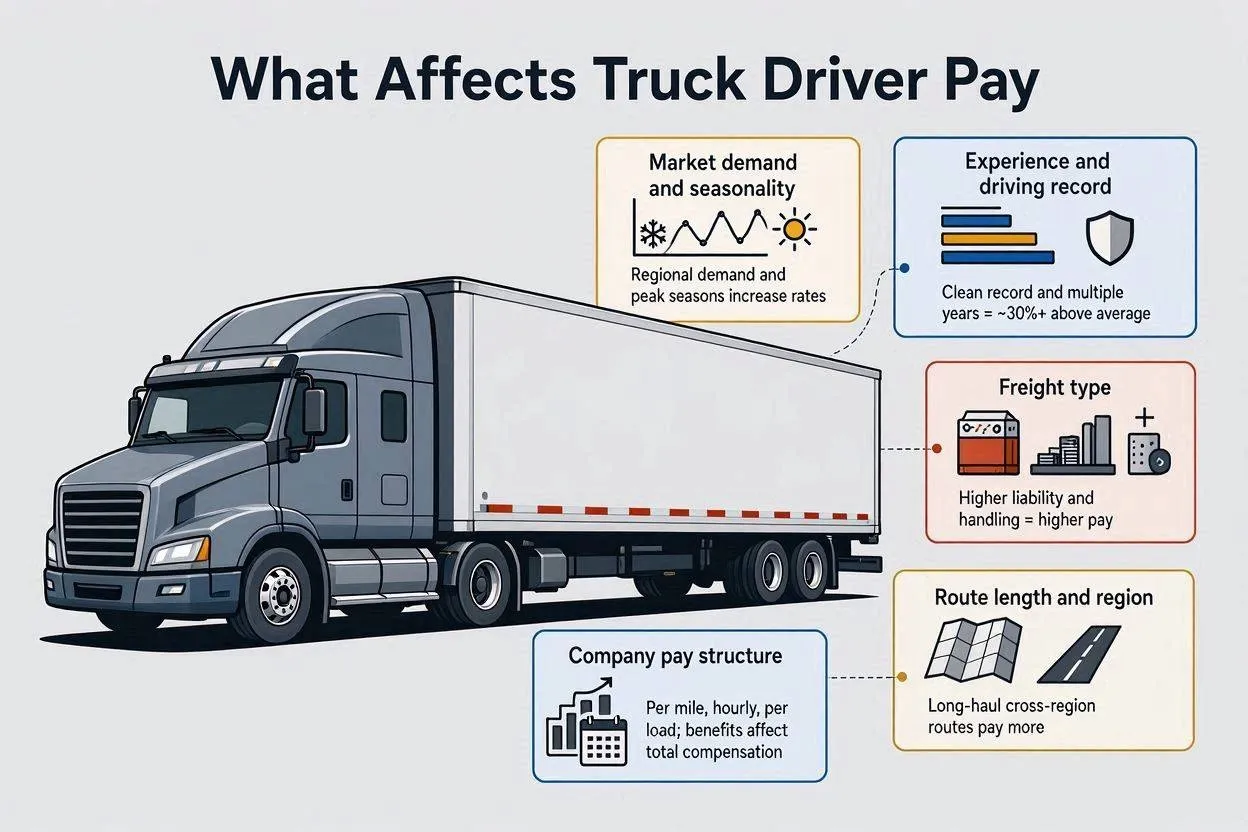
Five factors explain almost all of the variation in truck driver earnings:
- Experience and driving record. Drivers with a clean record and multiple years of experience earn 30% or more above industry average, since carriers price out risk directly.
- Freight type. Refrigerated goods, oversized loads, and hazardous materials all carry higher liability and handling requirements, so pay goes up accordingly.
- Route length and region. Long-haul, cross-border, and high-cost-of-living regions all add a premium to base pay.
- Pay structure. Per-mile, hourly, salary, and per-load structures each reward different driving styles and route types.
- Bonuses and union representation. Safety bonuses, fuel efficiency incentives, referral bonuses, and union-negotiated contracts add $5,000 to $15,000 on top of base pay at many carriers.
Non-Wage Benefits That Add to Total Compensation
Base salary is only part of what a driving job pays. Most large carriers offer health insurance covering medical, dental, and vision, plus 401(k) retirement plans with employer matching between 3% and 6%. Sign-on bonuses at competitive carriers currently range from a few thousand dollars up to $10,000 for experienced hires. Two named carriers illustrate the gap well: UPS starts truck drivers at $70,000 and Walmart starts at $75,000, both well above the industry entry-level average once benefits are included.
Paid vacation time matters more in trucking than in most careers, because OTR drivers are away from home for three to six weeks at a stretch. Extended home time between runs functions as both a benefit and a retention tool for carriers competing over the same driver pool.
How to Increase Truck Driver Earnings
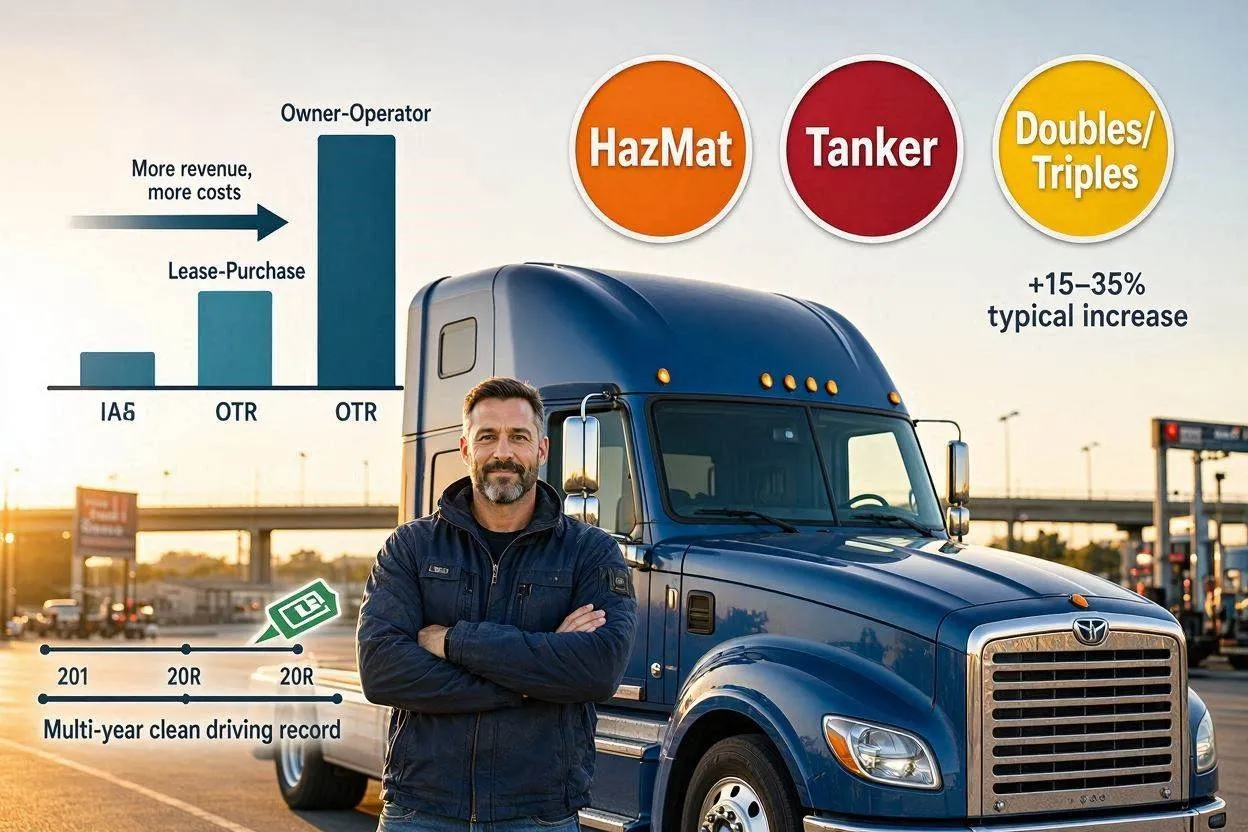
Add an endorsement (HazMat, tanker, or doubles/triples) and you’ll typically earn 15% to 35% more than standard OTR rates for the same miles. Want six figures faster? Transitioning into an owner-operator role or a lease-purchase arrangement shifts more revenue to the driver in exchange for taking on operating costs and business risk. To boost pay without changing jobs, build a multi-year clean driving record. Carriers reward tenure and safety with raises well above the broader labor market’s 2% to 3% annual average.
Team driving offers another path: two drivers split both the miles and the pay, but because the truck runs nearly around the clock instead of parking during one driver’s mandatory rest, total household income from a two-driver team often beats two separate solo OTR jobs.
The Owner-Operator Independent Drivers Association (OOIDA) and organizations like Women in Trucking publish additional resources for drivers evaluating a shift from company driving to independent operation, since that move carries real financial upside alongside real financial risk.
Conclusion
Truck driver pay ranges from $37,440 for new drivers to over $200,000 for top owner-operators, and the gap comes down to experience, freight type, pay structure, and state. A driver chasing higher pay has three real levers: add a specialty endorsement, move toward owner-operator or team driving, or relocate to a higher-paying state or region. None of those moves happen overnight. But each one shifts the number by thousands of dollars a year, which is why “how much do truck drivers earn” never has one single answer, only a range shaped by the choices a driver makes along the way.
Frequently Asked Questions

Esther Howard
Esther Howard leads TruckingHow’s trucking, commercial driving, and transportation content division. She specializes in CDL training, trucking regulations, fleet operations, truck maintenance, and logistics best practices. With over a decade of experience researching the commercial transportation industry, Esther brings a practical, research-driven approach to driver education, safety standards, and industry regulations. She is the primary author of TruckingHow’s CDL guides, trucking career resources, maintenance tips, and transportation content, helping drivers, fleet owners, and trucking professionals make informed decisions on and off the road
Related Posts