
Houston Truck Accident Lawyer TX | Free Case Review, No Fee Unless You Win
A collision with a loaded semi rarely looks like a routine fender-bender. The weight difference alone changes the injuries, the insurance response, and everything about the legal process that follows. Houston sits at the center of one of the busiest freight networks in the country, with the Port of Houston, I-45, I-10, and Beltway 8 funneling commercial trucks through the metro area every day. That much truck traffic has real consequences for the drivers sharing the road with it.
Here’s what a truck accident lawyer in Houston actually does, how these cases differ from an ordinary car accident claim, and what Texas law lets you recover.
What Does a Truck Accident Lawyer in Houston, TX Do?
A truck accident lawyer investigates the crash, figures out who bears responsibility, and negotiates or litigates against the trucking company’s insurer to get the injured person compensated.
The job goes well past filing paperwork. Commercial trucking runs under its own set of federal rules, and attorneys who don’t handle these cases often miss the regulatory violations that would make a claim stronger. A lawyer who knows the Federal Motor Carrier Safety Administration’s (FMCSA) requirements will request driver qualification files, maintenance logs, and dispatch records within days of the crash, before the carrier’s retention window closes on that paperwork for good.
There’s a medical side too. Attorneys coordinate with treating physicians to document the link between the crash and the injury, and bring in economists or life-care planners when the case involves long-term disability. None of that happens on its own. Someone has to request it, chase it down, and put it in front of an adjuster or a jury in a form that actually holds up.
Why Truck Accident Cases Differ From Car Accident Claims

Truck accident cases bring in federal regulations, multiple corporate defendants, and insurance limits that dwarf what you’d see in a standard car accident claim.
A fully loaded commercial truck can weigh up to 80,000 pounds under federal law. A passenger car runs around 4,000 pounds. That twenty-to-one ratio is a big part of why truck collisions produce catastrophic injuries so much more often than crashes between two cars.
Liability spreads out more, too. In a typical car accident, one driver and one insurance policy usually handle the claim. A truck accident can pull in the driver, the motor carrier, the company that loaded the cargo, and whoever maintained the vehicle. Each one carries its own insurance. Each one has a legal team looking to point the finger somewhere else.
The insurance limits raise the stakes further. Texas only requires passenger vehicles to carry $30,000 in liability coverage per person. Interstate trucking companies must carry at least $750,000, and plenty carry $1 million to $5 million depending on what they’re hauling. That gap is exactly why a carrier’s insurer fights so much harder: there’s real money on the table from day one.
Common Types of Truck Accidents in Houston
The most frequent truck accidents in Houston are jackknife crashes, underride collisions, rollovers, and rear-end impacts caused by a truck that simply couldn’t stop in time.
A jackknife happens when a tractor-trailer folds at the coupling point and swings the trailer across adjacent lanes, usually triggered by sudden braking or a load that shifts mid-turn.
Underride crashes happen when a smaller vehicle slides underneath the back or side of a trailer. These rank among the deadliest truck accidents on the road, since the impact hits the passenger compartment directly instead of getting absorbed by the car’s frame.
Rollovers happen when a truck’s center of gravity shifts too far, often from an overloaded trailer or a sharp steering correction. Picture a driver on I-610 taking a curved exit ramp too fast with an unbalanced load. The truck can go over before the driver ever touches the brakes.
Rear-end collisions come down to following distance. A loaded semi needs far more room to stop than a passenger car does, and distracted driving, fatigue, or plain tailgating eats up that margin fast.
Who Can Be Held Liable in a Houston Truck Accident?
Liability can fall on the driver, the trucking company, the cargo loading company, the maintenance contractor, or the vehicle’s manufacturer, depending on what actually caused the crash.
The driver is on the hook when fatigue, distraction, or an hours-of-service violation caused the wreck. But drivers rarely have enough personal assets to cover a serious injury claim, which is why attorneys look past the driver almost immediately.
The trucking company can be liable for negligent hiring, poor training, or pushing drivers to blow through federal service limits to hit a delivery deadline. A carrier that skips background checks or ignores a driver’s history of violations can be independently negligent, separate from whatever the driver did behind the wheel.
Cargo loading companies come into the picture with a specific kind of case: improperly secured freight. Say a flatbed is hauling steel pipe that wasn’t chained down right. If that cargo shifts and hits a following vehicle, the company that loaded it can share liability with the carrier, even though none of its employees ever touched the steering wheel.
Maintenance contractors and manufacturers round things out, covering brake failures, tire blowouts, and defective parts that no amount of careful driving could have prevented.
What Compensation Can You Recover After a Truck Accident?
Texas law lets truck accident victims recover economic damages (financial losses) and non-economic damages (physical and emotional harm).
Economic damages cover medical bills, from the ER visit through years of rehab, plus lost wages and diminished earning capacity. Property damage and out-of-pocket costs like home health aides or transportation to appointments fall in here as well.
Non-economic damages cover the harder-to-quantify losses: pain and suffering, mental anguish, disfigurement, and loss of consortium for a spouse. There’s no receipt for any of that, but Texas juries award it regularly, usually based on medical records and testimony from people close to the injured person.
Families who lose someone in a fatal truck crash can pursue wrongful death damages separately, covering funeral costs, lost financial support, and loss of companionship. A surviving spouse, for example, might recover both the wrongful death claim and a survival claim for the pain their loved one went through between the crash and death.
Texas follows a proportionate responsibility rule. A plaintiff found 30 percent at fault still recovers 70 percent of their damages. Cross the 50 percent mark, though, and recovery is barred entirely.
Federal and Texas Regulations That Affect Your Claim
The FMCSA sets hours-of-service limits, driver qualification standards, and vehicle maintenance rules, and all of them carry real legal weight in a Houston truck accident claim.
Federal hours-of-service rules cap interstate drivers at 11 hours of driving within a 14-hour on-duty window. Drivers log their status through an electronic logging device (ELD), which automatically tracks driving time, on-duty time, and rest periods. A driver who blows past those limits, or whose logs don’t line up with GPS and dispatch records, has just handed the opposing attorney direct evidence of negligence.
Vehicle maintenance rules require carriers to document inspections, repairs, and parts replacement. Skipped brake service or a known steering defect that never got fixed turns a maintenance file into evidence against the carrier.
Texas layers its own requirements on top of the federal ones. The Texas Department of Public Safety regulates seatbelt use, load securement, and licensing for commercial vehicles operating in-state. The Texas Department of Transportation sets size and weight limits by axle count, with permits required for oversized loads.
None of this exists separately from a lawsuit. Violate any of these rules and a case can move from ordinary negligence into something closer to strict liability. In cases involving reckless disregard for safety, it can even support a claim for punitive damages.
Evidence That Determines the Outcome of a Truck Accident Case
The strongest cases rely on electronic logging device data, driver qualification files, and maintenance records secured before the trucking company’s retention window runs out.
ELD data shows speed, braking patterns, and location at the moment of impact, and it can get overwritten within days unless an attorney sends a preservation letter demanding the carrier hold onto it.
Driver qualification files show whether the company knew about a history of violations before putting someone behind the wheel. These include the driver’s application, road test results, and drug and alcohol testing history.
Dispatch records matter too. Text messages and fleet-communication logs between a driver and dispatcher can show pressure to skip rest periods or blow through delivery windows, turning what looks like a scheduling decision into evidence of corporate negligence.
Here’s a detail worth knowing: every commercial truck displays a USDOT number, usually on the driver’s door or near the fuel tank on the side of the cab. That number lets an attorney pull the carrier’s safety record straight from FMCSA’s public database, including prior violations and out-of-service orders. If it’s safe to do so, photographing that number at the scene gives your case a head start before your attorney even opens a file.
Steps to Take After a Truck Accident in Houston
Call 911, get medical treatment right away, and photograph the scene before you contact a truck accident lawyer.
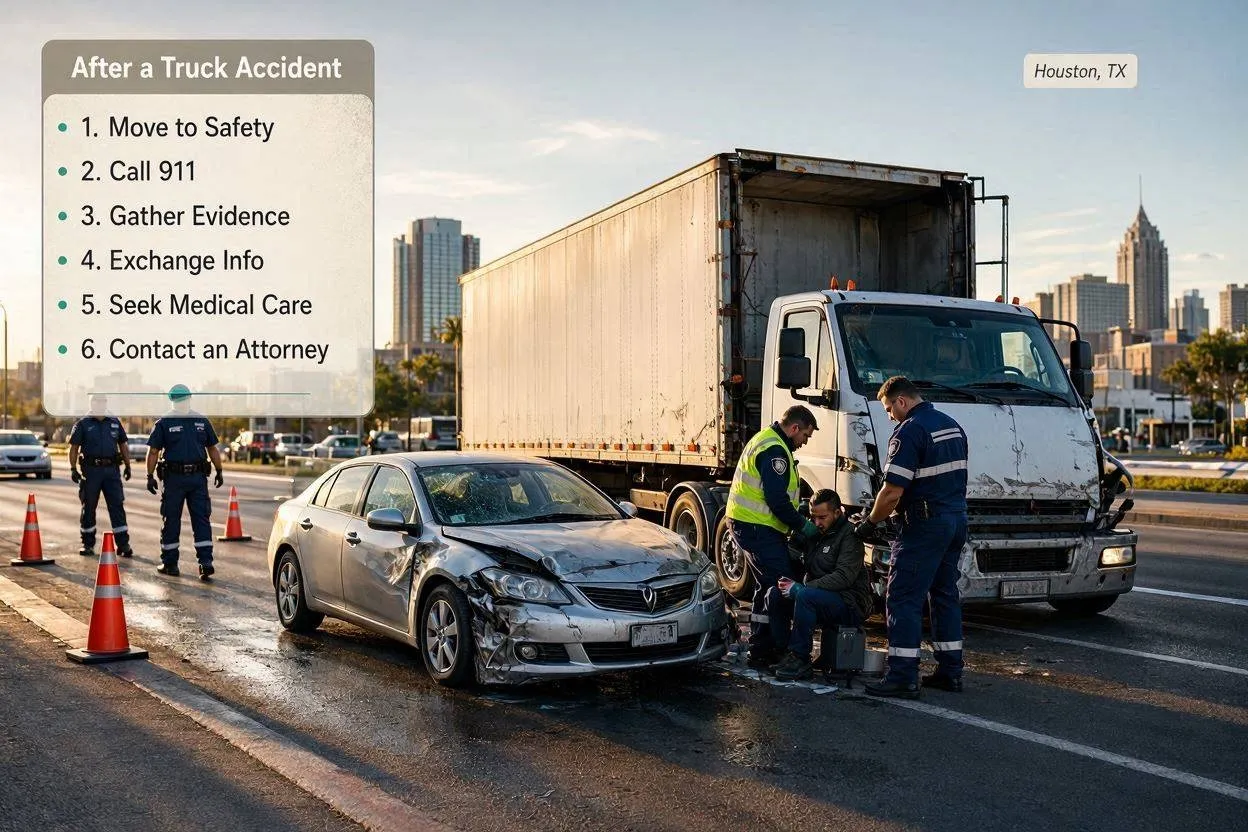
Medical treatment comes first, full stop. Internal injuries and concussions don’t always show symptoms immediately, and a same-day evaluation creates a record tying the injury to the crash.
Documentation matters almost as much. Photograph the truck’s cab, trailer, and license plate. Get the USDOT number if you can see it. Grab contact information from witnesses before they leave, since truck accident witnesses are often other drivers who are hard to track down later.
Don’t talk to the trucking company’s insurance adjuster before you’ve talked to an attorney. Adjusters move fast, sometimes calling within hours, hoping to lock in a recorded statement that minimizes the claim. Nothing said to that adjuster helps you.
Once it’s available, request a copy of the police report. It names the driver, the carrier, and the officer’s initial read on fault, which gives your attorney somewhere to start.
How Long Do You Have to File a Truck Accident Claim in Texas?
Texas gives injured people two years from the date of the crash to file a personal injury lawsuit, under Texas Civil Practice and Remedies Code § 16.003.
For a wrongful death claim, that two-year clock starts on the date of death instead of the date of the crash. Filing an insurance claim doesn’t pause the deadline. Only filing a lawsuit does.
The legal deadline isn’t actually the most urgent one. Evidence disappears long before two years pass. Electronic logging data can be overwritten in days. Dash-cam footage on some fleet systems cycles out within weeks. Miss that practical window and a case can end up weaker even if the lawsuit itself gets filed right on time.
How Much Does It Cost to Hire a Truck Accident Lawyer?

Most truck accident lawyers work on contingency, meaning you pay nothing upfront and the attorney only gets paid after they recover compensation for you.
Contingency fees usually run as a percentage of the final settlement or verdict, and that percentage can shift depending on whether the case settles before a lawsuit is filed or ends up going through litigation and trial. Court costs and case expenses are typically billed separately from the attorney’s fee, and a firm should spell out both in writing before any work starts.
This setup lines up the attorney’s incentive with yours. Nobody gets paid unless the case actually succeeds.
Conclusion
Truck accident claims move differently than car accident claims from the moment the collision happens. Federal regulations, corporate defendants, and evidence with a shelf life measured in days all change what it takes to win. Texas gives you two years to file suit, but the real deadline usually arrives much sooner, once logbooks get overwritten and skid marks fade off the pavement. Acting fast, documenting everything, and bringing in an attorney who handles these cases regularly puts you in a far stronger position than waiting to see how the trucking company’s insurer responds first.
FAQs

Esther Howard
Esther Howard leads TruckingHow’s trucking, commercial driving, and transportation content division. She specializes in CDL training, trucking regulations, fleet operations, truck maintenance, and logistics best practices. With over a decade of experience researching the commercial transportation industry, Esther brings a practical, research-driven approach to driver education, safety standards, and industry regulations. She is the primary author of TruckingHow’s CDL guides, trucking career resources, maintenance tips, and transportation content, helping drivers, fleet owners, and trucking professionals make informed decisions on and off the road
Related Posts