
Semi Truck Weight Limits: Federal & State Rules Explained
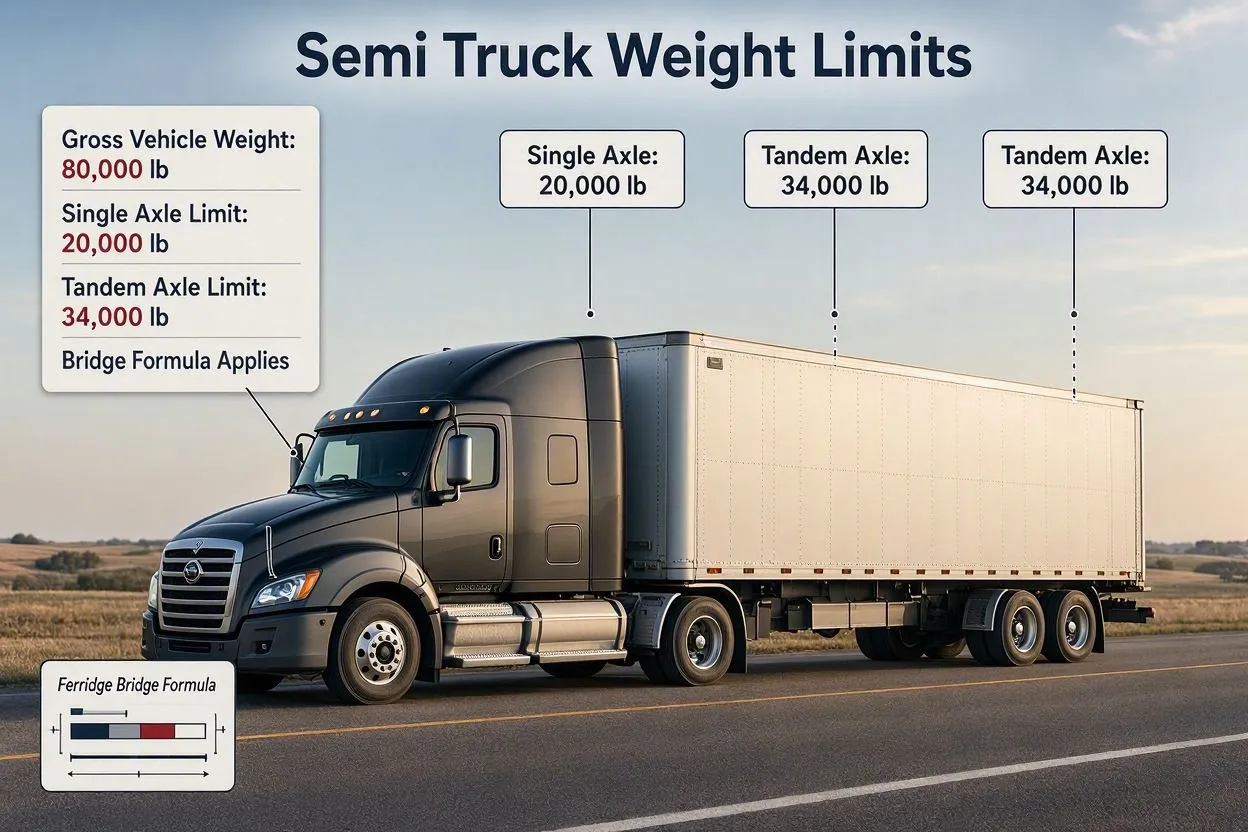
Federal law caps semi truck weight at 80,000 pounds (36,287 kg) gross on the Interstate Highway System. Single axles top out at 20,000 pounds, tandem axle groups at 34,000 pounds. States adjust these numbers on their own roads, so a loaded tractor-trailer that’s fully legal on a federal interstate can turn into a citation the moment it crosses onto a state highway with different axle rules. New York’s single-axle limit, for instance, sits at 22,400 pounds, above the federal figure used on interstates just a few miles away.
This guide covers it all: federal baselines, the bridge formula, trailer capacities, state-by-state rules, GVWR vs. GVW, weigh stations, permits, and the newer exemptions for electric and natural gas rigs. Owner-operators, dispatchers, and fleet managers need the full picture, not just one number. Checking gross weight alone, without axle limits or state rules, is how carriers end up overweight without realizing it.
What Are the Federal Semi Truck Weight Limits?
The federal gross vehicle weight limit for semi trucks on the Interstate Highway System is 80,000 pounds (36,287 kg). This comes from the Federal Highway Administration under 23 U.S.C. § 127, and it covers the combined weight of the tractor, cargo trailer, freight, fuel, and driver. Axle limits apply on top of that gross figure, so a rig can sit under 80,000 pounds total and still get flagged for an overweight violation if one axle carries too much.
Three numbers matter most here. A single axle can’t exceed 20,000 pounds (9,072 kg). A tandem axle group is capped at 34,000 pounds (15,422 kg). Gross combination weight tops out at 80,000 pounds unless a state permit or federal exemption raises the ceiling. Miss any one of these, and the combination is overweight no matter what the total scale reading shows.
These limits apply specifically to the Interstate System. Once a tractor-trailer leaves federal highways for state routes or local roads, individual states set their own rules, and those rules can be stricter or looser depending on infrastructure and local law.
How Does the Federal Bridge Formula Work?
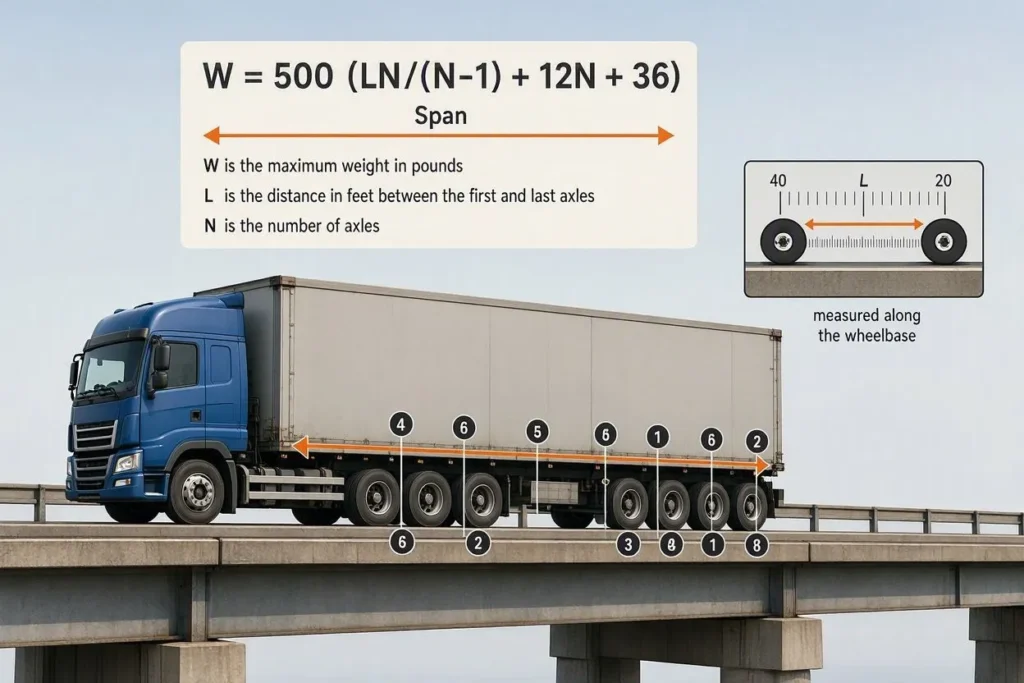
The bridge formula calculates the maximum weight allowed based on the distance between axles, not just the axle count. Officially the Bridge Gross Weight Formula, it exists to spread heavy loads across a longer wheelbase so bridges and pavement don’t take concentrated stress in one spot.
The formula is W = 500 (LN/(N-1) + 12N + 36):
- W is the maximum weight in pounds
- L is the distance in feet between the first and last axles in the group
- N is the number of axles in that group
- A five-axle tractor-trailer with axles spaced across roughly 51 feet can legally carry the full 80,000 pounds
- Compress that same axle group into a shorter wheelbase and the formula drops the allowable weight below 80,000 pounds, even with the same number of axles
Drivers rarely run this by hand. Most fleets lean on bridge formula calculators built into dispatch software or state DOT websites, because a manual error here leads straight to a citation at the scale, especially on 53-foot trailers where axle placement affects legal weight distribution.
What Are the Axle Weight Limits for Semi Trucks?
Standard federal axle weight limits are 20,000 pounds for a single axle and 34,000 pounds for a tandem group, and they apply nationwide on the Interstate System. Several states raise the tandem figure on non-interstate roads.
A single axle carries one set of wheels and is capped at 20,000 pounds. A tandem axle group, two axles spaced 40 to 96 inches apart, carries a combined limit of 34,000 pounds and shows up on most dry van and reefer trailers. A tridem, or tri-axle group, adds a third axle and typically pushes the total to 42,000 to 60,000 pounds, though tri-axle limits aren’t standardized federally the way single and tandem limits are, so the exact number depends on the state.
New York sets its own axle numbers above the federal baseline on state roads: 22,400 pounds for a single axle, 36,000 pounds for a tandem group. Both beat the federal figures used on interstates just down the road, which is about as clean an example as you’ll find of state and federal limits pulling apart on the same physical highway network.
What Are the Weight Capacities of Common Cargo Trailer Types?
Trailer type determines how much freight a semi can legally haul, since the trailer’s own empty weight eats into the 80,000-pound gross limit. Pull a heavier trailer and you’ve got less room left for cargo before hitting the ceiling.
- 53-foot dry van: 10,000–14,000 lbs empty, hauls 43,000–46,000 lbs of freight
- 53-foot reefer: a bit heavier due to insulation and cooling gear, hauls 43,000–45,000 lbs
- 53-foot flatbed: lighter than an enclosed van, hauls 45,000–48,000 lbs
- 48-foot dry van: 9,000–10,000 lbs empty, slightly less than the 53-foot version
- 28-foot pup trailer: around 4,500 lbs unloaded, the lightest common trailer on the road
The tractor itself usually runs 10,000 to 25,000 pounds, depending on cab type and fuel tank size. Add it up and an empty rig weighs roughly 30,000 to 35,000 pounds before any freight goes on.
How Do Semi Truck Weight Limits Vary by State?
Limits change the moment a rig exits the Interstate System, since states control gross weight and axle limits on non-interstate roads. Federal law only governs the interstates directly. Everywhere else, state highways, county roads, all of it, is state jurisdiction.
Montana allows up to 131,060 pounds on certain routes. Washington State allows up to 105,500 pounds under permit. Most states, Texas, Ohio, and Illinois included, stick to the federal baseline: 80,000 pounds gross, 20,000/34,000-pound axle splits.
Tri-axle limits swing the widest. Tennessee allows 54,000 pounds; Louisiana caps the same setup at 42,000. California, Nevada, Oregon, and Washington skip a fixed number entirely and use their own weight tables instead.
Bottom line: check each state’s DOT site before you cross a line. A rig legal in Ohio can be overweight the moment it hits a state with tighter axle limits.
What Is Gross Vehicle Weight Rating (GVWR) and How Does It Differ From GVW?
Gross Vehicle Weight Rating (GVWR) is the maximum weight a truck or trailer is engineered to carry safely. Gross Vehicle Weight (GVW) is what it actually weighs right now. The manufacturer sets GVWR as a fixed limit for the chassis and axles; GVW moves every time cargo, fuel, or passengers get added or pulled off.
The FHWA uses GVWR to sort commercial trucks into Classes 1 through 8. Class 8 trucks, which cover most semi tractors and heavy cargo trailers, carry a GVWR above 33,000 pounds. A tractor-trailer with a combined GVWR of 80,000 pounds can legally run anywhere from empty (roughly 30,000 to 35,000 pounds for tractor and trailer together) up to full rated capacity, as long as the actual GVW stays at or below both the rating and whatever the road allows.
Mixing these two numbers up causes real problems. A truck’s GVWR might allow 85,000 pounds under the manufacturer’s spec sheet, but federal and state law still cap road-legal weight at 80,000 pounds without a permit. Whichever number is lower is the one that governs.
What Happens at a Truck Weigh Station?
Weigh stations check gross weight, axle weight, and paperwork, and drivers have to stop if the station is open and their vehicle exceeds 10,000 pounds. Inspectors use static scales or weigh-in-motion (WIM) sensors embedded in the road to capture weight without always requiring a full stop.
There are basically three ways this goes. The rig passes weight and paperwork checks and the driver’s back on the road in minutes. The load is overweight but divisible, meaning cargo can be shifted or offloaded, and the driver redistributes before continuing. Or the load is non-divisible and overweight, meaning it can’t be split without damaging the freight, and the carrier needs a permit obtained in advance or faces a citation right there.
WIM technology has pushed compliance checks well beyond fixed stations. New York City’s Brooklyn-Queens Expressway (BQE) pairs WIM sensors with license plate cameras to issue automated overweight citations. That system went live for Queens-bound traffic in November 2023 and expanded to Staten Island-bound traffic in June 2025.
How Do You Get an Overweight or Oversize Permit?
Carriers apply through the state DOT for each state the loaded trailer will pass through, providing route, weight, and dimension details for review. Permits come into play when a load exceeds standard gross or axle limits and can’t be split into smaller, legal-weight shipments.
First, the carrier maps out every state and jurisdiction along the route, since a single four-state trip might need four separate permits. Then they submit the load specifics, exact trailer weight, dimensions, axle configuration, through each state’s permit portal or by phone. The state DOT issues a permit that may lock in an approved route, travel hours, and required escort vehicles for oversized loads.
New York issues several permit types through NYSDOT: Type 1, Type 1A, Type 2, and Type 9, each covering different combinations of overweight and oversize conditions. Some require Downstate Grandfather Rights, a legacy provision tied to rigs that were already operating under specific weight allowances before current rules took effect. Costs and processing times vary by state, so carriers who move heavy or oversized freight regularly tend to build several business days of permit lead time into their route planning.
What Are the Weight Exemptions for Electric and Natural Gas Trucks?
Electric and natural gas trucks can go up to 82,000 pounds gross, 2,000 pounds over the standard limit. Congress added this exemption in the 2019 Consolidated Appropriations Act, since battery and alt-fuel powertrains weigh more than diesel engines.
States are catching up. Texas passed S.B. 1364 to match the federal 82,000-pound cap. Pennsylvania has moved similar legislation for battery-powered trucks.
APUs get their own break. These are the small generators behind the sleeper cab that run climate control without idling the engine. Federal law allows up to 550 extra pounds for trucks with qualifying APUs, though some states still cap it at 400, so check before you assume the full amount applies.
What Are the Penalties for Exceeding Semi Truck Weight Limits?
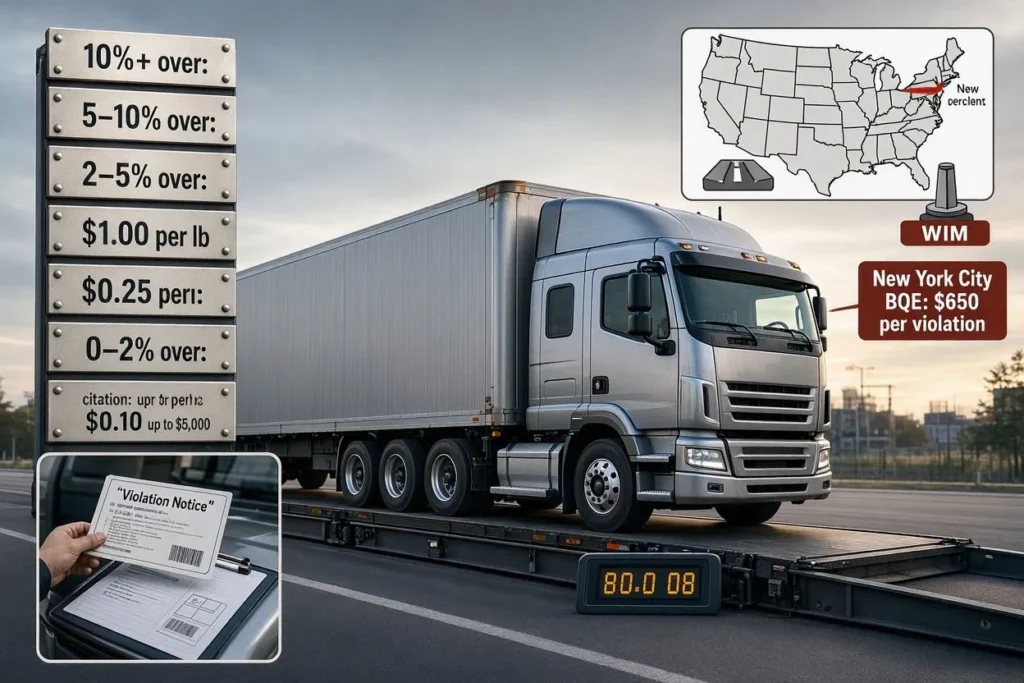
Overweight penalties scale with how far over the limit a rig is, and they vary a lot by state, from small per-pound fines to citations worth several thousand dollars. Most states use a tiered structure where the penalty per pound climbs as the overage grows.
New York City’s BQE program charges a flat $650 per violation for any truck or trailer that trips the WIM sensors on gross or axle weight. Plenty of other states use graduated fee schedules instead. A rig 1,000 pounds over might face $50 to $100; one that’s 5,000 pounds over could see $500 to $1,000 or more, depending on the state.
The fine is rarely the whole cost. Drivers may get held at the scale while cargo gets redistributed or offloaded, which eats into delivery windows. Repeat violations can affect a carrier’s safety rating with the Federal Motor Carrier Safety Administration (FMCSA), which feeds into insurance premiums and eligibility for certain freight contracts. One overweight citation won’t threaten a carrier’s operating authority on its own, but a pattern of them showing up during Compliance, Safety, Accountability (CSA) reviews will draw closer FMCSA scrutiny.
How Do NYC and New York State Enforce Truck Weight Limits?
New York City enforces weight limits through posted axle and gross weight tables plus automated WIM enforcement on the BQE, while New York State applies its own axle limits statewide through NYSDOT. The city’s legal weight table sets limits by axle count and tire width, capping gross weight at 80,000 pounds unless axle spacing calls for less.
Key details on how it works:
- The BQE program is one of the few automated truck weight enforcement systems of its kind in the country
- Governor Kathy Hochul signed the authorizing legislation in July 2023
- Sensors between Atlantic Avenue and Sands Street in Brooklyn capture axle and gross weight from passing tractor-trailers and sync it with license plate cameras to issue citations without a police stop
- Statewide, NYSDOT’s baseline axle limits sit at 22,400 pounds for a single axle and 36,000 pounds for a tandem group, both above the federal interstate figures
- Trucks pulling 53-foot trailers also face routing restrictions within city limits: they’re permitted only on specific segments of I-95, I-695, I-295, and I-495 between the Bronx-Westchester line and the Queens-Nassau line
How Do Seasonal Frost Laws Affect Truck Weight Limits?

Frost laws temporarily cut legal weight limits on certain roads during spring thaw, usually March through May, to keep heavy trucks from tearing up pavement weakened by freeze-thaw cycles. Cold winters push moisture to freeze beneath the road surface; when it thaws in spring, the ground underneath softens and loses load-bearing strength.
New York applies frost restrictions mainly to secondary state routes and local roads upstate, while major highways and New York City stay largely exempt. Minnesota and Michigan run similarly aggressive frost law programs, sometimes cutting legal axle weights by 25% to 35% on affected roads for several weeks each spring.
Local municipalities can shift frost law timing based on regional conditions, so two counties in the same state might lift or impose restrictions on different dates. Carriers running loaded trailers through frost law states in early spring should check state DOT postings before departure. A rig that’s legal in February can be overweight on the same road by mid-March.
Conclusion
Semi truck weight limits combine federal, state, and local rules that don’t always line up, and treating any single number as universal is how carriers end up with compliance headaches. The federal 80,000-pound gross limit, 20,000-pound single axle cap, and 34,000-pound tandem limit form the baseline for interstate travel, but states from New York to Montana adjust these figures on their own roads. Carriers running multi-state routes need to check axle and gross limits state by state, confirm bridge formula compliance for their trailer’s specific axle spacing, and account for seasonal frost restrictions where they apply. Electric and natural gas trucks now carry a federally recognized 82,000-pound allowance, a detail that matters more every year as fleets add zero-emission tractors and trailers. Staying compliant comes down to checking current state DOT postings before each trip rather than working off last year’s numbers or a single federal figure.
FAQs

Esther Howard
Esther Howard leads TruckingHow’s trucking, commercial driving, and transportation content division. She specializes in CDL training, trucking regulations, fleet operations, truck maintenance, and logistics best practices. With over a decade of experience researching the commercial transportation industry, Esther brings a practical, research-driven approach to driver education, safety standards, and industry regulations. She is the primary author of TruckingHow’s CDL guides, trucking career resources, maintenance tips, and transportation content, helping drivers, fleet owners, and trucking professionals make informed decisions on and off the road
Related Posts