
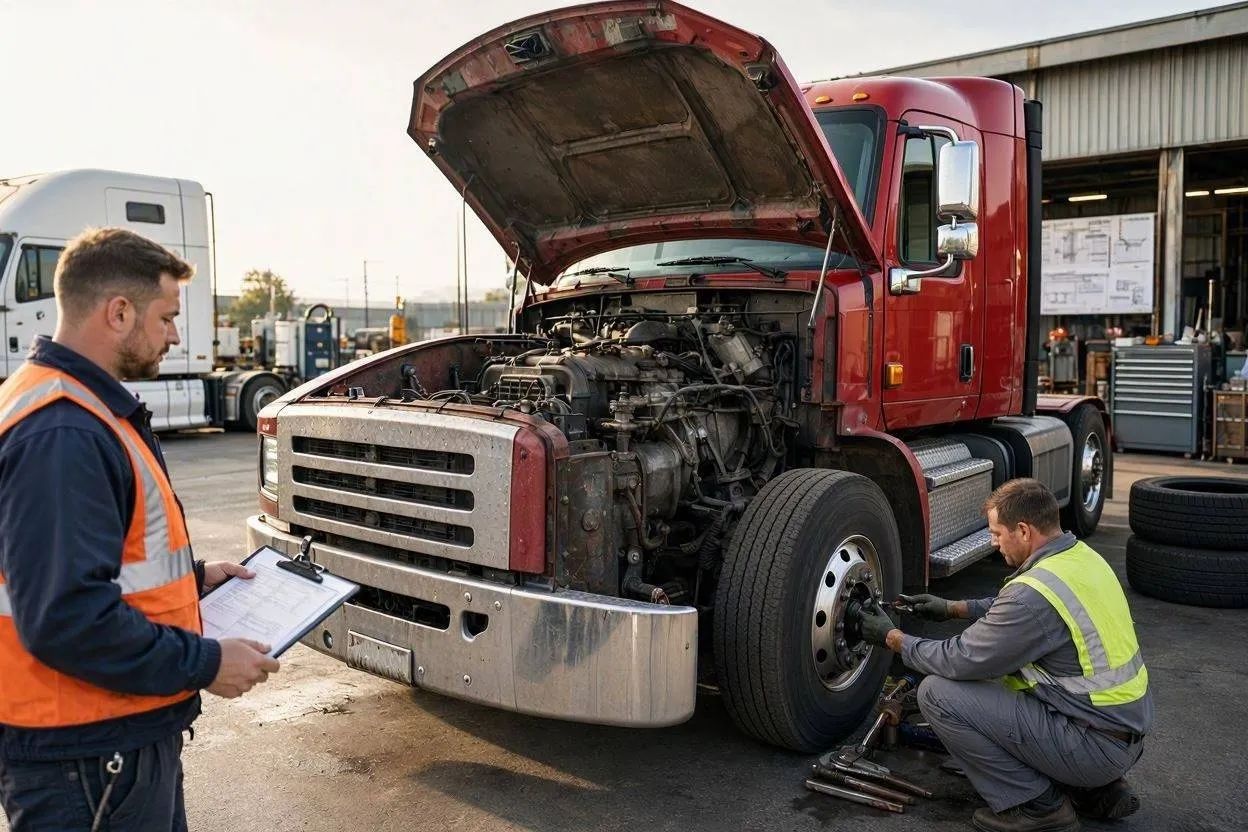
Semi Truck Maintenance Checklist: The Complete 2026 Interval Guide
A semi truck maintenance checklist only works if it matches the way a truck actually wears down: a little every day, more every few thousand miles, and differently depending on the season. Most fleets already own a checklist. Few run it on a schedule tight enough to catch problems before they turn into roadside calls. This guide breaks the semi truck maintenance checklist into five intervals (daily, weekly/monthly, PM-A through PM-D, seasonal, and annual DOT) with the exact mileage points, federal citations, and tools each stage requires.
What Belongs on a Semi Truck Maintenance Checklist?
A complete semi truck maintenance checklist covers six systems (tires, brakes, fluids, electrical, steering/suspension, and the coupling system) checked at five intervals: daily, weekly, monthly, quarterly, and annually. Skip a system and a small problem, like a hairline crack in a brake hose, turns into a roadside breakdown three weeks later. Owner-operators and fleet managers need the same framework. The only difference is who signs off on the paperwork.
This guide breaks the checklist down by interval, not by vague category, because a driver at 6 a.m. doesn’t need a philosophy of maintenance. He needs to know what to check today, what waits until the next oil change, and what the Department of Transportation (DOT) will look at during an annual inspection.
What Does FMCSA Require for Semi Truck Maintenance?
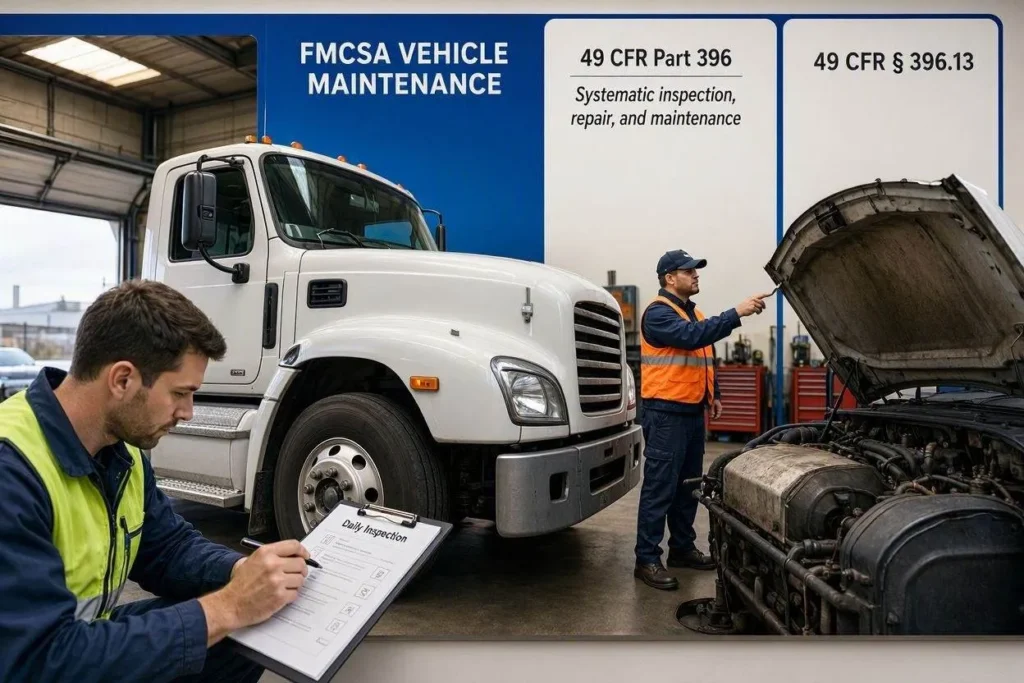
The Federal Motor Carrier Safety Administration (FMCSA) requires every motor carrier to systematically inspect, repair, and maintain all vehicles under its control, under 49 CFR Part 396. The word “systematically” carries the legal weight here. A maintenance habit that skips weeks isn’t a system, and an inspector treats it that way during an audit.
Two rules do most of the work. Under 49 CFR § 396.13, drivers must complete a pre-trip inspection before every trip, checking brakes, tires, lights, and coupling devices at minimum. Under 49 CFR Part 396.3, carriers must keep maintenance records for at least 12 months while a vehicle stays in service, and no less than six months after it’s retired. A carrier with three years of gap-free digital logs walks into a Compliance, Safety, Accountability (CSA) audit in a completely different position than one with a shoebox of handwritten notes.
Brake violations alone account for close to 45% of all out-of-service conditions found during roadside inspections, according to Commercial Vehicle Safety Alliance (CVSA) data. That single statistic explains why brakes appear first on almost every checklist in this guide.
How Do You Complete a Daily Pre-Trip Inspection?
To complete a daily pre-trip inspection, walk the full perimeter of the truck and trailer, checking seven areas: tires, brakes, lights, fluids, coupling devices, mirrors and glass, and the undercarriage. Do this before every trip. FMCSA treats it as a legal requirement, not a suggestion.
Tires come first. Check cold tire pressure against the manufacturer’s spec, then look for cuts, bulges, and uneven wear across all positions, including the trailer. Federal minimum tread depth sits at 4/32 of an inch (about 3.2 mm) on steer tires and 2/32 of an inch (about 1.6 mm) on every other position.
Brakes need a full 360-degree check. Listen for air leaks during the walk-around, confirm air pressure builds to 85 to 100 psi (roughly 586 to 689 kPa) within two minutes, and make sure air loss doesn’t exceed 3 psi (about 21 kPa) per minute with the brakes applied. A driver who skips this step and pulls onto the interstate with a slow air leak is betting the trip on a system that’s already failing.
Fluids get a visual scan next: engine oil, coolant, power steering fluid, washer fluid, and Diesel Exhaust Fluid (DEF). A puddle under the truck almost always means a leak that hasn’t triggered a dashboard warning yet.
Lights, coupling devices (including the fifth wheel, kingpin, and safety chains), and the undercarriage round out the walk-around. A driver who reports a rough shift pattern at the end of a run gives the shop something specific to diagnose overnight, instead of leaving a fleet manager to discover a transmission problem the next morning when the truck is already loaded.
What Goes on a Weekly and Monthly Maintenance Checklist?
A weekly checklist adds battery terminal inspection, belt and hose checks, and calibrated tire pressure readings on top of the daily walk-around. If a truck runs different trailers through the week, weekly checks should also cover trailer lights and electrical connections, since those swap out more often than the tractor’s own wiring.
Monthly maintenance goes one layer deeper. Air filters need attention at least monthly on trucks running dusty or high-particulate routes, because a clogged filter reduces combustion efficiency and adds strain to the turbocharger. Fuel water separators get drained if they’re not already on a shorter cycle, and cooling system hoses get squeezed by hand to check for softness or swelling. That’s a check a visual inspection alone will miss.
Battery load testing matters most for trucks running in extreme heat or cold. A battery can pass a visual inspection and still fail a load test, and a dead battery at 4 a.m. in a January parking lot is the kind of failure a monthly check exists to prevent.
What Are PM-A, PM-B, PM-C, and PM-D Services?
PM-A, PM-B, PM-C, and PM-D are labeled preventive maintenance (PM) tiers tied to mileage: PM-A around 10,000 miles (16,000 km), PM-B around 30,000 miles (48,000 km), PM-C around 60,000 miles (97,000 km), and PM-D around 120,000 miles (193,000 km). Each tier builds on the one before it, so a PM-D visit includes everything a PM-A does, plus a much deeper system review.
PM-A (~10,000 miles)
Chassis lubrication, fluid top-offs, a brake inspection with lining-thickness measurement, a lighting check, and tire inspection.
PM-B (~30,000 miles)
An oil and filter change, fuel filter replacement, transmission fluid check, coolant system inspection, and a deeper brake, steering, and suspension review.
PM-C (~60,000 miles)
Transmission and differential fluid changes, a wheel alignment check, and exhaust after-treatment service on the Diesel Particulate Filter (DPF) and Selective Catalytic Reduction (SCR) system.
PM-D (~120,000 miles)
Coolant replacement, a full charging-system test, and an air conditioning (AC) performance check.
A Paccar MX-13 engine and a Cummins X15 don’t share the same factory oil-change interval, so the original equipment manufacturer (OEM) manual is the starting point, not the finish line. A truck hauling heavy loads through mountain grades in July wears components faster than one running flat highway miles in mild weather, and the PM schedule should shift to match.
How Often Should You Change Oil, Brakes, and Tires on a Semi Truck?
Engine oil on a semi truck typically gets changed every 15,000 miles (24,000 km) under normal duty, tightening to 10,000 miles (16,000 km) under severe duty. Brakes get a professional inspection every 15,000 to 20,000 miles (24,000 to 32,000 km), and tires get rotated around every 50,000 miles (80,000 km). These numbers shift with route type, load weight, and climate, so treat them as a baseline, not a rule carved in stone.
Longer-interval components follow their own mileage milestones. Valve adjustments happen first at 150,000 miles (241,000 km), then every 300,000 miles (483,000 km) under normal duty or 200,000 miles (322,000 km) under severe duty. DPF systems need cleaning or replacement around 400,000 miles (644,000 km), shortening to 250,000 miles (402,000 km) for trucks running severe-duty cycles. Differential oil gets replaced at 250,000 miles (402,000 km) under normal conditions and 150,000 miles (241,000 km) under severe conditions.
Fleets that stick to manufacturer-recommended intervals for these longer-cycle components report close to 37% fewer roadside breakdowns tied to major systems, based on fleet benchmarking data. That gap is the entire argument for building a mileage-tracked semi truck maintenance checklist instead of relying on memory or a rough guess at the next service date.
What Should a Seasonal Maintenance Checklist Include?
A seasonal maintenance checklist should cover cooling system performance before summer and battery, electrical, and brake-line checks before winter, since temperature extremes stress different systems on a semi truck. Skip this step and the truck that ran fine in October can overheat in July or refuse to start in January.
Summer Prep
Summer prep starts with a cooling system pressure test, a check for radiator debris, and confirmation that the fan clutch engages properly under load. AC systems need a refrigerant level check and condenser cleaning, ideally every three months during hot-weather operation. Heat also accelerates coolant loss through expansion and evaporation, and it breaks down rubber hoses and belts faster than moderate weather does.
Winter Prep
Winter prep shifts focus to the electrical system, since cold weather puts maximum strain on batteries and starting circuits. Load testing every six months catches a weak battery before it fails on a subzero morning. Air dryers and moisture traps need a functional check too, because moisture in the air brake lines can freeze and cause a stuck valve exactly when a driver needs the brakes most. Switching to winter-grade oil and keeping fuel tanks fuller than usual, to limit condensation, round out the cold-weather pass.
Does Trailer Maintenance Need Its Own Checklist?
Yes. Trailer maintenance needs a separate checklist, since FMCSA regulations apply to trailers independently of the tractor and DOT inspectors review them as a distinct unit. A carrier that builds a maintenance program around the tractor alone leaves half the rig unchecked.
Trailer-specific items include brake systems, lighting, landing gear, the fifth wheel plate and kingpin wear pattern, and structural integrity of the frame and cross-members. Reefer trailers add refrigeration unit checks to that list, since a failed reefer unit turns a load into a total loss faster than almost any other mechanical failure on the truck. Many carriers underinvest in trailer maintenance relative to the tractor, and that gap shows up directly in brake and lighting violations during roadside inspections. Both are cheap to prevent and expensive to explain to an inspector.
What Tools Do You Need to Run a Semi Truck Maintenance Checklist?
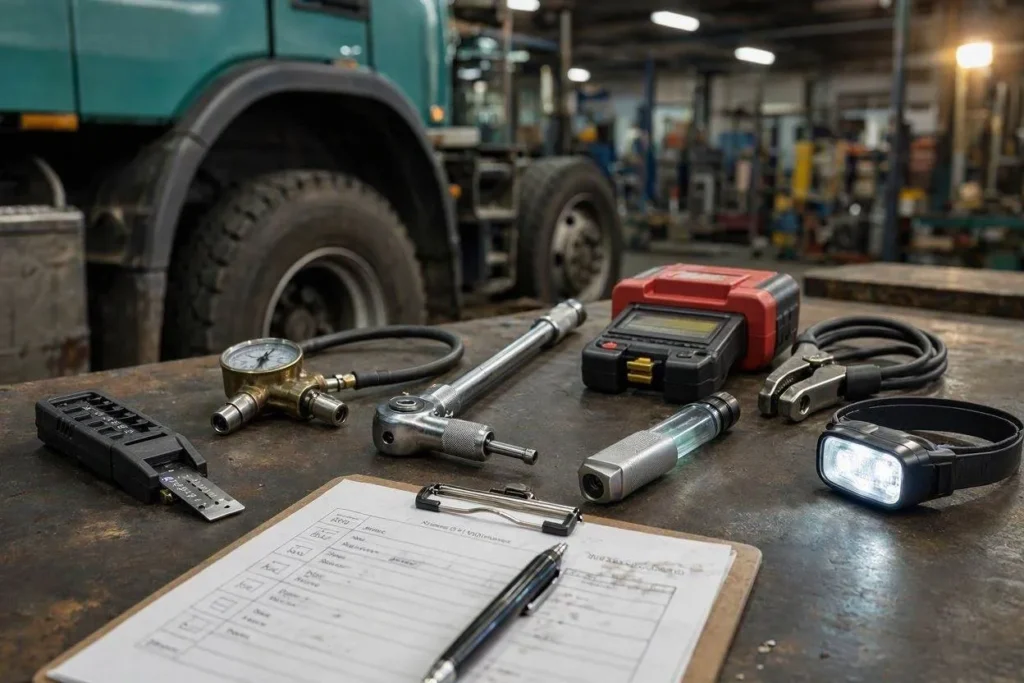
Running a semi truck maintenance checklist properly requires six core tools: a tread depth gauge, a calibrated tire pressure gauge, a torque wrench, a battery load tester, a coolant refractometer, and a flashlight or headlamp for undercarriage checks. None of these cost more than a few hundred dollars combined, and skipping them turns a precise inspection into a guess.
A tread depth gauge removes the guesswork behind that 4/32-inch and 2/32-inch tread standard. Eyeballing tread wear is unreliable, especially on a tire that’s worn unevenly across its width. A torque wrench matters most after tire rotations and wheel-end service, since under-torqued lug nuts are a known cause of wheel separation on the highway. Battery load testers catch the failure a visual check can’t: a battery that looks fine and starts fine in July can still fail a cold-morning start in January, and a load tester is the only way to know in advance.
A coolant refractometer checks freeze protection and supplemental coolant additive (SCA) levels in seconds, which matters most during the seasonal cooling-system checks covered above. Larger fleets add a handheld ECM (electronic control module) scan tool to this list, since it reads fault codes and lets a technician catch a developing sensor or aftertreatment issue before it becomes a check-engine light on the interstate. Owner-operators running a single truck can get by without the ECM scanner, leaning instead on a trusted shop for that layer of diagnostics during PM-B and PM-C visits.
What Happens During an Annual DOT Inspection?
A DOT annual inspection is a mandated physical review of every major system on the vehicle, covering brakes, steering, suspension, tires, wheels, lighting, frame integrity, fuel system, exhaust, coupling devices, and emergency equipment, under 49 CFR Part 393 and Appendix G. A truck that fails gets placed out of service until every violation is corrected and documented.
The best-run fleets treat this inspection as confirmation, not discovery. A truck maintained on a consistent PM schedule throughout the year should pass without surprises, because nothing on the inspector’s list is news to the shop that’s been servicing it. A truck maintained reactively, fixed only when something breaks, tends to surface problems during the annual review that could have been caught six months earlier at a fraction of the repair cost.
The annual inspection is also the right moment to pull a truck’s full service history and look for patterns. If the same sensor keeps failing, or the same component gets replaced every few months, that recurring cost is data the maintenance schedule should account for going forward.
Why Do Maintenance Checklists Fail in Practice?
Maintenance checklists fail in practice for four repeatable reasons: interval drift, incomplete DVIR follow-through, poor record quality, and inconsistent shop work. Recognizing these four patterns matters more than adding new checklist items, since most breakdowns trace back to one of them rather than to a missing task.
Interval drift happens when a truck scheduled for service at 12,000 miles (19,000 km) doesn’t come in until 15,000 miles (24,000 km), because dispatch had a load that couldn’t wait. Once, that’s a minor variance. Repeated across a fleet, it compounds into trucks running consistently behind schedule and wearing components faster than the plan accounts for.
DVIR follow-through is a second common gap. A driver notes a concern on the Driver Vehicle Inspection Report (DVIR), and that note never turns into a shop visit before the truck goes back out. The pre-trip system only works if what a driver reports actually gets acted on, not filed.
Record quality becomes a real liability during a DOT audit. Maintenance logs missing mileage, dates, or specifics create exposure that a clean digital record avoids entirely. Shop quality is the fourth variable, and it’s the hardest to control from the fleet-office side. A rushed PM service that skips steps produces a paper trail that looks complete but doesn’t reflect what actually happened to the truck.
Does Preventive Maintenance Actually Reduce Breakdowns?
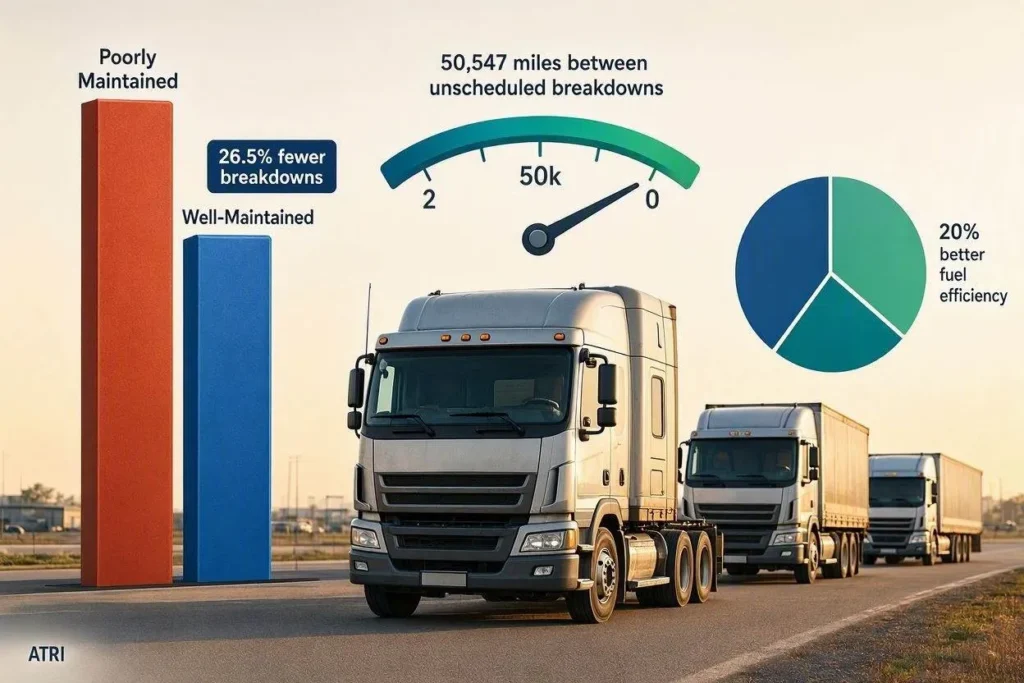
Yes. Preventive maintenance measurably reduces breakdowns, with well-maintained fleets showing close to 26.5% lower breakdown rates and up to 20% better fuel efficiency compared to poorly maintained ones, according to American Transportation Research Institute (ATRI) data. Trucks on a disciplined PM schedule also average around 50,547 miles (81,320 km) between unscheduled breakdowns, a number that’s climbed roughly 7,900 miles over the previous industry benchmark, credited in part to better maintenance discipline across the industry.
The cost math supports the same conclusion. Repair and maintenance spending averaged 19.6 cents per mile in 2022, up 12% in a single year, making a disciplined checklist one of the few levers a fleet controls directly against that rising line item. Every dollar spent on preventive maintenance saves an estimated three to four dollars in reactive repair costs down the line, and neglected maintenance runs three to four times more expensive than the preventive version of the same fix.
Fernando Castro, who runs Mega Trucking out of Houston across Texas and Florida, credits an industry safety award to maintenance discipline rather than added rules. His trucks stay on routes, his drivers stay on payroll, and his fleet’s turnover sits at zero in an industry where driver churn is the norm. That outcome didn’t come from a bigger rulebook. It came from running the same semi truck maintenance checklist consistently, week after week.
Driver retention connects to maintenance in a way fleet managers sometimes overlook. Drivers quit companies whose trucks strand them on the shoulder at 2 a.m., and no pay bump fixes that frustration on its own. A truck that starts every morning, brakes smoothly, and doesn’t trigger a fault code mid-route builds driver confidence the same way it builds equipment reliability: through repetition, not luck.
Conclusion
A semi truck maintenance checklist works only when it runs on a fixed interval, gets documented every time, and covers the tractor and trailer as one system instead of two. Daily pre-trip checks catch what changed overnight, PM-A through PM-D services catch what wears out over months, and seasonal passes catch what the calendar itself puts at risk. Fleets that treat these three layers as one program, not three separate habits, are the ones showing up in the breakdown statistics as the exception, not the rule.
FAQs

Esther Howard
Esther Howard leads TruckingHow’s trucking, commercial driving, and transportation content division. She specializes in CDL training, trucking regulations, fleet operations, truck maintenance, and logistics best practices. With over a decade of experience researching the commercial transportation industry, Esther brings a practical, research-driven approach to driver education, safety standards, and industry regulations. She is the primary author of TruckingHow’s CDL guides, trucking career resources, maintenance tips, and transportation content, helping drivers, fleet owners, and trucking professionals make informed decisions on and off the road
Related Posts