How Long Does Truck Driving School Take? The Full CDL Timeline
Truck driving school takes as long as the training provider’s program, plus a federal minimum of 14 days between your learner’s permit and your skills test. Full-time programs finish fastest. Part-time and weekend schedules stretch across more calendar weeks. Program length in weeks varies by school, though the real finish date often hinges on when the DMV can fit you in for a skills test.
Key Takeaways
- The length of truck driving school depends on the training provider, because the federal Entry-Level Driver Training (ELDT) rule sets no minimum classroom or behind-the-wheel hours.
- Federal rules require every CDL applicant to hold a Commercial Learner’s Permit (CLP) for at least 14 days before taking the CDL skills test.
- Behind-the-wheel training can run during the 14-day CLP holding period, so the two steps overlap instead of stacking on top of each other.
- A truck driving school must be listed on the FMCSA Training Provider Registry (TPR), or its training doesn’t count toward the ELDT requirement.
- State DMV skills test scheduling often sets the real CDL finish date, so applicants should book a test slot as early as possible.
- No verified national figure for program length in weeks or for tuition cost is available, so applicants should confirm both with each school in writing.
What Is Truck Driving School?
Truck driving school is a career training program that prepares students to pass the commercial driver’s license (CDL) knowledge and skills tests. Since February 7, 2022, every first-time Class A or Class B applicant must complete Entry-Level Driver Training (ELDT) from a provider that meets Federal Motor Carrier Safety Administration (FMCSA) standards. Not every school qualifies.
In the USA, truck driving school comes in several forms. Private CDL schools and community college programs teach the same federal ELDT curriculum, and carrier-run training academies cover it too, yet each provider sets its own schedule. Only the calendar changes.
Every provider approved to deliver ELDT appears on the FMCSA Training Provider Registry (TPR). Training from a school that isn’t on the TPR doesn’t satisfy the federal rule, no matter how many weeks the program runs. Length can’t fix that.
Ask “how long does truck driving school take” and you’re really asking two things. The school controls training. Licensing belongs to the state, and that chain runs from the medical certificate to the skills test, with the permit sitting in between.
Anyone searching “how long does it take to complete truck driving school” needs both answers. Here’s why. A school can wrap up training right on schedule while its graduate still waits on a DMV road test appointment.
How Long Does Truck Driving School Take on Each Schedule?
How long truck driving school takes depends mainly on the schedule: full-time programs finish in the fewest calendar weeks, part-time and weekend programs spread the same ELDT curriculum over more weeks, and company-sponsored programs pair training with a hiring pathway on a timeline the carrier controls.
No verified national figure for program length in weeks is available. Ask each school directly. Every school should be able to show you its published schedule and the number of range and road hours it provides before you sign anything. Ask about the usual skills test wait.
This table compares how fast the four common CDL training schedules move and who each one suits.
| Schedule | Typical Format | Relative Speed | Best For |
|---|---|---|---|
| Full-Time | Weekday daytime classes, range and road | Fastest | Students who can pause work |
| Part-Time Evening | Weeknight sessions after work hours | Slower | Workers keeping a current job |
| Weekend | Saturday and Sunday sessions | Slowest | People with weekday jobs |
| Company-Sponsored | Carrier-run training linked to hiring | Set by the carrier | Students who want tuition covered |
Full-Time CDL Programs
A full-time CDL program runs on weekdays, usually during daytime hours. Classroom theory flows straight into range practice, and public road driving follows soon after, with no long breaks between one session and the next. It’s the most compressed format.
Full-time training suits students who can stop working while they train. Daily repetition pays off. Straight-line and offset backing stay fresh from one session to the next, and the pre-trip inspection sticks better when students run it every day.
Part-Time and Weekend CDL Programs
Part-time CDL school takes more calendar weeks than full-time school because the same ELDT curriculum gets spread across evenings or weekends. The upside is income. Students on these schedules can usually hold on to a full-time job while they train.
The catch is longer gaps between driving sessions. Skills fade a little. A student who only gets behind the wheel on Saturdays needs extra practice time just to rebuild muscle memory for backing and shifting.
Make sure the CLP stays valid for the whole part-time schedule. Federal rules cap a CLP at one year from issuance, and a state can set an even shorter validity period, so a slow schedule can outrun the permit. Check the state’s limit first.
Company-Sponsored CDL Training
Company-sponsored CDL training is training that a motor carrier provides or pays for in exchange for a work commitment after licensing. It isn’t always faster than private school. The carrier sets the schedule, and some programs tack on a supervised driving phase with a trainer after the CDL is issued.
Read the contract before enrolling. Company programs commonly require a set term of employment, and walking away early can trigger repayment of the training cost.
Get every contract term in writing, especially how long the work commitment lasts and exactly what repayment looks like if you leave. Pay during training belongs there too. Those details weigh as much as the number of weeks spent in a classroom.
Community College CDL Programs
Community college CDL programs follow the college’s academic calendar, so start dates are fixed and students may have to wait for the next term to begin. Some colleges run short certificate blocks inside the term. Ask about those.
Community colleges and private schools can both accept Workforce Innovation and Opportunity Act (WIOA) funding when the program appears on the state’s eligible training provider list. Approval runs through a local American Job Center. Budget paperwork time before day one.
How Long Does It Take to Get a CDL from Start to Finish?
Getting a CDL requires a federal minimum of 14 days between the learner’s permit and the skills test, plus the time needed to complete a Department of Transportation (DOT) medical exam, pass the knowledge tests, finish ELDT and book a DMV road test in your state. The main federal clock is the permit wait, and every other step depends on appointments and on the school’s own pace. Plan around both.
Anyone asking “how long does it take to get your CDL” should map out every phase before picking a school or a start date. Several phases overlap. A few can’t be compressed at all.
This table breaks down each phase of the CDL process, showing its federal time rule and whether it can run alongside other steps.
| Phase | What Happens | Federal Time Rule | Runs in Parallel |
|---|---|---|---|
| DOT Medical Exam | Certified examiner checks fitness to drive | No federal wait | Yes, with ELDT theory |
| Knowledge Tests | DMV tests general knowledge and vehicle topics | No federal wait | Yes, with ELDT theory |
| CLP Issuance | State issues permit after a Clearinghouse query | No federal wait | No |
| CLP Holding Period | Permit held before the skills test | At least 14 days | Yes, with behind-the-wheel training |
| ELDT Theory | Online or classroom lessons, 80% passing score | No minimum hours | Yes, can finish before the CLP |
| ELDT Behind-the-Wheel | Range and public road driving | No minimum hours | Yes, during the CLP hold |
| TPR Upload | School reports completion to FMCSA | By the end of the second business day | No |
| CDL Skills Test | Pre-trip, basic control and road test | Set by state scheduling | No |

DOT Medical Exam and Certificate
Book the DOT physical with a medical examiner listed on the FMCSA National Registry of Certified Medical Examiners, and confirm the listing before the appointment. Registry status matters. Only examiners on that registry can issue a valid Medical Examiner’s Certificate.
A Medical Examiner’s Certificate is valid for up to 24 months. Some run shorter. An examiner can cut that window short when a condition such as high blood pressure needs regular monitoring between DOT physicals.
Applicants who self-certify as non-excepted interstate drivers must provide the certificate to the State Driver Licensing Agency (SDLA). Plan ahead. Bring medical records for any ongoing condition to the exam so a missing document doesn’t force a second appointment.
Knowledge Tests and the Commercial Learner’s Permit
Getting a CLP means passing the state’s CDL knowledge tests. A Class A tractor-trailer applicant typically sits for general knowledge and air brakes, then the combination vehicles test on top of those. That’s three exams in total.
Before issuing a CLP, the SDLA must query the FMCSA Drug and Alcohol Clearinghouse, a requirement in force since November 18, 2024. A prohibited status blocks the permit. It stays blocked until the applicant completes the return-to-duty process.
Applicants must be at least 18 years old to get a CLP for driving within one state. The interstate rule is stricter. Anyone planning to drive a commercial vehicle across state lines, even on a short regional run, must be at least 21 years old.
The 14-Day CLP Rule
Federal rules require a CLP holder to wait at least 14 days after the permit is issued before taking the CDL skills test. The first day of school doesn’t matter. Only the permit’s issue date starts the count.
That 14-day window doubles as training time. Students complete behind-the-wheel practice during the holding period, so the wait adds no calendar time when training already fills those two weeks.
A CLP holder can drive a commercial motor vehicle (CMV) only when accompanied by a CDL holder with the proper class and endorsements. Schools handle this. They supply a qualified instructor for range and road sessions.
ELDT Training and the Registry Upload
ELDT comes in two parts. Theory covers hours of service and vehicle inspection, with hazard perception also on the syllabus, while behind-the-wheel (BTW) training handles the driving. Students must score at least 80% on the theory assessment.
BTW training happens on a practice range and on public roads. There’s no clock on it. The instructor signs off only after the student demonstrates proficiency in every required skill, however many sessions that happens to take.
After training ends, the provider must submit completion data to the TPR by midnight of the second business day. Timing matters here. The state can’t give the skills test until that record shows up, so a school that files late pushes your road test back with it.
Skills Test Scheduling at the DMV
The CDL skills test has three parts. It starts with the pre-trip vehicle inspection and basic vehicle control, then ends with the on-road driving test. Each state controls how quickly test slots open.
Some states rely on certified third-party skills testers, which can shorten the wait for a test date when DMV slots are scarce. Ask if the school uses one. Also find out how far ahead it books slots.
Skills test wait times vary by state. No verified national figure is available, so call the local DMV or check its online scheduler before enrolling in any program.
Why ELDT Sets No Minimum Training Hours
The Entry-Level Driver Training (ELDT) rule sets no minimum number of classroom or behind-the-wheel hours because FMCSA built the rule around proficiency instead of seat time, so a student finishes after scoring at least 80% on the theory assessment and demonstrating every required driving skill to a qualified instructor.
The proficiency standard explains why program lengths differ. Two ELDT-compliant schools can teach an identical curriculum on very different schedules, with one finishing well ahead of the other.
Still, a state or a school can layer its own hour requirements on top of the federal rule, and some programs run longer because of it. Check before enrolling. The state CDL manual and the school’s catalog will show any extra required hours.
ELDT applies to first-time Class A and Class B applicants and to drivers upgrading from Class B to Class A. Endorsements count too. First-time applicants for the hazardous materials (H) and passenger (P) endorsements need it, and so do first-time school bus (S) endorsement applicants.
ELDT doesn’t apply to drivers who already held a valid CDL or endorsement issued before February 7, 2022. They’re grandfathered. Their existing credentials carry forward, and nobody in that group has to go back through entry-level training to keep driving.
How Long Does It Take to Get a Class a CDL?
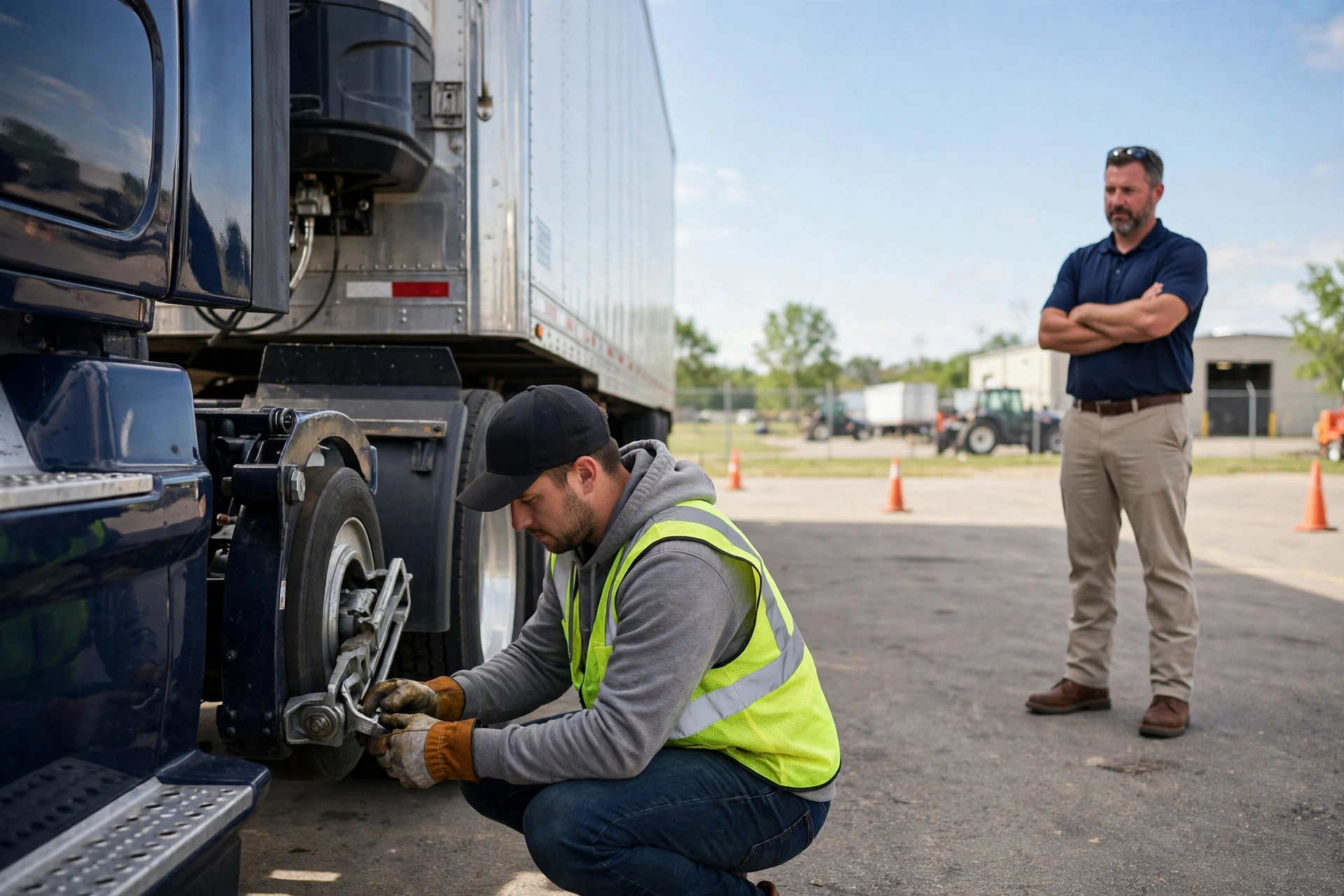
A Class A CDL takes the most training of the commercial license classes because students must learn coupling, uncoupling and backing a tractor-trailer, and applicants must pass the general knowledge, air brakes and combination vehicles tests before the 14-day CLP clock starts.
Many applicants search “how long does it take to get CDL Class A” because Class A is the license for tractor-trailers. The rules don’t change. Every licensing step after training, from the 14-day CLP rule and TPR upload to the skills test, works for Class A exactly as it does for Class B.
This table compares Class A and Class B by vehicles covered, weight thresholds, knowledge tests and training scope.
| License Class | Vehicles Covered | Weight Threshold (lb / kg) | Knowledge Tests | Training Scope |
|---|---|---|---|---|
| Class A | Tractor-trailers and other combination vehicles | GCWR 26,001+ lb / 11,794+ kg, towed unit over 10,000 lb / 4,536 kg | General, air brakes, combination vehicles | Includes coupling and uncoupling |
| Class B | Straight trucks, dump trucks, buses | GVWR 26,001+ lb / 11,794+ kg, towing 10,000 lb / 4,536 kg max | General, air brakes if equipped | No coupling or uncoupling |
How Long Does a Class B CDL Take?
A Class B CDL usually needs less training time than Class A because the Class B curriculum skips coupling and uncoupling a trailer. The permit wait doesn’t shrink, though. Class B applicants face the same 14-day CLP rule.
Class B covers straight trucks, dump trucks, box trucks and buses. Buses need more. Anyone driving one also needs the passenger (P) endorsement, which comes with its own ELDT training and a separate knowledge test on top of Class B.
Upgrading from Class B to Class a Later
A Class B holder can upgrade to Class A at any time. It’s a full process. The upgrade requires Class A ELDT from a TPR-listed provider, the combination vehicles knowledge test, a Class A CLP and a Class A skills test.
Class B makes sense as a starting point for local delivery and construction jobs. Drivers who plan to haul trailers should go straight to Class A, since it spares them a second round of training later. One round beats two.
Manual vs Automatic Transmission Restrictions
Taking the skills test in an automatic transmission vehicle adds an E restriction to the CDL, which bars the driver from operating a manual transmission CMV. A manual avoids that. Training on one means extra shifting practice, but the license skips the E restriction.
Ask which transmission each school uses. A school running nothing but automatic trucks will send every graduate out with a restricted license, no matter how well they drive.

Can You Get a CDL in 3 Weeks?
Yes, federal rules allow an applicant to get a CDL in about 3 weeks when the medical exam and knowledge tests happen early, ELDT finishes during the 14-day CLP holding period, and the DMV has an open skills test slot. Any single delay pushes that date back.
Here’s the math. The CLP holding period lasts at least 14 days, and the TPR upload can take up to two business days once training ends. After that, everything rides on an open skills test appointment.
Finishing ELDT theory before the permit is issued removes the largest block of classroom time from the calendar. That’s the key move. Whatever BTW training remains can then fit inside the 14-day hold, so the permit wait and the driving practice happen at the same time.
A fast program still meets ELDT when the provider is on the TPR and the student shows proficiency in every required skill. Speed alone doesn’t disqualify training.
Carriers set their own hiring standards. Before choosing an accelerated CDL course, ask the carriers you want to work for whether they require a minimum number of training hours or only hire graduates of specific schools.
What Is the Fastest Way to Get a CDL?
The fastest way to get a CDL is to finish ELDT theory and the DOT medical exam before getting the permit, run behind-the-wheel training inside the 14-day CLP holding period, and book the skills test slot as soon as the school confirms a finish date.
Use these steps to cut dead time out of the calendar:
- Confirm eligibility: at least 18 for in-state driving or 21 for interstate driving, a valid regular driver’s license and no prohibited Clearinghouse status.
- Verify the school on the Training Provider Registry at tpr.fmcsa.dot.gov before paying tuition.
- Ask the school how far ahead it books skills tests and whether it uses a third-party tester.
- Apply for WIOA, GI Bill or carrier funding before enrollment if you need tuition help.
- Book a DOT physical with an examiner on the National Registry of Certified Medical Examiners.
- Complete ELDT theory online while waiting for the physical, if the school offers online theory.
- Study the state CDL manual and pass all required knowledge tests in one DMV visit.
- Start behind-the-wheel training the day the CLP is issued.
- Schedule the skills test for a date at least 14 days after CLP issuance and after the TPR upload.
- Practice the pre-trip inspection out loud every day to avoid a failed test and a state retest wait.
Searches for the “fastest way to get CDL” credentials often lead straight to accelerated programs. Those can help. Still, the 14-day CLP rule and DMV scheduling control the real finish date, however quickly a school moves through its curriculum.
How Long Does a Hazmat Endorsement Take?
A hazmat endorsement can take longer than the rest of the CDL process because the Transportation Security Administration (TSA) must complete a security threat assessment, including fingerprints and a background check, before the state can add the H endorsement to the license. No verified processing time is available. TSA posts current guidance on its hazmat endorsement page, so check there before planning around a date.
Hazmat applicants must complete ELDT hazmat theory from a TPR-listed provider. Two more conditions apply. Every applicant has to pass the hazmat knowledge test and be at least 21 years old before the H endorsement goes on the license.
Sometimes the hazmat process can start during CDL school. Ask the state DMV whether it accepts a TSA application before the CDL is issued, because filing early lets the background check run alongside training. Don’t assume it does.
How Much Does Truck Driving School Cost?
No verified national figure for truck driving school cost is available, so the reliable way to compare cost is to collect written tuition quotes from TPR-listed schools and check whether a carrier, a community college or WIOA funding can cover part of the bill.
Funding shifts start dates too. This table compares who pays for each common CDL funding path and what that path does to the start date.
| Funding Path | Who Pays Upfront | Time Impact | Main Trade-Off |
|---|---|---|---|
| Self-Pay Private School | Student | Start at any open class date | Student covers full tuition |
| Company-Sponsored | Motor carrier | Carrier sets the start date | Work commitment, repayment if leaving early |
| WIOA-Funded | Local workforce board | Approval adds time before class | Eligibility review and paperwork |
| Community College | Student, financial aid or grants | Fixed term start dates | Less flexible schedule |
| GI Bill | Department of Veterans Affairs | VA approval check before enrolling | School must be VA-approved |
Ask every school for a written quote that lists tuition, fees, permit and test fees, and the medical exam cost. Read it closely. A low tuition figure can hide added fees.
Common Causes of CDL Timeline Delays
Common CDL timeline delays come from steps outside the classroom: medical certification problems, a prohibited Clearinghouse status, failed tests, DMV skills test backlogs, late registry uploads and slow tuition funding approval, and each one can add days or weeks to an otherwise fast training plan.
Anyone estimating “how long does it take to obtain a CDL” should build in extra time for these risks, even with a fast school lined up. Most can be prevented with early planning.
This table compares each common delay by cause and prevention step.
| Delay | Cause | Prevention |
|---|---|---|
| Medical Hold | Condition needs specialist paperwork | Bring medical records to the DOT exam |
| Clearinghouse Status | Prohibited status blocks the CLP | Complete return-to-duty before applying |
| Failed Knowledge Test | Retest rules set by the state | Study the state CDL manual first |
| Skills Test Backlog | Limited DMV or examiner slots | Book early, ask about third-party testers |
| Late TPR Upload | School misses the filing deadline | Confirm the upload before test day |
| Funding Approval | WIOA or VA review takes time | Start funding paperwork before enrolling |
| Failed Skills Test | Retest wait set by the state | Practice the pre-trip inspection daily |
Conclusion
How long does truck driving school take comes down to three controllable choices: the schedule you pick, how early you finish the medical exam and knowledge tests, and how fast you lock in a DMV skills test slot. The 14-day CLP rule is the only fixed federal clock in the training phase. Everything else can move.
Federal CDL rules keep changing. The ELDT rule took effect in 2022, and the Clearinghouse query requirement followed in November 2024. Check the FMCSA and state DMV pages before enrolling, because the next rule change could shift your timeline.
Search the TPR first. Get a written quote from each school, then call the local DMV about test wait times so a vague estimate turns into a real start-to-finish date.
Frequently Asked Question

Esther Howard leads trucking and commercial driving content at TruckingHow, covering CDL training, trucking regulations, fleet operations, and truck maintenance. With over a decade of experience researching the transportation industry, she brings a practical, research-driven approach to driver education and safety standards. Her guides help drivers, fleet owners, and trucking professionals make informed decisions on and off the road.
Related Posts