CDL Endorsement Types: The Complete 2026 Guide to All 6 Codes
A Commercial Driver’s License qualifies you to drive large trucks and buses, but the base license doesn’t cover every vehicle type or cargo category on its own. Six CDL endorsements get added to an existing license through the state licensing agency, and each one unlocks a specific vehicle class or cargo type: hauling fuel, driving a school bus, pulling double trailers. None of it comes standard. Each endorsement is its own line item on your driving record, with its own application, test, and renewal cycle.
This guide walks through the licensing requirements for all six endorsement types, the restriction codes people mix up with them, how the application and renewal process actually works, and what it costs state by state.
What Is a CDL Endorsement?
A CDL endorsement is an add-on qualification that lets a driver operate a specific vehicle type or transport a specific category of freight. A base CDL covers general truck driving. An endorsement stacks a narrow, tested skill on top of that: hauling liquid tankers, say, or carrying 20 passengers on a charter bus.
These aren’t optional extras drivers pick up for fun. FMCSA rules require them before you can legally operate certain vehicles, and skipping one carries the same weight as driving without a license at all. A driver caught hauling propane without an X endorsement faces fines, plus a compliance violation on the carrier’s safety record.
Six endorsement types exist under FMCSA rules. Two more restriction codes, L and E, get mistaken for endorsements constantly, but the difference matters: a restriction limits what you can do, an endorsement expands it.
The 6 CDL Endorsement Types
The six cover hazardous materials, tank vehicles, a combination of the two, passenger transport, school buses, and multiple trailers. Every one requires its own knowledge test, and three of the six also require a skills test behind the wheel.
H – Hazardous Materials Endorsement
The H endorsement lets a driver transport placarded hazardous materials: flammable liquids, compressed gases, explosives. Getting one takes more than a written exam. You’ll need to complete a TSA Security Threat Assessment, submit fingerprints, and clear a federal background check before the state issues the endorsement.
The whole process usually takes four to six weeks, mostly because of the TSA screening. A disqualifying criminal history (certain felonies, for example) can get the assessment denied outright, and that blocks the endorsement no matter how clean your driving record is. Carriers hauling chemicals, fuel, or industrial gases hire almost exclusively from the H-endorsed pool. That scarcity is a big part of why the endorsement pays more.
N – Tank Vehicle Endorsement
The N endorsement authorizes operating any vehicle with a permanent or temporary tank, liquid or dry bulk. Tankers haul milk, gasoline, water, industrial chemicals. They also carry dry loads like grain or sand.
Liquid cargo shifts inside the tank during braking and turns. It’s called surge, and it’s the core skill the N endorsement tests for. A half-full tanker braking on a downhill grade handles nothing like a fully loaded dry van, and the knowledge test drills exactly that kind of scenario. Only a written exam is required here, no skills test, which makes N one of the faster endorsements to pick up.
X – Tanker/HazMat Combination Endorsement
The X endorsement folds H and N into one credential: hauling hazardous materials in tank vehicles. There’s no separate exam for it. If a driver already holds both H and N, plus a valid TSA clearance, the X designation gets applied automatically.
Fuel delivery is the job most tied to this one. Gasoline, diesel, jet fuel, all of it moves in tankers, and X-endorsed drivers are the only ones legally cleared to haul it. Propane and asphalt transport fall in the same bucket, which is why fuel-hauling carriers chase X-endorsed drivers hard and often pay a premium over standard tanker rates.
P – Passenger Endorsement
The P endorsement authorizes driving a vehicle built for 16 or more passengers, including the driver. Charter buses, city transit buses, and shuttle vans above that seating count all need it.
Both a knowledge test and a skills test apply, and the skills portion covers pre-trip inspection, passenger loading, and defensive driving specific to carrying people instead of freight. A city bus route with frequent stops and pedestrian traffic calls for different reflexes than long-haul freight, and examiners test for exactly that during the road evaluation.
S – School Bus Endorsement
The S endorsement authorizes driving a school bus, and it requires the P endorsement first. You can’t jump straight to S. Passenger qualifications come before the school-specific layer gets added.
This one carries the strictest background screening of the six. On top of the standard CDL background check, most states run a federal criminal history check specific to working with minors, along with training on safe boarding, exiting procedures, and managing student behavior. School districts and bus contractors treat the S endorsement as non-negotiable. A lapse in the background clearance can pull a driver off the route immediately.
T – Doubles/Triples Endorsement
The T endorsement authorizes pulling two or three trailers connected in sequence, and it’s only available to Class A CDL holders. Coupling, uncoupling, and handling the extra sway of multiple trailers are the core skills tested.
Multi-trailer rigs carry a higher rollover risk on curves and in crosswinds, so the knowledge test leans hard on weight distribution and safe following distance. Not every state allows doubles and triples on its highways; some cap combination length regardless of endorsement. Anyone planning long-haul routes across state lines should check each state’s rules before counting on this endorsement for a route.
CDL Restriction Codes vs. Endorsements
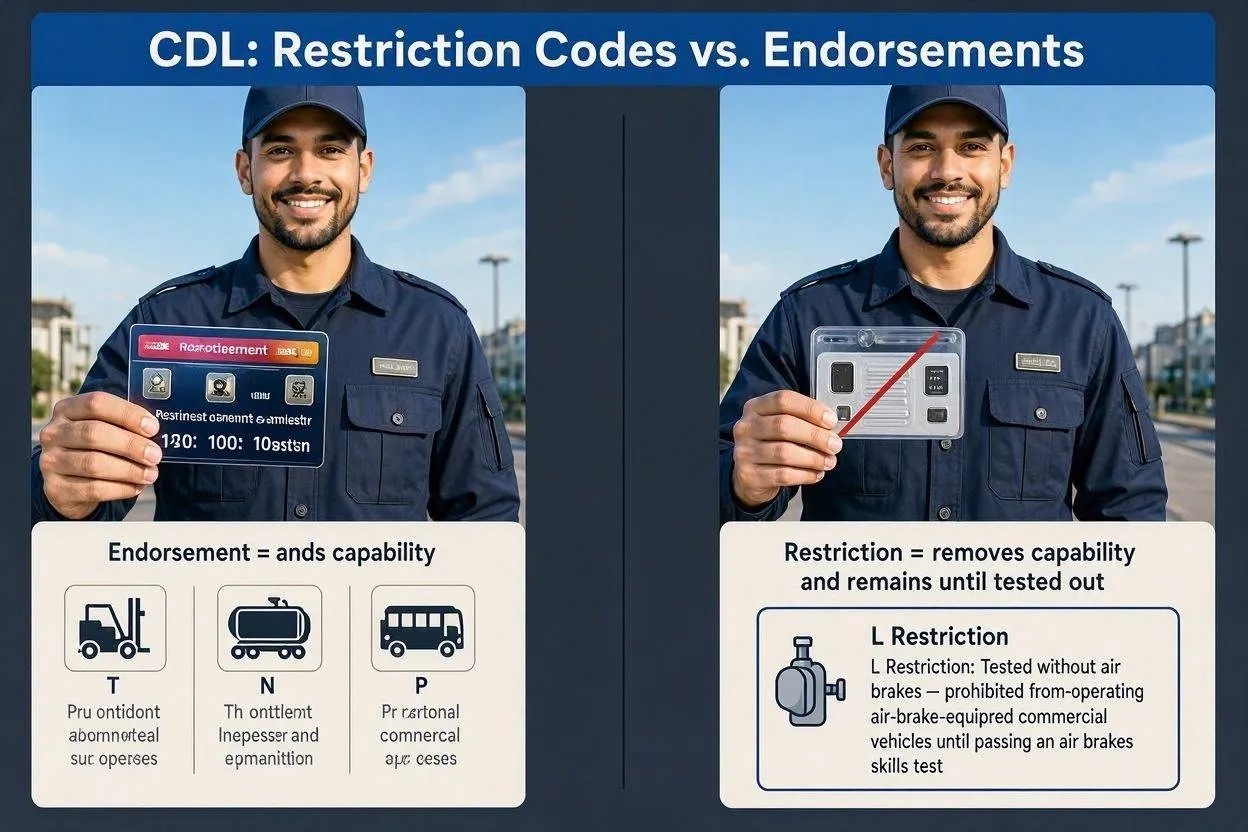
Restriction codes are not endorsements, and mixing the two up is a common mistake among new drivers. An endorsement adds a capability. A restriction removes one, and it stays on the license until the driver tests out of it.
Two restriction codes come up most:
L Restriction
Applied when a driver takes the CDL skills test in a vehicle without air brakes. That bars the driver from operating any air-brake-equipped commercial vehicle until they pass a separate air brake skills test.
E Restriction
Applied when a driver tests in a vehicle with automatic transmission. That bars the driver from manual-transmission commercial vehicles until they retest in a manual truck.
Since most modern commercial trucks run air brakes as standard equipment, an L restriction can quietly cut a driver off from a large share of available jobs. Clearing it just takes a skills test in an air-brake-equipped vehicle. No written exam, no waiting period beyond scheduling the test.
Which CDL Class Allows Which Endorsement?
CDL class determines eligibility, and not every class qualifies for every endorsement.
| CDL Class | Vehicle Threshold | Endorsements Allowed |
| Class A | Combination vehicles with a GCWR of 26,001 lbs (11,793 kg) or more, where the towed unit exceeds 10,000 lbs (4,536 kg) | H, N, P, S, T, X — all six |
| Class B | Single vehicles with a GVWR of 26,001 lbs (11,793 kg) or more | H, N, P, S, X — all except T |
| Class C | Smaller vehicles hauling hazmat or 16+ passengers | H, P, S only |
Class A is the only license that qualifies for the T endorsement, since doubles and triples require towing capacity that only combination vehicles provide. If multi-trailer routes are part of the long-term plan, starting with a Class A CDL saves an upgrade step down the road.
How to Add an Endorsement to Your CDL
Adding an endorsement follows roughly the same four-step sequence in nearly every state.
First, apply at the state DMV or equivalent licensing agency and pay the registration fee. Second, study the FMCSA-published manual section for that endorsement and schedule the knowledge test through the licensing office. Third, if the endorsement requires it (P, S, and T all do in most states), complete a skills test administered by the issuing agency. Fourth, for H and X specifically, submit fingerprints and complete the TSA Security Threat Assessment before the agency finalizes the credential.
Timelines vary a lot by endorsement. N can often get done in a single visit, since it’s just a written test. H and X take four to six weeks minimum because of TSA processing, and S adds another one to two weeks for the extra background screening. Scheduling the knowledge test and background check at the same time, where the agency allows it, cuts down the overall wait.
Renewal runs on its own cycle, separate from the initial application. Most states renew endorsements automatically alongside the base CDL, as long as the driving record stays clean and no disqualifying violations show up. Renewing a CDL online or in person usually confirms each active endorsement in that same transaction rather than requiring a separate renewal filing per endorsement.
How Much Does a CDL Endorsement Cost?
CDL endorsement fees typically run $10 to $200 per endorsement, and the exact number depends heavily on the state and which endorsement is being added. Knowledge tests usually cost $10 to $40 per attempt. Skills tests, where required, add another $50 to $150. H and X carry the highest total cost because of the TSA fingerprinting and background check fee, which runs roughly $86.50 nationally as of 2026 and gets billed separately from the state testing fee.
Some employers cover part or all of these costs as a hiring incentive. Schneider, for instance, reimburses drivers for HazMat endorsement expenses but doesn’t extend that to the combination (X) endorsement, a distinction worth confirming directly with any prospective employer rather than assuming full reimbursement applies. Adding all six endorsements independently, with no employer help, should run somewhere between $300 and $700 total once you account for retest fees if a test doesn’t get passed the first time.
Do CDL Endorsements Expire?
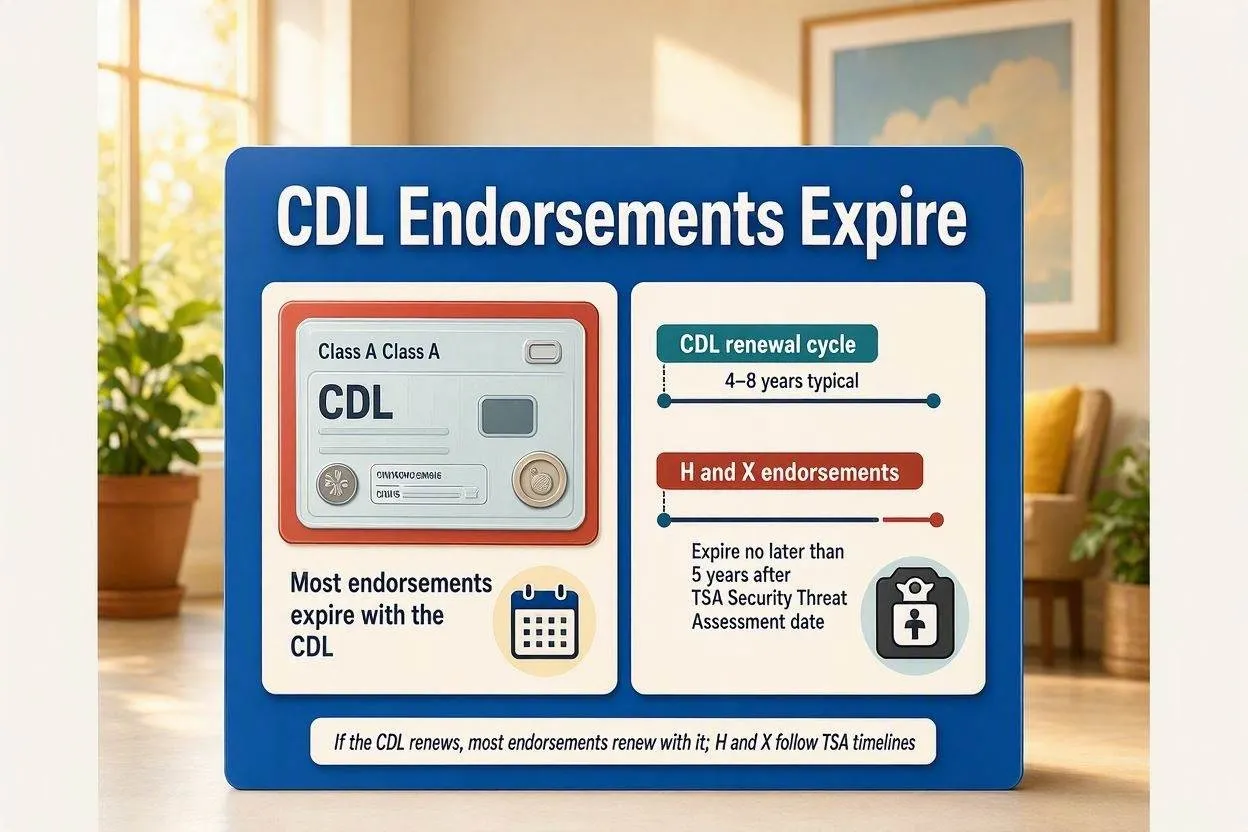
Yes. The timeline depends on the specific endorsement. Most share the expiration date of the CDL itself, which typically runs four to eight years depending on the state. If the license renews, the endorsement renews with it, usually without a full retest.
H and X work differently. Both expire no later than five years after the TSA Security Threat Assessment date, regardless of the CDL’s own renewal cycle. A driver whose CDL is valid for six more years but whose HazMat clearance is only two years old will need to redo the TSA screening well before the license itself comes up for renewal. Miss that window and hazmat-hauling privileges disappear immediately, not at the next license renewal.
Can You Transfer a CDL Endorsement to Another State?
Yes, though the process isn’t always automatic. A driver relocating typically has 30 to 60 days, depending on the new state’s rules, to exchange the out-of-state CDL for a resident license, and endorsements carry over in that exchange in most cases.
H is the exception people most often get tripped up by. TSA background clearances are federal and don’t need to be redone across state lines, but a handful of states still require the driver to reapply for the hazmat endorsement specifically as part of the residency transfer, even though the underlying TSA assessment stays valid. Checking directly with the new state’s DMV before the move, rather than assuming automatic transfer, avoids a gap in hauling eligibility during the transition.
How Endorsement Type Affects Pay
CDL endorsements can add $2,000 to $10,000 or more to a driver’s annual pay, and the licensing agency’s records are what carriers check to verify eligibility for specialized routes. H and X typically carry the highest premium, since hazmat and fuel-hauling jobs pay more to offset the added regulatory risk that comes with the federal clearance requirement. The Bureau of Labor Statistics counted more than 2.2 million heavy and tractor-trailer drivers working in the U.S. as of 2024, and endorsed drivers tend to sit toward the higher end of that pay range.
Studying for the Licensing Exam
Every endorsement knowledge test draws directly from the FMCSA’s Commercial Driver’s License Manual, and most state licensing agency websites post free practice questions alongside the official study guide. Reviewing the manual chapter specific to each endorsement, rather than general trucking material, is still the fastest way to pass on the first attempt, since agencies pull test questions straight from that source.
A failed attempt costs money and time. Most agencies charge a retest fee of $10 to $40, and some require a mandatory waiting period, often one to seven days, before you can resubmit for the same knowledge test.
Where to Verify Endorsement Requirements
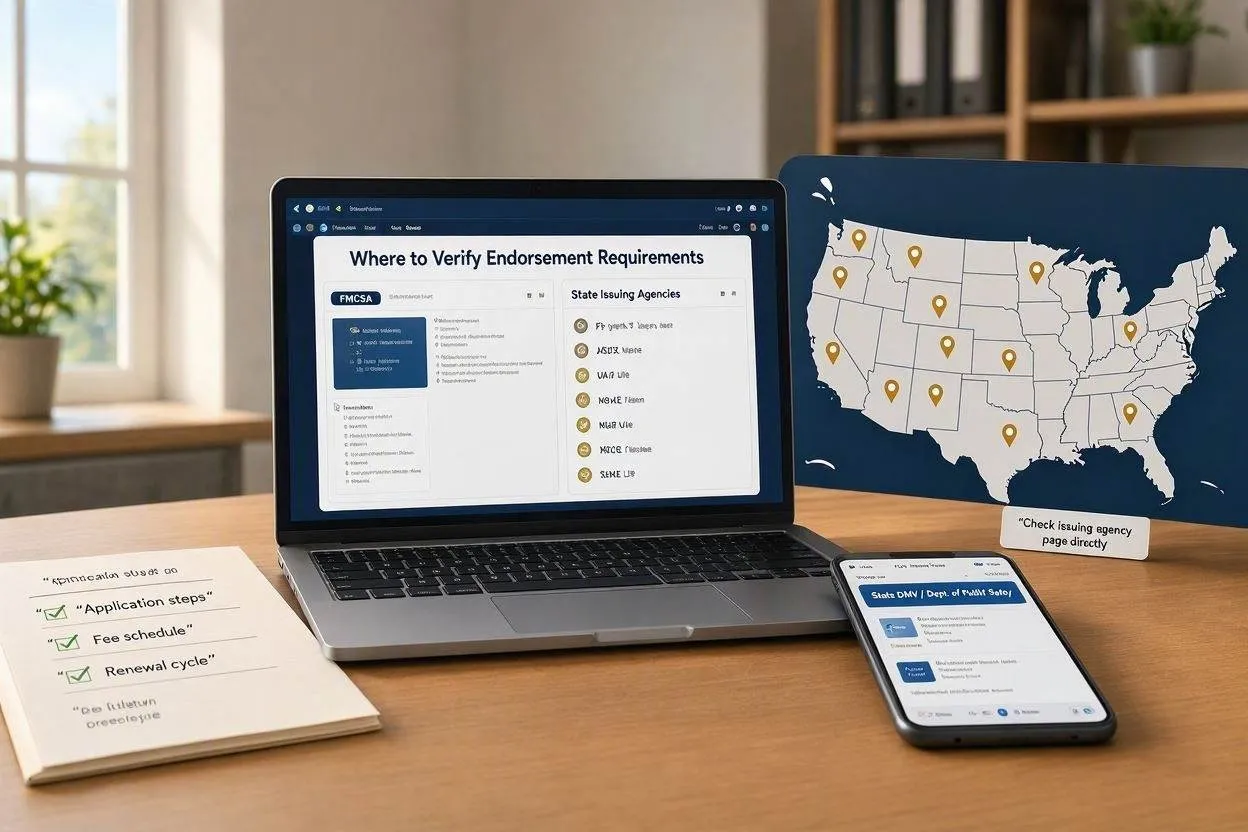
State licensing agencies are the authoritative source here, since application procedures, fee schedules, and renewal cycles vary by jurisdiction. The FMCSA’s official CDL endorsement page confirms federal baseline requirements, while each state’s DMV or Department of Public Safety publishes the exact registration steps and fee schedule for that jurisdiction. Checking the issuing agency’s page directly, instead of relying on a third party, is the safest way to confirm current requirements before submitting paperwork or scheduling a test.
Conclusion
Six CDL endorsement types exist under federal rules: H, N, X, P, S, and T. Each one opens a different lane of trucking work, from hazmat tankers to school bus routes. Matching the right endorsement to the right CDL class, budgeting for TSA processing time on H and X, and confirming state-specific transfer rules before a move all shape how fast a driver gets into higher-paying, specialized freight work.
FAQs

Esther Howard
Esther Howard leads TruckingHow’s trucking, commercial driving, and transportation content division. She specializes in CDL training, trucking regulations, fleet operations, truck maintenance, and logistics best practices. With over a decade of experience researching the commercial transportation industry, Esther brings a practical, research-driven approach to driver education, safety standards, and industry regulations. She is the primary author of TruckingHow’s CDL guides, trucking career resources, maintenance tips, and transportation content, helping drivers, fleet owners, and trucking professionals make informed decisions on and off the road
Related Posts