
Truck Driver Safety Tips: 15 Rules Every CDL Driver Should Follow
A rig loaded to 80,000 pounds doesn’t forgive the same mistakes a sedan does. Truck driver safety tips only work if they become habits repeated on every shift, not advice read once and forgotten at the next fuel stop. This guide skips the generic advice and sticks to the numbers, regulations, and checks that matter: pre-trip inspection steps, hours-of-service math, cargo securement timing, and compliance factors like CSA scores and sleep apnea screening that rarely make it into a standard tip list.
Why Truck Driver Safety Tips Matter on U.S. Highways

Large trucks carry more weight, need more space, and take longer to stop than passenger vehicles, which is the whole reason these tips exist. A fully loaded semi-truck, classified as a commercial motor vehicle (CMV) under federal rules, weighs up to 80,000 pounds (36,287 kilograms). An average sedan weighs roughly 4,000 pounds (1,814 kilograms). That gap changes braking distance, turning radius, and crash severity for everyone sharing the road.
Roadway fatalities involving large trucks remain a persistent safety concern, and the numbers haven’t been trending down. Federal crash-reporting data (FARS) puts large-truck-crash fatalities at 5,472 in 2023, the most recent full year with finalized figures, up from 5,149 in 2021. Truck drivers aren’t always at fault, either. Research from the University of Michigan Transportation Research Institute (UMTRI) has found that passenger-vehicle drivers are solely responsible for a majority of fatal two-vehicle crashes involving a truck, versus a much smaller share attributed to truck drivers alone. Even so, a trucker’s habits behind the wheel still decide whether a dangerous situation turns into a near-miss or a collision.
Pre-Trip Inspection: The First Line of Defense
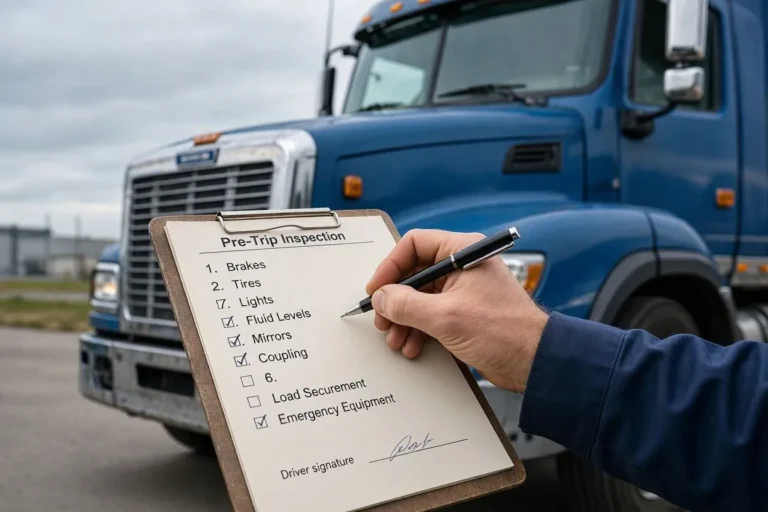
You catch brake, tire, and fluid problems before a truck ever leaves the yard with a pre-trip inspection. Skip this step and you’re inviting the kind of mechanical failure that fleet safety data ranks among the top causes of preventable breakdowns and roadside accidents.
A complete inspection covers seven areas:
- Brakes — check pad thickness and confirm the air lines aren’t cracked or leaking.
- Tires — look for embedded objects, uneven tread wear, and correct psi on all axles.
- Lights — test headlights, brake lights, turn signals, and marker lights, especially before night driving.
- Fluid levels — verify engine oil, coolant, brake fluid, power steering fluid, and washer fluid.
- Battery — confirm secure mounting and clean, corrosion-free terminals.
- Windshield and wipers — check for cracks and confirm wiper function before rain or snow is forecast.
- Coupling system — inspect the fifth wheel, mounting bolts, locking jaws, and the air lines connecting tractor to trailer.
Log every inspection. That paper trail protects you if something goes wrong mid-route. And if a defect turns up during the check, the truck stays parked until it’s fixed — driving on a known brake or tire problem violates FMCSA regulations and stacks the odds toward a roadside failure.
Defensive Driving Techniques Every Trucker Needs
Defensive driving means constantly scanning the road, keeping extra following distance, and assuming other drivers will make mistakes. That mindset is what separates experienced truckers from drivers who rely purely on reaction time.
Five techniques anchor defensive driving for CMV operators:
- Follow the three-second rule. Pick a fixed point on the road and count the seconds between when the vehicle ahead passes it and when your truck reaches the same spot. Three seconds is the minimum; wet roads or heavy traffic call for four or five.
- Scan 12 to 15 seconds ahead. On an interstate, that’s roughly a quarter mile. In city traffic, it’s one to two blocks.
- Signal early, every time. Signal at least 100 feet (30 meters) before a lane change or turn, giving smaller vehicles time to react.
- Stay calm during road-rage encounters. Pulling into a truck stop to let a situation cool off costs a few minutes. A confrontation on the highway can cost a CDL, or a life.
- Check mirrors every 8 to 10 seconds. Regular mirror checks catch vehicles entering blind spots before they disappear from view entirely.
Combine all five and you close the reaction-time gaps that cause rear-end collisions, one of the most common truck-involved crash types on interstate highways.
Blind Spots, Stopping Distance, and Wide Turns
A fully loaded rig traveling around 65 mph (105 km/h) needs roughly 600 feet, close to the length of two football fields, to stop completely. That’s FMCSA’s own published figure for good conditions and dry pavement. Wet pavement, worn brakes, or a downhill grade stretch it further.
Blind spots compound the risk on all four sides of the vehicle: front, rear, and both trailer flanks. You’ll hear the passenger side called the “no-zone” because it runs nearly the full length of the trailer and traps the most passenger vehicles. If a car sits in that zone, widen your following distance and hold off on any lane change until it clears.
Wide turns bring a different hazard, one tied to trailer geometry rather than visibility. A tractor-trailer swings its rear wheels inside the path of its front wheels during a turn, a behavior called off-tracking, and cutting the turn too tight risks striking curbs, signs, or vehicles caught in the gap between tractor and trailer. Jackknifing takes that risk further: the trailer swings out and folds against the tractor during hard braking or a sharp turn. It’s still one of the leading causes of multi-vehicle highway pileups, especially on wet or icy pavement. The fix for both off-tracking and rollovers is the same: slow down before the turn, not during it.
Hours of Service Rules and Managing Driver Fatigue
FMCSA’s Hours of Service (HOS) rules require a 30-minute break after 8 cumulative hours of driving and at least 10 hours off duty per day. Treat those as legal minimums, not safety targets. If you only meet the minimum, fatigue still accumulates over multiple days on the road.
Heavy eyelids, frequent yawning, drifting within a lane, delayed reaction to brake lights ahead — once symptoms like these show up, pull into a rest area instead of pushing toward a delivery window. The Electronic Logging Device (ELD) mandate, in effect since December 2019, automatically records driving hours and removes the temptation to falsify paper logs, a practice tied to fatigue-related crashes before the rule took hold.
The Split Sleeper Berth Provision
The split sleeper berth provision lets you divide your required 10-hour off-duty period into two separate blocks, say 7 hours and 3 hours, instead of one continuous stretch. Both segments have to add up to at least 10 hours, and neither counts against the 14-hour driving window if structured correctly. Drivers running unpredictable freight schedules, port pickups, or shipper delays lean on this provision to fit rest around loading and unloading windows without violating HOS limits.
Cargo Securement and Loading Safety
Properly secured cargo keeps a trailer from behaving unpredictably during braking and cornering. An unbalanced or loose load causes shifting weight that leads to rollovers, jackknifing, and load loss on the highway, even when you follow every other safety rule to the letter.
Loading and unloading safety comes down to four practices:
- Keep three points of contact (two hands and one foot, or two feet and one hand) while climbing in or out of the cab or trailer.
- Distribute weight evenly across the trailer floor and axles before securing straps or chains.
- Cover exposed cargo with a tarp when rain, snow, or high wind is forecast along the route.
- Recheck strap and chain tension early in the trip, since loads settle during initial transit — a common guideline is the first 50 miles (80 kilometers).
Skip that recheck and you risk discovering a shifted load at highway speed, where your options for correcting it narrow fast.
Truck Stop and Parking Security

Lock every door and park under well-lit, occupied areas. That alone prevents most cargo theft and personal safety incidents at truck stops. Empty, poorly lit lots attract theft, and an unsecured trailer is an easy target, particularly overnight.
Three habits cut that risk considerably:
- Choose truck stops with visible security cameras and a steady flow of other trucks parked nearby.
- Avoid talking about cargo value over CB radio or in public areas near the truck.
- Back into a space using the G.O.A.L. method (Get Out And Look) before committing to a tight dock or parking spot. It also prevents backing collisions.
Drivers hauling high-value freight face extra risk from organized cargo theft rings that track shipments through public load boards, so stay alert at fuel stops and rest areas, not just on the interstate.
Weather-Specific Driving Hazards
Trucks respond to wind, ice, and rain differently than passenger vehicles because of their height, weight distribution, and trailer surface area. The general rule: slow down and lengthen your following distance before the weather hits, not after.
Black ice. A thin, transparent layer of ice can coat the road surface, making it nearly invisible until tires lose traction. Chains help on packed snow, but they don’t restore meaningful grip on black ice. If you suspect ice ahead, slow to well below the posted limit and stretch your following distance to 8 to 10 seconds instead of the standard 3.
High wind and bridge crossings. Strong crosswinds, commonly flagged in trucking safety guidance once gusts pass roughly 40 mph (64 km/h), can push an empty or lightly loaded trailer into an adjacent lane, especially on elevated bridges. If a truck starts swaying noticeably in a crosswind, pull over and wait out the gust rather than trying to correct steering at highway speed. Bridges and overpasses amplify wind effects because they remove the wind-blocking terrain found at ground level.
Technology That Improves Truck Driver Safety
ELDs, dash cams, and truck-specific GPS units each cover a different safety gap that general-purpose apps and paper logs can’t. Together, they give drivers documentation, route accuracy, and legal protection that didn’t exist for previous generations of truckers.
- Electronic Logging Devices track drive time automatically and flag HOS violations before they happen, replacing error-prone paper logs.
- Dash cams record footage that protects your record after a crash, which matters given how often, per the UMTRI research cited above, the truck driver wasn’t the one at fault.
- Truck-specific GPS systems route around low bridges, weight-restricted roads, and height-restricted tunnels that consumer navigation apps often miss.
- Hands-free communication tools let you stay in touch with dispatchers without violating state or federal handheld-device laws.
A driver relying on a phone-based consumer map app risks routing into a bridge with insufficient clearance. Truck-specific GPS software exists specifically to prevent that.
Health, Wellness, and Mental Health on the Road
Fatigue doesn’t only come from hours behind the wheel — poor sleep, poor diet, and chronic stress all lower your alertness before you even start driving, which is why wellness belongs on a safety list, not just a lifestyle one. Extended sitting combined with unpredictable hours also raises the risk of obesity and cardiovascular strain among commercial drivers over time.
Three habits protect both short-term alertness and long-term health:
- Stretch or walk for 5 to 10 minutes during each mandatory HOS break.
- Pack meals with protein and vegetables instead of relying entirely on truck-stop fast food.
- Recognize early signs of stress or anxiety and use calming techniques, like deep breathing, before they affect driving decisions.
Obstructive Sleep Apnea and Fatigue Risk
Obstructive sleep apnea (OSA) causes repeated breathing interruptions during sleep, which leads to daytime drowsiness that looks a lot like standard driver fatigue. That’s why carriers increasingly require OSA screening during Department of Transportation (DOT) physicals: undiagnosed apnea contributes to fatigue-related crashes even among drivers who meet every HOS requirement on paper. A driver diagnosed with OSA typically uses a CPAP (Continuous Positive Airway Pressure) machine at night, which restores sleep quality and improves daytime alertness behind the wheel.
CSA Scores, Weigh Stations, and Regulatory Compliance
A driver’s Compliance, Safety, Accountability (CSA) score comes from FMCSA’s Safety Measurement System, which tracks violations across seven Behavior Analysis and Safety Improvement Categories (BASICs): unsafe driving, hours-of-service compliance, driver fitness, controlled substances/alcohol, vehicle maintenance, hazardous materials compliance, and crash indicator. That score directly affects insurance rates, employability, and how often you get pulled for roadside inspection. Speeding tickets, HOS violations, and failed vehicle inspections all raise it; a clean record lowers the odds of an extended roadside stop.
Weigh stations enforce weight limits and check HOS compliance, so have your logs, permits, and load documentation ready before pulling in. Skipping a mandatory weigh station, or bypassing scales without authorization, adds violations straight to a carrier’s CSA profile and can suspend your ability to operate legally until it’s resolved. Staying current on required stops protects both your CSA score and the carrier’s overall safety rating with FMCSA.
Emergency Preparedness Checklist
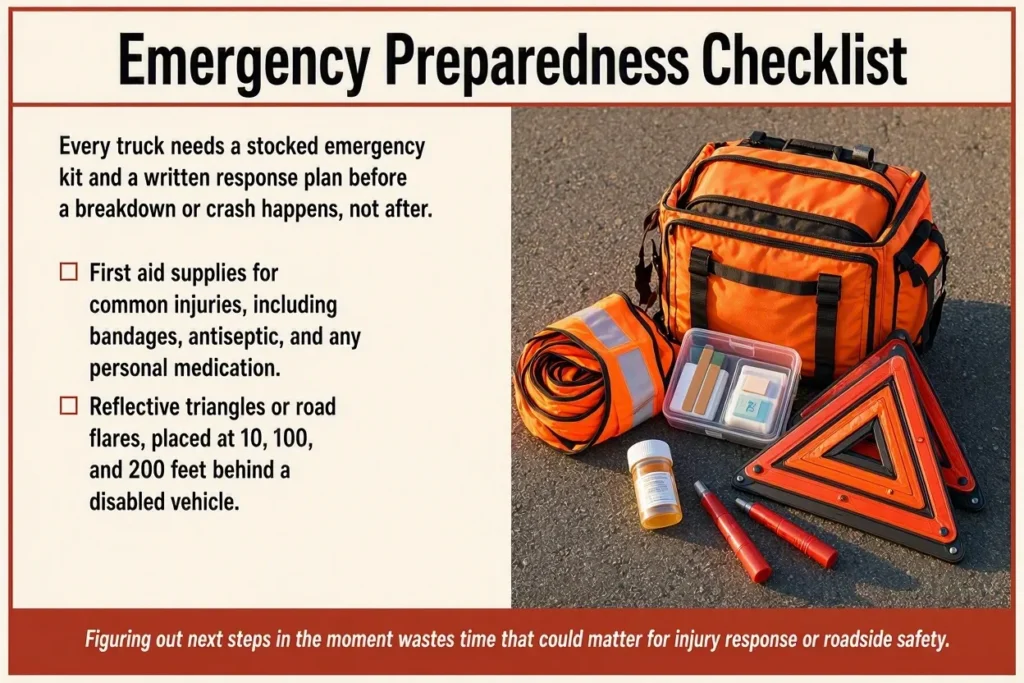
Every truck needs a stocked emergency kit and a written response plan before a breakdown or crash happens, not after. Figuring out next steps in the moment wastes time that could matter for injury response or roadside safety.
A complete emergency kit includes:
- First aid supplies for common injuries, including bandages, antiseptic, and any personal medication.
- Reflective triangles or road flares, placed at 10, 100, and 200 feet behind a disabled truck.
- A charged backup phone or power bank, since cell service gaps are common on rural interstates.
- Non-perishable food and water for at least 24 hours, particularly on winter routes prone to closures.
- Basic repair tools and spare fuses for minor roadside fixes.
Report your location to dispatch or emergency services immediately after a breakdown. It shortens response time and cuts down your exposure to passing traffic while parked on a shoulder.
Conclusion
Truck driver safety tips only work when they turn into daily habits instead of one-time reading material. Check the brakes before every trip. Track hours through an ELD. Watch wind speed near bridges. Keep a stocked emergency kit. Do those consistently and you cut risk across nearly every category FMCSA tracks in its crash data. The next pre-trip inspection is the next chance to put all of this into practice.
FAQs

Esther Howard
Esther Howard leads TruckingHow’s trucking, commercial driving, and transportation content division. She specializes in CDL training, trucking regulations, fleet operations, truck maintenance, and logistics best practices. With over a decade of experience researching the commercial transportation industry, Esther brings a practical, research-driven approach to driver education, safety standards, and industry regulations. She is the primary author of TruckingHow’s CDL guides, trucking career resources, maintenance tips, and transportation content, helping drivers, fleet owners, and trucking professionals make informed decisions on and off the road
Related Posts