

Truck Dispatcher Salary: Average Pay, Full Range, and How to Earn More
A truck dispatcher earns between $42,000 and $80,000 a year in the United States, with a national average landing around $50,000 to $60,000. Pay swings hard based on three things: whether you work for a carrier or run independently, how many years you’ve put in, and which state you’re clocking in from. A brand-new dispatcher in a small Midwest fleet office and a ten-year veteran running hazmat freight out of Houston are technically doing the same job title. Their paychecks aren’t close.
This guide breaks the truck dispatcher salary question down by experience, location, employment type, and freight specialty, then walks through the specific moves that push pay toward the top of the range.
Truck Dispatcher Salary at a Glance
| Metric | Figure |
| National average (BLS, dispatchers excluding emergency services) | $46,810 – $46,860/year |
| Typical range across job boards | $42,000 – $80,000/year |
| Average hourly rate | $22 – $30/hour |
| Entry-level (0-2 years) | $30,000 – $42,000/year |
| Experienced (8+ years) | $68,000 – $95,000/year |
| Independent dispatcher (5 trucks, moderate commission) | $60,000 – $95,000/year |
| Top 10% of earners | $75,000 – $95,000/year |
These numbers pull from the Bureau of Labor Statistics (BLS), Glassdoor, ZipRecruiter, and PayScale. None of them agree exactly, and that’s normal for a role with this much variation by employer type.
What Does the Average Truck Dispatcher Make?

The average truck dispatcher salary in the U.S. sits around $50,000 to $60,000 a year, though the exact figure shifts by source. The BLS puts the median annual wage for dispatchers, excluding police, fire, and ambulance roles, at roughly $46,860, and O*NET’s occupational data lands close to that same range. PayScale reports a lower average near $49,957, while Indeed and Glassdoor climb into the low-to-mid $60,000s, since their listings skew toward metro job postings where pay runs hot. Government surveys lump every non-emergency dispatcher into one bucket, including rail and warehouse dispatch, which drags the median down. Job boards, by contrast, reflect what employers are actively advertising right now, and postings cluster above median to attract applicants.
Neither figure is wrong; they’re measuring different slices of the same market. For planning purposes, $50,000 to $60,000 is the safest annual estimate for a full-time company dispatcher with a couple years of experience.
Truck Dispatcher Salary by Experience Level
Experience is the single biggest lever on a truck dispatcher’s paycheck. Someone six months into the job and someone six years in aren’t earning anywhere near the same number, and the gap widens fast after year three.
| Experience Level | Annual Salary Range | With Bonuses |
| New (0-2 years) | $30,000 – $42,000 | Up to $50,000 |
| Mid-career (3-7 years) | $50,000 – $65,000 | Up to $70,000 |
| Experienced (8+ years) | $68,000 – $80,000+ | Up to $95,000+ |
A dispatcher with five or more years of experience typically earns $15,000 to $20,000 more annually than someone just starting. Why does the jump happen so quickly? New dispatchers are still learning to read load boards, negotiate with brokers, and manage driver schedules without burning out their carriers. By year three or four, most have built broker relationships that get them better rates on the same freight, and that skill alone justifies a raise most managers will approve without much pushback.
Senior dispatchers who move into titles like Chief Dispatcher or Dispatch Supervisor often clear $85,000 to $95,000, especially in busy metro fleets. At that point, though, the job description usually expands past pure dispatching into team management, which is really a different role wearing the same title.
Truck Dispatcher Salary by State and City
Location can shift a truck dispatcher’s salary by more than $25,000 a year, and that’s before accounting for cost of living. Major logistics hubs pay more because demand for skilled dispatchers outpaces supply there.
| City/Area | Typical Annual Range |
| New York City, NY | $65,000 – $80,000 |
| Los Angeles, CA | $60,000 – $78,000 |
| Chicago, IL | $58,000 – $75,000 |
| Houston, TX | $55,000 – $72,000 |
| Atlanta, GA | $52,000 – $68,000 |
| Washington, D.C. | ~$66,200 average |
| Oklahoma City, OK | Up to ~$50,000 |
| Knoxville, TN | Up to ~$50,000 |
| Non-metro Kansas | ~$39,460 average |
Chicago sits at the crossroads of rail and interstate freight, so dispatch demand there rarely lets up. Houston’s port and oil industry do the same thing for that market. Atlanta functions as the main distribution hub for the entire Southeast, which keeps its logistics postings full year-round. Compare that to non-metro Kansas, where the BLS shows dispatcher pay averaging roughly $39,460, over $26,000 below D.C.’s figure for the same job title.
States like Illinois, Texas, California, Georgia, Washington, Colorado, and Massachusetts consistently rank above the national average. If relocation is on the table, moving to one of these markets is the fastest lever available, though a $70,000 salary in New York doesn’t stretch the way a $55,000 salary does somewhere cheaper to live.
Truck Dispatcher Hourly Pay Breakdown
The average truck dispatcher earns between $22 and $30 an hour, which works out to roughly $45,000 to $60,000 annually for a standard 40-hour week. Hourly framing matters more in this job than in most office roles, because dispatch runs 24/7 and overtime is common during peak freight seasons.
Here’s how the hourly scale typically breaks down:
- Starting out (lowest 10%): around $11 to $16 per hour
- Building experience (25th percentile): around $17 to $20 per hour
- Solid performer (75th percentile): around $23 to $28 per hour
- Top earners (highest 10%): $33 to $34 per hour or more
A dispatcher earning $22 an hour makes about $881 for a standard 40-hour week. Add five hours of overtime at time-and-a-half ($33/hour), and that’s another $165 in the same paycheck, no extra days worked, just longer shifts during a busy stretch. That’s the fastest short-term income boost available to a salaried dispatcher, and plenty of them lean on it during peak shipping months.
What’s Included in a Truck Dispatcher’s Compensation Package
A dispatcher’s real income is rarely just the base salary printed in the job listing. Total compensation usually stacks four components together, and the base number alone can be misleading if you’re comparing two job offers.
| Component | Description | Typical Range |
| Base salary | Guaranteed fixed pay | $34,680 – $73,680/year |
| Performance bonuses | Tied to load volume, on-time rate, revenue goals | $2,000 – $7,500/year |
| Commission | Percentage of load profit, common in hybrid roles | 5% – 10% of load revenue |
| Overtime pay | Time-and-a-half beyond standard hours | 1.5x base hourly rate |
A lower base salary paired with strong bonuses and commission can beat a higher base with no extras attached. That’s the trap most job-seekers fall into: they compare the number on the offer letter and skip the question that actually matters, which is how much of the package is guaranteed versus performance-dependent.
Independent Truck Dispatcher Salary vs. Company Dispatcher
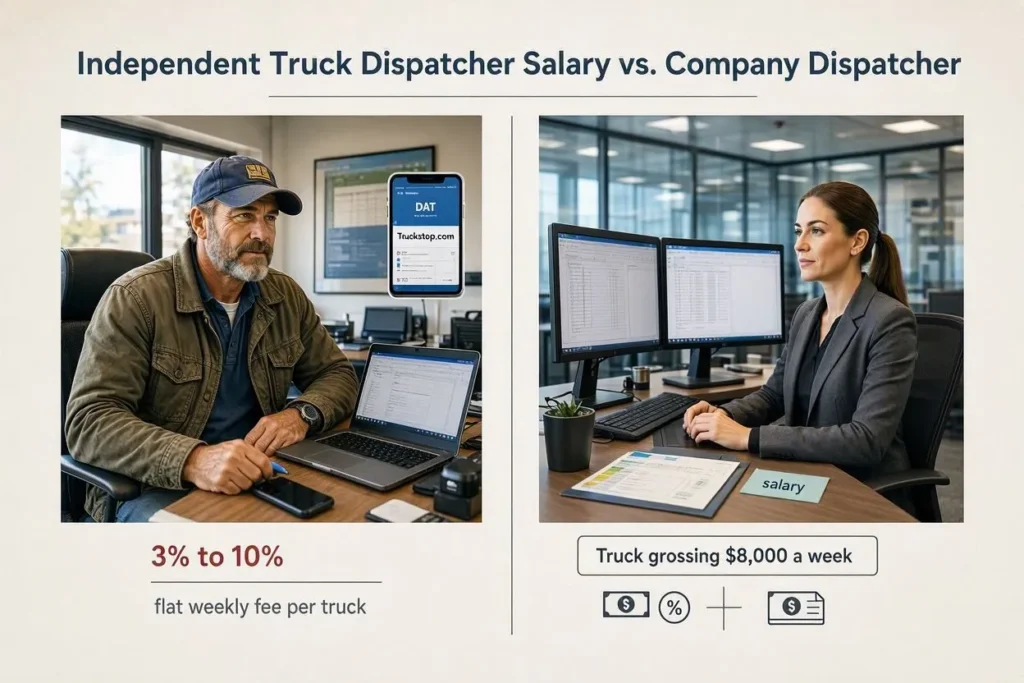
Independent dispatchers don’t earn a salary. They charge a percentage of each load’s revenue, usually 3% to 10%, or a flat weekly fee per truck. That single distinction reshapes the whole income ceiling. Clients tend to be owner-operators and small fleet owners, sourced through load boards like DAT and Truckstop.com rather than a broker relationship built up over years. Run the math: a truck grossing $8,000 a week at 5% commission nets $400 weekly, about $1,600 a month. A flat-fee dispatcher might charge $250 per truck per week instead, trading upside for steadier income. Five trucks under commission, a realistic solo workload, puts gross earnings near $95,000 a year before expenses.
Downtime eats into that figure. Trucks break down, drivers take time off, and new dispatchers rarely charge top commission before earning a client’s trust. A safer estimate lands near $1,000 per truck monthly, or $60,000 a year across five trucks, on par with a senior company dispatcher’s base pay, minus benefits. Independent dispatchers file 1099, not W-2, so software costs and office setup come out of pocket, on top of self-employment tax on every dollar earned. Factoring companies often bridge the gap when brokers pay loads out 30 to 60 days late. Manage eight to ten trucks with a virtual assistant handling the paperwork, though, and gross income can clear $100,000, well past what a salaried dispatcher earns even with bonuses.
What Factors Influence Truck Dispatcher Salary
Seven variables account for most of the spread in truck dispatcher pay, and they compound. A dispatcher who’s strong on three or four of these will consistently out-earn one who’s only strong on one.
- Years of experience and track record of on-time deliveries
- Geographic location and local cost of living
- Company size and fleet complexity
- Freight specialization, such as hazmat or oversized loads
- Certifications, including the Certified Transportation Dispatcher (CTD) credential
- Shift flexibility, since nights and weekends often pay a premium
- Employment type, meaning salaried employee versus independent contractor
None of these factors work in isolation. A dispatcher with eight years of experience in Chicago, hazmat-certified, handling a 40-truck fleet, sits in an entirely different pay bracket than a two-year dispatcher doing general freight in a small rural office, even though both hold the same job title.
Truck Dispatcher Salary by Specialization
Specialized freight dispatchers earn a premium over general freight dispatchers, often $5,000 to $15,000 more annually. Hazmat-certified dispatchers, for example, sometimes command $1 to $2 more per hour than the average because of the safety and compliance stakes involved in moving hazardous materials.
Refrigerated (reefer) freight dispatch pays well because the margin for error is thin. A dispatcher who lets a temperature-sensitive load sit too long can cost a carrier the full value of that shipment. Flatbed and oversized-load dispatch pays a premium too, since it demands knowledge of special permits and route restrictions most general dispatchers never touch.
Outside trucking entirely, dispatchers in rail transportation average around $86,000, and those in natural gas distribution average closer to $89,000, according to BLS data. Those aren’t truck dispatcher roles, but they show that dispatching, as a skill set, scales in value wherever the freight or cargo carries higher risk or higher stakes.
Is Truck Dispatching a Good Career Right Now?
Yes. Trucking moves roughly 72% of U.S. domestic freight by tonnage, and every truck on the road needs someone coordinating its loads, routes, and paperwork. Demand for dispatchers tracks closely with overall freight volume, which has stayed near historic highs even through recent supply-chain shifts.
Entry into the field doesn’t require a college degree, just a high school diploma and the willingness to learn load boards, routing software, and federal compliance rules on the job. That low barrier to entry, paired with a clear path toward six-figure independent income or a management track, makes dispatching one of the more accessible logistics careers available without years of prior schooling.
How to Increase Your Truck Dispatcher Salary
To increase truck dispatcher salary, focus on five moves that carry the most weight with employers and clients alike.
- Get certified. A Certified Transportation Dispatcher (CTD) credential or a completed dispatcher training program signals readiness before you’ve built a track record.
- Specialize in a niche. Hazmat, reefer, and flatbed freight all pay more than general dispatch because fewer people are qualified to handle them.
- Master the software. Fluency in Transportation Management Systems (TMS), plus load boards like DAT and Truckstop.com, makes you faster and more valuable in any dispatch office.
- Relocate strategically. Moving toward a logistics hub such as Chicago, Houston, or Atlanta can add $10,000 or more to a base offer.
- Track your results. Keep records of on-time delivery rates, cost savings, or driver retention. Numbers like these are what actually justify a raise in a performance review, not tenure alone.
Independent dispatching is the sixth lever, though it’s less a tip and more a career decision. Once you’ve built broker relationships and industry contacts as a company dispatcher, going independent removes the salary cap entirely, provided you’re willing to handle your own marketing, billing, and client retention.
Truck Dispatcher Salary vs. Truck Driver Pay

Truck drivers generally out-earn truck dispatchers, especially owner-operators, though the gap narrows in senior dispatch roles. A company driver typically earns $50,000 to $70,000 a year, while owner-operators can clear $100,000 or more before expenses. Dispatchers, sitting at a desk rather than behind the wheel, trade higher earning potential for more predictable hours and no time away from home.
The two roles depend on each other directly. A dispatcher’s efficiency at finding high-paying loads and minimizing empty miles has a direct effect on how much a driver earns per week, which is part of why strong dispatchers with proven results can negotiate real leverage in salary talks.
Conclusion
Truck dispatcher salary isn’t one number. It’s a range shaped by experience level, location, freight specialization, and whether you’re punching a clock for a carrier or running your own book of trucks. A new dispatcher starts closer to $35,000, a senior company dispatcher can clear $90,000 with bonuses, and an independent dispatcher managing a handful of trucks can beat both once the client base is built out. The fastest path to the top of that range runs through certification, specialization in higher-stakes freight, and a willingness to track your own performance numbers well enough to prove your value at review time. Pay grows with skill in this field faster than it does in most entry-level logistics roles, and that’s exactly what keeps drawing new people into dispatching every year.
FAQs

Esther Howard
Esther Howard leads TruckingHow’s trucking, commercial driving, and transportation content division. She specializes in CDL training, trucking regulations, fleet operations, truck maintenance, and logistics best practices. With over a decade of experience researching the commercial transportation industry, Esther brings a practical, research-driven approach to driver education, safety standards, and industry regulations. She is the primary author of TruckingHow’s CDL guides, trucking career resources, maintenance tips, and transportation content, helping drivers, fleet owners, and trucking professionals make informed decisions on and off the road
Related Posts