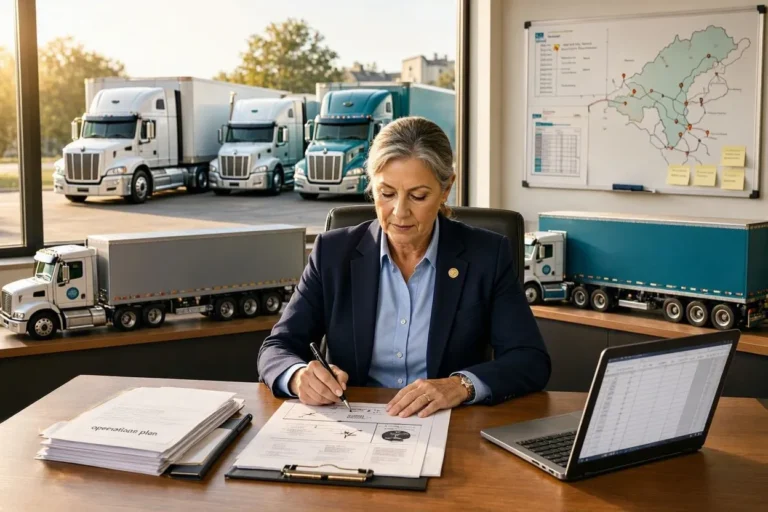
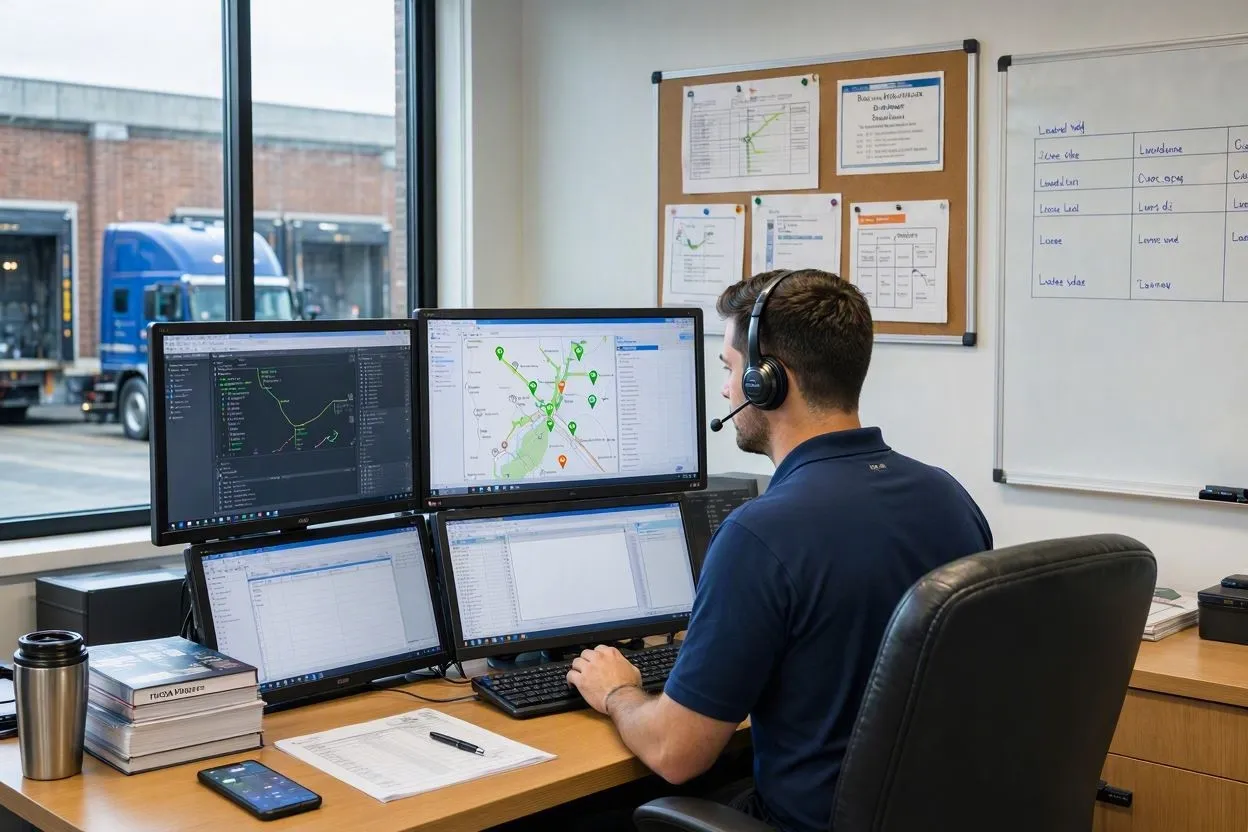
How to Become a Truck Dispatcher: Steps, Salary, and Skills
You can become a truck dispatcher in 2 to 4 weeks by completing a training program, learning the two major load boards, and landing your first carrier client, no CDL or college degree required. Most people who enter this field come from outside logistics entirely. Retail managers, military veterans, nurses, customer service reps. The job rewards organization and a thick skin on the phone, not a trucking background.
This guide breaks down the real requirements, the skills that actually matter, and what dispatchers earn once they’re working. It also flags the mistakes that trip up almost every beginner.
What Does a Truck Dispatcher Do?
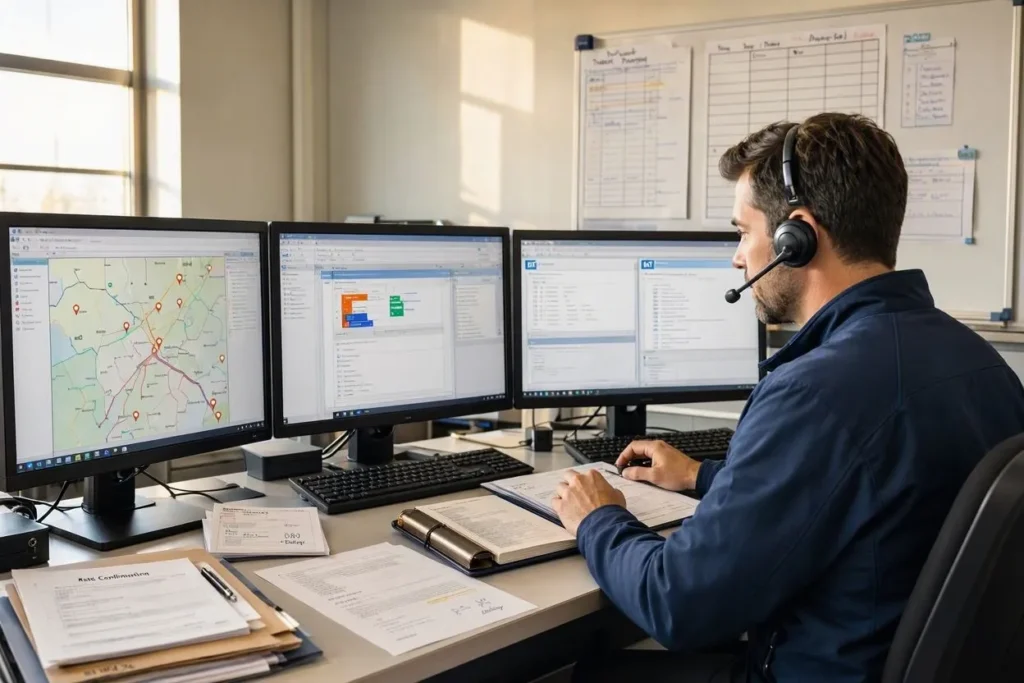
A truck dispatcher finds freight for a carrier, negotiates the rate, and manages the driver’s schedule from pickup to delivery. The role sits entirely on the carrier’s side of the transaction. Every morning starts with checking active loads, then moves into sourcing new freight on platforms like DAT and Truckstop.com.
Rate negotiation eats up a big chunk of the day. So does paperwork: rate confirmations, bills of lading, proof of delivery, invoices. A dispatcher also has to track Hours of Service (HOS) limits under Federal Motor Carrier Safety Administration (FMCSA) rules, because scheduling a driver past their legal limit creates real liability for the carrier. Weather delays, breakdowns, and last-minute reschedules land on the dispatcher’s desk too, and they need to be solved fast.
Independent dispatchers run this across several carrier accounts at once. Company dispatchers usually handle one fleet. Either way, the core job doesn’t change: keep trucks loaded, keep drivers compliant, keep brokers happy.
Truck Dispatcher vs. Freight Broker: What’s the Difference?
A truck dispatcher works only for the carrier, while a freight broker holds a federal license and can represent both the shipper and the carrier in the same deal. That distinction isn’t just semantic. It’s legal.
Freight brokers operate under 49 U.S.C. § 13102 and must file for FMCSA broker authority, post a $75,000 surety bond, and register a process agent in every state they operate in. It’s a regulated position with real compliance overhead. A dispatcher needs none of that. No bond, no federal registration, no license application sitting in a queue for weeks.
That gap matters if you’re choosing between paths. Becoming a working dispatcher takes weeks. Becoming a licensed broker takes considerably longer and costs more upfront. Some professionals eventually do both, using dispatch work as the entry point before pursuing broker authority later.
How to Become a Truck Dispatcher: 7 Steps
Here’s the actual sequence, start to finish.
Step 1: Learn the Freight Industry Basics
Understand how freight moves from shipper to carrier to receiver, and get familiar with the major freight categories: dry van, refrigerated (reefer), flatbed, and LTL (less-than-truckload). You don’t need years of study here, just enough to speak the language when a broker calls.
Step 2: Complete a Dispatcher Training Program
Programs run about 40 hours of instruction and typically cost between $300 and $600. Look for a curriculum that covers FMCSA compliance, load board mechanics, and rate negotiation, not just theory.
Step 3: Get Comfortable on DAT and Truckstop.com
These are the two dominant load boards, and DAT alone sees roughly 722,500 load postings a day. Practice searching, filtering by lane, and reading rate-per-mile data before you’re doing it live with a client’s money on the line.
Step 4: Build Your Document Library
Dispatch service agreements, power of attorney forms, carrier onboarding checklists, invoice templates. If you’re going independent, these need to be ready before your first call with a carrier.
Step 5: Apply for Entry-Level Roles or Line Up Your First Carrier Client
Company-employed dispatchers usually start at $34,000 to $45,000 a year. Independent dispatchers skip the salary and go straight to commission, though the first 90 days are typically slower while you build a client base.
Step 6: Vet Carriers Using Their Compliance, Safety, Accountability (CSA) Score
This score, tracked by FMCSA, tells you whether a carrier has a clean safety record, and it protects your own reputation with brokers if something goes wrong on the road.
Step 7: Start Working Loads and Build Broker Relationships
Your first few weeks will be slower than you’d like. That’s normal, and it’s the same for nearly everyone who starts this career.
What Skills Do You Need to Become a Truck Dispatcher?
You need strong phone communication, fast problem-solving, and the ability to track multiple active shipments without losing detail. These aren’t specialized skills tied to trucking. They’re the same skills that make someone good at customer service or scheduling, just applied to freight.
Multitasking is non-negotiable. A dispatcher might be rerouting one driver around a weather delay while quoting a rate to a broker on another call, all within the same 10 minutes. Attention to detail matters just as much, because a missed HOS violation or an unfiled rate confirmation causes real problems downstream.
Negotiation skill separates dispatchers who plateau from ones who scale. Reading market rates by lane and equipment type, then countering a low-ball broker offer without losing the relationship, takes practice. It’s learnable. Most people aren’t born good at it.
Do You Need a License to Become a Truck Dispatcher?
No, you don’t need a federal or state license to work as a truck dispatcher. FMCSA doesn’t require dispatchers to hold authority, post a bond, or register with any agency. That’s the single biggest reason this career draws so many people with zero trucking background.
Employers and carriers do increasingly expect documented training, though, even if it’s not legally mandatory. A certificate of completion from a recognized program signals that you understand FMCSA compliance and load board operations, which matters when you’re asking a stranger to trust you with their truck.
How Long Does It Take to Become a Truck Dispatcher?
Becoming a truck dispatcher takes about 2 to 4 weeks for training, plus another 30 to 90 days if you’re building an independent client base. Training itself runs roughly 40 hours and can be completed on your own schedule, often in 2 to 3 weeks for someone studying full-time.
If you’re joining an existing carrier or dispatch service, you can start working almost immediately after certification. Independent dispatchers face a longer runway, simply because finding that first paying carrier takes cold outreach and time.
How Much Do Truck Dispatchers Earn?
Company-employed truck dispatchers earn a median of $52,060 a year according to the Bureau of Labor Statistics (BLS), with entry-level pay starting between $34,000 and $45,000. Experienced dispatchers managing larger fleets bring in $55,000 to $75,000, and senior dispatch managers at large carriers can clear $75,000 to $97,000.
Independent dispatchers work differently. Commission runs 5% to 10% of a carrier’s gross revenue per load. A dispatcher managing 10 trucks at $8,000 in weekly revenue each, at a 7% commission rate, earns roughly $5,600 a week before expenses, which annualizes to around $290,000. That figure sits at the high end. Most independent dispatchers with 12+ months in business, managing 8 to 15 active trucks, report $70,000 to $130,000 a year.
Geography shifts these numbers too. Dispatchers in Chicago, Dallas, Houston, and Atlanta tend to earn above the national median, largely because those cities sit on dense freight corridors.
Can You Become a Truck Dispatcher From Home?
Yes, you can become a truck dispatcher entirely from home with just a computer, a reliable phone, and high-speed internet. The work is conducted by phone and screen: sourcing loads, negotiating rates, tracking shipments, none of it requires a physical office.
Business hours matter more than location, though. Freight markets run hardest during standard U.S. business days, so a home-based dispatcher still needs to be reachable when brokers and drivers are active. Many independent dispatchers build in more flexibility once they’ve established a stable client base and predictable workflow.
What Tools Do Truck Dispatchers Use?

Truck dispatchers rely on load boards, a Transportation Management System (TMS), and basic office gear: a computer, a phone line dedicated to business calls. DAT and Truckstop.com dominate the load board space, and most working dispatchers check both every day. A TMS pulls load tracking, invoicing, and carrier paperwork into one dashboard. Plenty of beginners skip it at first, though, running everything off a spreadsheet until the client list grows large enough to justify the cost.
Add GPS tracking and digital logging on top of that, and the toolkit’s complete. A dispatcher checks a driver’s location in seconds, catches an HOS problem before it turns into a violation. None of it demands serious technical skill. Get comfortable navigating a few dashboards, though, and the whole job moves faster.
How to Start an Independent Truck Dispatching Business
Starting an independent dispatch business requires forming a legal business entity, drafting service agreements for each carrier client, and building a strategy to land your first few clients. This is where the career shifts from “job” to “business,” and it comes with real startup considerations.
Pricing usually follows one of two models: a flat fee per load, commonly $50 to $150, or a percentage commission of 5% to 10%. Flat fees tend to suit owner-operators running short regional hauls, while percentage models work better for dispatchers managing higher-value freight.
Finding that first carrier client is the hardest part. Owner-operators and small carriers found through trucking forums, Facebook groups, and load board networks tend to convert faster than cold outreach through generic job boards. Freight factoring, a financing tool that lets carriers get paid faster on invoices, is also worth understanding even though dispatchers don’t handle it directly, since it affects how quickly your carrier clients get paid and how willing they are to take on new lanes.
Common Mistakes to Avoid When Becoming a Truck Dispatcher
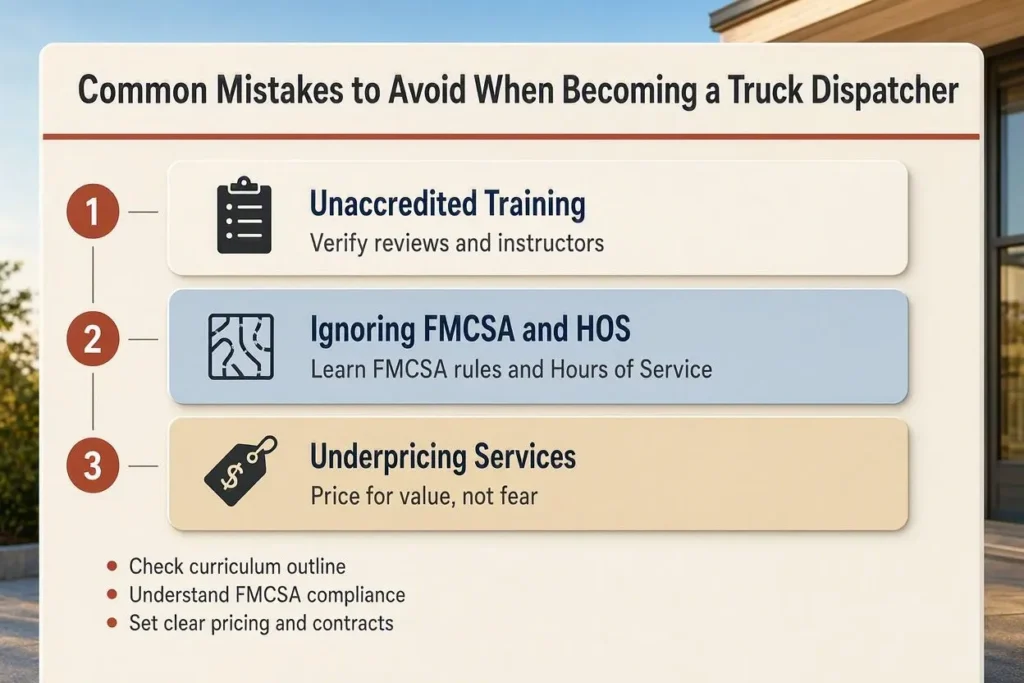
The biggest mistakes are enrolling in an unaccredited training program, skipping FMCSA compliance knowledge, and underpricing services out of fear of losing a client. Not every dispatcher course delivers what it promises. Before paying $300 to $600, check for verifiable reviews, a real curriculum outline, and instructors who are actually active in freight, not just teaching from old material.
Skipping FMCSA and HOS knowledge is another common trap. A dispatcher who schedules a driver into an HOS violation creates liability for the carrier and damages their own reputation fast. Underpricing is the third mistake, usually made out of nerves during the first few client conversations. Once a rate is set too low, raising it later is far harder than starting fair.
Conclusion
Becoming a truck dispatcher doesn’t require a degree, a CDL, or years of industry experience, just 40 hours of focused training and the willingness to get comfortable on the phone. The path is short: learn the basics, complete a program, master the load boards, and start working loads within a month. Pay ranges widely depending on whether you’re company-employed or building an independent book of clients, but both paths offer a realistic, fast entry into logistics. For anyone researching how to become a truck dispatcher right now, the barrier to entry has never been lower, and the freight industry isn’t slowing down anytime soon.
FAQs

Esther Howard
Esther Howard leads TruckingHow’s trucking, commercial driving, and transportation content division. She specializes in CDL training, trucking regulations, fleet operations, truck maintenance, and logistics best practices. With over a decade of experience researching the commercial transportation industry, Esther brings a practical, research-driven approach to driver education, safety standards, and industry regulations. She is the primary author of TruckingHow’s CDL guides, trucking career resources, maintenance tips, and transportation content, helping drivers, fleet owners, and trucking professionals make informed decisions on and off the road
Related Posts