Freightliner VIN Decoder: Free Lookup for Cargo Trucks & Trailers
A Freightliner VIN decoder reads the 17-character vehicle identification number (VIN) stamped on a commercial truck’s frame rail and translates it into manufacturer, cargo-truck model, engine, axle configuration, and gross vehicle weight rating (GVWR) data. Every Freightliner semi-truck, day cab, sleeper cab, and vocational cargo chassis built after 1981 uses this 17-character format under federal commercial-vehicle safety standards. Fleet managers, owner-operators, trailer haulers, and truck mechanics use a VIN decoder for Freightliner trucks to confirm a tractor-trailer listing matches its title, check for open recalls on heavy-duty equipment, or order axle and drivetrain parts without guessing.
This guide breaks down every VIN position on Class 4 through Class 8 commercial trucks, shows real engine and axle codes used on cargo haulers and tractor-trailers, and walks through a worked example on a Cascadia sleeper cab used for long-haul freight.
What Is a Freightliner VIN and What Does It Show on a Commercial Truck?
A Freightliner VIN is the unique 17-character code required for every commercial cargo truck and truck-tractor sold in the United States. It shows the manufacturer, vehicle type, axle and chassis configuration, engine, trailer-towing GVWR class, model year, assembly plant, and production sequence number for the specific unit hauling freight.
The code splits into three sections. The World Manufacturer Identifier (WMI) occupies positions 1 through 3 and identifies the truck builder and country of assembly. The Vehicle Descriptor Section (VDS) covers positions 4 through 9 and encodes the axle count, cab style, drivetrain, engine, and cargo-weight class. The Vehicle Identifier Section (VIS) fills positions 10 through 17 and records the model year, assembly plant code, and a six-digit production serial number unique to that tractor or straight truck.
Freightliner has built heavy-duty trucks and truck-tractors for the freight and trucking industry since 1942. Its VIN structure changed around 1988 and again on May 1, 2000, when the trucking industry adopted a revised commercial-vehicle coding format. A 2005 Columbia tractor pulling a dry van trailer and a 2022 Cascadia sleeper cab pulling a reefer trailer both use 17-character VINs, but positions 4 through 8 mean different things on each, since axle and chassis codes shifted between eras.
Where Is the VIN Located on a Freightliner Cargo Truck?
The VIN plate sits riveted to the driver’s side door frame of the tractor cab, and it’s also stamped into the left frame rail near the front axle, roughly 2 inches (50 mm) below the top edge of the rail at frame station 30.
Three additional locations back up the cab-door plate on commercial trucks. The Vehicle Specification Decal, usually mounted inside the driver’s door or glovebox, repeats the VIN alongside factory axle, transmission, and trailer-hitch option codes. Sleeper-cab tractors often carry a duplicate serial number stamped on the sleeper box frame itself. On Freightliner Custom Chassis Corporation (FCCC) vocational and cargo-box chassis, the final six digits get stamped directly into the frame steel, separate from the printed plate, so a damaged plate doesn’t erase the truck’s identity mid-haul.
Trucks assembled in Mexico for cross-border freight carry a wrinkle. The door plate lists a “CHASSIS” number instead of a standard VIN, and a data card in the glovebox lists a matching “CABIN” number. The final six digits of that CABIN number line up with the Freightliner production serial, which is the figure a VIN decoder for Freightliner trucks actually needs to match against the trailer bill of lading or fleet asset tag.
How to Decode a Freightliner VIN Number Step by Step
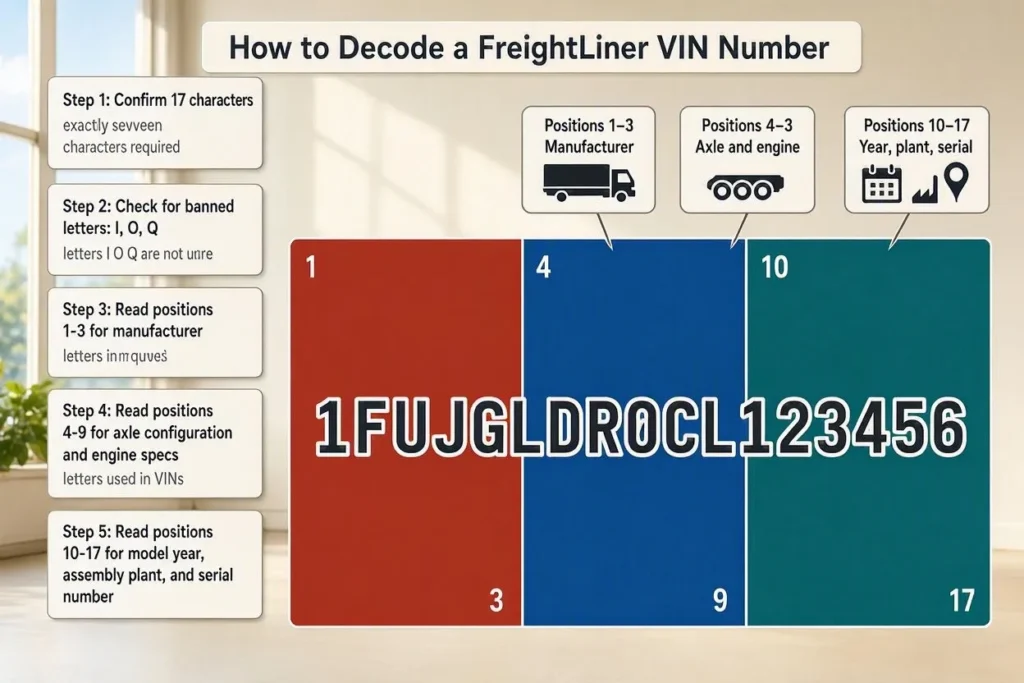
To decode a Freightliner VIN, read the 17 characters in three blocks: positions 1-3 for the truck-tractor manufacturer, positions 4-9 for axle configuration and engine specs, and positions 10-17 for model year, assembly plant, and cargo-hauler serial number. Follow these five steps in order.
- Confirm the VIN has exactly 17 characters and contains no letters I, O, or Q, since those three are banned from VIN strings worldwide to avoid confusion with 1 and 0 on both cargo trucks and passenger vehicles.
- Read positions 1 through 3. A code starting with 1FU means the truck-tractor was built in the United States as a complete highway hauler; 2FU marks Canadian assembly; 3AK marks a Mexican-built cargo unit after April 1996.
- Read positions 4 through 8 (pre-2000 VINs) or 4 through 9 (2000-and-later VINs) against an axle, cab, and GVWR reference table, since these characters shift meaning between the two commercial-vehicle coding eras.
- Read position 10 for the model year letter or number, then position 11 for the two-letter or single-letter assembly-plant code.
- Confirm positions 12 through 17 form a six-digit serial number unique to that individual truck-tractor or straight truck.
A parts counter worker at a heavy-duty truck dealership runs this same five-step check dozens of times a day before pulling a fifth-wheel coupler, brake valve, or drive-axle differential, because ordering the wrong part from a mismatched VIN read stalls a freight-bound tractor at the shop instead of on the road.
Freightliner VIN Decoder Chart for Commercial Trucks
The table below shows what each VIN position reveals on trucks and truck-tractors built from May 1, 2000, forward, which covers most cargo haulers and sleeper-cab tractors still running freight lanes today.
| VIN Position | What It Tells You | Example Code |
| 1-3 | World Manufacturer Identifier (country + builder) | 1FU = U.S.-built Freightliner truck-tractor |
| 4 | Axle configuration and drive type | H = 6×4 truck-tractor for trailer towing |
| 5-6 | Cargo-truck model and cab style | GA = Cascadia 113-inch day cab |
| 7-8 | Engine and brake type | DR = Detroit DD15, air brakes |
| 9 | Check digit (validates the other 16 characters) | Calculated, not looked up |
| 10 | Model year | 8 = 2008; A = 2010; N = 2022 |
| 11 | Assembly plant | P = Portland, Oregon |
| 12-17 | Production serial number | 6-digit unique identifier |
Position 9, the check digit, deserves a separate note on commercial equipment. It’s calculated using a weighted formula applied to the other 16 characters, and it exists specifically to catch VIN tampering on stolen or salvage-title tractor-trailers. If a decoded VIN fails the check-digit formula, the number was either copied wrong or altered, and that single failed check is often the first sign of VIN cloning fraud on used freight equipment.
Freightliner Axle and Trailer-Towing Configurations
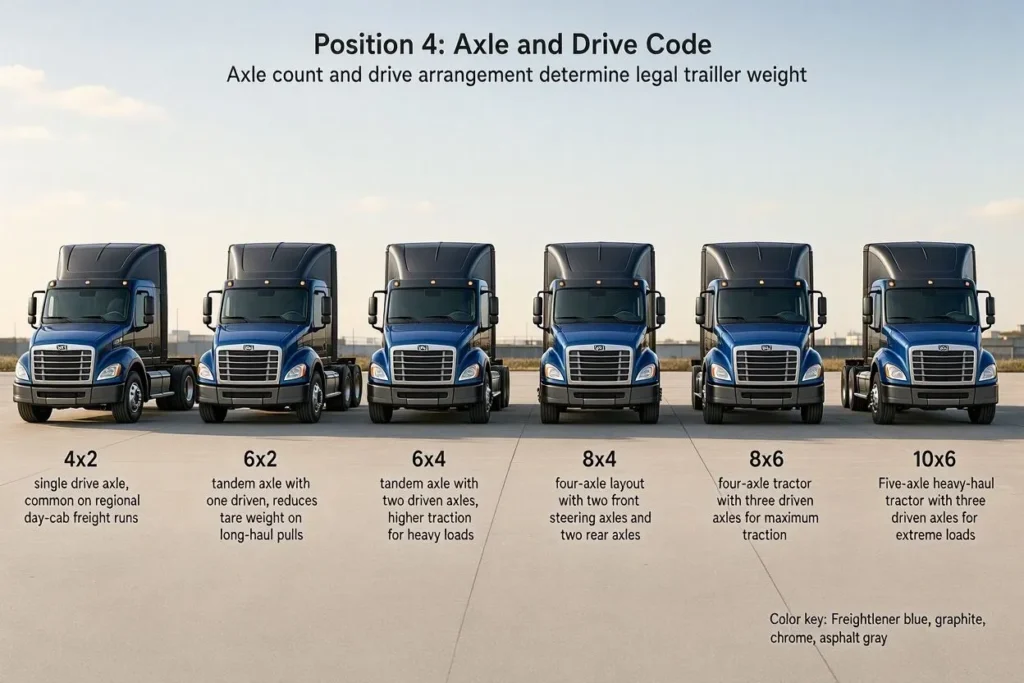
Position 4 on a Freightliner VIN identifies the axle count and drive arrangement that determines how much trailer weight the tractor can legally pull. Six configurations cover most cargo trucks and highway tractors in the current fleet.
- 4×2 truck-tractor: single drive axle, common on regional day-cab freight runs.
- 6×2 truck-tractor: tandem axle with one driven, used to reduce tare weight on long-haul trailer pulls.
- 6×4 truck-tractor: tandem drive axle, the standard configuration for over-the-road sleeper cabs pulling 53-foot dry van and reefer trailers.
- 8×4 truck: tandem front and rear drive axles, used on heavy vocational cargo chassis.
- 8×6 truck-tractor: triple-axle configuration for oversize or heavy-haul trailer combinations.
- Glider configuration: a reused cab and chassis mated to a new engine, coded separately from standard drivetrain builds.
A fleet dispatcher assigning a 6×4 tractor to pull a loaded flatbed trailer confirms the axle code first, because a 4×2 configuration lacks the drive-axle traction needed for that same trailer weight on a grade.
Freightliner Engine Codes Hidden in the VIN
Positions 7 and 8 on a post-2000 Freightliner VIN identify the exact engine make, model, fuel type, and displacement installed in the truck-tractor at the factory. Six named engine families cover the majority of commercial Freightliner production since 2000.
- Detroit Diesel Series 60, coded CD through CM depending on displacement, ranging from 11.1 to 14.0 liters, common on older long-haul tractors.
- Detroit DD13, DD15, and DD16, the current-generation Detroit engines that replaced the Series 60 starting in 2007 for line-haul freight applications.
- Cummins ISX, ISM, ISC, ISL, and ISB, spanning 3.9 to 15.0 liters across medium-duty cargo trucks and heavy-duty tractors.
- Caterpillar C7 through C16, covering 7.2 to 15.8 liters, though Caterpillar exited the on-highway engine market in 2010.
- Mercedes-Benz MBE900 and MBE4000, common on M2 cargo trucks and Business Class straight trucks in the 4.3 to 12.0-liter range.
- John Deere 6081H, a compressed natural gas (CNG) option coded C8 and C9, used on select vocational cargo chassis.
A fleet buyer checking a used M2 106 cargo truck against a VIN decoder for Freightliner trucks confirms the engine family and displacement before the box truck ever leaves the lot, which matters because a mismatched engine listing is one of the most common disputes in used commercial-truck and trailer-hauler sales.
Freightliner Model Year Codes (Position 10)
Position 10 of a Freightliner VIN uses a single letter or number to represent the model year, and the code resets every 30 years under the federal commercial-vehicle VIN standard. Trucks built from 2000 through 2009 use the digits 0 through 9, while trucks from 2010 onward switch back to letters, skipping I, O, Q, U, and Z.
| Code | Model Year | Code | Model Year |
| Y | 2000 | A | 2010 |
| 1 | 2001 | B | 2011 |
| 5 | 2005 | K | 2019 |
| 9 | 2009 | L | 2020 |
| N | 2022 |
If two Freightliner cargo trucks share the same position-10 code, one built in 2001 and one built in 2031, the surrounding VIN characters, including the assembly-plant code and engine code, resolve the ambiguity, since engine offerings on freight tractors from 2001 don’t match anything sold three decades later.
Freightliner GVWR Classes and Trailer-Towing Capacity
Positions 5 and 6 on a post-2000 Freightliner VIN encode the cargo-truck model and GVWR class together, splitting commercial trucks into Class 4 through Class 8 by weight. GVWR measures the maximum loaded weight the truck or tractor is rated to carry or pull, including cargo, fuel, trailer tongue weight, and passengers.
- Class 4: 14,001 to 16,000 pounds (6,351 to 7,257 kg), typical of the FL50 box truck.
- Class 5: 16,001 to 19,500 pounds (7,258 to 8,845 kg), common on light M2 106 cargo configurations.
- Class 6: 19,501 to 26,000 pounds (8,846 to 11,793 kg), the range for medium-duty FL60 and FC70 cargo trucks.
- Class 7: 26,001 to 33,000 pounds (11,794 to 14,969 kg), a bracket shared by Cascadia day cabs and M2 112 cargo haulers.
- Class 8: 33,001 pounds (14,969 kg) and above, covering every Cascadia and Coronado sleeper-cab tractor built to pull loaded semi-trailers for long-haul freight.
A dispatcher assigning loads needs the correct class before booking a shipment, because a Class 7 straight truck paired with a Class 8-rated trailer combination risks a weight citation at the scale house.
Worked Example: Decoding a Real Freightliner Tractor-Trailer VIN
Take the VIN 1FUJGLDR8NLGA1234 as a sample string and walk through it position by position on a highway tractor built to pull a semi-trailer.
Positions 1-3 read 1FU, confirming a U.S.-built Freightliner truck-tractor. Position 4 reads J, indicating a 6×4 configuration built for over-the-road trailer towing. Positions 5-6 read GL, which maps to a Cascadia 125-inch sleeper cab in the Class 8 weight bracket. Positions 7-8 read DR, identifying a Detroit DD15 diesel engine with air brakes, the standard powertrain for a loaded 53-foot trailer. Position 9, the digit 8, serves as the calculated check digit. Position 10 reads N, placing the model year at 2022. Position 11 reads L, pointing to the Cleveland, North Carolina assembly plant. The final six characters, GA1234, form the unique production serial number for that individual tractor.
Running this same string through a VIN decoder for Freightliner trucks online would return an identical breakdown in under three seconds, confirming the manual read matches the automated one for the cargo hauler.
VIN Decoder vs. Vehicle History Report: What’s the Difference?
A VIN decoder reads the factory-encoded specifications built into a commercial truck’s VIN, while a vehicle history report pulls external records tied to that VIN, such as accidents, title brands, and prior fleet ownership. The two tools answer different questions for a tractor-trailer buyer.
A decoder confirms what the cargo truck was built as: engine, axle configuration, GVWR class, plant, and model year. A history report confirms what happened to the truck-tractor after it left the factory: reported accidents, odometer readings, salvage or flood titles, open recalls, and auction sale records. A 2016 Freightliner M2 cargo truck with a clean decoded VIN can still carry six open recalls and three logged accidents on its history report, so relying on decoding alone leaves real risk on the table for a used tractor-trailer buyer.
Both checks matter before a freight-equipment purchase closes. Decoding confirms the listing matches the physical tractor, and the history report confirms the truck’s condition matches the fleet seller’s claims.
How to Spot VIN Cloning on a Used Freightliner Tractor
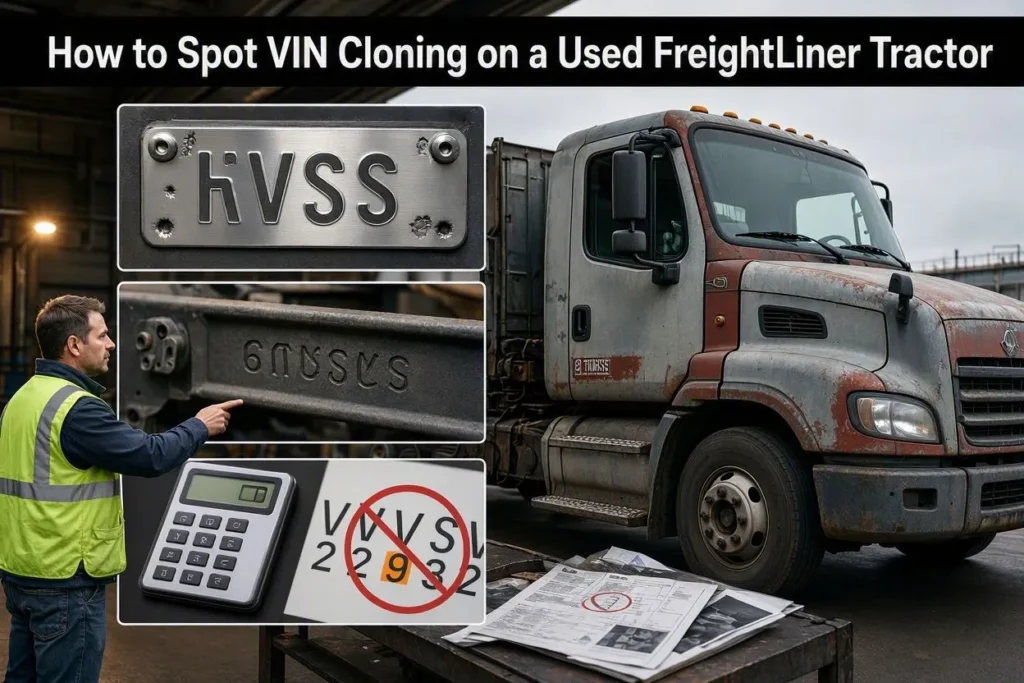
Yes, VIN cloning happens on commercial cargo trucks and tractor-trailers, and it involves copying a legitimate VIN from one truck onto a stolen or salvage-title unit to disguise its true history. Four warning signs point to a cloned VIN on freight equipment.
- The check digit in position 9 fails when recalculated against the other 16 characters.
- The VIN plate rivets on the tractor cab show fresh drill marks, mismatched paint, or signs of removal and reattachment.
- The frame-stamped serial number near the front axle doesn’t match the door-plate VIN.
- A vehicle history report returns a different model, year, or engine than what’s physically installed under the hood of the cargo truck.
A buyer who decodes the VIN, checks the physical plate against the frame stamp, and pulls a history report closes off the three common cloning entry points before money changes hands on a used tractor. Skipping any one of these three checks is how cloned freight trucks slip through private-party sales.
Best Free Freightliner VIN Decoder Tools for Fleet and Cargo Trucks
Several free tools decode a Freightliner VIN in under 30 seconds, and the National Highway Traffic Safety Administration (NHTSA) offers the most authoritative option at nhtsa.gov/vin-decoder. The NHTSA tool pulls directly from manufacturer-submitted commercial-vehicle data and includes open recall information for cargo trucks and truck-tractors at no cost.
Third-party decoders add convenience features the government tool skips. Some generate a printable build sheet listing factory-installed axle, transmission, and trailer-hitch options. Others attach sample vehicle history data, including recall counts, accident records, and prior auction sales, directly to the decoded result. A few split Freightliner into individual cargo-truck model pages, Cascadia, M2, Columbia, and Classic among them, which speeds up lookups for fleet buyers who already know the model but not the full spec sheet.
Whichever tool gets used, cross-checking the result against the physical VIN plate and frame stamp remains the single most reliable step in the entire process for any tractor-trailer purchase.
Conclusion
Decoding a Freightliner cargo truck or tractor-trailer VIN takes five steps: verify the 17-character format, read the manufacturer code in positions 1 through 3, check the axle configuration and engine data in positions 4 through 9, confirm the model year and assembly plant in positions 10 and 11, and match the production serial number in positions 12 through 17. Every fleet manager, owner-operator, and mechanic running a VIN decoder for Freightliner trucks should pair that decoded result with a physical VIN-plate inspection and, for used tractors and cargo trucks, a separate vehicle history report before any money changes hands on freight equipment.
FAQs

Esther Howard
Esther Howard leads TruckingHow’s trucking, commercial driving, and transportation content division. She specializes in CDL training, trucking regulations, fleet operations, truck maintenance, and logistics best practices. With over a decade of experience researching the commercial transportation industry, Esther brings a practical, research-driven approach to driver education, safety standards, and industry regulations. She is the primary author of TruckingHow’s CDL guides, trucking career resources, maintenance tips, and transportation content, helping drivers, fleet owners, and trucking professionals make informed decisions on and off the road
Related Posts