CDL Permit Practice Test: Free Questions to Pass Your CLP Exam
A CDL permit practice test walks you through the same kind of material as the real Commercial Learner’s Permit (CLP) written exam: traffic laws, vehicle systems, safe driving procedures. Most states want 50 General Knowledge questions answered with at least 80% correct (40 right) before they’ll issue anything. Going for a Class A license? You’ll also need to clear the Air Brakes and Combination Vehicle sections. Run through a practice test two or three times, with a day off in between to let it sink in, and you’ll catch the weak spots before they cost you a second trip to the DMV.
What Is a CDL Permit Practice Test?
It’s a practice version of the written exam every commercial driving applicant has to sit for at the DMV, built with the same question style and topic breakdown as the real thing. Instead of walking in blind, applicants get to work through realistic scenarios about following distances, cargo securement, and pre-trip inspections before they’re ever sitting at a testing center.
Two formats show up across most prep sites. One gives instant feedback, explaining why an answer is right or wrong the moment you pick it. The other simulates real exam conditions: no hints, just a running score at the end. A first-time applicant in Ohio might start with the feedback version to actually learn the material, then switch to the timed version a few days before their DMV appointment to build speed.
Who Needs to Take a CDL Permit Practice Test?
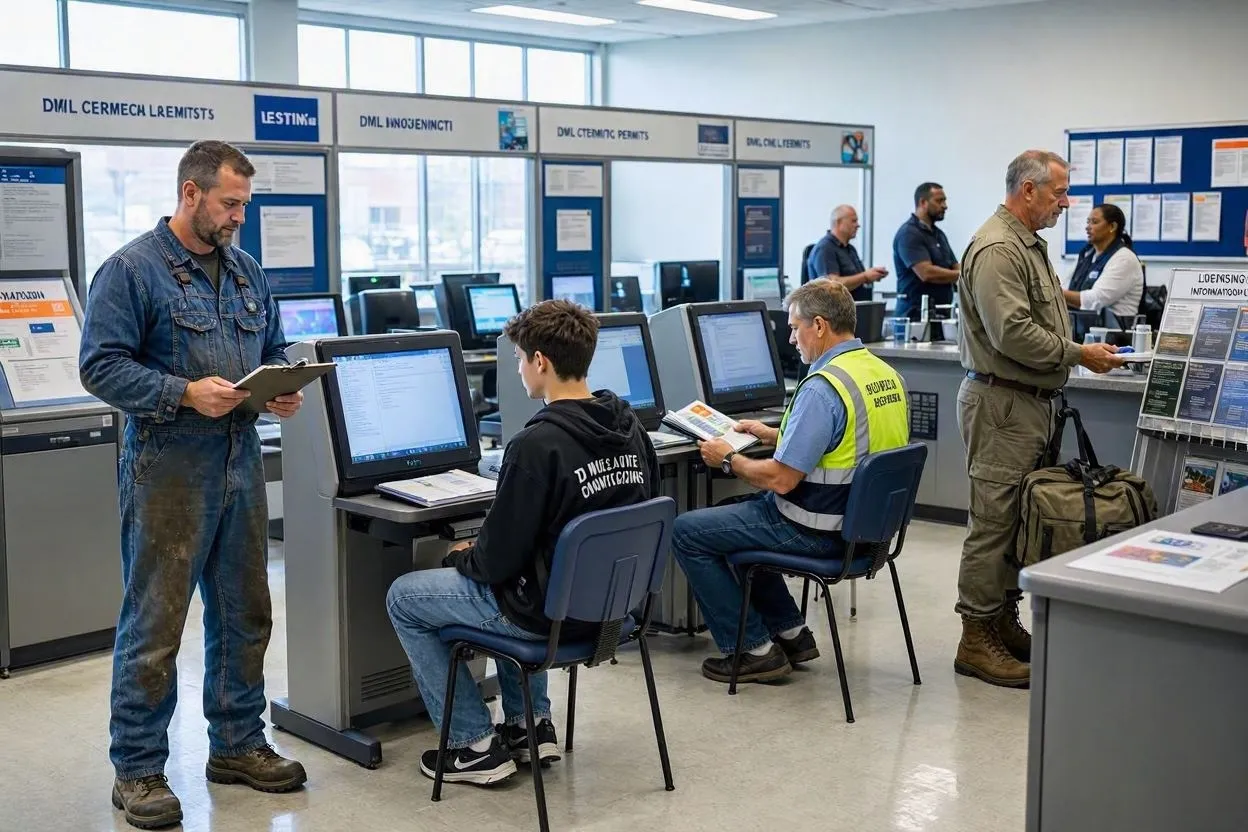
Anyone applying for a CLP, basically, since every state requires a passing written score before it’ll issue the permit. That covers career changers entering trucking, employees moving from a Class B to a Class A license, and military veterans converting driving experience into a civilian CDL. A 35-year-old warehouse worker switching careers and a 22-year-old fresh out of high school face the exact same exam, regardless of what either of them has driven before.
Three groups make up most CDL permit test-takers:
- First-time applicants with no prior commercial driving experience
- Experienced drivers upgrading from Class B or C to Class A
- Out-of-state transfers who need to retest under new state rules
Company-sponsored trainees are a bit of a different case. Some trucking companies require applicants to pass General Knowledge, Air Brakes, and Combination Vehicle before they’ll let them enroll in a paid training program, worth confirming directly with the carrier you’re applying to, since sponsorship terms vary.
What’s on the CDL General Knowledge Test?
Ten core topics, and every applicant sits for this section no matter which CDL class they’re going after:
- Traffic signs, signals, and right-of-way rules
- Speed management and space cushion driving
- Vehicle inspection procedures (pre-trip and post-trip)
- Basic commercial vehicle control
- Hours of service and electronic logging device (ELD) rules
- Accident procedures and emergency response
- Hazard perception and defensive driving
- Cargo handling and weight distribution
- Extreme driving conditions (fog, ice, night driving)
- Alcohol, drug, and fitness-for-duty regulations
Take a question on speed management, something like how far a fully loaded 80,000-pound rig needs to safely stop at 55 mph. That’s physics, regulation, and judgment all packed into one question, which is exactly why applicants who skip practice tests tend to underestimate how technical this exam actually gets.
How Many Questions Are on the CDL Permit Test?
Fifty, for General Knowledge, in nearly every state. Air Brakes adds 25 more, Combination Vehicles another 20, if those apply to your license class. The total climbs fast once endorsements enter the picture.
| Section | Questions |
| General Knowledge | 50 |
| Air Brakes | 25 |
| Combination Vehicle | 20 |
| Hazardous Materials (HazMat) | 30 |
| Tanker | 20 |
| Passenger | 20 |
| School Bus | 25 |
| Doubles/Triples | 20 |
An applicant going for a Class A CDL with air brakes has to pass three separate sections, 95 questions combined, before the DMV hands over a permit. Most testing centers don’t put a hard time limit on any section, though a handful of states set a soft cap around 60 minutes for General Knowledge, check your state’s manual for the current rule.
What’s the Passing Score for the CDL Permit Test?
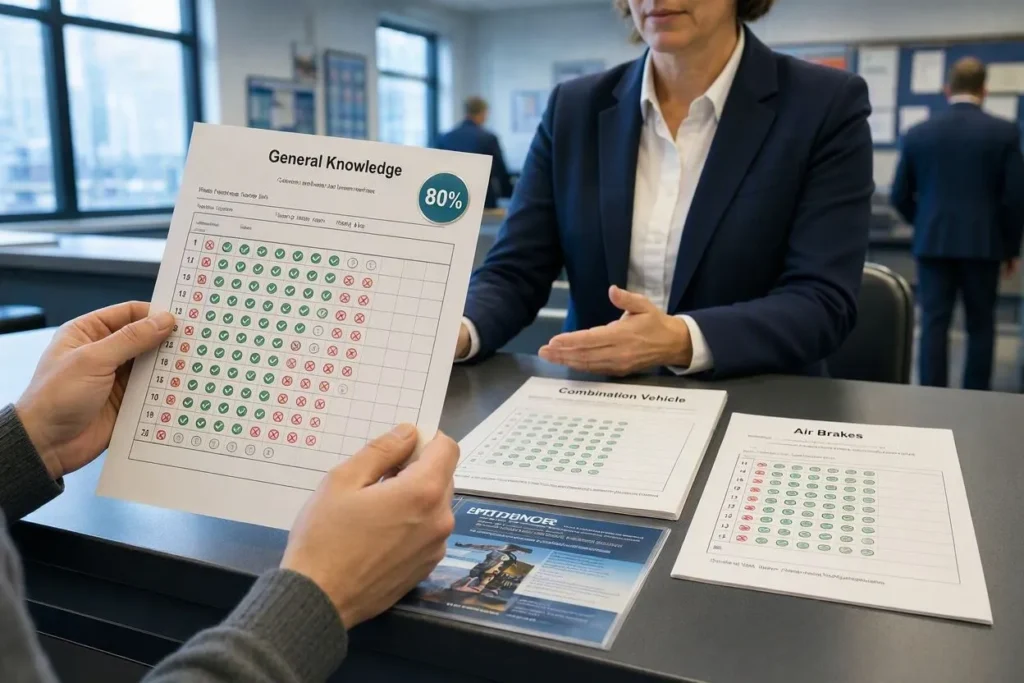
80%, in every U.S. state. That means missing no more than 10 of the 50 General Knowledge questions. Same threshold applies to Air Brakes, Combination Vehicle, and the endorsement sections, so a 25-question Air Brakes test only allows 5 wrong answers before you fail it.
Failing a section only fails that section, not your whole application. Pass General Knowledge and Combination Vehicle but flunk Air Brakes, and most DMVs will let you retest just the one you missed rather than starting over from scratch. Several states, including Kansas and Texas, spell this out in their official CDL manuals, worth checking yours to confirm the same policy applies.
How to Study for the CDL Permit Practice Test
Start with your state’s official CDL manual, move on to practice questions, and finish with a timed mock exam under real test conditions. Skip the manual and jump straight to practice questions, and you’ll leave gaps, because practice tests reinforce material, they don’t teach it from scratch.
- Download your state-specific CDL manual from your state DOT website and read it once, fully, before you touch a practice test.
- Take an untimed practice test with answer explanations to find weak topics early.
- Review missed questions against the manual section they came from, not just the correct answer.
- Repeat every 2 to 3 days until scores hold above 90% consistently.
- Take one timed mock exam within 48 hours of your scheduled DMV appointment to simulate the real thing.
A driver who studies 30 minutes a day for two weeks usually beats one who crams for six hours the night before. Spaced repetition wins here because commercial driving regulations are stuffed with specific numbers (following distances, weight limits, brake stopping distances) that fade fast without repeated review.
A few habits separate the applicants who pass on the first try from the ones making a second DMV trip:
- Memorizing answers instead of concepts backfires, since rotating question banks make memorized sequences useless.
- Skipping the pre-trip inspection material because it “only” shows up on the skills test is a mistake, General Knowledge questions reference the same components.
- Air Brakes tends to get underestimated relative to General Knowledge, so don’t treat it as an afterthought.
- Regulations change periodically, particularly ELD and hours-of-service rules, so review for recent updates rather than relying on an older study guide.
- A single practice-test pass doesn’t mean you’re ready. A candidate who scores 82% once is sitting right at the edge of failing; retesting until scores land consistently above 90% builds real margin for unfamiliar phrasing on exam day.
CDL Permit Practice Tests by Endorsement
Each endorsement runs its own practice test, since HazMat, Tanker, and Passenger material covers completely different ground than General Knowledge. If you only need a standard Class A license, you can skip endorsement testing altogether.
- HazMat tests placarding rules, shipping paper requirements, and security threat awareness (30 questions, plus a TSA background check)
- Tanker tests liquid surge control, weight distribution, and bulkhead safety (20 questions)
- Passenger tests boarding procedures, emergency evacuation, and mirror adjustment for buses (20 questions)
- School Bus tests student loading zones, railroad crossing procedures, and emergency exits (25 questions)
- Doubles/Triples tests coupling systems, off-tracking, and trailer sway control (20 questions)
A driver hauling reefer freight cross-country typically only needs the standard Class A license, no endorsements at all. A tanker driver moving flammable cargo, fuel for example, generally needs both Tanker and HazMat, which means two extra 20-to-30-question sections stacked on top of General Knowledge.
How Long Is a Commercial Learner’s Permit (CLP) Valid?
180 days, in most states, though a few stretch that out further. During that window, permit holders can practice with a CDL holder riding along, but they can’t drive commercially on their own yet.
State rules vary here. FMCSA sets a 180-day floor, and some states allow a CLP renewal for another 180 days if the skills test doesn’t happen in time, check with your state DMV for its current renewal policy. Federal law also makes CLP holders wait at least 14 days after getting the permit before they can take the skills test, giving new drivers a bit of runway to build actual seat time first.
What Happens If You Fail the CDL Permit Test?
You retake only the section you failed, though most states charge a retest fee and make you wait before trying again, both the fee amount and wait period vary widely by state, so confirm yours with your local DMV. A section you already passed stays passed, so failing Air Brakes won’t send you back to retake General Knowledge.
Retest rules generally shift by state in three ways:
- Wait time: some states require none; others enforce a mandatory wait of a day or more.
- Attempt limits: most states cap it at around 3 per day or per visit before you need a new appointment.
- Fees: typically somewhere in the $10 to $50 range per retest, higher at some private testing centers.
If you’ve failed the same section twice, switching study methods entirely tends to help more than repeating what already didn’t work, moving from passively rereading the manual to actively working through a practice test with detailed answer explanations.
Do CDL Permit Test Questions Vary by State?
The wording and format do, yes, but the core content stays consistent nationwide because FMCSA sets federal minimum standards every state manual has to follow. A stop-distance question in Georgia and one in Oregon are testing identical physics, just phrased a little differently.
A few things do shift by state:
- Some states offer the test in additional languages alongside English (Texas and Florida, for instance, offer Spanish)
- A handful of states use third-party testing centers instead of DMV offices
- Question banks rotate on different schedules, so memorizing exact answer sequences from some outdated PDF you found online often backfires
If you’re relocating mid-application, grab the new state’s manual right away. Federal minimums guarantee some overlap, but state-added questions on local rules can still catch you off guard.
How Much Does the CDL Permit Test Cost?
Costs vary significantly by state, and by whichever DMV or testing center processes your application, so treat the numbers below as a rough range rather than a quote. Training program fees run separately from the permit test itself and can range from roughly $1,000 to $10,000 depending on the program.
Total cost generally breaks down into three pieces:
- State permit fee: typically in the $10 to $100 range for the written exam itself
- Endorsement add-ons: each extra endorsement test (HazMat, Tanker) often carries its own additional fee
- HazMat background check: a separate fee through the TSA, on top of the standard permit fee, confirm the current amount directly with TSA since it’s periodically adjusted
Company-sponsored training programs sometimes cover these costs entirely, some carriers pay trainees during CDL school instead of charging tuition, which removes the cost barrier for anyone who commits to driving for that carrier after graduation. Ask any program directly about its current fee structure.
What Comes After You Pass the CDL Permit Test?
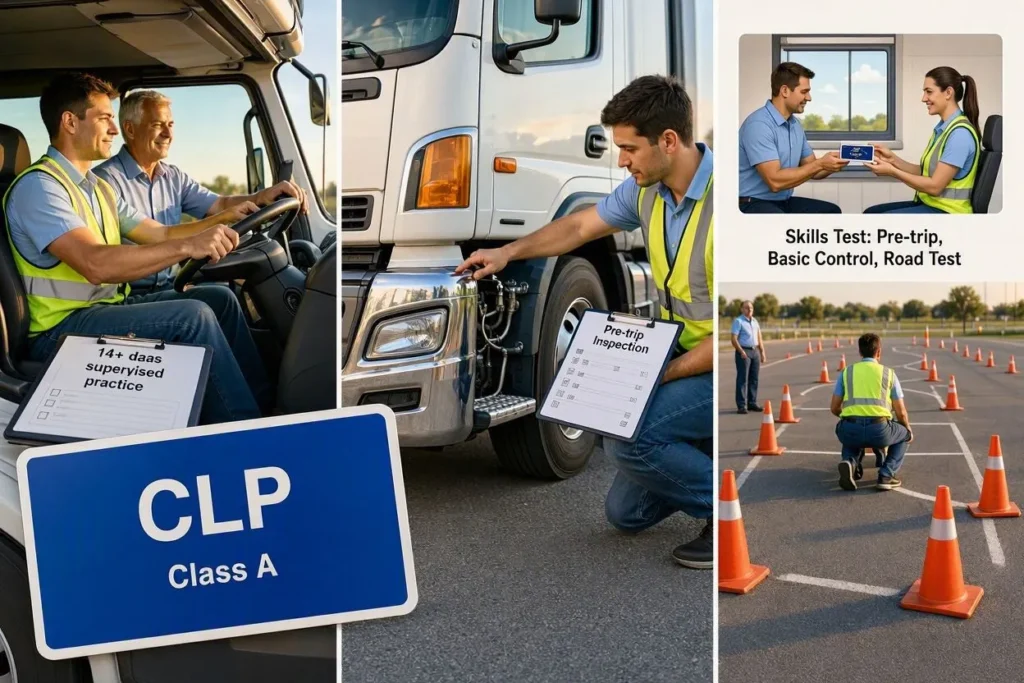
You get a CLP, which lets you practice driving under supervision for at least 14 days before you’re eligible for the skills test. That test covers three parts and decides whether you walk away with a full CDL.
- Behind-the-wheel training: minimum 14 days with a licensed CDL holder present, often 3 to 6 weeks in a formal program
- Pre-trip inspection test: identify and explain safety-critical components on the vehicle
- Basic controls and road test: demonstrate backing, parking, and on-road driving skills for a state examiner
Pass all three, and the DMV issues the full CDL. Employer paperwork like the Pre-Employment Screening Program (PSP) report typically follows within days.
Conclusion
A CDL permit practice test is about as close as you’ll get to a preview of the real DMV exam: the same 50-question General Knowledge format, the same 80% passing threshold, the same endorsement-specific content that trips up unprepared candidates. States set the fees, the retest rules, and how long the CLP stays valid, and those details shift, so always cross-check the specifics against your state’s current manual. Study the manual first, work through practice questions until your scores hold above 90%, and book the DMV appointment only once that consistency actually shows up.
FAQs

Esther Howard
Esther Howard leads TruckingHow’s trucking, commercial driving, and transportation content division. She specializes in CDL training, trucking regulations, fleet operations, truck maintenance, and logistics best practices. With over a decade of experience researching the commercial transportation industry, Esther brings a practical, research-driven approach to driver education, safety standards, and industry regulations. She is the primary author of TruckingHow’s CDL guides, trucking career resources, maintenance tips, and transportation content, helping drivers, fleet owners, and trucking professionals make informed decisions on and off the road
Related Posts