DOT Number Requirements : Who Needs One and How to Get It
Running a fleet across state lines without a DOT number can get your truck placed out of service at the next roadside inspection. That’s the short version. The longer version involves weight thresholds, passenger counts, hazmat placarding, and a patchwork of state rules that trip up even experienced freight operators. A single box truck rated at 10,500 pounds GVWR needs one. So does a church van hauling 20 people for a weekend trip, paid fare or not. Here’s exactly which carriers qualify, what the Federal Motor Carrier Safety Administration (FMCSA) charges, and how to stay compliant once the number’s issued.
What Is a DOT Number?
A DOT number, also called a USDOT number, is a unique identifier FMCSA assigns to companies that operate commercial vehicles in interstate freight or passenger transport. It lets federal and state agencies track a carrier’s safety record, inspection history, and crash reports across every load it hauls. The number stays tied to the business itself, not to any single truck, so a company keeps the same DOT number even after it retires or replaces equipment.
Every roadside inspection, safety audit, and compliance review runs through this number. Trucking companies, bus operators, freight brokers, even some private carriers hauling their own cargo need to know these rules before a single load moves across state lines. Skip this step and you’re not just risking a fine. You could have a shipment shut down entirely at a weigh station.
Who Needs One
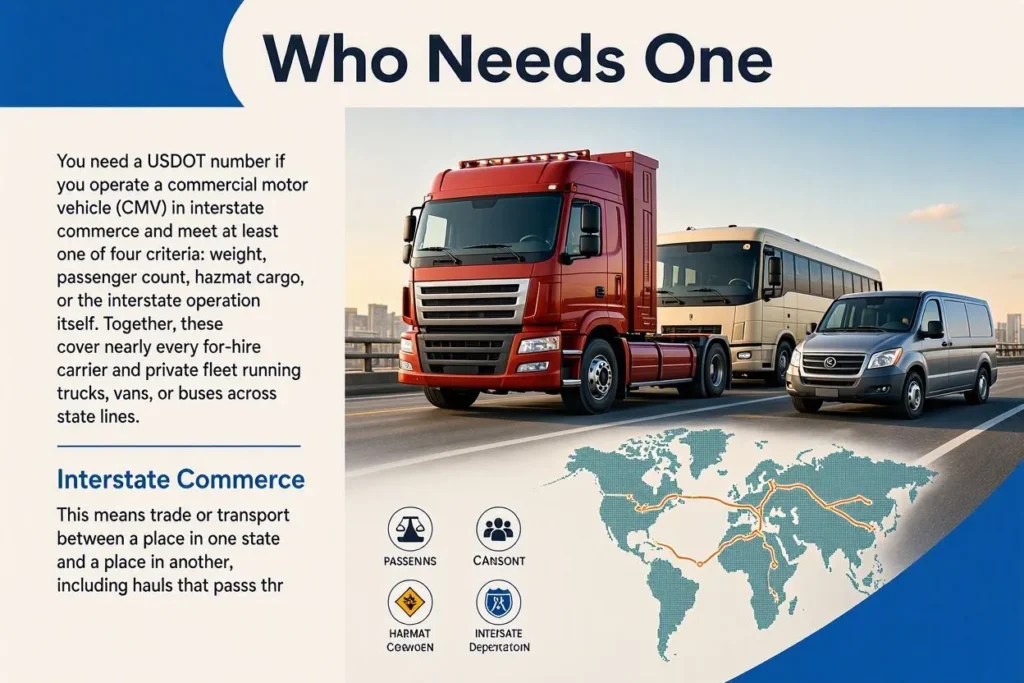
You need a USDOT number if you operate a commercial motor vehicle (CMV) in interstate commerce and meet at least one of four criteria: weight, passenger count, hazmat cargo, or the interstate operation itself. Together, these cover nearly every for-hire carrier and private fleet running trucks, vans, or buses across state lines.
Interstate Commerce
This means trade or transport between a place in one state and a place in another, including hauls that pass through a state on the way to a third destination. A furniture company in Ohio delivering to Kentucky qualifies, even if the truck never crosses more than one border. But interstate status alone doesn’t trigger the requirement. It has to combine with one of the three conditions below.
Weight
Vehicles with a gross vehicle weight rating (GVWR) or gross combination weight rating (GCWR) of 10,001 pounds (4,536 kg) or more need a number. That catches most box trucks, semis, and heavy-duty pickups pulling loaded trailers. A flatbed rated at 12,000 pounds crosses this line even if it never hauls a full load.
Passengers
Two thresholds apply, both tied to compensation. Carriers transporting 9 to 15 passengers (including the driver) for direct or indirect compensation need a number. Carriers transporting 16 or more need one regardless of whether money changes hands, so a church van shuttling 20 volunteers falls under this rule even without a paid fare.
Hazmat
Any commercial vehicle carrying hazardous materials in quantities that require placarding needs a number, no matter its cargo weight. A small delivery van hauling placarded flammable liquid meets this bar just as surely as a full tanker. Intrastate carriers moving certain hazmat quantities also fall under 49 CFR 385.403, which requires a safety permit tied to a DOT number even without crossing a state line.
Intrastate Requirements by State
Thirty-eight states plus Puerto Rico require a USDOT number for intrastate carriers, even ones that never cross a state line: Alabama, Alaska, Arizona, California, Colorado, Connecticut, Delaware, Florida, Georgia, Hawaii, Idaho, Indiana, Iowa, Kansas, Kentucky, Maine, Maryland, Massachusetts, Michigan, Minnesota, Missouri, Montana, Nebraska, Nevada, New Jersey, New York, North Carolina, Ohio, Oklahoma, Oregon, Pennsylvania, South Carolina, Texas, Utah, Washington, West Virginia, Wisconsin, and Wyoming.
Twelve states skip this requirement, but that’s not the same as being fully in the clear. Vermont sits outside the mandatory list, yet it’s small enough that running a real freight route without eventually crossing into New York or New Hampshire is nearly impossible, which triggers the federal rule anyway. New York adds another wrinkle through NYSDOT and the OSCAR credentialing system, tying a federal number to state Highway Use Tax (HUT) decals and IFTA filings. Run trucks over 18,001 pounds through New York and you need both the federal number and HUT registration. Check the state rules, not just the federal list.
Who’s Exempt
Five categories cover most exemptions:
- Personal vehicles used exclusively for non-business purposes, like a pickup hauling a family’s own furniture during a move
- Business vehicles under 10,000 pounds GVWR carrying no hazmat and no compensated passengers
- Carriers operating entirely within a state that doesn’t mandate an intrastate number, as long as no other trigger applies
- Farm vehicles used exclusively for agricultural hauling within a limited radius that varies by state
- Vehicles operated exclusively by federal, state, or local government agencies
Volunteer or non-commercial transport can qualify too, but only if the driver gets no financial benefit at all, not even indirectly. Someone driving a horse to a rodeo in exchange for a cut of the prize money still counts as compensated transport under FMCSA rules. The exemption is narrower than it looks.
How to Apply
Complete registration through FMCSA’s Unified Registration System (URS) online. Most applicants get through it in under an hour if they’ve got their carrier information ready.
FMCSA asks for six things:
- Legal business name, physical address, and mailing address, verified against USPS records
- EIN or SSN, depending on business structure
- Operation classification: For-Hire Carrier, Private Carrier, Broker, or Exempt For-Hire
- Type of transportation: passengers, freight, or both
- Vehicle count and GVWR for each unit in the fleet
- Cargo classification, including whether hazmat moves through the operation
A business without hazmat requirements can usually start hauling as soon as the number is issued. Carriers applying for full operating authority under an MC number wait longer, generally 21 to 25 days, since that process includes insurance filing and a BOC-3 process agent designation. A startup applying for both on the same day should expect the DOT number to activate almost immediately while the MC number clears weeks later.
DOT Number vs. MC Number
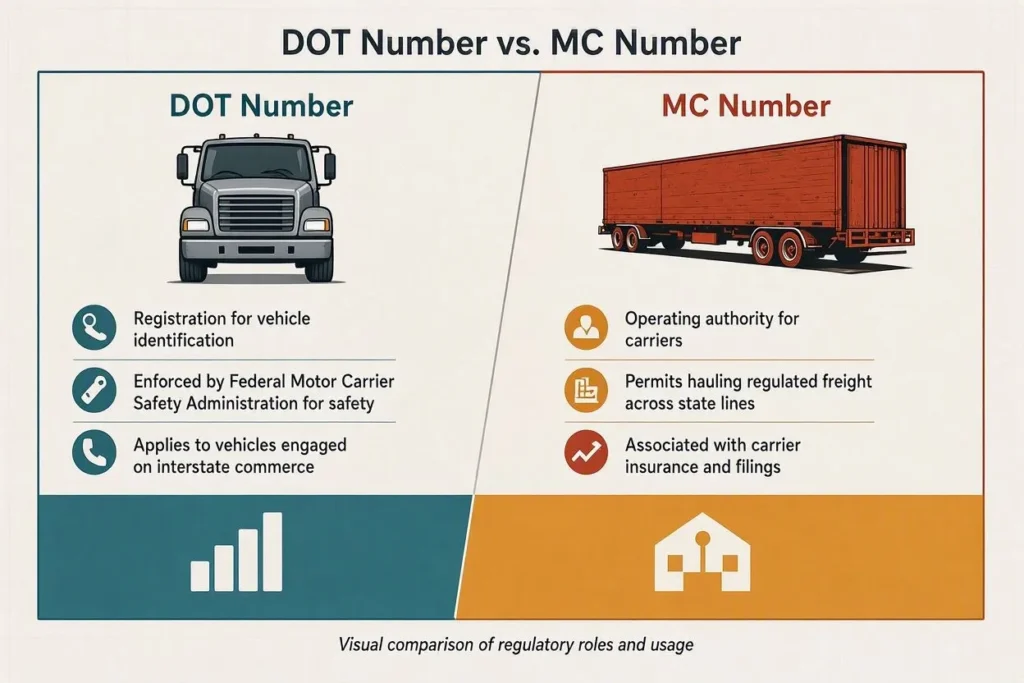
A DOT number identifies a carrier for safety tracking. An MC number grants legal authority to haul regulated freight or passengers for hire across state lines. They serve different functions and don’t always travel together.
| Factor | USDOT Number | MC Number |
| Purpose | Safety tracking and carrier ID | Operating authority for for-hire interstate business |
| Cost | Free | $300 per operating classification |
| Who needs it | Most CMV operators meeting weight, passenger, or hazmat thresholds | For-hire carriers, household goods movers, brokers crossing state lines |
| Displayed on vehicle | Yes, both sides of the power unit | No display requirement |
| Classifications | Single classification per company | Multiple classifications possible |
A moving company that only shuffles its own equipment between warehouses needs a DOT number but not an MC number, since it’s not hauling freight for hire. A moving company transporting customers’ household goods across state lines needs both.
Display Requirements
A USDOT number has to appear on both sides of the power unit, in lettering at least 2 inches (5.08 cm) tall, legible from 50 feet away in daylight. That standard exists so inspectors can confirm compliance without pulling a load off its schedule.
Most carriers put it on the cab door, though any unobstructed spot on the power unit works. Contrast matters as much as size: a black tractor needs white or light lettering, a white or silver one needs dark lettering, and low contrast can draw a citation even when the numbers technically meet the 2-inch minimum. Arial or Helvetica tend to hold up best, since their clean, block-style characters stay legible even as decals wear down from road grime and UV exposure.
Carriers also need to display the legal business name, or one approved trade name, next to the DOT number at the same legibility standard. A fleet manager who checks each truck quarterly for decal wear avoids scrambling before a scheduled audit.
What It Costs
The number itself is free. FMCSA doesn’t charge anything for base registration, no matter the fleet size or freight type.
The costs show up once you need operating authority. Each MC number classification runs $300, and carriers needing multiple classifications, say both household goods and general freight authority, pay per classification. Add a BOC-3 process agent filing (typically $25 to $75 through a third-party service) and annual UCR fees based on fleet size, and a five-truck operation applying for general freight authority might land under $400 in total startup registration costs, even though the DOT number itself never carries a price tag.
What Happens Without a Required Number
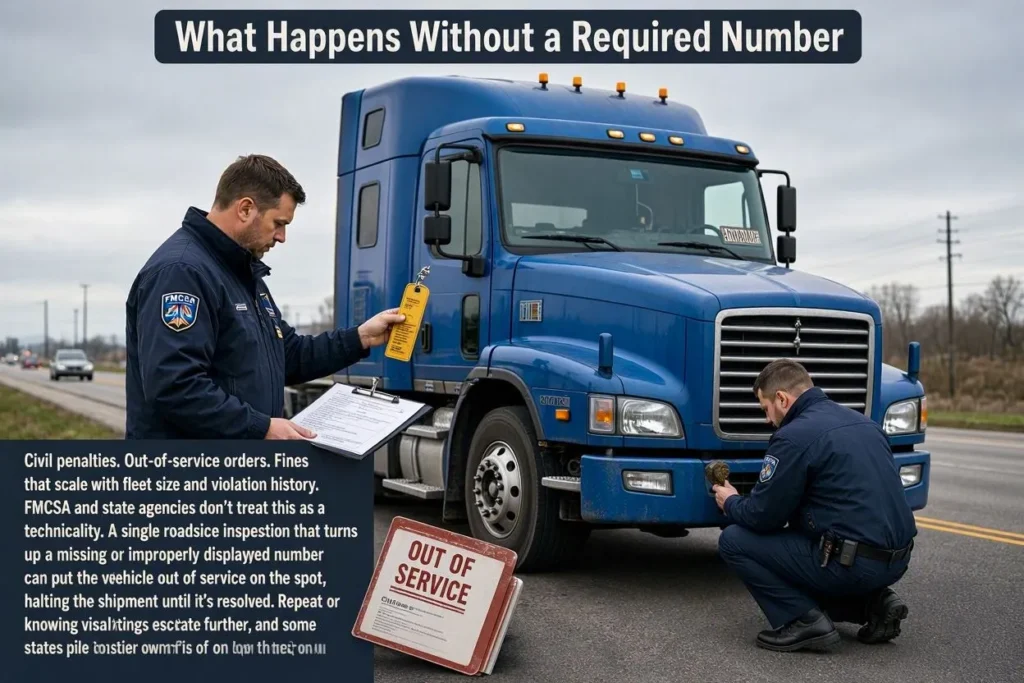
Civil penalties. Out-of-service orders. Fines that scale with fleet size and violation history. FMCSA and state agencies don’t treat this as a paperwork technicality.
A single roadside inspection that turns up a missing or improperly displayed number can put the vehicle out of service on the spot, halting the shipment until it’s resolved. Repeat or knowing violations escalate further, and some states pile their own fines on top of the federal ones. New York, for example, cites failure to register commercial vehicles under its Highway Use Tax rules, layering state penalties onto whatever federal violation already applies. Get caught without a required number and you don’t just lose the load in transit. You end up with a documented safety violation that follows the operation through future audits.
The MCS-150 Biennial Update
Carriers have to update their MCS-150 form with FMCSA every 24 months to keep the number active. It confirms that business details, fleet size, and operational classification still match what’s on file.
FMCSA sets update deadlines based on the last digit of a carrier’s DOT number, so two companies registered the same day can end up with different renewal windows. Miss the deadline and the number doesn’t cancel outright, but the account gets flagged, and it can eventually deactivate if left unresolved. A company that grows from 3 trucks to 15 in two years needs to reflect that on the MCS-150 update, since an outdated fleet count can raise questions during a compliance review.
New carriers also face a separate checkpoint: FMCSA typically schedules a new entrant safety audit within the first 12 months, reviewing driver qualification files, hours-of-service records, and maintenance logs. Pass it, and the carrier’s operating authority stays in good standing.
Bottom Line
Four triggers decide whether you need a DOT number: vehicle weight over 10,000 pounds, passenger thresholds, hazmat cargo, or interstate freight operation. Thirty-eight states extend similar rules to intrastate carriers, and the display, cost, and renewal obligations don’t stop once you’ve got the number. Getting it is free and usually instant. Staying compliant with display rules, MCS-150 updates, and safety audits is where most trucking operations actually lose time and money.
FAQs

Esther Howard
Esther Howard leads TruckingHow’s trucking, commercial driving, and transportation content division. She specializes in CDL training, trucking regulations, fleet operations, truck maintenance, and logistics best practices. With over a decade of experience researching the commercial transportation industry, Esther brings a practical, research-driven approach to driver education, safety standards, and industry regulations. She is the primary author of TruckingHow’s CDL guides, trucking career resources, maintenance tips, and transportation content, helping drivers, fleet owners, and trucking professionals make informed decisions on and off the road
Related Posts