Truck Driver Salary by State 2026: Full Pay Comparison & Rankings
Pay for the same trucking job can differ by more than $17,000 depending on which state a driver calls home. A dry van driver in Mississippi and a nearly identical driver running the same freight class in Alaska work under completely different pay scales. Freight demand, cost of living, and the sheer size of each state’s trucking industry all play a part.
This guide breaks down truck driver salary by state using the latest Bureau of Labor Statistics (BLS) data, then adds route type, experience, endorsements, and taxes into the mix. The headline number on a job posting rarely tells the whole story, and anyone comparing offers across state lines needs all four pieces before the real picture comes into focus.
How Much Do Truck Drivers Make by State in 2026?
Truck driver salary by state ranges from roughly $44,000 to $70,000 a year, with a national median of $57,440 according to the BLS. That figure comes from the May 2024 Occupational Employment and Wage Statistics (OEWS) survey, the most recent federal release available, and works out to about $27.62 an hour for heavy and tractor-trailer drivers. The national mean sits a bit higher at $58,240, or $28.00 an hour, across roughly 2.07 million drivers nationwide.
Averages hide a lot of movement underneath them. Drivers in the bottom 10% earn under $38,640 a year. The top 10% clear $78,800 before bonuses or per-diem pay. A rookie driver in Mississippi and a ten-year veteran hauling tankers in Alaska technically share a job title, but their paychecks look nothing alike, and that gap only widens once route type and freight specialization enter the picture.
Truck Driver Salary by State: Full Comparison Table
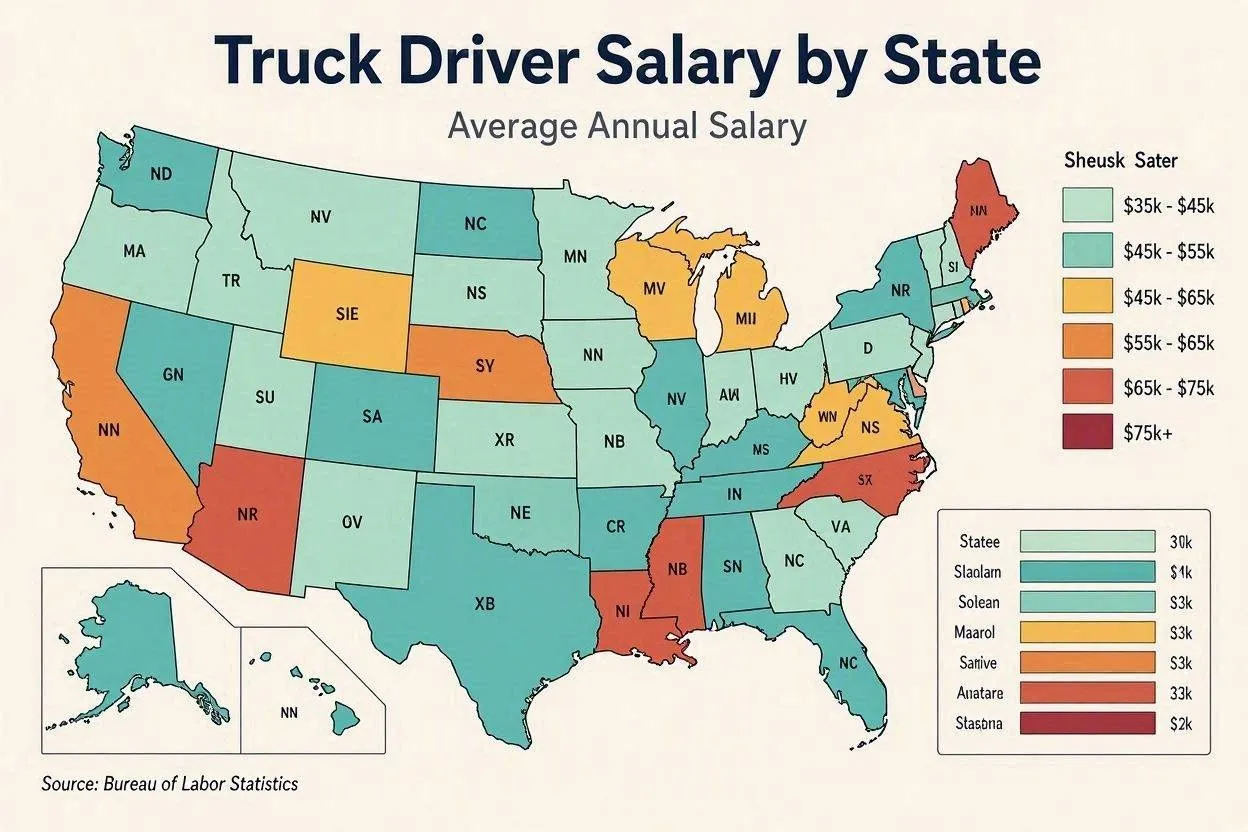
Every state pays truck drivers differently. 2026 estimates range from $51,310 in Louisiana to $68,520 in Alaska, based on BLS OEWS wage data adjusted for current trends. The table below lists all 50 states plus Washington, D.C., ranked highest to lowest for average annual wage among heavy and tractor-trailer truck drivers.
| Rank | State | Average Annual Wage |
| 1 | Alaska | $68,520 |
| 2 | New Jersey | $66,850 |
| 3 | Washington | $65,670 |
| 4 | Oregon | $63,890 |
| 5 | Wyoming | $63,220 |
| 6 | Minnesota | $62,110 |
| 7 | Nevada | $61,750 |
| 8 | Illinois | $61,230 |
| 9 | Colorado | $61,230 |
| 10 | New York | $61,200 |
| 11 | District of Columbia | $60,900 |
| 12 | California | $60,500 |
| 13 | Massachusetts | $60,200 |
| 14 | Connecticut | $59,950 |
| 15 | Pennsylvania | $59,700 |
| 16 | Utah | $59,500 |
| 17 | Texas | $59,300 |
| 18 | Rhode Island | $59,100 |
| 19 | Delaware | $58,950 |
| 20 | Arizona | $58,800 |
| 21 | Maryland | $58,700 |
| 22 | Hawaii | $58,600 |
| 23 | Indiana | $58,400 |
| 24 | Wisconsin | $58,300 |
| 25 | Ohio | $58,100 |
| 26 | Virginia | $57,900 |
| 27 | Idaho | $57,700 |
| 28 | Montana | $57,500 |
| 29 | Iowa | $57,300 |
| 30 | New Hampshire | $57,100 |
| 31 | Kansas | $56,900 |
| 32 | South Dakota | $56,700 |
| 33 | Nebraska | $56,500 |
| 34 | North Dakota | $56,300 |
| 35 | Vermont | $56,100 |
| 36 | Georgia | $55,900 |
| 37 | Tennessee | $55,700 |
| 38 | South Carolina | $55,500 |
| 39 | Kentucky | $55,300 |
| 40 | Oklahoma | $55,200 |
| 41 | Arkansas | $55,150 |
| 42 | Michigan | $55,090 |
| 43 | Missouri | $54,480 |
| 44 | Florida | $54,360 |
| 45 | Alabama | $54,040 |
| 46 | North Carolina | $53,990 |
| 47 | Maine | $53,960 |
| 48 | West Virginia | $51,920 |
| 49 | New Mexico | $51,530 |
| 50 | Mississippi | $51,330 |
| 51 | Louisiana | $51,310 |
Texas and California employ the largest number of heavy and tractor-trailer drivers in the country, yet neither cracks the top 10 for pay. A big driver population keeps supply closer to demand, which holds average wages nearer the national midpoint even with heavy freight volume moving through both states year-round. Alaska and Wyoming show the opposite pattern. Smaller driver pools and remote geography force wages upward no matter how much freight actually moves.
Which States Pay Truck Drivers the Most?
Alaska, New Jersey, and Washington pay the highest truck driver salaries in the country. Alaska’s mean annual wage reaches $68,520. New Jersey follows at $66,850, and Washington rounds out the top three at $65,670, per BLS OEWS data for 2024. Nevada, New York, Oregon, and Colorado also land well above the national mean.
Freight demand drives most of this. Alaska’s remote terrain and reliance on resource transport push carriers to pay a premium just to keep routes staffed. Washington’s port activity and proximity to Canadian trade routes create year-round freight volume. New Jersey’s dense population centers near New York City and Philadelphia mean a steady stream of short-haul and specialized freight work.
Washington, D.C. sometimes shows up above these figures in state-level rankings, but its driver population is tiny (fewer than 700 workers in the category), so a handful of high earners skew the average far more than they would in a state with tens of thousands of drivers.
Which States Pay Truck Drivers the Least?
Mississippi, Louisiana, and New Mexico pay the lowest truck driver salaries. Mississippi’s average lands near $51,330 a year. Smaller trucking industries, fewer major freight corridors, and lower overall wage floors keep pay below the national median in these states. West Virginia’s mountainous terrain limits certain freight routes, and Louisiana’s coastal geography narrows the pool of available long-haul lanes compared to interstate hubs like Illinois or Texas.
A driver in one of these states isn’t necessarily worse off in real terms, though. Lower cost of living often offsets a smaller paycheck, which is worth remembering before ruling out a state based on salary alone.
Why Does Truck Driver Salary by State Vary So Much?
Four things drive the spread: local freight demand, cost of living, the size of a state’s trucking industry, and how much specialized versus standard freight is available. No single factor explains it on its own.
States with major ports, agricultural exports, or manufacturing hubs need freight moving constantly, and that demand pushes carriers to compete on pay. Texas employs more heavy and tractor-trailer drivers than any other state, yet its average wage sits closer to the middle of the pack, because the supply of drivers roughly matches demand there. Alaska has the opposite problem. Extreme distances and a thin labor pool force wages upward regardless of freight volume.
Cost of living plays a role too. A state with a high Cost of Living Index, like Alaska at 127.7 or New York at 126.6, typically shows inflated wages across most professions, trucking included. Employers raise pay to keep workers able to afford housing and daily expenses in that market.
Specialized freight adds a third layer on top of geography. Hazardous materials, tanker loads, and oversized freight routinely add 15% to 35% over standard dry van rates, and states with more of that kind of freight, chemical corridors in New Jersey or oil-field routes in parts of Texas and Oklahoma, see wages climb accordingly.
How Does Route Type Affect Truck Driver Salary by State?
Route type changes pay more than almost anything else. Over-the-road (OTR) drivers earn $75,000 to $110,000+ a year, regional drivers average around $75,877, and local drivers average $63,020. These national numbers shift up or down by state, but the order between route types barely ever changes.
OTR drivers spend weeks away from home covering multiple states, and carriers pay a premium for that time commitment. A driver running dedicated long-haul lanes out of Chicago, for instance, can clear $62,000 in an entry-level year and push well past $80,000 with three to five years of experience and a clean safety record.
Regional drivers cover a defined multi-state area, like the Southeast or Midwest, and get home more often than OTR drivers while still logging enough miles to out-earn most local positions. Local drivers trade the highest pay ceiling for predictable schedules and nightly returns home. A lot of drivers with families choose that tradeoff on purpose, ceiling or not.
How Does Experience Level Change Truck Driver Pay?
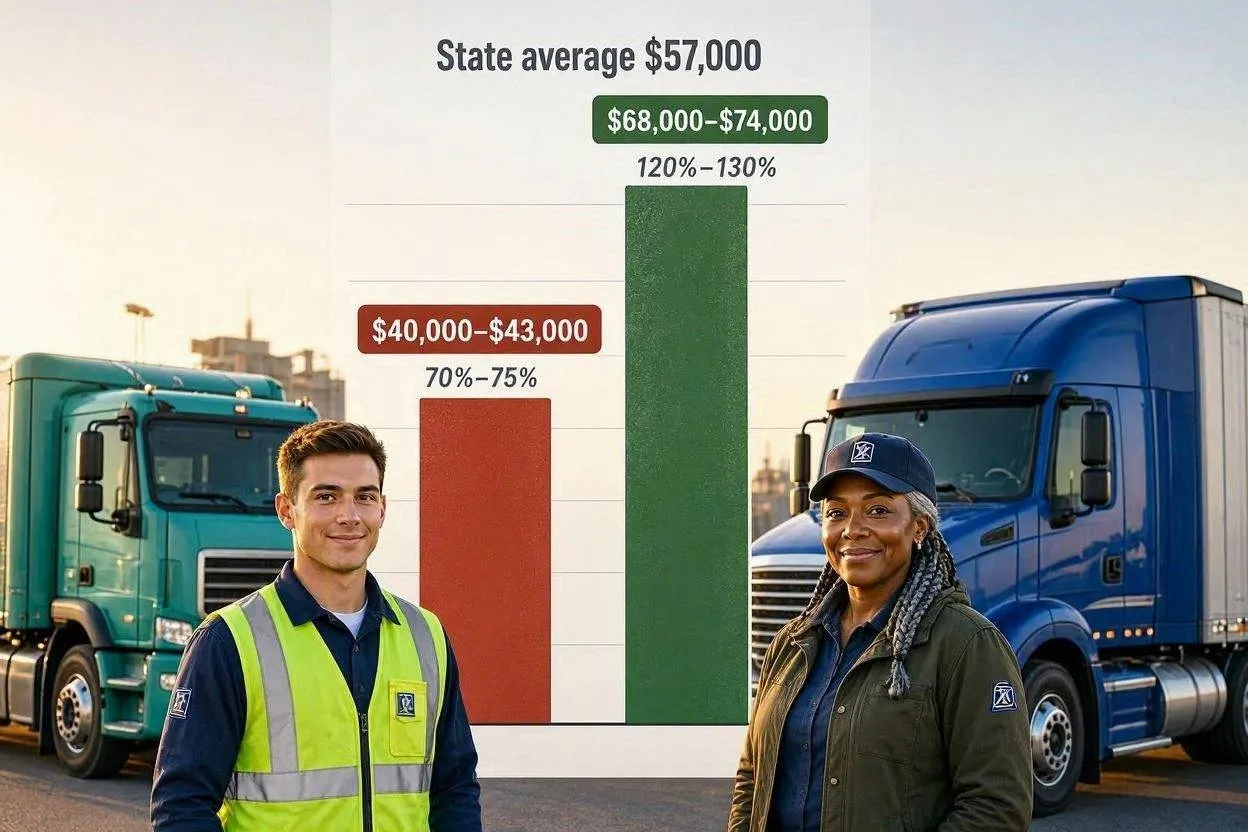
Entry-level truck drivers typically earn 70% to 75% of the state average in their first year. Drivers with three or more years on the road earn 120% to 130% of that average. A driver starting in a state with a $57,000 average might see $40,000 to $43,000 in year one, then climb toward $68,000 to $74,000 once tenure, a clean record, and added endorsements come into play.
Carriers reward safety history above almost everything else. Getting through a probationary period without violations, staying with a first employer for at least a year, and picking up endorsements like Hazmat or Tanker along the way usually gets a driver into the higher pay brackets faster than job-hopping every few months does.
How Much Do Owner-Operators Make Compared to Company Drivers?
Owner-operators earn a national average base of $228,000 a year, roughly four times what a company driver earns, though that number covers gross revenue rather than take-home pay. Reported owner-operator income commonly ranges from $150,000 to $312,000, with top earners in high-demand lanes reaching close to $400,000.
That figure looks impressive until the overhead gets factored in. Owner-operators cover their own fuel, maintenance, insurance, and truck payments, expenses a company driver never sees on a paycheck. Fuel alone can eat up 20% to 25% of gross revenue on a long-haul route, and an unplanned repair on a Class 8 tractor can easily run into the thousands. A company driver earning $65,000 with full benefits sometimes nets more in actual disposable income than an owner-operator grossing $180,000 with high overhead and no employer-paid health coverage.
Does Cost of Living Matter More Than the Salary Number?
Yes, often. A $55,000 wage in a low-cost state frequently stretches further than a $65,000 wage in a high-cost one. Housing, groceries, and taxes eat into take-home pay at very different rates depending on where a driver settles.
Wyoming makes the case well. Its Cost of Living Index sits at 95.3, below the national baseline of 100, while its average trucking wage of $63,220 already ranks among the highest in the country. A driver there gets a strong salary and an affordable place to live at the same time, a combination few high-paying coastal states can match. Compare that to New York, where a $61,200 average wage runs up against a Cost of Living Index over 126, and the real spending power drops noticeably.
Which CDL Endorsements Increase Truck Driver Pay?
Hazmat, Tanker, and Doubles/Triples endorsements typically add 15% to 35% over standard dry van rates. Each one requires passing a written exam through the state’s Commercial Driver’s License (CDL) process, and Hazmat also requires a background check through the Transportation Security Administration (TSA).
Carriers pay more for these because fewer drivers hold them and the freight involved carries higher liability. A Hazmat-endorsed driver hauling chemical freight through a corridor in New Jersey or Texas can out-earn a standard dry van driver in the same state by several thousand dollars a year, even at similar experience levels. Stack two or three endorsements, Hazmat plus Tanker for example, and that advantage compounds, opening access to the highest-paying specialized freight lanes.
How Does State Income Tax Affect Take-Home Pay?
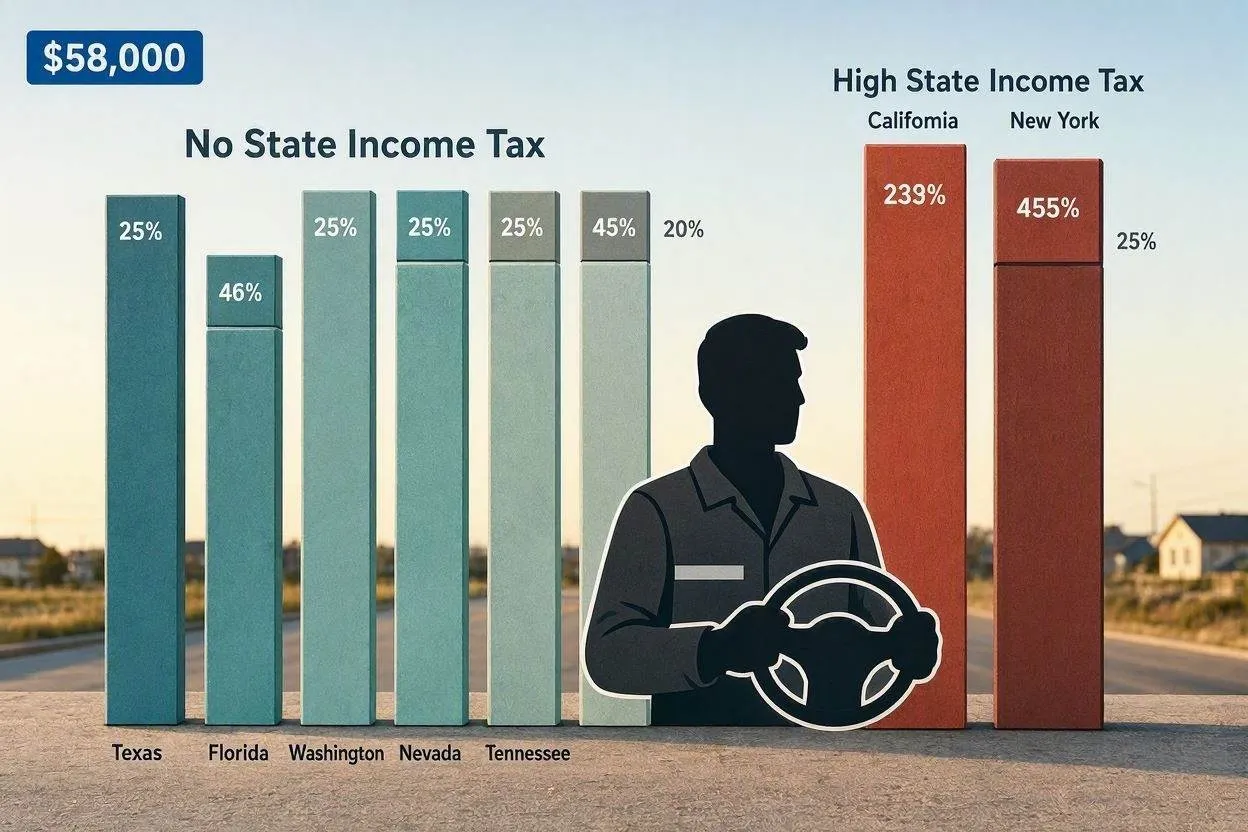
States with no income tax, including Texas, Florida, Washington, Nevada, and Tennessee, let drivers keep a larger share of their gross pay than high-tax states do. A driver earning $58,000 in Texas pays no state income tax on that amount, while a driver earning the same gross salary in California or New York loses a meaningful chunk to state withholding before cost-of-living differences even come into it.
This matters most for OTR and regional drivers who technically establish residency in one state while working routes across many others. Choosing a no-tax state as a home base, when the carrier and route structure allow for it, adds real dollars to annual take-home pay without a single extra mile driven.
Conclusion
Truck driver salary by state comes down to geography, freight demand, route type, and tax exposure, not a single number pulled off a job board. Alaska, New Jersey, and Washington sit at the top of the pay scale. Mississippi, Louisiana, and New Mexico anchor the bottom. The gap between them stretches past $17,000 a year before bonuses or endorsements even enter the calculation.
A driver weighing offers across state lines gets a clearer picture by checking the state average, the route type on offer, the cost of living in that market, and whether the job comes with pay-boosting endorsements like Hazmat or Tanker. None of these factors work in isolation. The strongest paycheck usually comes from stacking two or three at once, like an experienced OTR driver with a Hazmat endorsement working out of a no-income-tax state such as Texas or Washington.
FAQs

Esther Howard
Esther Howard leads TruckingHow’s trucking, commercial driving, and transportation content division. She specializes in CDL training, trucking regulations, fleet operations, truck maintenance, and logistics best practices. With over a decade of experience researching the commercial transportation industry, Esther brings a practical, research-driven approach to driver education, safety standards, and industry regulations. She is the primary author of TruckingHow’s CDL guides, trucking career resources, maintenance tips, and transportation content, helping drivers, fleet owners, and trucking professionals make informed decisions on and off the road
Related Posts