CDL Restrictions Explained: Every Code, Meaning, and Removal Step (2026)
A single letter on a Commercial Driver’s License can decide which jobs a driver actually qualifies for. That letter is a restriction code, and the Federal Motor Carrier Safety Administration (FMCSA) uses ten of them to flag the gap between what a driver tested on and what they’re legally cleared to drive. Some codes barely matter day to day. Others, like L or O, can quietly rule out most long-haul trucking work before a driver even applies. One, the V code, doesn’t track a driving skill at all, just a medical condition on file. This guide walks through every federal CDL restriction code, why it gets applied, and what it takes to remove it in 2026.
What Are CDL Restrictions?
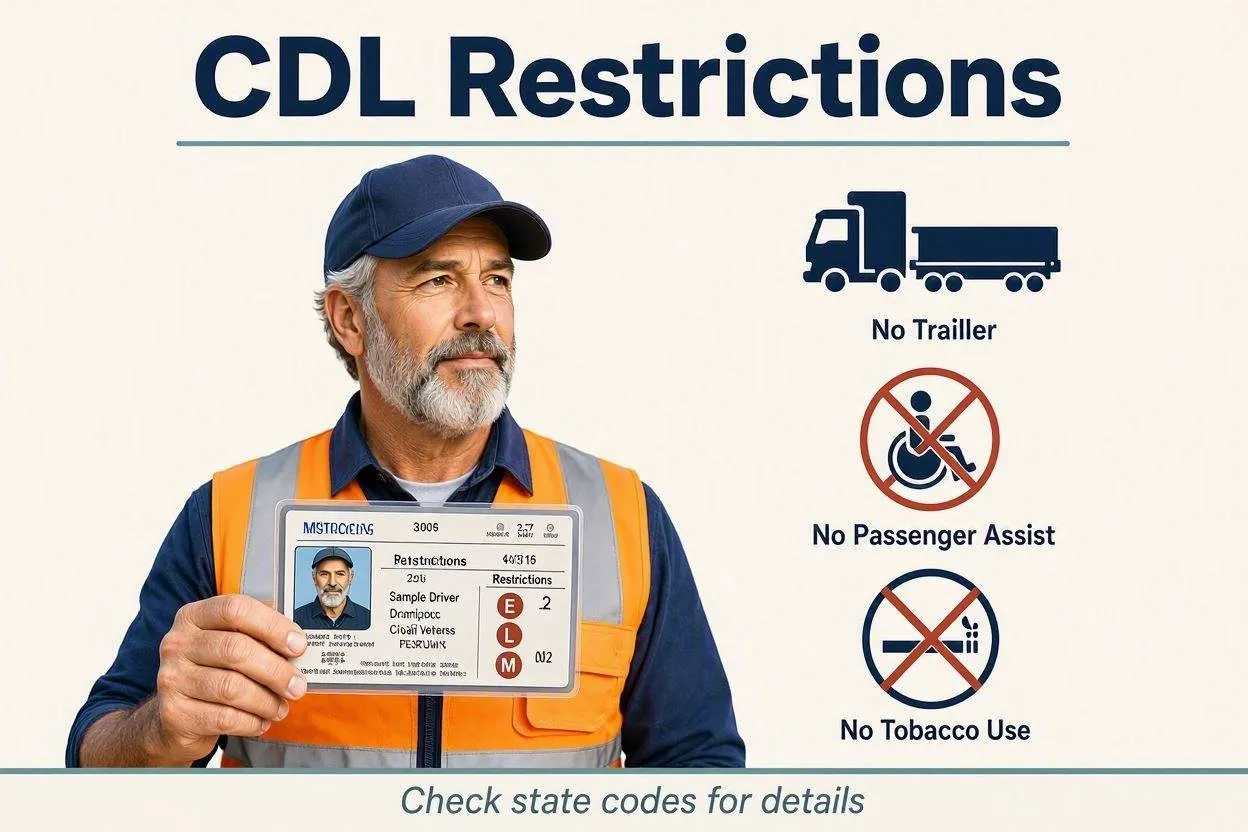
A CDL restriction is a limitation FMCSA or a state licensing agency places on a Commercial Driver’s License, and it blocks the holder from operating certain vehicles or working under certain conditions until they pass an additional test. It shows up as a single letter on the front of the license, printed after the letter “R,” right below the expiration date. Skip the air brake portion of your skills test, for instance, and you’ll get an L restriction, which means no full-air-brake commercial motor vehicle (CMV) until you clear it.
Restrictions aren’t the same thing as endorsements. Endorsements expand what you can haul or operate: passenger (P), school bus (S), tanker (N), hazardous materials (H). Restrictions narrow your privileges instead, until you prove you can handle whatever the test skipped. Ten codes cover most CDL restrictions nationwide, though states can and do tack on their own.
How Many CDL Restriction Codes Exist?
Ten: E, K, L, M, N, O, P, V, X, and Z. Each one ties to a specific testing gap or medical condition, and each applies to a defined set of license classes, Class A, B, C, or a Commercial Learner’s Permit (CLP). States sometimes add their own letters on top (Texas uses A through W across both commercial and non-commercial licenses), but these ten federal codes are the baseline every CDL holder in the country needs to know.
The 10 Federal CDL Restriction Codes Explained
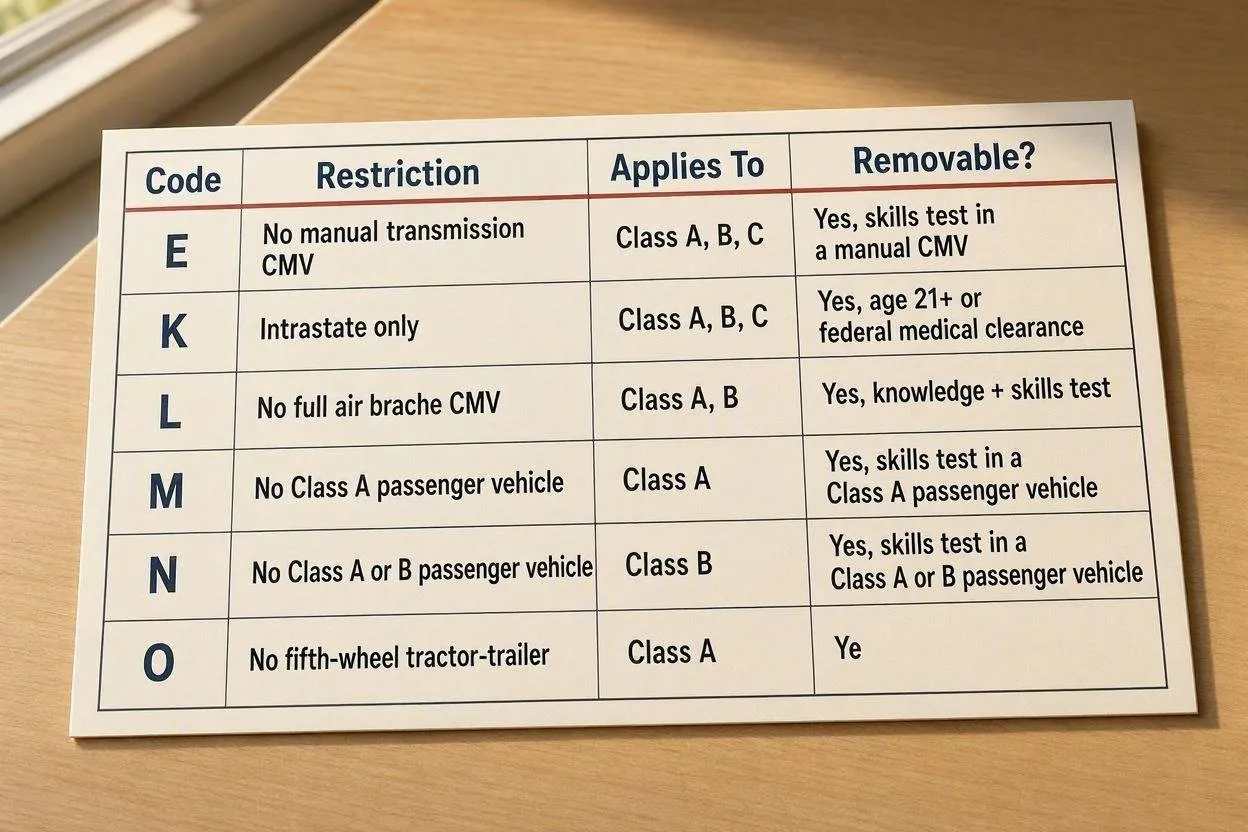
FMCSA ties each of the ten codes to a specific vehicle type, testing gap, or medical condition. Here’s the full list before the breakdown:
| Code | Restriction | Applies To | Removable? |
| E | No manual transmission CMV | Class A, B, C | Yes, skills test in a manual CMV |
| K | Intrastate only | Class A, B, C | Yes, age 21+ or federal medical clearance |
| L | No full air brake CMV | Class A, B | Yes, knowledge + skills test |
| M | No Class A passenger vehicle | Class A | Yes, skills test in a Class A passenger vehicle |
| N | No Class A or B passenger vehicle | Class B | Yes, skills test in a Class A or B passenger vehicle |
| O | No fifth-wheel tractor-trailer | Class A | Yes, skills test in a fifth-wheel CMV |
| P | No passengers in CMV (training) | CLP | Yes, skills test in a passenger-carrying vehicle |
| V | Medical variance on file | Class A, B, C | No, tied to an active FMCSA waiver |
| X | No cargo in tank vehicle | CLP | Yes, skills test in a loaded tank vehicle |
| Z | No full air brake CMV (air-over-hydraulic) | Class A, B | Yes, knowledge + skills test |
E Restriction
An E restriction means you can only drive CMVs with automatic or semi-automatic transmissions. FMCSA slaps this on when you take your skills test in an automatic instead of a manual. That still matters more than people expect, because manual transmissions haven’t disappeared from long-haul trucking. Plenty of carriers run older fleets built around them, and an E restriction quietly closes those jobs off.
Getting rid of it takes a restriction-free CLP held for at least 14 days, followed by an on-road skills test in a manual-transmission CMV. Train on something like a 2023 Freightliner Cascadia with a 10-speed manual, pass the test, and the restriction is gone the same day. You’ll still owe the standard state reissue fee.
K Restriction
K limits a driver to CMV operation inside the state that issued the CDL. It shows up most for drivers under 21, since federal law bars them from interstate commerce, and for drivers whose medical condition clears a state waiver but not a federal one. A K-restricted driver can run local delivery routes or short hauls within state lines, but crossing into the next state, even for a 20-mile trip, isn’t legal.
For drivers restricted purely on age, the K comes off automatically at 21, though a DMV visit is still needed to get the upgraded card. Medical K restrictions require meeting full federal medical standards first. There’s one newer wrinkle worth knowing: FMCSA’s Safe Driver Apprenticeship Pilot Program lets some 18-to-20-year-olds drive interstate under strict mentorship and safety-tech requirements, sidestepping the age-based K entirely.
L Restriction
L blocks a driver from operating any CMV with a full air brake system. Since most commercial trucks over 26,000 pounds (about 11,793 kg) run air brakes, this one restriction can eliminate a huge share of the trucking job market on its own. FMCSA applies it if you fail the air brakes knowledge test, can’t identify the components correctly, or test in a non-air-brake vehicle.
Clearing it takes four steps: hold a restriction-free CLP for 14 days, pass the air brakes knowledge test, complete the skills test in an air-brake-equipped CMV, and pay the reissue fee. Good news, the knowledge test has no attempt limit, so retaking it costs nothing but time.
M Restriction
M stops a Class A CDL holder from driving Class A passenger vehicles, including large articulated buses. It shows up when a Class A driver earns a passenger (P) or school bus (S) endorsement but tests in a Class B or C vehicle instead of Class A. Nothing else on the license changes. Freight hauling, tanker work, general trucking, all still fine. Only Class A passenger operation is off the table.
Clearing the M restriction means the same pattern: 14-day restriction-free CLP hold, then a skills test in an actual Class A passenger vehicle. Pass in something like a 45-foot articulated transit bus, and it’s done in one attempt.
N Restriction
N keeps a Class B CDL holder out of Class A or Class B passenger vehicles. It applies when a Class B driver completes the P or S endorsement skills test in a Class C vehicle instead. Non-passenger Class B work, box trucks, dump trucks, stays fine, and so does driving Class C passenger vehicles. Just not the larger buses.
Here’s a wrinkle worth knowing: if the driver later tests in a Class B passenger vehicle instead of Class A, the N doesn’t disappear, it converts into an M restriction. Full removal requires testing in whichever class of passenger vehicle the driver actually plans to operate, plus the usual 14-day CLP hold beforehand.
O Restriction
O bars a driver from operating tractor-trailers connected through a fifth-wheel coupling. It applies when the skills test uses a pintle hook, gooseneck, or ball-and-chain setup instead. Fifth-wheel connections power most long-haul semis on the road, so an O restriction can cut off a serious chunk of available work. One large produce hauler in California, for example, requires fifth-wheel proficiency on every dry-van route it runs, no exceptions.
Clearing it means the standard 14-day restriction-free CLP hold plus a full skills test in a fifth-wheel-equipped tractor-trailer. Pass that, and the reissued CDL covers standard semi-truck operation nationwide.
P Restriction
P stops a CLP holder from carrying passengers in a CMV bus during training. It applies to drivers working toward a passenger endorsement who haven’t yet passed the skills test in a passenger-carrying vehicle. During that training window, riders are limited to CDL examiners, state or federal auditors, CDL trainers, and other CLP holders in training. Regular members of the public don’t count, no matter the circumstances.
The restriction lifts once a driver holds a restriction-free CLP for 14 days, passes the required knowledge tests for the vehicle class and endorsement, and completes the skills test in a passenger-carrying vehicle. After that, paying passengers and the general public are both fair game.
V Restriction
V is different from the rest. It flags a documented medical variance on file with FMCSA rather than limiting which vehicles you can drive. Diabetes requiring insulin, a history of seizures, hearing or vision impairments managed under an approved waiver, these are the conditions that typically qualify. A driver carrying a V restriction keeps proof of the variance on hand and stays current on required medical evaluations, but faces no vehicle-class limitation because of it.
You can’t clear this one at the DMV. It stays on the license as long as the underlying condition and its FMCSA waiver remain active, and it only drops off if the condition resolves or the driver requalifies under standard DOT medical certification without needing a variance at all.
X Restriction
X blocks a driver from operating a tank vehicle that’s carrying cargo, liquid, or gas residue. It applies to CLP or CDL holders with a tanker (N) endorsement who tested in an empty tank instead of a loaded one. Worth noting separately: any tank that previously carried hazardous material has to be purged and carry a purge certificate before it can move, X restriction or not.
To remove it: 14-day restriction-free CLP hold, any outstanding knowledge tests for the class and endorsement, and a skills test completed in a tank vehicle loaded with liquid cargo. Pass all that, and the new CDL comes without the X.
Z Restriction
Z prohibits operating a CMV with a full air brake system, same as L, but the trigger is different. Z gets applied specifically when the skills test used a vehicle with an air-over-hydraulic or partial hydraulic braking setup, not because the driver failed or skipped the air brakes test outright.
Removal follows the L pattern almost exactly: 14-day restriction-free CLP hold, air brakes knowledge test if it hasn’t been passed already, skills test in a full-air-brake CMV, and reissue. Once that’s done, the driver can operate any CMV regardless of brake system.
Why CDL Restrictions Matter
Three things are really at stake here.
Employment access. An L or O restriction alone can knock a driver out of most long-haul trucking positions, since the majority of semi-trucks on the road run air brakes and fifth-wheel couplings.
Road safety. Restrictions exist so a driver only gets cleared on equipment they’ve actually operated. That cuts down the odds of someone misjudging a system they’ve never trained on, at highway speed, with a full trailer behind them.
Legal exposure. Operate a CMV outside a listed restriction and you’re risking fines, a downgraded CDL, or in repeat cases, license suspension if a roadside inspection catches it. A driver pulled over hauling a loaded tanker under an active X restriction isn’t getting a warning. That’s an out-of-service order on the spot.
How to Remove a CDL Restriction
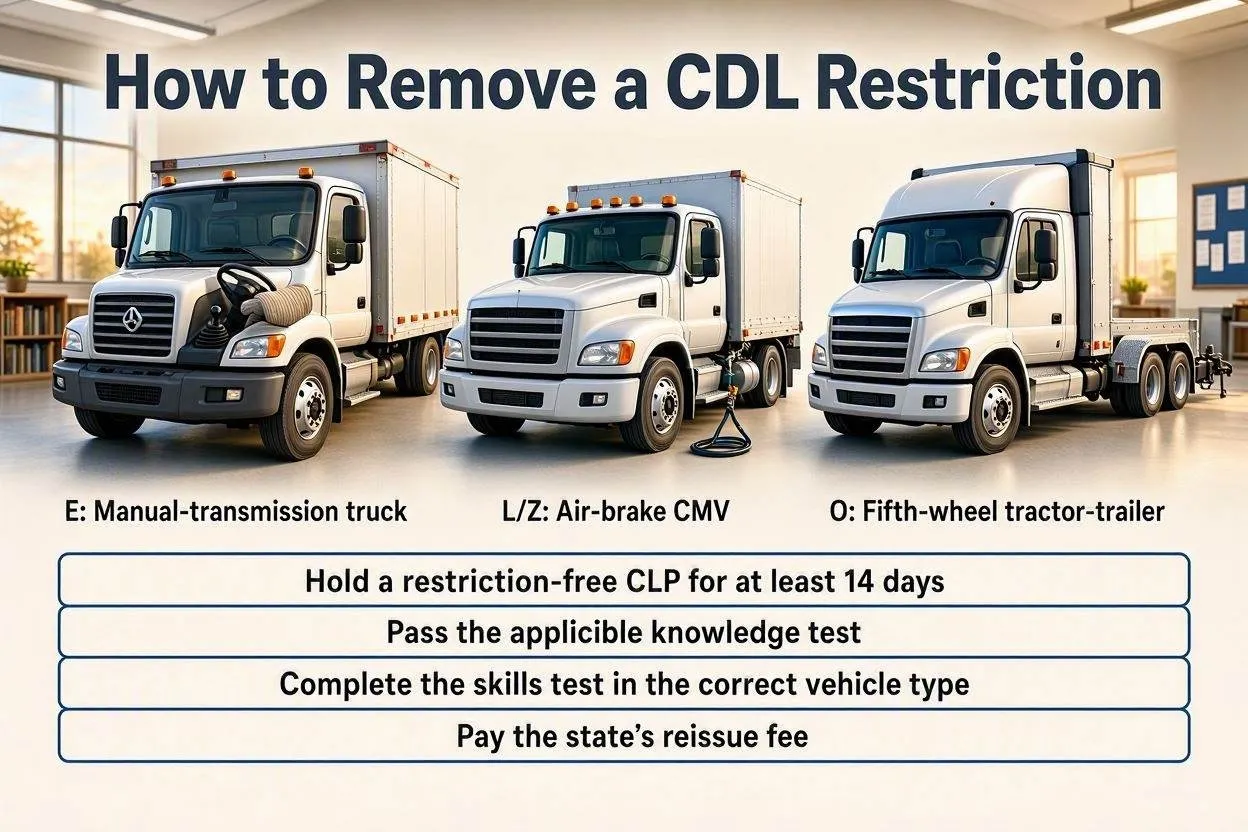
Most restrictions come off the same way: hold a restriction-free CLP for at least 14 days, pass whatever knowledge test applies, complete the skills test in the correct vehicle type, and pay the state’s reissue fee. Which vehicle you need depends on the code, a manual-transmission truck for E, an air-brake CMV for L or Z, a fifth-wheel tractor-trailer for O.
Two exceptions break that pattern. Age-based K restrictions resolve automatically at 21, no new skills test required, just a DMV visit, assuming there’s no other restriction attached. And V can’t be removed at the DMV at all. It stays active for as long as FMCSA’s medical variance remains on file, full stop.
CDL Restrictions vs. State License Restrictions (Texas Example)
Federal CDL codes and state driver’s license codes reuse the same letters for completely different meanings, and that trips up a lot of drivers checking their own card. Texas is a clean example. Under the Texas Department of Public Safety system, “K” means moped-only and “M” means CDL intrastate commerce only. Under the federal FMCSA system printed on the CDL itself, “K” means intrastate only and “M” means no Class A passenger vehicle, the opposite letters carrying opposite meanings.
This matters most for drivers moving between states, or anyone holding both a standard license and a CDL. If you’re reading a Texas state restriction list, assume it applies to the standard license, not the federal codes on your commercial license. When in doubt, flip the physical CDL over. FMCSA’s full restriction text is printed there, and it settles any ambiguity a state chart can’t.
CDL Restrictions and Endorsements: How They Interact
Restrictions and endorsements show up together constantly, and one often causes the other directly. Earn a tanker (N) endorsement without testing in a loaded tank, and the X restriction gets attached automatically, the endorsement grants general tanker privileges while the restriction narrows how you can use them until you close the testing gap. The P and S endorsements work the same way, pairing with a P restriction during training that only clears once the full skills test is passed in an actual passenger vehicle.
Three pairings come up most in practice:
- N endorsement + X restriction: tanker privileges without loaded-tank testing.
- P or S endorsement + P restriction: passenger or school bus privileges still in training status.
- Class B CDL + P/S endorsement tested in Class C: triggers an N restriction instead of a clean endorsement.
If a tanker career is the goal, request a loaded-tank skills test from the start. It sidesteps the X restriction entirely and saves a second DMV trip down the line.
Non-Domiciled CDLs and the K Restriction
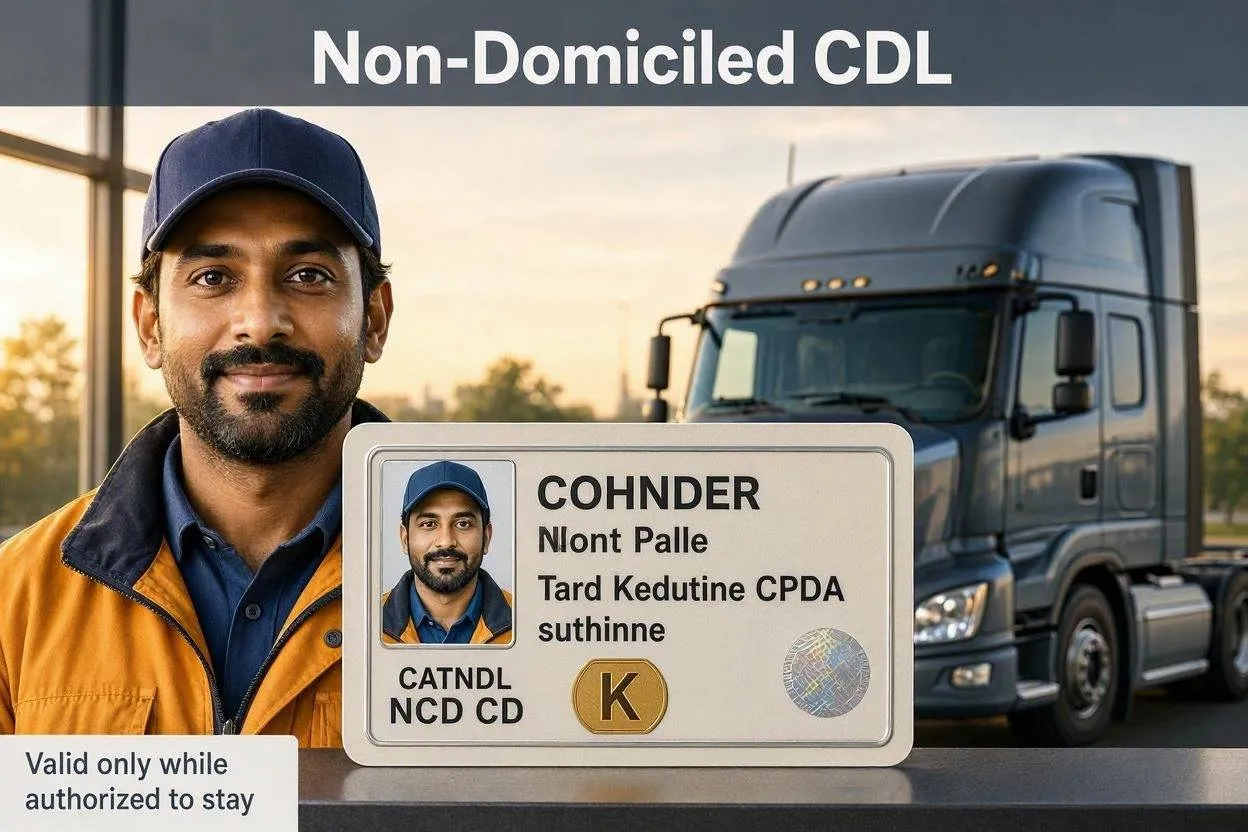
A non-domiciled CDL goes to drivers who aren’t U.S. citizens or permanent residents but hold valid work authorization, and it can carry the same K restriction under the same intrastate rules as any standard CDL. That matters for foreign nationals working U.S. trucking on a visa, since their CDL’s validity ties to their authorized stay in the country. Any K restriction on that card behaves exactly like one on a domestic license: no interstate hauls until it clears through the same 14-day CLP and testing process.
CDLIS, the national Commercial Driver’s License Information System, tracks every restriction against a driver’s record across all 50 states, domiciled or not. Add a restriction in one state and it shows up instantly if that driver applies for a CDL anywhere else, which is exactly why restriction-shopping between states doesn’t work.
Conclusion
Ten federal codes, each tied to a specific testing gap or medical condition, each removable through a defined process built around a 14-day CLP hold and a targeted skills test. V is the one exception no amount of retesting clears, since it tracks an active FMCSA medical variance rather than a missing skill. Every other code, E, K, L, M, N, O, P, X, and Z, comes off the same way it went on: by proving the exact skill FMCSA flagged as missing, in the exact vehicle type the restriction names.
FAQs

Esther Howard
Esther Howard leads TruckingHow’s trucking, commercial driving, and transportation content division. She specializes in CDL training, trucking regulations, fleet operations, truck maintenance, and logistics best practices. With over a decade of experience researching the commercial transportation industry, Esther brings a practical, research-driven approach to driver education, safety standards, and industry regulations. She is the primary author of TruckingHow’s CDL guides, trucking career resources, maintenance tips, and transportation content, helping drivers, fleet owners, and trucking professionals make informed decisions on and off the road
Related Posts