
CDL Age Requirements by State (2026): Full Chart, Rules & Exceptions
The minimum age to get a CDL is 18 for intrastate driving and 21 for interstate driving in every U.S. state except Hawaii, where it’s 21 across the board. Those floors come from the Federal Motor Carrier Safety Administration, and states can’t set them any lower. A few states tack on extra rules around endorsements, so the age you actually need depends on where you live and what you plan to haul.
This guide breaks down the state-by-state picture, explains the 18-vs-21 split, and covers the endorsement ages, exceptions, and a federal pilot program most other guides skip over.
What Is the Minimum Age to Get a CDL?
Eighteen. In 49 states and D.C., an 18-year-old can hold a Commercial Learner’s Permit, complete Entry-Level Driver Training, and pass the skills test for a Class A, B, or C license. The catch isn’t the license itself, it’s what it lets you do. An 18-year-old CDL holder can be driving a fully loaded tractor-trailer the same week they pass the test, but only inside their home state.
Hawaii breaks the pattern. State law sets its CDL floor at 21 for every class and every route, intrastate or interstate. States are allowed to set stricter standards than the federal minimum, and Hawaii is the only one that does.
CDL Age Requirements by State: 18 vs. 21 Explained
Intrastate Driving (Age 18)
An 18-year-old can legally drive a commercial truck as long as the whole route stays inside their home state. A Texas-licensed 18-year-old can haul freight from Houston to El Paso without any issue, since both cities sit inside Texas. That same driver can’t legally carry the load another fifteen miles into Louisiana. Local delivery, construction hauling, agricultural transport, municipal work: this is where most 18-to-20-year-old CDL holders start out.
Interstate Driving (Age 21)
Twenty-one is the required age to cross state lines, and there’s no state-level wiggle room here. The rule sits in 49 CFR Part 391 and kicks in the moment a route crosses a border, no matter how short that stretch is. It also applies to any load requiring hazmat placards, even if the trip never leaves the driver’s home state. Most long-haul and over-the-road carriers, including the big national fleets, need interstate eligibility from their drivers, which is why they typically won’t hire anyone under 21.
Which State Has a Different CDL Age Requirement?
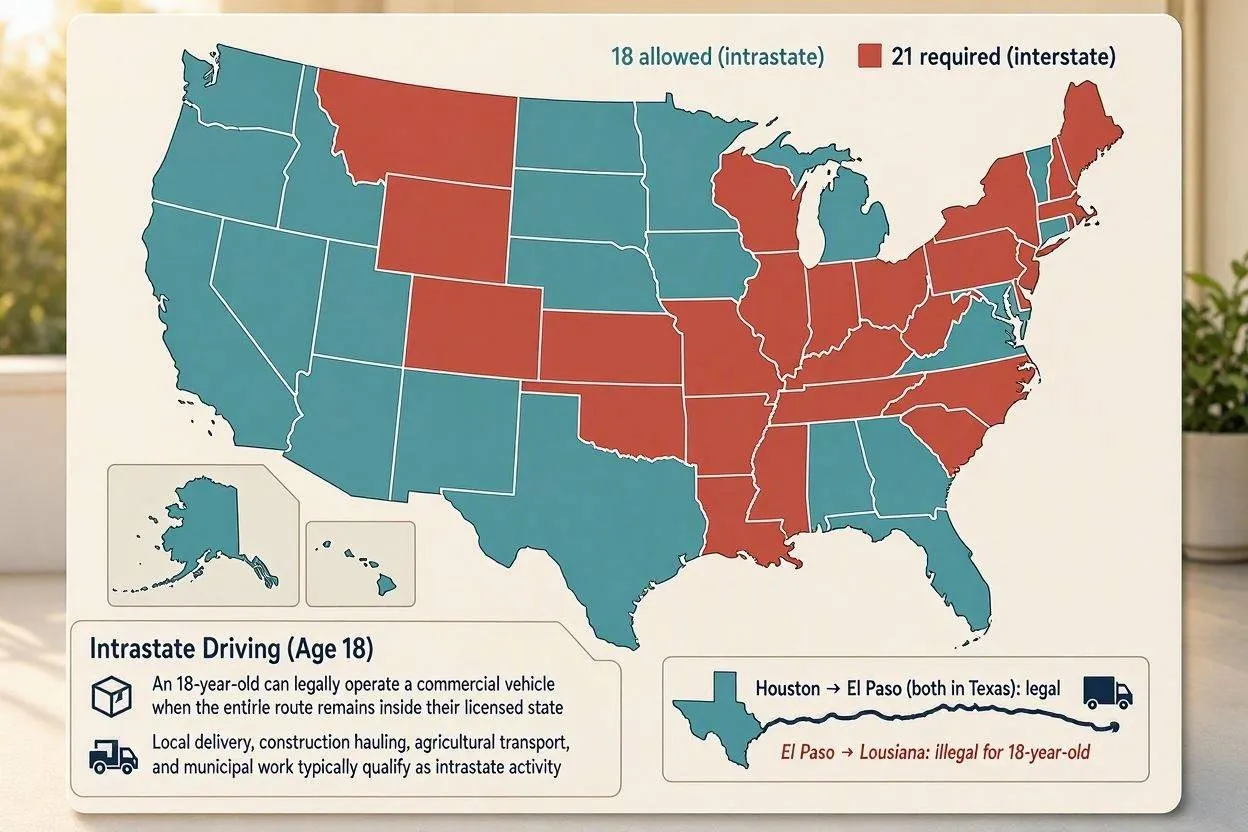
Hawaii, and it’s the only one. Every applicant there, intrastate or interstate, has to be at least 21 before applying. Move to Hawaii with an out-of-state CDL you got at 19 or 20, and you’ll be waiting until your 21st birthday to transfer it, since Hawaii doesn’t recognize the intrastate-only CDLs other states hand out to younger drivers.
You’ll also see some sources online claiming Alaska requires drivers to be 19. That number doesn’t show up in Alaska’s DMV CDL manual, in FMCSA’s state comparison data, or anywhere in the Commercial Motor Vehicle Safety Act. Alaska follows the standard 18/21 rule like everyone else. Treat that 19 claim as wrong and confirm directly with Alaska DMV if you’ve seen it somewhere.
CDL Age Requirements by State: Full Chart
| State | Intrastate Minimum | Interstate Minimum |
| Alabama | 18 | 21 |
| Alaska | 18 | 21 |
| Arizona | 18 | 21 |
| Arkansas | 18 | 21 |
| California | 18 | 21 |
| Colorado | 18 | 21 |
| Connecticut | 18 | 21 |
| Delaware | 18 | 21 |
| District of Columbia | 18 | 21 |
| Florida | 18 | 21 |
| Georgia | 18 | 21 |
| Hawaii | 21 | 21 |
| Idaho | 18 | 21 |
| Illinois | 18 | 21 |
| Indiana | 18 | 21 |
| Iowa | 18 | 21 |
| Kansas | 18 | 21 |
| Kentucky | 18 | 21 |
| Louisiana | 18 | 21 |
| Maine | 18 | 21 |
| Maryland | 18 | 21 |
| Massachusetts | 18 | 21 |
| Michigan | 18 | 21 |
| Minnesota | 18 | 21 |
| Mississippi | 18 | 21 |
| Missouri | 18 | 21 |
| Montana | 18 | 21 |
| Nebraska | 18 | 21 |
| Nevada | 18 | 21 |
| New Hampshire | 18 | 21 |
| New Jersey | 18 | 21 |
| New Mexico | 18 | 21 |
| New York | 18 | 21 |
| North Carolina | 18 | 21 |
| North Dakota | 18 | 21 |
| Ohio | 18 | 21 |
| Oklahoma | 18 | 21 |
| Oregon | 18 | 21 |
| Pennsylvania | 18 | 21 |
| Rhode Island | 18 | 21 |
| South Carolina | 18 | 21 |
| South Dakota | 18 | 21 |
| Tennessee | 18 | 21 |
| Texas | 18 | 21 |
| Utah | 18 | 21 |
| Vermont | 18 | 21 |
| Virginia | 18 | 21 |
| Washington | 18 | 21 |
| West Virginia | 18 | 21 |
| Wisconsin | 18 | 21 |
| Wyoming | 18 | 21 |
Forty-nine states plus D.C. follow the exact same 18/21 structure, so the real work here isn’t memorizing 50 numbers, it’s understanding the two exceptions that actually matter: Hawaii’s age floor and the endorsement rules below.
How Old Do You Need to Be for CDL Endorsements?
Twenty-one is the minimum for three major endorsements: Hazardous Materials, and, in most states, Passenger and School Bus. Getting your base CDL at 18 doesn’t clear you for every job a CDL can cover. Endorsements have their own age floors, and a couple sit even higher than 21.
Hazmat Endorsement Age
Every state requires 21 for the Hazardous Materials (H) endorsement, no exceptions. This comes from federal law, not state discretion, because hazmat transport has interstate implications by default. You’ll also need to pass a TSA Security Threat Assessment, background check and fingerprinting included, before the endorsement gets issued.
Passenger and School Bus Endorsement Age
Most states set the Passenger (P) endorsement at 21, matching the interstate minimum. School Bus (S) endorsements often run higher, sometimes 21 to 24 depending on the state, since a bus full of kids brings extra scrutiny beyond what FMCSA requires. A 19-year-old with a valid intrastate CDL still can’t drive a school route in most states until they hit that state’s specific age floor.
Can 18-Year-Olds Drive Interstate? The SDAP Pilot Program
Yes, a small number of them can, through FMCSA’s Safe Driver Apprenticeship Pilot. Launched in 2022, SDAP lets younger drivers cross state lines under conditions the standard rule doesn’t allow: employment with a participating carrier, at least 120 hours of supervised interstate driving alongside an experienced mentor, and a truck fitted with specific safety tech, including active braking collision-mitigation systems and forward-facing event recorders.
SDAP doesn’t lower the national age requirement. It creates a narrow, monitored exception for drivers who complete the apprenticeship. Coverage is limited to carriers that have opted in, so most 18-to-20-year-olds are still stuck under the standard intrastate-only restriction until they turn 21.
Is There a Maximum Age for a CDL?
No. A driver in their seventies can hold and renew a CDL indefinitely, provided they pass the same requirements as everyone else: a current DOT physical exam, a clean-enough driving record, and passing scores on any required tests. Age by itself never disqualifies a driver, only medical fitness and driving history do.
What Else Affects CDL Eligibility Besides Age?
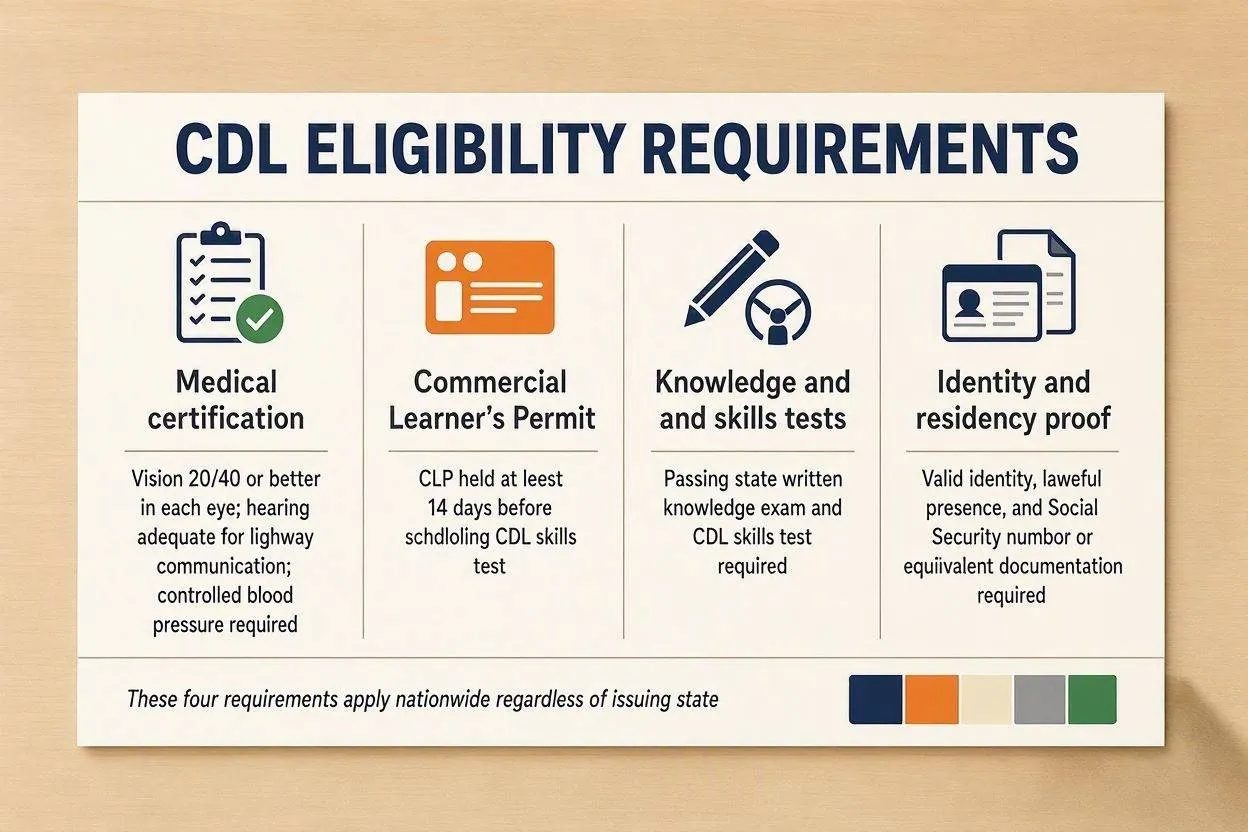
Age sets the floor, but four other requirements apply nationwide regardless of which state issues the license.
- Medical certification: a current Medical Examiner’s Certificate from an examiner on the FMCSA National Registry, covering vision (20/40 or better in each eye), hearing, and blood pressure.
- Commercial Learner’s Permit: most states require holding a CLP for at least 14 days before you can schedule the CDL skills test.
- Entry-Level Driver Training: required since February 2022 for any first-time applicant, combining classroom theory with behind-the-wheel instruction.
- Legal residency proof: federal regulation requires documenting citizenship or lawful permanent residency, plus an Alien Registration Number for lawful permanent residents going for a Hazmat endorsement.
How to Get a CDL at 18
Apply for a Commercial Learner’s Permit, complete ELDT training, and pass the state skills test, all within your home state, since interstate driving is off-limits until 21. The process typically takes four to eight weeks from CLP application to final road test, though that shifts depending on your state DMV’s scheduling and how fast a training provider can get you in. Most 18-year-olds start in intrastate roles like construction hauling, local delivery, or agricultural transport, then apply for interstate privileges the day they turn 21, which is usually a straightforward upgrade that doesn’t require retesting.

Conclusion
CDL age requirements come down to two numbers that hold steady across nearly the whole country: 18 for intrastate driving, 21 for interstate and hazmat. Hawaii is the lone exception at 21 across the board, and SDAP is the narrow federal carve-out that lets a small group of 18-to-20-year-olds drive interstate under supervision. Everything else, endorsement ages, CLP hold periods, ELDT training, sits on top of that same 18/21 foundation. Checking your state’s DMV page directly is still the fastest way to catch anything that’s changed since this guide was written.
FAQs

Esther Howard
Esther Howard leads TruckingHow’s trucking, commercial driving, and transportation content division. She specializes in CDL training, trucking regulations, fleet operations, truck maintenance, and logistics best practices. With over a decade of experience researching the commercial transportation industry, Esther brings a practical, research-driven approach to driver education, safety standards, and industry regulations. She is the primary author of TruckingHow’s CDL guides, trucking career resources, maintenance tips, and transportation content, helping drivers, fleet owners, and trucking professionals make informed decisions on and off the road
Related Posts