

CDL Medical Exam Requirements: The Complete 2026 Driver’s Guide
Most commercial drivers don’t think much about their health paperwork until the day it almost costs them their job. A blood pressure cuff, a whisper test, a urine sample, and suddenly a career built over years hangs on numbers most people never bother tracking. CDL medical exam requirements exist to prevent exactly that kind of surprise, and understanding them ahead of time is the difference between a routine appointment and a scramble to save your license.
This guide covers what the exam actually checks, who has to take it, the four self-certification categories the FMCSA requires, and the filing changes rolling out through 2026 that affect how quickly your results reach your state.
What Are CDL Medical Exam Requirements?
CDL medical exam requirements are the federal health standards set out in 49 CFR 391.41 that every commercial driver must meet to receive a Medical Examiner’s Certificate, often called a DOT medical card. A Certified Medical Examiner (CME) listed on the FMCSA National Registry performs the exam and checks vision, hearing, blood pressure, and general physical fitness against those standards. Pass, and you get a certificate valid for up to two years. Fall short on any one measure, and your certification gets delayed, shortened, or denied outright until the issue is resolved.
The exam isn’t a formality tacked onto licensing. It’s a genuine fitness-for-duty screening, built around a simple premise: a driver who can’t see a stop sign clearly, hear a warning shout, or manage a cardiovascular event behind the wheel puts everyone on the road at risk, not just themselves.
Who Has to Meet CDL Medical Exam Requirements?

Anyone operating a commercial motor vehicle in interstate commerce with a gross vehicle weight rating over 10,000 pounds falls under these rules. So does anyone transporting more than 15 passengers, anyone paid to carry more than 8 passengers, and anyone hauling placarded hazardous materials. Many states extend similar standards to intrastate drivers too, so staying purely within one state’s borders doesn’t automatically exempt a driver.
Weight class, passenger count, and cargo type decide whether the requirement applies, not the length of the route. A local delivery driver in a box truck loaded near the weight threshold faces the same standard as someone driving cross-country. It catches people off guard how often “local” and “regulated” turn out to be the same thing.
Inside the DOT Physical: What Actually Gets Tested
A DOT physical runs through several distinct pieces, and understanding the sequence helps drivers know what to expect walking in. First comes a medical history questionnaire covering roughly 32 health questions, everything from past surgeries to current medications to any history of seizures or fainting. Then the CME moves into the hands-on portion: a physical exam covering ten body systems, including the eyes, ears, heart, lungs, spine, and nervous system.
From there, three specific measurements determine most outcomes: vision, hearing, and blood pressure. A urinalysis screens for protein, blood, and sugar, which can signal kidney disease or diabetes, though it isn’t a drug test (that’s a separate 5-panel screen under 49 CFR Part 40, usually scheduled at a different point in the hiring process). Depending on a driver’s history, the exam may also flag a need for further evaluation of sleep apnea, cardiovascular risk, or neurological function before certification is finalized.
Vision Standards
To pass the vision portion, a driver needs at least 20/40 visual acuity in each eye, with or without corrective lenses. Peripheral vision has to reach 70 degrees in each eye, and the driver must correctly identify red, yellow, and green traffic signal colors. The CME records all three results separately on FMCSA Form MCSA-5875.
Bring glasses or contacts to the exam room. Corrected vision is what gets measured, not natural acuity. A driver who fails in one eye but passes in the other still has options through the FMCSA vision exemption program, though the paperwork for that has to be filed before the exam, not scrambled together after a failed result comes back.
Hearing Standards
The hearing standard is more forgiving than most drivers expect: perceive a forced whisper from 5 feet away in at least one ear, with or without a hearing aid, and you pass. The examiner stands at that distance, whispers a short string of numbers or letters, and checks whether the driver, ear covered on one side, catches them accurately. Anyone who can’t clear the whisper test can instead take an audiometric exam measuring hearing loss across specific frequencies in decibels.
Hearing aids stay in during the test, and examiners note their use on the certificate itself. Significant hearing loss in both ears doesn’t end the process automatically; the FMCSA hearing exemption program covers drivers whose audiometric results meet its threshold.
Blood Pressure and Cardiovascular Standards
Blood pressure trips up more drivers than any other single measure in the exam, and it’s graded across four tiers rather than a simple pass-fail line.
- Stage 1 (below 140/90 mmHg): full 24-month certification
- Stage 2 (140/90–159/99 mmHg): 12-month certification, with a follow-up check required at renewal
- Stage 3 (160/100–179/109 mmHg): a one-time certificate valid up to 12 months, contingent on getting the reading down to 140/90 or below
- Stage 4 (180/110 mmHg or higher): disqualification until blood pressure is controlled and re-checked
A Stage 2 reading at a routine visit isn’t a failure. It just means a shorter certification window and a note requiring proof of management next time around. Caffeine, tobacco, and heavy sodium intake in the 24 hours before an exam can nudge a borderline number into a higher stage, which is why experienced CMEs tell drivers to skip all three the day before.
Cardiovascular history gets weighed alongside the raw numbers. A driver recovering from a heart procedure typically needs a cardiologist’s clearance letter before any certificate gets issued, regardless of what the blood pressure cuff shows on exam day.
Diabetes, Sleep Apnea, and Other Disqualifying Conditions
Chronic conditions don’t automatically disqualify a driver, but they reshape how certification works. Drivers on insulin have to apply for a Federal Diabetes Exemption, which requires ongoing documentation from a treating endocrinologist, typically at least three months of blood glucose records, and usually results in annual renewal instead of the standard two-year cycle. Diabetes managed through diet or oral medication alone doesn’t require the same exemption process.
Sleep apnea sits in murkier territory. The FMCSA doesn’t mandate universal sleep apnea testing, but a CME who suspects it, based on neck size, reported daytime fatigue, or other risk factors, can require a sleep study before signing off. Drivers already diagnosed need to show CPAP compliance data covering at least 30 days; non-compliance counts as a real disqualifying factor, not a minor note on the file. Epilepsy, uncontrolled seizure disorders, and certain neurological conditions get evaluated case by case, often requiring an exemption application if the condition is otherwise well-managed.
The 4 CDL Self-Certification Categories
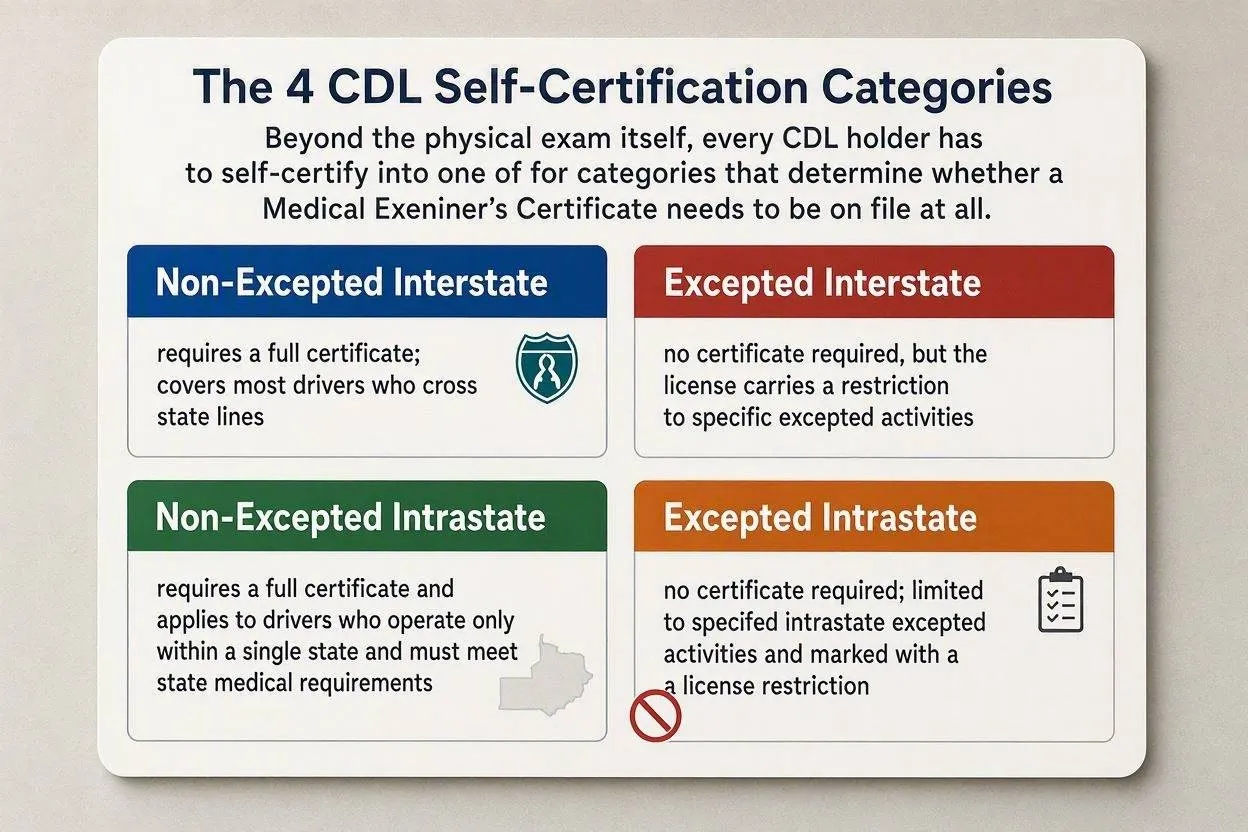
Beyond the physical exam itself, every CDL holder has to self-certify into one of four categories that determine whether a Medical Examiner’s Certificate needs to be on file at all.
- Non-Excepted Interstate: requires a full certificate; covers most drivers who cross state lines
- Excepted Interstate: no certificate required, but the license carries a restriction to specific excepted activities
- Non-Excepted Intrastate: requires a certificate; covers drivers who stay within one state without qualifying for an exception
- Excepted Intrastate: no certificate required, reserved for narrow cases like pre-1989 farm-related driving or certain oilfield and crane operations
Most drivers working for a regional or national carrier fall into Non-Excepted Interstate. Choosing the wrong category isn’t a small clerical error, either; state agencies cross-reference the self-certification on file against the CME’s submitted results, and a mismatch can trigger an outright rejection of the filing.
How to Prepare for a DOT Physical
Walking in prepared cuts down on delays more than almost anything else a driver controls. Bring a valid photo ID, a current medication list, and documentation for any chronic conditions as the baseline. Prior medical certificates help establish continuity, and contact information for a primary care physician speeds up any follow-up questions the examiner has.
Drivers managing specific conditions should go a step further: a CPAP compliance report for sleep apnea, recent A1C results for diabetes, or a cardiologist’s clearance letter after a cardiac event. None of this guarantees an automatic pass, but missing it almost always turns a routine visit into a “pending” status while the examiner waits on records that should have come in the door already. On the practical side, skip caffeine and salty food the day before, get a decent night’s sleep, and show up hydrated. It sounds minor. It isn’t. A rushed, dehydrated, over-caffeinated driver can post a blood pressure reading that doesn’t reflect their actual baseline health at all.
What Happens If You Fail
Failing a DOT physical doesn’t end a driving career, even though it feels that way in the moment. The path forward follows a fairly consistent sequence:
- Get the exact reason for disqualification directly from the examiner.
- Talk to a treating physician about managing the underlying condition.
- Apply for an FMCSA exemption if the condition qualifies, which covers vision, hearing, diabetes, and certain seizure disorders.
- Schedule a re-examination once the condition improves. There’s no cap on how many times a driver can retest.
- Keep a record of every visit, treatment note, and piece of correspondence tied to the disqualification.
A driver flagged for a Stage 4 blood pressure reading, for instance, can often return within weeks of bringing the number down with medication, not months. The process is built to be survivable, not punitive, as long as a driver actually follows through on treatment.
How Long a Medical Card Stays Valid
A DOT medical card runs up to 24 months for drivers in good health, though specific conditions shorten that to 12 months, 6 months, or in some cases just 90 days. The printed expiration date on the card is the number that matters, not a general assumption that certification always lasts two years.
A driver with Stage 2 hypertension typically renews annually. Someone managing a Stage 3 reading might only get a 90-day window tied directly to bringing blood pressure under control. Fleet managers juggling several drivers on staggered schedules often set reminders at 90, 60, and 30 days out, since a lapsed certificate doesn’t come with a grace period.
The 2026 Shift to Electronic Certificate Filing
Paper certificates are on their way out. As of the most recent filing changes, examiners must submit exam results electronically through the National Registry II (NRII) rather than handing drivers a paper card to carry to the DMV themselves. States began accepting electronic submissions ahead of the mandatory deadline, giving both examiners and state agencies time to adjust before paper filing stopped being an option entirely.
Under the electronic system, a CME has to transmit results by midnight local time on the day after the exam, and state agencies typically update a driver’s record within about ten business days. That’s faster than the old paper process in most cases, but it also means drivers should verify their status through their state’s licensing portal rather than assuming a physical copy alone will satisfy a roadside inspection. Keeping a paper copy in the cab still matters in the transition period, mainly as a backup while digital records catch up.
What a DOT Physical Costs and Who Pays
Pricing varies more than most drivers expect. A standard DOT physical typically runs somewhere between $75 and $150 out of pocket, though urgent care chains, occupational health clinics, and independent CMEs all price it differently. Add a required follow-up, like a sleep study or an audiometric retest, and the total climbs well past the base exam fee.
Employer policy matters here just as much as the price tag. Many carriers cover the cost of the initial exam and any required exemption paperwork for current drivers, treating it as a standard operating expense rather than something a driver absorbs personally. Owner-operators and independent contractors don’t get that cushion, so the cost lands squarely on them. It’s worth asking directly, before scheduling anything, whether an employer reimburses the exam, covers re-testing after a failed result, or expects the driver to handle it solo. That single question saves a lot of confusion down the line.
State-by-State Variations Worth Knowing
The federal baseline under 49 CFR 391.41 applies everywhere, but states don’t administer it identically. Some states, Texas among them, run their own self-certification forms and licensing portals layered on top of the federal exam. Others rely more heavily on the federal National Registry with minimal state-specific paperwork. A driver who moves between states for work, or switches carriers based in different states, can run into filing quirks that don’t show up in the federal rule text at all.
This is where a lot of drivers get tripped up without realizing it. A certificate that satisfies the federal standard doesn’t automatically mean the paperwork trail is complete with a new state’s driver licensing agency. Anyone relocating, or taking a job based in a different state than their current CDL, should check that state’s specific filing process rather than assuming the federal certificate transfers itself.
Common Mistakes That Cost Drivers Their Certification
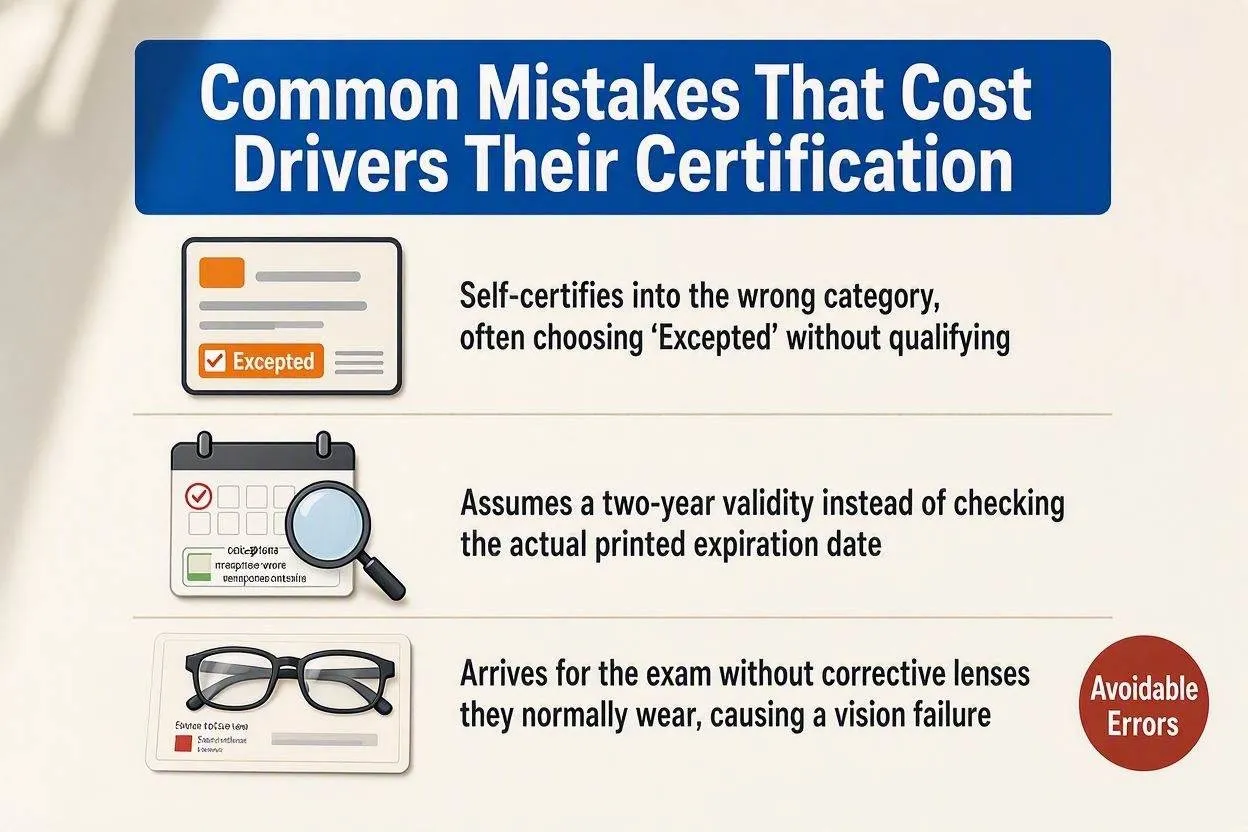
A handful of avoidable errors show up again and again. Drivers self-certify into the wrong category, usually picking “Excepted” because it sounds simpler, without actually qualifying for it. Others let a certificate lapse because they tracked the two-year assumption instead of the actual printed expiration date on their specific card. Some show up to the exam without corrective lenses they normally wear, which tanks a vision test that would otherwise pass easily.
The biggest mistake, though, is treating the DOT physical as a one-time hurdle instead of a recurring compliance task. CDL medical exam requirements aren’t a box checked once at hiring; they follow a driver for the length of their career, and the drivers who stay ahead of renewal dates are the ones who never get caught by a surprise downgrade.
Conclusion
CDL medical exam requirements combine federal health thresholds, state filing rules, and a self-certification system that has to match a driver’s actual job. Clearing the vision, hearing, and blood pressure checks gets a driver through the exam room, but staying road-legal long-term means tracking expiration dates, keeping documentation current for any chronic condition, and understanding how electronic filing through the National Registry II changes the timeline for updates to reach state agencies. Treat CDL medical exam requirements as an ongoing part of the job rather than a one-time gate, and the surprise downgrade that catches so many drivers off guard stops being a threat at all.
FAQs

Esther Howard
Esther Howard leads TruckingHow’s trucking, commercial driving, and transportation content division. She specializes in CDL training, trucking regulations, fleet operations, truck maintenance, and logistics best practices. With over a decade of experience researching the commercial transportation industry, Esther brings a practical, research-driven approach to driver education, safety standards, and industry regulations. She is the primary author of TruckingHow’s CDL guides, trucking career resources, maintenance tips, and transportation content, helping drivers, fleet owners, and trucking professionals make informed decisions on and off the road
Related Posts