How Long Does CDL Training Take? Full Timeline by Program Type (2026)
CDL training takes 3 to 4 weeks if you go full-time, and 6 to 10 weeks if you go part-time. A Commercial Driver’s License lets you operate trucks and buses that require federal certification, and most schools build their programs around the same core requirement: the Entry-Level Driver Training (ELDT) standard set by the Federal Motor Carrier Safety Administration (FMCSA). Once you factor in permit testing and getting your skills test scheduled, the realistic total lands at 5 to 9 weeks full-time, or 3 to 6 months part-time if you’re also juggling a job.
Here’s the full breakdown: what happens week by week, what stretches or shrinks the calendar, and how long it actually takes to go from day one of training to your first paycheck.
How Long Does CDL Training Take by Program Type
Every program type lands in a different window, and the format you pick matters more than anything else.
- Accelerated full-time programs: 2 to 3 weeks, where available.
- Standard full-time programs: 3 to 4 weeks, Monday through Friday.
- Part-time or evening programs: 6 to 10 weeks, meeting nights and weekends.
- Community college programs: 4 to 16 weeks, often spread across a full semester.
- Employer-sponsored training: 3 to 6 weeks, paid or reimbursed by a carrier in exchange for a driving commitment.
A full-time student training 35 to 50 hours a week finishes the same 160-hour curriculum a part-time student covers in 3 to 4 hours a night. That’s the whole reason the part-time path takes two to three times longer, not some difference in material.
The Full CDL Timeline, Step by Step
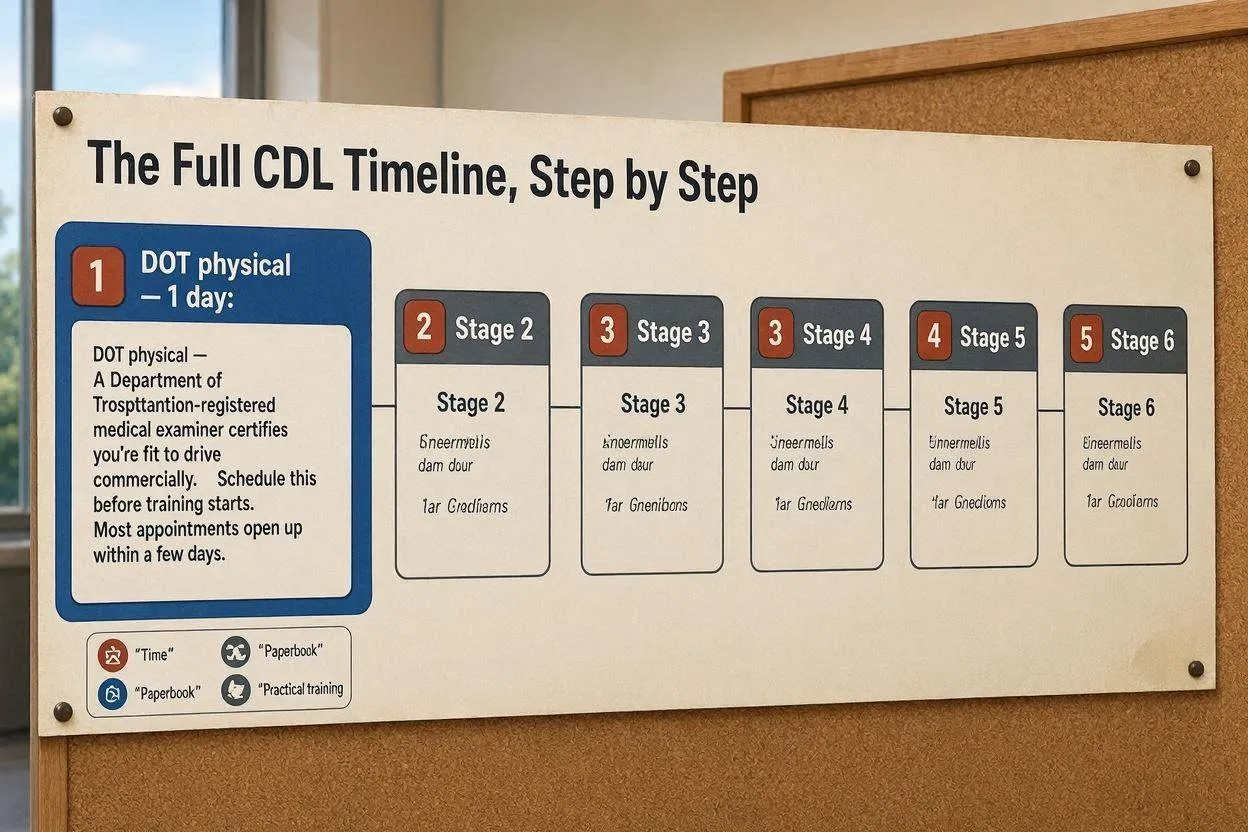
Getting a CDL involves six stages. Each one adds a predictable chunk of time.
DOT physical (1 day). A Department of Transportation-registered medical examiner certifies you’re fit to drive commercially. Schedule this before training starts. Most appointments open up within a few days.
CLP knowledge test (1 to 10 days). Study the CDL manual, then take the written test at your state DMV to earn your Commercial Learner’s Permit. Many schools fold this into week one.
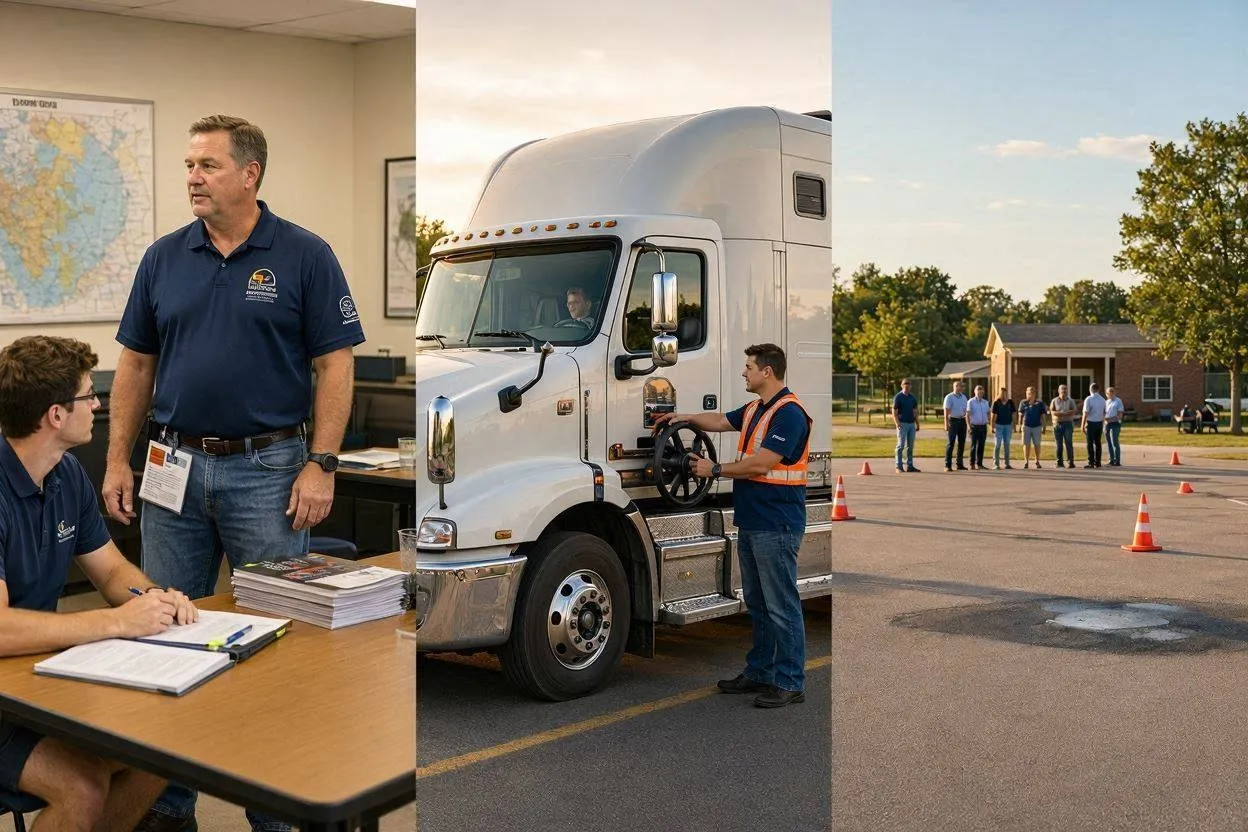
CDL training program (3 to 10 weeks). Classroom instruction plus behind-the-wheel practice on a closed range and public roads, delivered by a school on the FMCSA Training Provider Registry.
14-day CLP hold (built into training). Federal law requires you to hold your CLP for at least 14 days before the skills test. A 3-to-4-week program absorbs this wait without you noticing.
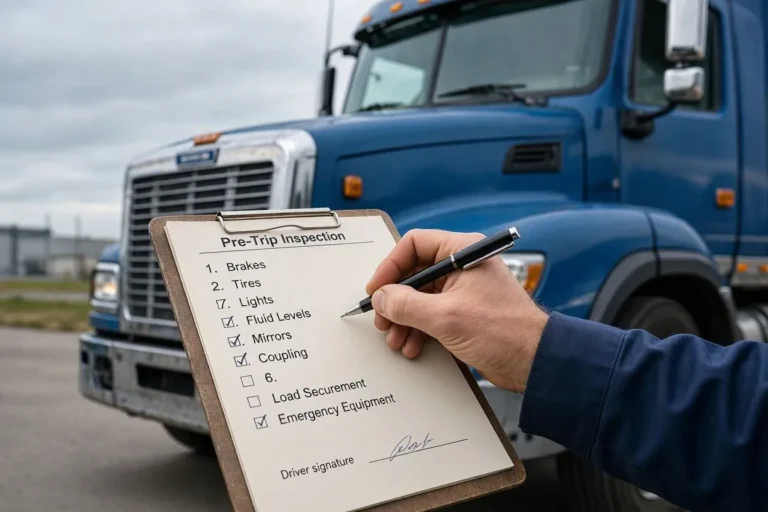
CDL skills test (1 day). Three parts: pre-trip vehicle inspection, basic controls on the range, and a road test in live traffic.
License issuance (same day to 2 weeks). Your state DMV hands you a temporary credential right after you pass. The permanent card follows by mail within 1 to 2 weeks.
Add it all up, and a full-time student typically holds a CDL 5 to 9 weeks after day one.
What Affects How Long CDL Training Takes
Five things determine where you land within that range.
The CDL class you’re training for. A Class A CDL covers combination vehicles over 26,001 pounds and requires 160-plus hours of instruction, so it takes the longest. Class B covers single vehicles over that same weight threshold and moves faster since there’s no trailer coupling, backing, or articulation to learn. Class C, used for smaller vehicles carrying hazardous materials or 16-plus passengers, has the shortest requirement of the three.
The endorsements you add. Six exist, and each one tacks on classroom or testing time: Passenger (P), School Bus (S), Doubles/Triples (T), Tanker (N), Hazardous Materials (H), and the combined Tanker/HAZMAT (X). Hazmat adds the most time by far, since it requires a TSA background check that can take 3 to 8 weeks to process, completely separate from your training schedule.
Your prior experience. If you’ve run farm equipment, RVs, or forklifts before, you’ll likely pick up backing and spatial-awareness maneuvers faster than someone starting from zero, which shortens your time on the range.
Classroom time versus road time. Programs generally split instruction one-third classroom, two-thirds range and road. A school that makes you sit through lectures before ever getting behind the wheel is going to feel slower, even if the total hours match a school that blends theory with driving from day one.
How fast you can book your skills test. Some schools test on-site through third-party examiners and get you through within days of finishing. Others rely on state DMV scheduling, which in busy metro areas can tack on 1 to 3 weeks of waiting around.
Full-Time vs. Part-Time CDL Schedules
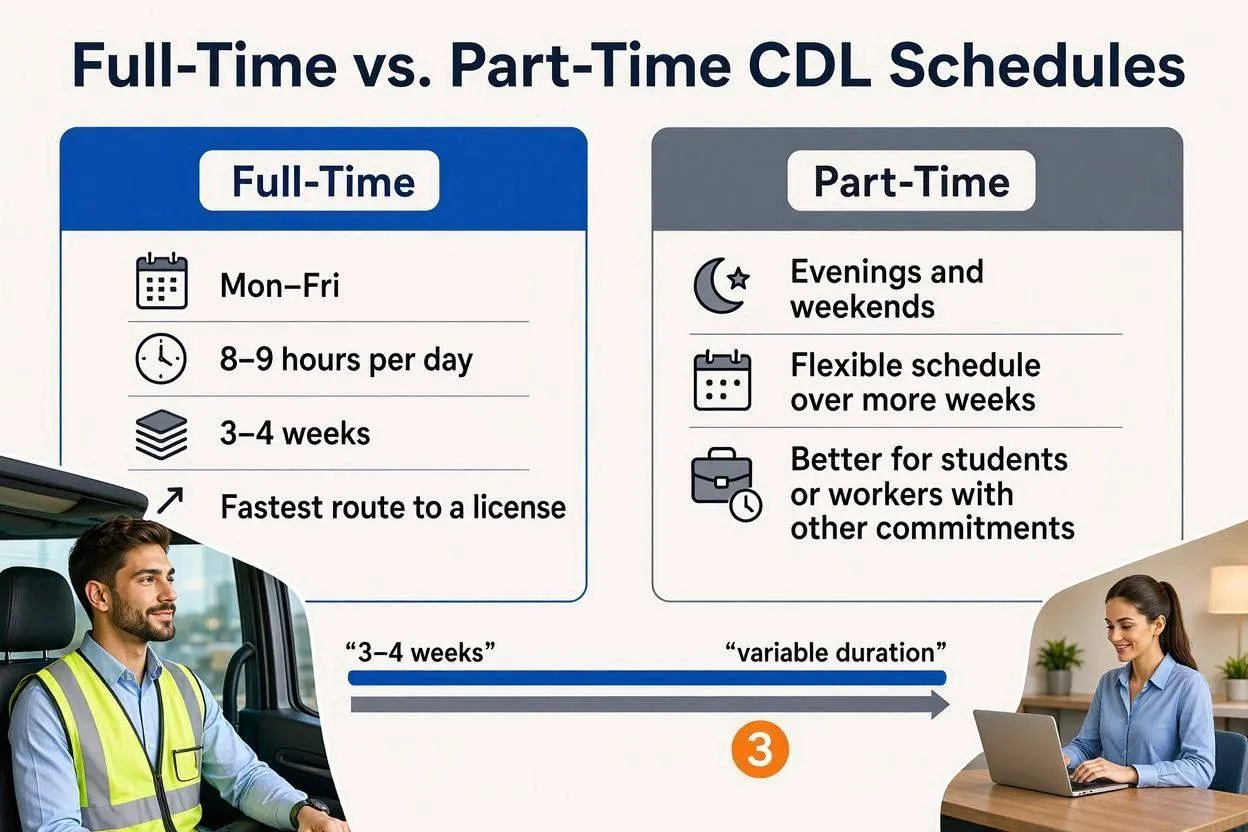
Full-time programs run Monday through Friday, usually 8 to 9 hours a day, and wrap up in 3 to 4 weeks. It’s the fastest route to a license, and the standard pick for anyone who can commit to a single, uninterrupted month.
Part-time and evening programs meet 3 to 4 hours a night or on weekends, stretching the same curriculum across 6 to 10 weeks. Weekend-only programs, running roughly 7 to 8 hours a day on Saturday and Sunday, often take the longest of all, since they only deliver 14 to 16 hours of instruction a week.
Working adults tend to pick part-time so a paycheck keeps coming in during training, even though it adds 4 to 6 extra weeks compared to full-time. If you can step away from work for a month, full-time is the more direct path, both to a license and to a driving job.
How Long Until You’re Earning Money After CDL Training
Most new CDL holders start earning within 2 to 4 weeks of finishing training. That covers the job search, the application, and a carrier’s orientation process, which itself often runs 1 to 2 weeks at larger companies. If you line up a job offer before graduation, or train through an employer-sponsored program, you can start earning within 1 to 2 weeks of licensing, since orientation just replaces the job-search step entirely.
Count from day one of CLP study to first paycheck, and most students are working within 8 to 12 weeks total. Entry-level over-the-road pay typically falls between $48,000 and $62,000 a year, depending on the carrier, route type, and home-time schedule.
What Speeds Up or Slows Down Your Timeline
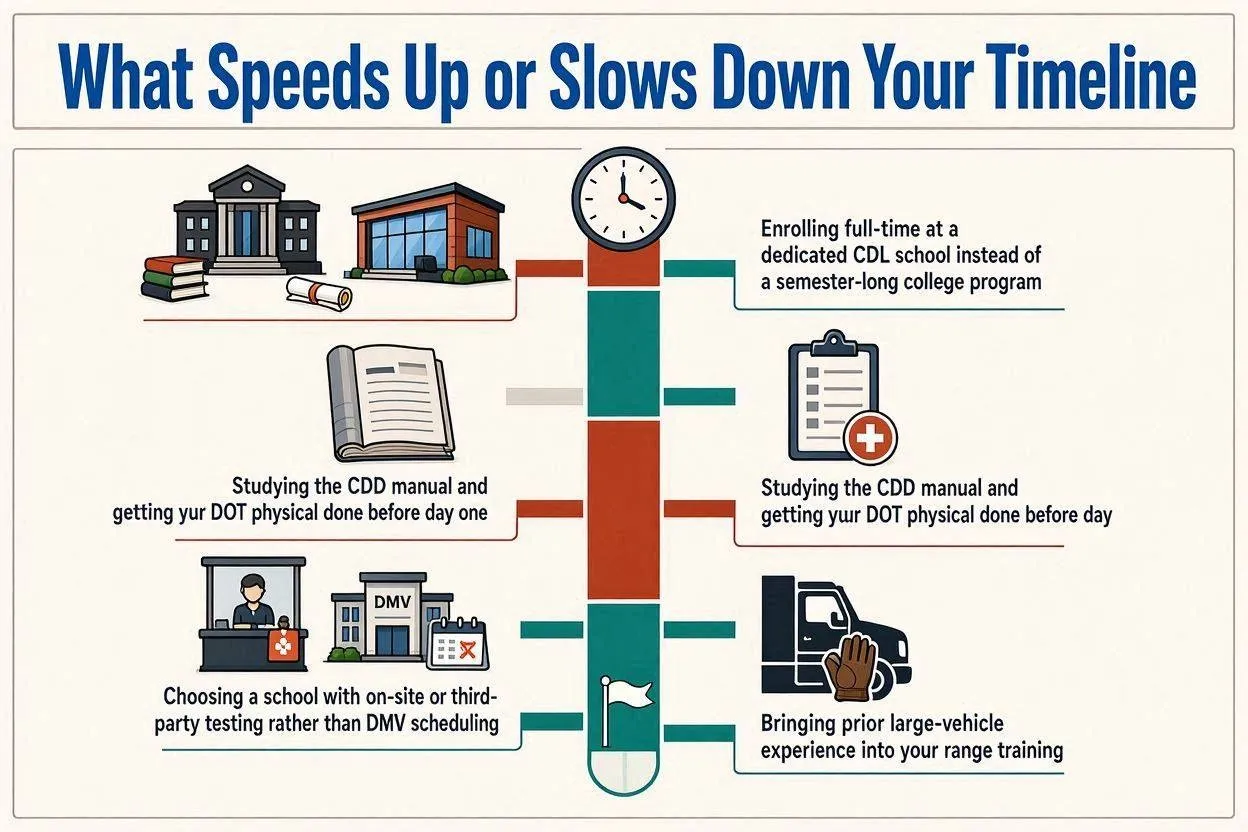
Four things shorten your timeline: enrolling full-time at a dedicated CDL school instead of a semester-long college program, studying the CDL manual and getting your DOT physical done before day one, choosing a school with on-site or third-party testing rather than DMV scheduling, and bringing prior large-vehicle experience into your range training.
Five things stretch it out: picking part-time over full-time, training in a state with longer DMV wait times or extra licensing steps, failing the knowledge or skills test and needing a retake, adding an endorsement that requires background-check processing, and enrolling at a school with sloppy ELDT reporting (your training completion has to hit the FMCSA system before you’re even eligible to test).
If a program promises a CDL in a matter of days, take that as a red flag, not a shortcut. The federal 14-day CLP hold and proficiency-based ELDT standards put a practical floor under every legitimate program, and no school can train around that.
Conclusion
CDL training takes 3 to 4 weeks full-time, 6 to 10 weeks part-time, and 5 to 9 weeks total once permit testing and licensing enter the picture. The class you choose, the endorsements you add, and the schedule you commit to all decide exactly where you land in that range. Full-time gets you to a paycheck fastest. Part-time protects your current income while you make the switch. Either way, you end up with the same federally regulated license, and knowing the real timeline before you enroll means you can plan your job start date around facts instead of guesswork.
FAQs

Esther Howard
Esther Howard leads TruckingHow’s trucking, commercial driving, and transportation content division. She specializes in CDL training, trucking regulations, fleet operations, truck maintenance, and logistics best practices. With over a decade of experience researching the commercial transportation industry, Esther brings a practical, research-driven approach to driver education, safety standards, and industry regulations. She is the primary author of TruckingHow’s CDL guides, trucking career resources, maintenance tips, and transportation content, helping drivers, fleet owners, and trucking professionals make informed decisions on and off the road
Related Posts