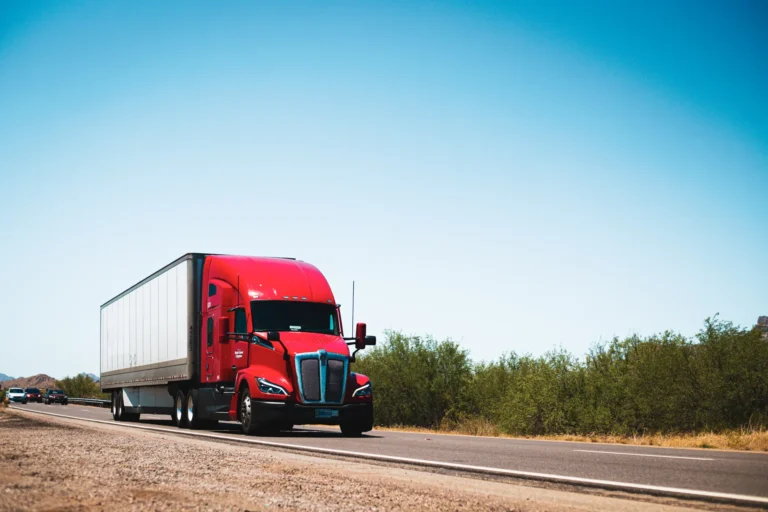
What Is a Reefer Trailer? A Guide for US Drivers and Shippers
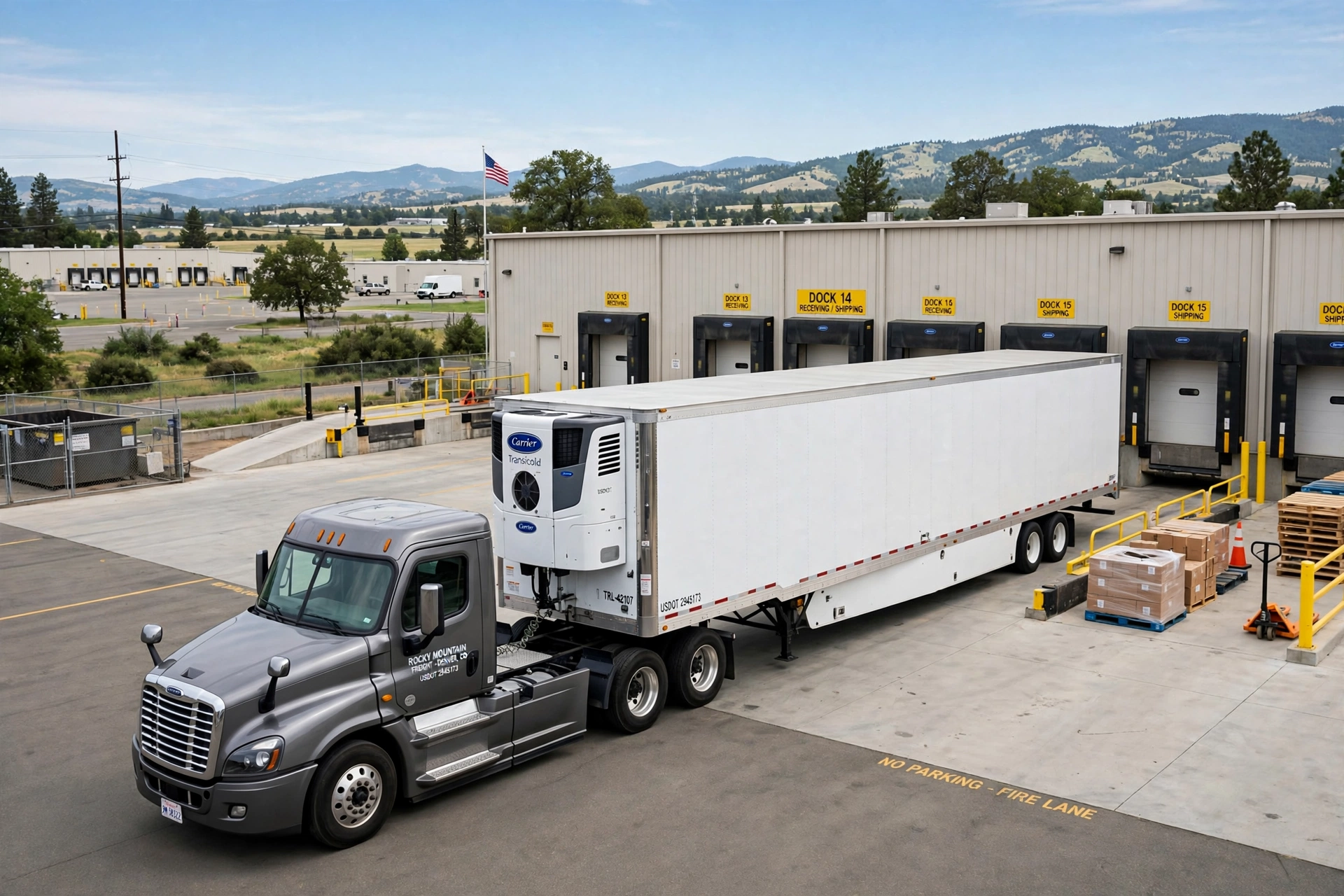
A reefer trailer is a temperature-controlled semi-trailer that uses insulated walls and a front-mounted refrigeration unit to keep perishable freight at a set temperature during transport. US carriers rely on reefers to haul produce, meat, dairy, frozen food, flowers and pharmaceuticals through the cold chain, from farms and plants to stores. That freight can’t ride warm.
Key Takeaways
- A reefer trailer is an insulated semi-trailer with a transport refrigeration unit (TRU) that holds freight at a set temperature.
- “Reefer” is trucking shorthand for refrigerated equipment, and the word can mean the trailer, the refrigeration unit or the load.
- A bulkhead in a reefer trailer is a panel that keeps cargo off the front wall or divides the trailer into separate temperature zones.
- A reefer unit holds product at temperature but doesn’t cool warm product, so shippers must load freight that’s already at its required temperature.
- The dry van vs reefer choice depends on the freight. Dry vans carry non-perishable goods, and reefers carry anything that needs temperature control.
- In the USA, refrigerated food loads fall under the U.S. Food and Drug Administration (FDA) Sanitary Transportation rule, and reefer units in California must meet California Air Resources Board (CARB) rules.
What Is a Reefer Trailer in Trucking?
A reefer trailer in trucking is a refrigerated semi-trailer, usually 53 ft (16.2 m) long, that a tractor pulls to move temperature-sensitive freight, and the word “reefer” is the industry’s short name for any refrigerated trailer, refrigeration unit or refrigerated load.
Ask what is a reefer in trucking and the answer depends on who’s talking. A dispatcher saying “you’re pulling a reefer” means the trailer. When a mechanic grumbles that “the reefer won’t start,” the problem sits in the refrigeration unit itself, not the box behind it. Load boards are different. There, a posting marked “reefer” signals freight that needs a refrigerated trailer.
From a distance, a reefer trailer looks like a dry van. The giveaway is the boxy refrigeration unit mounted on the front wall, called the nose, which faces the back of the tractor cab. Spot that, and you know.
Size and weight rules don’t change either. Federal law caps trailer width at 102 in (2.59 m), and a tractor-trailer on the Interstate System can’t exceed a gross weight of 80,000 lb (36,287 kg). Those are the same limits every other semi-trailer follows.
Where the Word Reefer Comes From
“Reefer” is slang. It’s a clipped, informal form of “refrigerator” and “refrigerated,” and anyone asking what is reefer in a shipping context wants to know about refrigerated equipment.
The word stretches well past trucking, too, covering refrigerated ocean containers and cargo ships as well as the historic refrigerated railcars of earlier decades. In US trucking, it’s everywhere. Load postings, rate reports, job ads and equipment listings all use it.
Main Parts of a Reefer Trailer
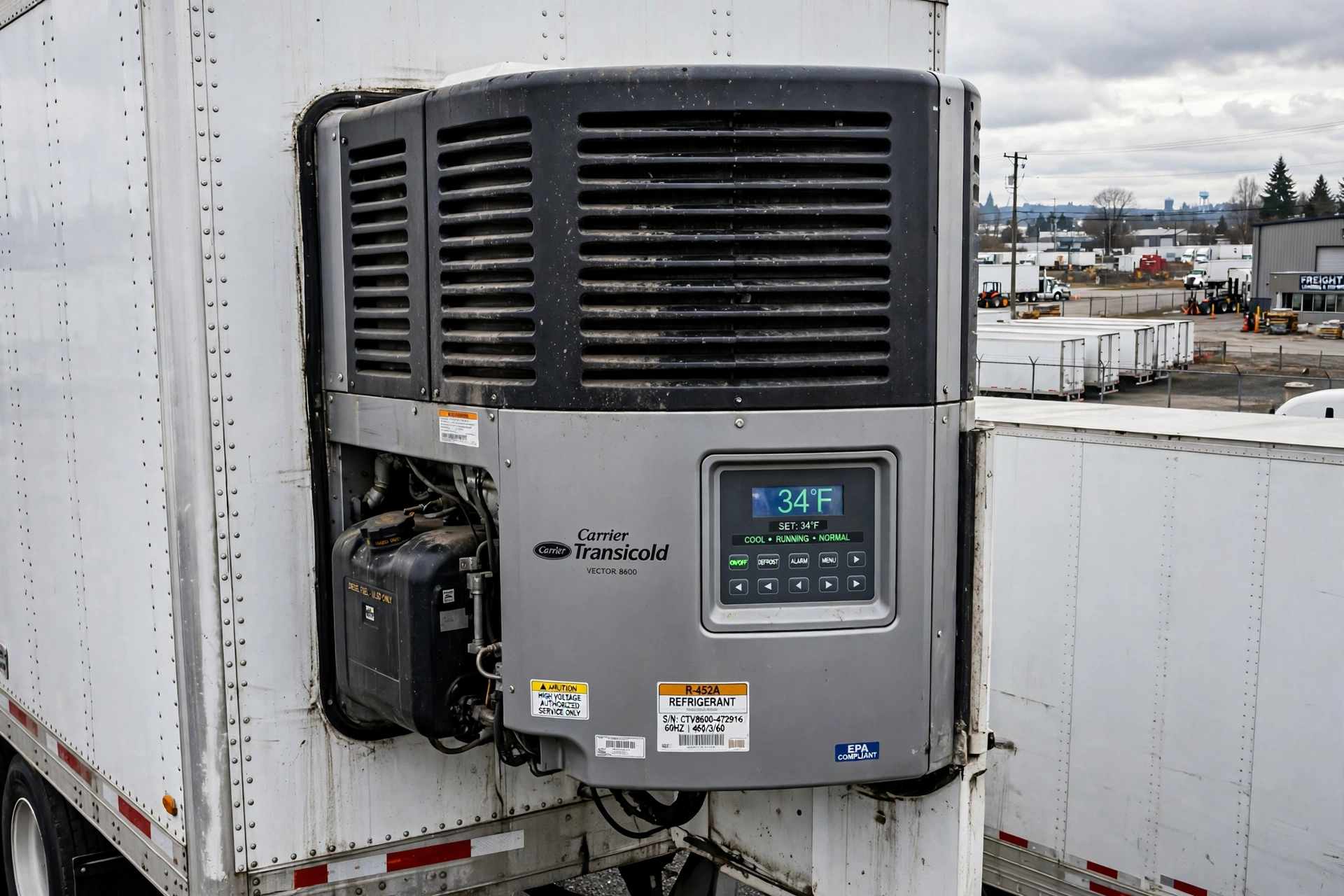
A reefer trailer pairs an insulated box with a refrigeration system, then adds airflow parts that move cold air around the load from the nose to the doors. Each part has one job.
This table lists the main parts of a reefer trailer and what each one does.
| Component | Location | Function |
|---|---|---|
| Insulated Box | Walls, roof, floor, doors | Slows heat moving into the cargo area |
| Refrigeration Unit (TRU) | Front wall (nose) | Cools or heats air to the set point |
| Evaporator | Inside the front wall | Pulls heat out of trailer air |
| Air Chute | Ceiling, front to rear | Spreads supply air along the load |
| Ducted Floor | Floor channels | Lets air flow back under pallets |
| Fuel Tank | Under the trailer | Feeds the unit’s diesel engine |
| Door Seals | Rear swing doors | Keeps cold air in and warm air out |
| Bulkhead | Front wall or movable track | Protects return airflow or splits zones |
How Does a Reefer Trailer Stay Cold?
A reefer trailer stays cold because its transport refrigeration unit pulls warm return air from the trailer, removes heat through a refrigerant cycle, and blows chilled supply air back over the load, while the insulated walls slow outside heat from entering the cargo area.
Picture a household refrigerator bolted to the trailer’s front wall. That’s essentially the unit. Inside it, a compressor pushes refrigerant through a condenser outside the trailer and an evaporator inside, a loop that carries heat out of the cargo area. Air passing over the evaporator gives up its heat.
Air moves in a loop. Cold supply air leaves the top of the unit and travels toward the rear doors along the ceiling or through an air chute, then falls through and around the freight. Warmer return air flows back to the front along the ducted floor and enters the unit near the bottom.
A controller reads sensors in the supply and return air, then compares those readings with the set point the driver or shipper entered. Then it adjusts. Cooling output rises or falls as needed to hold that temperature.
Over time, ice builds up on the evaporator coils. That’s normal. To clear it, the unit runs a defrost cycle that warms the coils briefly, melting the ice so air can flow freely again.
Continuous Mode vs Start-Stop Mode
Reefer units run in two main modes. Thermo King calls its start-stop mode Cycle-Sentry, while other manufacturers sell the same basic function under different brand names of their own.
This table compares the two reefer operating modes.
| Mode | How It Runs | Best For | Fuel Use |
|---|---|---|---|
| Continuous | Engine and fans run nonstop | Produce, flowers, sensitive loads | Higher |
| Start-Stop | Engine shuts off at set point | Frozen and well-packaged freight | Lower |
Continuous mode keeps air moving across the load at all times. That holds a tight, even temperature. Start-stop saves fuel but lets air sit still between cycles, which is why many fresh produce shippers write continuous mode into the bill of lading.
How Long a Reefer Runs on One Tank
No verified figure is available for run time on one tank. Too much varies. Tank size, set point, outside temperature, door openings, operating mode and unit model all push fuel burn up or down from one trip to the next.
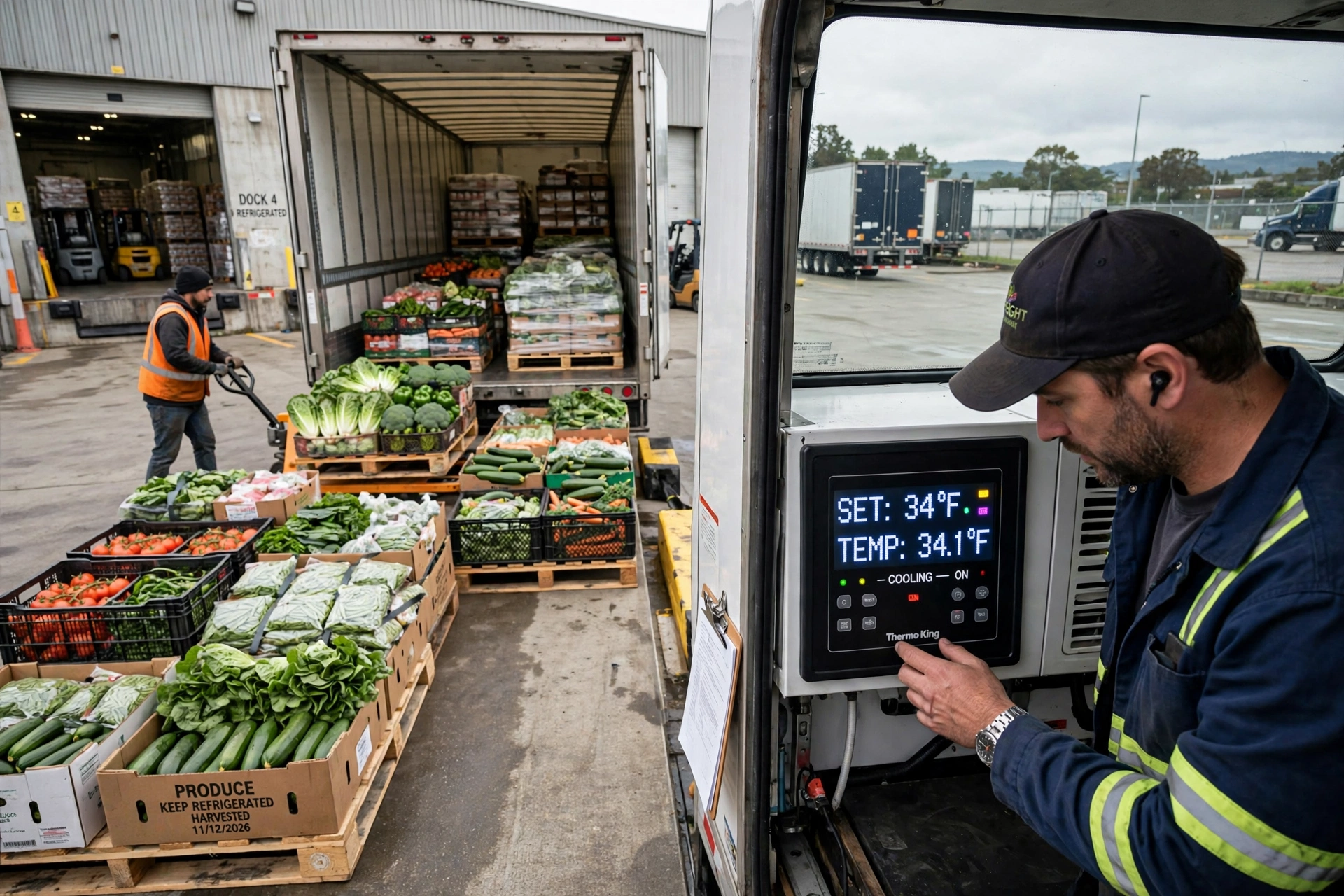
The reefer unit draws from its own fuel tank, separate from the tractor’s tanks. Check it before every trip. Drivers who skip that step and let the unit run dry can ruin an entire load, so filling the reefer tank at fuel stops is standard practice.
What Temperature Can a Reefer Trailer Reach?
A reefer trailer can hold freight at frozen, chilled or mild set points, and the exact range depends on the refrigeration unit model listed on its spec sheet. Food sets two common benchmarks. Frozen product generally ships at 0°F (-18°C) or below, while refrigerated food generally ships at or below 40°F (4°C).
Reefer units can also heat. In winter, heat mode keeps produce and beverages from freezing as a truck crosses cold northern states, and some chemicals get the same protection.
This table compares common freight temperature classes for reefer loads.
| Freight Class | Typical Set Point (°F / °C) | Example Products |
|---|---|---|
| Frozen | 0 / -18 or below | Frozen meals, ice cream, frozen meat |
| Chilled | 40 / 4 or below | Dairy, fresh meat, deli items |
| Fresh Produce | Varies by commodity | Lettuce, berries, apples, bananas |
| Refrigerated Drugs | 36 to 46 / 2 to 8 | Vaccines, insulin, biologics |
| Controlled Room Temperature | 68 to 77 / 20 to 25 | Many tablets and packaged medicines |
The pharmaceutical ranges come from United States Pharmacopeia (USP) storage definitions. Produce is trickier. Bananas and tomatoes suffer chilling damage at temperatures that suit lettuce just fine, so set points vary widely from one commodity to another. Whatever the product, the shipper sets the required temperature on the bill of lading and the driver follows it.

What Is a Reefer Trailer Used For?
A reefer trailer is used for hauling any freight that spoils, degrades or loses value outside a set temperature range, including fresh produce, meat, seafood, dairy, frozen food, flowers, beverages, pharmaceuticals and certain chemicals moving between farms, plants, warehouses and stores.
Food dominates. It makes up the largest share of reefer freight, with produce rolling out of growing regions such as California, Florida, Texas and Arizona to distribution centers nationwide. Packing plants send meat to grocery chains. Frozen food, meanwhile, moves from plants to cold storage warehouses.
Pharmaceutical and health care shippers book reefers for vaccines and biologics, along with other medicines that need a narrow temperature range. Paperwork gets heavier. These loads often call for temperature recorders and tighter documentation than food loads.
Non-food freight counts too. The list includes candy and chocolate in summer, cosmetics, film, artwork, live plants, and some paints, adhesives and chemicals. If a hot trailer or a freezing night can damage a product, it’s a reefer candidate.
Some reefers never leave the lot. Businesses rent them for on-site cold storage, and restaurants, caterers, grocery stores and event organizers all park one at their location for extra cold space during remodels or when equipment fails. Peak seasons drive rentals too.
Can a Reefer Haul Dry Freight?
Yes. A reefer trailer can haul dry, non-perishable freight, and it simply runs with the refrigeration unit turned off for the whole trip.
Carriers often fill a reefer with dry freight for the return trip after a refrigerated delivery, rather than hauling the trailer back empty. Empty miles drop. Before the trailer carries food again, though, it has to be clean and free of odors.
What Is a Bulkhead in a Reefer Trailer?
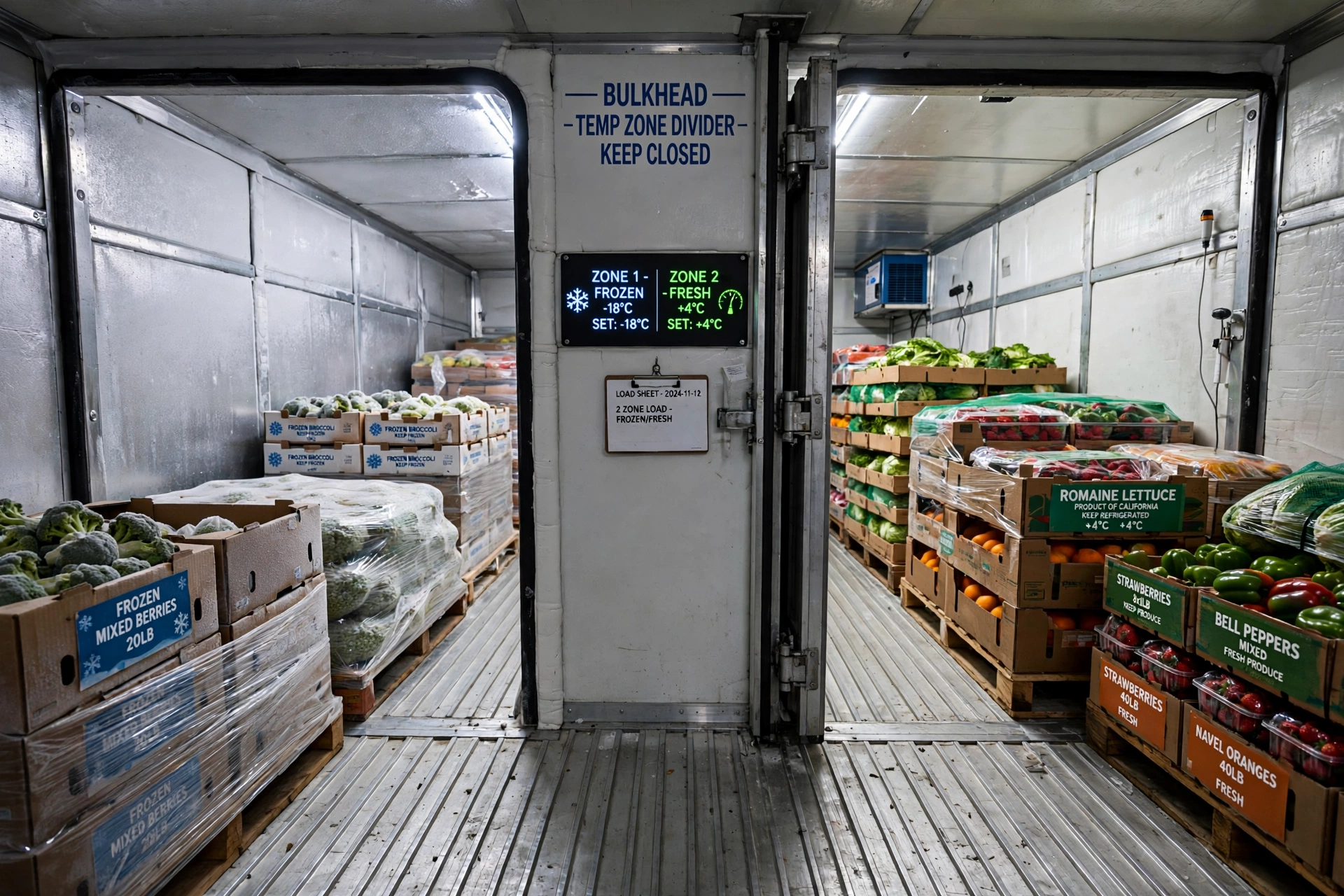
A bulkhead in a reefer trailer is a panel or partition inside the cargo area that either keeps freight off the front wall to protect return airflow or divides the trailer into separate compartments so each section holds a different temperature.
The term covers two different parts. Drivers and shippers need to know which one a given load requires well before the truck backs into the dock for pickup.
Front Bulkhead vs Movable Bulkhead
A front bulkhead is a ribbed or slotted panel fixed to the inside of the front wall. Its purpose is simple. That ribbed surface leaves a gap so warm return air can still reach the refrigeration unit even when pallets sit tight against the front.
A movable bulkhead works differently. This insulated wall slides on tracks or locks into the floor and ceiling, splitting the trailer into two or more compartments, such as frozen up front and chilled in the rear.
This table compares the two types of reefer bulkheads.
| Bulkhead Type | Fixed or Movable | Main Job | Common Use |
|---|---|---|---|
| Front Bulkhead | Fixed | Keeps return air path open | Every standard reefer load |
| Movable Bulkhead | Movable | Separates temperature zones | Multi-temp and grocery loads |
Some shippers add temporary bulkheads, such as load bars or air bags, to close off the empty section of a partial load. A smaller space holds temperature more easily.
What Is a Space Saver Reefer Trailer?
A space saver reefer trailer is a term sellers and fleets use for a reefer configured to give up less cargo room than a standard build, but no verified industry-standard definition is available, so buyers must confirm the exact feature with the seller or manufacturer before paying.
The phrase shows up in equipment listings without one fixed meaning. Sellers use it loosely. Depending on the listing, it might describe a unit design, an evaporator layout, a bulkhead style or some other feature tied to usable interior space.
Ask the seller these questions before buying or renting a trailer labeled “space saver”:
- Ask which component makes the trailer a space saver.
- Request the interior length, width and height in writing.
- Confirm the refrigeration unit make, model and hours.
- Compare the usable dimensions against a standard 53 ft (16.2 m) reefer.
Can One Reefer Trailer Hold Two Temperatures?
Yes. A multi-temperature reefer trailer holds two or three temperatures at once by using movable insulated bulkheads to create separate compartments and extra evaporators that cool each zone to its own set point from one refrigeration unit.
Grocery and food service distributors use multi-temp reefers so one truck can cover a store’s frozen and chilled orders, plus dry products, in a single trip. The layout follows a pattern. Frozen goods typically ride in the front compartment and chilled goods in the middle, leaving dry or produce goods at the rear.
Multi-temp reefers need careful loading. Every compartment has to match the product’s required temperature, and each bulkhead must seal fully against the walls and ceiling so cold air stays in its own zone.
What Is a Reefer Truck?
A reefer truck is a straight truck with a refrigerated box and refrigeration unit mounted on the same chassis as the cab and engine, so it cannot unhitch from its cargo area the way a tractor separates from a reefer trailer. Reefer trucks handle shorter local and regional deliveries.
Food distributors, florists, caterers and pharmacies rely on reefer trucks for city routes with many stops. Size is the advantage. A shorter body fits tight streets and alleys as well as the small loading docks found along city delivery routes.
This table compares a reefer truck with a reefer trailer.
| Equipment | Typical Length | Typical Route | Common User |
|---|---|---|---|
| Reefer Truck | Shorter box, varies by model | Local, multi-stop delivery | Food service, florists |
| Reefer Trailer | 53 ft (16.2 m) | Regional and long haul | Carriers, owner-operators |
Does a Reefer Truck Need a CDL?
Yes, if the truck has a gross vehicle weight rating (GVWR) of 26,001 lb (11,794 kg) or more. At that rating, the driver needs a Class B commercial driver’s license (CDL).
Lighter reefer trucks, rated at 26,000 lb (11,793 kg) or less, don’t require a CDL unless they carry placarded hazardous materials. Trailers are another story. Pulling a reefer trailer with a tractor takes a Class A CDL.
Dry Van vs Reefer: Which Trailer Fits Your Freight?
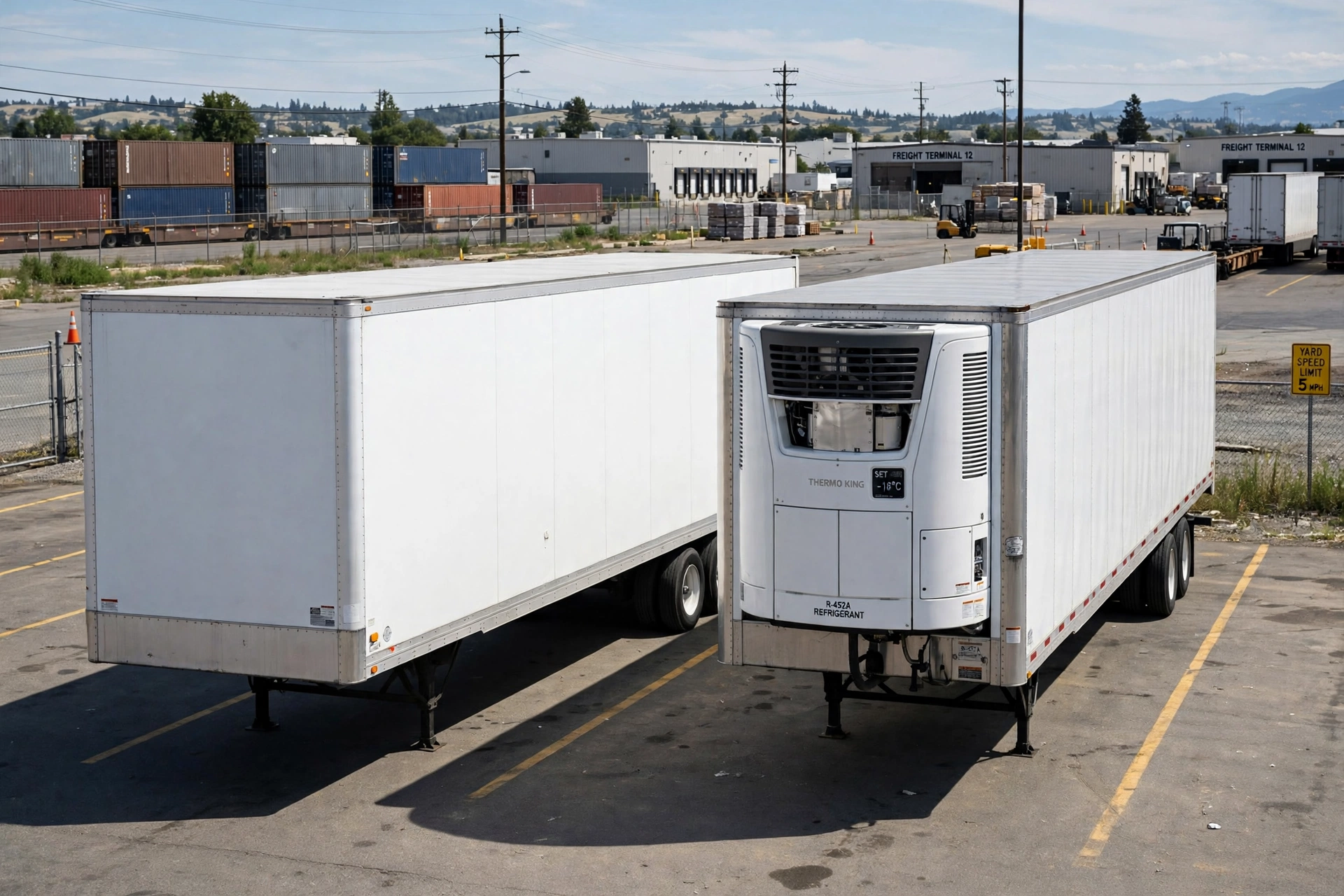
Choose a reefer if your freight needs any temperature control, and choose a dry van if your freight is non-perishable and tolerates outside heat and cold. Reefers carry a higher price tag. Running and maintaining one costs more as well, while dry vans offer slightly more interior space and simpler day-to-day operation.
This table compares a dry van and a reefer trailer on key attributes.
| Attribute | Dry Van | Reefer Trailer |
|---|---|---|
| Insulation | None or minimal | Insulated walls, roof, floor |
| Refrigeration Unit | None | Front-mounted TRU |
| Common Length (ft / m) | 53 / 16.2 | 53 / 16.2 |
| Interior Width | Wider | Narrower due to insulation |
| Freight | Dry, non-perishable goods | Perishable, frozen, pharmaceuticals |
| Extra Fuel | None | Separate tank for the unit |
| Driver Tasks | Standard pre-trip and securement | Adds temperature checks and records |
For shippers, the dry van vs reefer decision rarely involves a gray area. Perishables go in reefers. Paper goods, furniture, electronics and packaged dry groceries belong in dry vans, where they ride without needing any temperature control at all.
Carriers and owner-operators face a bigger decision, since the choice shapes the whole business. Reefers win on flexibility. A reefer can haul both dry and refrigerated loads, but a dry van can’t take refrigerated freight, so reefer equipment opens up more freight options.
Do Reefer Loads Pay More Than Dry Van Loads?
Yes. Reefer loads usually pay more per mile than dry van loads, because reefer carriers cover unit fuel and unit maintenance on top of higher equipment costs.
The gap shifts with season and lane, and market conditions move it too, so no single verified figure is available. Spring and summer run tight. Produce season in those months typically tightens reefer capacity. For current national averages on both equipment types, check load boards and rate services such as DAT.
US Regulations for Reefer Trailers
Reefer trailers in the USA follow the same Federal Motor Carrier Safety Administration (FMCSA) and federal size and weight rules as other trailers, plus two extra rule sets: the FDA Sanitary Transportation rule for food loads and California Air Resources Board rules for reefer unit emissions.
FDA Sanitary Transportation Rule
The FDA Sanitary Transportation of Human and Animal Food rule is part of the Food Safety Modernization Act (FSMA). Its reach is wide. Shippers, loaders, carriers and receivers that move food by motor vehicle or rail in the USA all fall under it.
Under the rule, the shipper must tell the carrier in writing about sanitary requirements, including the operating temperature and any pre-cooling. Carriers carry duties too. They must supply equipment in sanitary condition and pre-cool the trailer when required. On request, they also have to show that they held the agreed temperature.
Training is required as well. Carriers must train personnel in sanitary transportation practices and keep records of that training. Businesses with less than $500,000 in average annual revenue are exempt, along with some other specific situations the FDA lists.
California CARB TRU Rules
The California Air Resources Board regulates the diesel engines in transport refrigeration units through its TRU Airborne Toxic Control Measure (ATCM). Out-of-state units aren’t exempt. Any TRU operating in California falls under the rule, including units based elsewhere that enter the state.
The rule sets in-use emission standards based on engine model year. Registration is mandatory. Each unit must be entered in CARB’s Air Resources Board Equipment Registration (ARBER) system, and the trailer has to display a CARB identification number. In 2022, CARB amended the rule to add zero-emission requirements for truck TRUs, along with other changes.
Deadlines and requirements change over time. Before dispatching a reefer into the state, carriers that run California lanes must check CARB’s TRU program page for current compliance dates rather than relying on older guidance.
How to Pre-Cool and Load a Reefer Trailer
Pre-cool a reefer trailer by running the unit with the doors closed until the empty cargo area reaches the shipper’s set point, then load product that is already at its required temperature, because a reefer unit holds temperature but cannot pull heat out of warm freight quickly.
Follow these steps for a standard refrigerated pickup:
- Read the bill of lading and confirm the set point, operating mode and pre-cool requirement.
- Inspect the trailer for cleanliness, odors, damaged walls and torn door seals.
- Check the reefer fuel level and fill the tank before the trip.
- Set the unit to the required temperature and mode.
- Run the unit with the doors closed until the trailer reaches the set point.
- Turn the unit off before opening the doors at the dock to avoid pulling in warm, humid air.
- Check product temperature with a calibrated probe thermometer before accepting the load.
- Load pallets away from the front bulkhead and keep space under the air chute clear.
- Close the doors, restart the unit and confirm it reaches the set point.
- Record the set point, product temperature and seal number on the paperwork.
Airflow decides whether a load arrives in good condition. Block it and the rear suffers. When pallets choke the return air path at the front, or freight is stacked all the way to the ceiling, cold air never reaches the back of the trailer.
Who Builds Reefer Trailers and Units in the USA?
Reefer trailers and their refrigeration units usually come from two separate companies, with a trailer builder making the insulated box and an original equipment manufacturer (OEM) supplying the transport refrigeration unit mounted on the front wall. Buyers choose both when ordering new equipment.
This table lists major reefer trailer builders and refrigeration unit makers serving the US market.
| Company | Product Type |
|---|---|
| Utility Trailer | Reefer trailers |
| Great Dane | Reefer trailers |
| Wabash | Reefer trailers |
| Hyundai Translead | Reefer trailers |
| Thermo King | Refrigeration units |
| Carrier Transicold | Refrigeration units |
Dealers and leasing companies sell used reefers, and rental firms offer them too, which gives buyers several ways into refrigerated equipment without a factory order. Used units suit new owner-operators. They also work for businesses that need temporary cold storage.
What to Check on a Used Reefer Trailer
A used reefer is only as good as its refrigeration unit and insulation, and both can hide problems that a quick walk-around won’t catch. Check these items before buying:
- Download the unit’s data logger to review hours, alarms and temperature history.
- Confirm the unit engine model year meets CARB rules if the trailer will enter California.
- Inspect the floor for cracks, soft spots and damaged ducts.
- Look for wall and roof punctures that let moisture into the insulation.
- Test the door seals by closing a person inside with a flashlight and checking for light leaks.
- Run the unit to a frozen set point and time how long it takes to get there.
- Review maintenance records for the unit and the trailer.
Conclusion
The answer to what is a reefer trailer stays simple: an insulated trailer with a refrigeration unit that protects temperature-sensitive freight on the road. The equipment, though, is changing fast.
California’s zero-emission requirements for truck TRUs point toward quieter, lower-emission cold chain fleets, and so do wider use of electric standby and the arrival of battery-electric reefer units. Telematics are already here. Carriers and shippers can watch trailer temperatures in real time, and FDA recordkeeping expectations reward that visibility.
Learn the basics of reefer freight transport now. Drivers and owner-operators who understand bulkheads and pre-cooling, and shippers who keep up with CARB compliance, will be ready to haul and ship freight on the next generation of refrigerated equipment.
Frequently Asked Questions

Esther Howard leads trucking and commercial driving content at TruckingHow, covering CDL training, trucking regulations, fleet operations, and truck maintenance. With over a decade of experience researching the transportation industry, she brings a practical, research-driven approach to driver education and safety standards. Her guides help drivers, fleet owners, and trucking professionals make informed decisions on and off the road.
Related Posts