What Is Freight Brokerage? Definition, Process & How It Works
Freight brokerage is the business of arranging cargo transportation between a shipper and a carrier, without owning the trucks, ships, or planes that actually move the freight. A broker sits in the middle, matching the company that needs goods moved with the carrier that hauls them, then handling the negotiating and paperwork in between. The trouble is, the term gets used as a catch-all. Someone hires a “logistics company” expecting full door-to-door international service, only to learn the provider only touches domestic truck freight once cargo clears a port three states away, because freight broker, freight forwarder, third-party logistics (3PL) provider, and fourth-party logistics (4PL) provider are four different jobs that get lumped together constantly (more on how they differ below).
Picking the wrong one costs more than money. A shipper who hires a domestic broker for an international shipment ends up scrambling to find a forwarder mid-transit, usually at a premium rate and on a tighter deadline.
Why Freight Brokerage Exists

More than 1 million for-hire trucking companies operate in the United States, and the vast majority run small fleets rather than large ones. That fragmentation is the whole reason freight brokerage exists: no single shipper can vet a million small carriers on its own.
Take a grocery distributor in Ohio that needs 40 truckloads moved to five states by Friday. It can’t call carriers one by one and still hit that deadline. A broker with an established network sources all 40 loads within hours, using vetted relationships and rate history already in place.
The Federal Motor Carrier Safety Administration (FMCSA) requires every broker to register and post a surety bond before doing business (more on the exact licensing steps below). That requirement is what separates licensed brokerages from unregulated freight-matching apps.
Brokers typically work across multiple transportation modes: full truckload (FTL) fills an entire trailer for one shipper, less-than-truckload (LTL) shares trailer space among several shippers, and intermodal combines rail with truck for long-haul routes. Routing a 30-pallet order as LTL instead of FTL can cut costs by 40% or more.
What Does a Freight Broker Do?
A freight broker sources carriers, negotiates rates, and manages documentation for every load a shipper needs moved, a job that comes down to four core tasks:
- Finding capacity: checking carrier availability along a lane, confirming the right trailer type and safety rating, and lining up a replacement fast if a carrier cancels last-minute. A furniture manufacturer shipping 200 pallets from North Carolina to Texas might see the broker land a rate between $2,400 and $2,800 for the 1,100-mile (1,770-kilometer) route.
- Negotiating rates: landing a price that works for both sides, fair enough for the carrier to take the load and competitive enough for the shipper to book it.
- Coordinating pickup and delivery: scheduling appointments and steering shippers around retailer-specific penalties, like Walmart’s “On Time, In Full” (OTIF) program, which fines suppliers up to 3% of a shipment’s value for late, early, or incomplete deliveries.
- Tracking the shipment: staying in constant contact as it moves. Drivers call in with traffic delays, receiving docks push back appointment windows, and brokers relay every change to the shipper in real time. A broker managing 20 active shipments on a given day might field 60 or more phone calls and texts just to keep everyone informed.
How Does Freight Brokerage Work? (6-Step Process)
Freight brokerage runs through six sequential steps: request, carrier search, rate negotiation, coordination, tracking, and settlement. Each one depends on the step before it. Skip any of them and you get the kind of gap where shipments go missing or invoices don’t match.
- Shipper submits a request. The shipper provides origin, destination, freight type, weight, dimensions, and delivery deadline.
- Broker identifies carriers. The broker searches its vetted network for trucks matching the equipment and timeline requirements.
- Rates get negotiated. The broker negotiates a price with the carrier, then presents a quote to the shipper.
- Pickup and delivery get coordinated. Once both sides agree, the broker schedules pickup and prepares documents, including the bill of lading.
- Shipment gets tracked. The broker monitors the load in transit and communicates delays or issues to both parties.
- Payment gets settled. After delivery, the broker invoices the shipper and pays the carrier, typically within 30 days for standard terms or 24 hours for expedited “quick pay” arrangements.
A produce shipper moving 42,000 pounds (19,000 kilograms) of lettuce from California to Chicago has almost no room for delay at any of these steps. Refrigerated freight spoils fast, so a broker working this lane needs a temperature-controlled carrier locked in before step three even finishes.
Documentation ties every step together. The bill of lading serves as the legal contract between shipper and carrier, recording what’s being shipped, where it’s going, and in what condition it left the origin dock. A rate confirmation locks in the agreed price so a carrier can’t demand more money mid-transit. A proof of delivery, typically a signed document or photo, closes out the shipment and triggers invoicing. Miss any one of these three documents and payment can stall for weeks, with disputes that are hard to untangle after the fact.
Freight Broker vs. Freight Forwarder vs. Third-Party Logistics (3PL) Provider
A freight broker arranges domestic truck transportation only. A freight forwarder manages international shipments across multiple carriers and modes. A third-party logistics (3PL) provider bundles brokerage with warehousing, inventory management, and other supply chain services. A fourth-party logistics (4PL) provider coordinates an entire network of brokers and 3PLs on a shipper’s behalf. The distinction matters because each role carries different licensing requirements and liability.
| Role | What it handles | Best fit |
| Freight broker | Domestic truck transportation only | A shipper that just needs trucks found and rates negotiated |
| Freight forwarder | Customs documentation, ocean and air freight, multi-leg international routes, work that falls outside a domestic broker’s scope | A shipper moving goods internationally, e.g., importing electronics components from Vietnam and needing the port-to-warehouse leg handled too |
| Third-party logistics (3PL) provider | Brokerage plus warehousing, inventory management, TMS software, and supply chain consulting under one contract | A shipper that wants brokerage bundled with warehousing and inventory forecasting |
| Fourth-party logistics (4PL) provider | An entire supply chain network, including multiple 3PLs and brokers, managed on the shipper’s behalf | Large manufacturers with operations across a dozen states that need to coordinate several regional brokers under one strategy |
Sheer Logistics operates at the 4PL level, positioning itself as a native 4PL for midmarket shippers rather than a traditional brokerage. Smaller shippers rarely need this top layer; a single freight broker or 3PL usually covers what they need without the added management overhead.
How Do Freight Brokers Make Money?
Freight brokers earn revenue from the spread between what a shipper pays and what a carrier accepts for the same load. That spread, known as the buy-sell margin, typically runs between 15% and 20% of the total shipment cost, though it moves with market capacity and lane competitiveness.
Take a load that costs a carrier $2,000 to haul profitably. The broker might quote the shipper $2,400, keeping the $400 difference as revenue. When capacity is tight and trucks are scarce, that margin can compress to 8% or 10% because brokers are competing harder to lock in both the shipper’s business and the carrier’s availability. In slower freight markets, margins can widen past 20% as brokers gain more leverage over carriers hungry for loads.
That’s the number most shippers actually want spelled out: where the transportation dollar goes once it leaves their hands.
What Skills and Licenses Does a Freight Broker Need?
Licensing comes before anything else, but it’s not the whole job. Four things separate a broker who can legally operate from one who can actually compete:
| Requirement | What it involves |
| Licensing | Register with the FMCSA, get a Department of Transportation (DOT) number, secure Broker Authority under an MC number, and post a $75,000 BMC-84 surety bond or equivalent trust fund |
| Negotiation skills | Tracking carrier availability, shipper deadlines, and rate swings all at once, sometimes across 15 or more active loads on a single afternoon. Miss one carrier confirmation and a truck shows up empty at a dock |
| Technology skills | Comfort with transportation management system (TMS) software, real-time visibility platforms (RTTVP), and digital load boards; brokers slow to adopt these tools lose ground to competitors who can quote and book loads in minutes instead of hours |
| Career path | Most new brokers start as agents under an established brokerage’s authority and bond, building relationships with less financial exposure, then apply for an independent MC number once they’ve built a client base of their own, usually one to three years in |
Many brokers also pursue certification through the Transportation Intermediaries Association (TIA), which adds credibility with shippers comparing several brokers at once.
How Big Is the Freight Brokerage Industry?
Estimates on the exact growth rate vary by research firm, but most land somewhere in the mid-single digits annually for the U.S. freight brokerage market, with North America holding the largest global share thanks to rising demand for flexible, tech-enabled logistics.
The bigger story is the mismatch underneath those numbers. Tens of thousands of licensed brokers compete for capacity from a carrier base that’s overwhelmingly small fleets, and that combination (lots of brokers chasing mostly small carriers) is a big part of why rate volatility spikes so sharply during peak season. It’s also why a broker with strong relationships in one specific lane has a real edge over a broker starting cold: trust and payment history with individual carriers take months or years to build, not weeks.
What Are the Benefits of Using a Freight Brokerage?
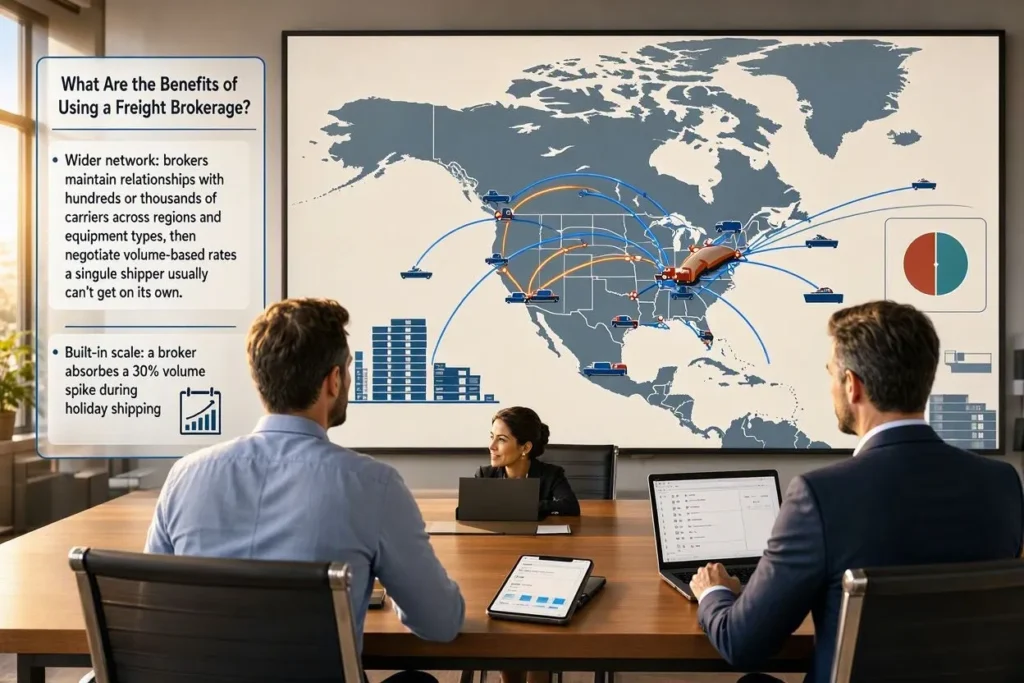
Most mid-size and large shippers use a broker instead of building carrier relationships from scratch. A few practical reasons explain why:
- Wider network: brokers maintain relationships with hundreds or thousands of carriers across regions and equipment types, then negotiate volume-based rates a single shipper usually can’t get on its own.
- Built-in scale: a broker absorbs a 30% volume spike during holiday shipping without the shipper hiring anyone new.
- Lower risk: brokers vet every carrier for safety ratings and insurance, which matters more than it used to. Cargo theft rose 26% in 2024 to 3,798 recorded incidents according to Verisk CargoNet, with losses topping $455 million, and CargoNet’s mid-2025 data shows the trend still climbing, up another 13% year over year.
- Ready-made technology: brokers supply TMS software and real-time tracking, so the shipper never has to buy or maintain that infrastructure itself.
Take a regional bakery chain expanding into three new states. It doesn’t need to stand up a logistics department overnight; partnering with an existing broker hands it a functioning carrier network in unfamiliar territory almost immediately, compressing what might otherwise take six months of relationship-building into a few weeks.
The cost math backs this up, too. Hiring one full-time logistics coordinator to manage carrier relationships in-house runs $65,000 to $80,000 a year in salary alone, before software, training, or benefits even enter the picture. A broker, by contrast, charges a percentage-based margin only on loads actually shipped, so cost scales with volume instead of sitting on the books as fixed overhead year-round.
Asset-Based vs. Non-Asset-Based Freight Brokerage
Some brokers own part of their own fleet. Others don’t own a single truck and depend entirely on third-party carrier networks to move every load they book. The difference matters most when the freight market tightens, since it changes how reliable a broker’s capacity actually is.
Penske Logistics, for instance, runs an asset-based model as part of Penske Transportation Solutions, which manages more than 400,000 trucks, tractors, and trailers. When third-party capacity dries up during peak season, Penske can fall back on its own equipment instead of scrambling for outside trucks. Non-asset-based brokers don’t have that cushion, but they run leaner, and that lower overhead often shows up as more competitive rates.
Neither approach wins across the board. A shipper moving predictable, high-volume freight on established lanes will probably do better with a non-asset-based broker’s pricing. A shipper with unpredictable or high-priority freight might be willing to pay more for an asset-based broker’s built-in backup capacity.
How to Choose a Freight Broker
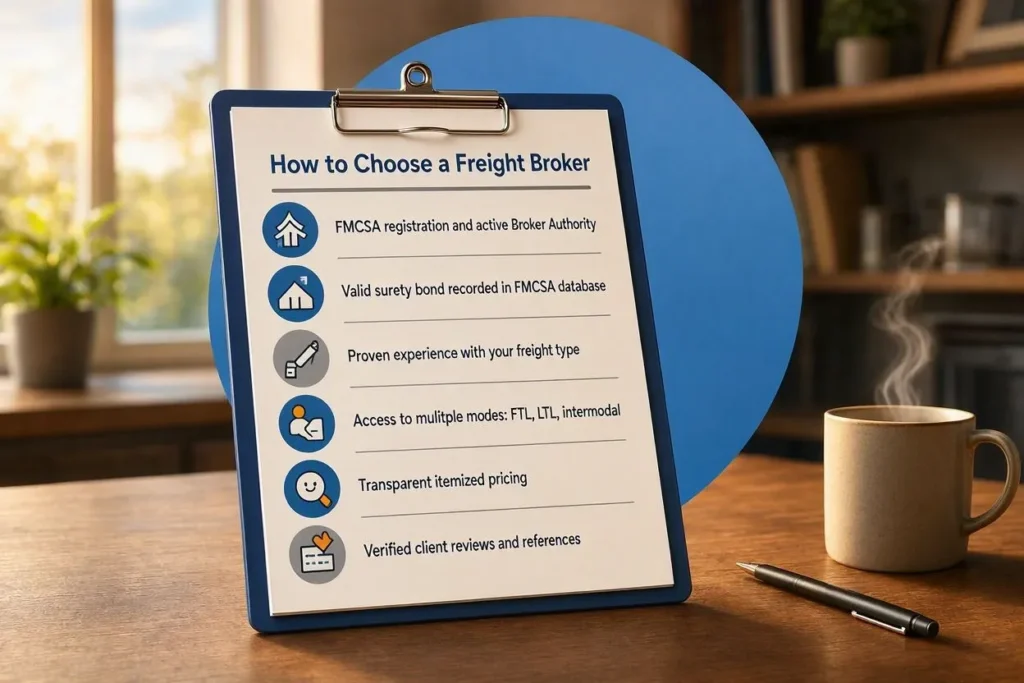
Six things separate a reliable freight broker from a risky one, and most of them are things a shipper can check before ever signing a contract: confirmed FMCSA registration and active Broker Authority, a valid surety bond documented in the FMCSA database, established experience in the shipper’s specific freight type, access to multiple transportation modes (FTL, LTL, intermodal), transparent and itemized pricing, and verified client reviews or industry recognition.
If a broker can’t produce proof of FMCSA registration within minutes of being asked, that’s a reason to walk away right there. Legitimate brokers keep this documentation on hand because shippers ask for it constantly. Network size matters just as much: a broker with 500 vetted trucking relationships across a shipper’s target lanes offers far more reliable capacity than one working with 50.
What Are the Risks of Working With a Freight Broker?
Freight brokerage isn’t risk-free. An unlicensed broker leaves a shipper exposed if a carrier fails to deliver, since there’s no bond backing the transaction to cover the loss.
Hidden fees are a more common headache. Some brokers quote a low base rate, then tack on unexpected accessorial charges (detention, fuel surcharges, liftgate service) once the shipment’s already booked. Cargo theft is the third risk, and it hasn’t leveled off; shippers are now losing more to fraud and hijacking than at almost any point in the past decade. A broker that skips carrier vetting to save time is putting every shipment at higher risk of landing with an unqualified or outright fraudulent carrier.
None of this erases the value freight brokerage provides. It just means a shipper needs to verify licensing, read contracts closely, and ask brokers directly how they screen carriers before signing on for the long haul.
Conclusion
Freight brokerage exists to solve a problem that’s been baked into trucking for decades: over 1 million for-hire carriers operate in the U.S., and no shipper can realistically vet that many on its own. A licensed broker steps into that gap, sourcing capacity, negotiating rates, and handling documentation, so shippers don’t have to build an in-house logistics team from scratch.
The rules around all of this (FMCSA licensing, the 15% to 20% margin structure, the six-step booking process) exist to keep the system honest on both sides of the transaction. Before signing with anyone, verify licensing first, then compare carrier network size and pricing transparency.
FAQs

Esther Howard
Esther Howard leads TruckingHow’s trucking, commercial driving, and transportation content division. She specializes in CDL training, trucking regulations, fleet operations, truck maintenance, and logistics best practices. With over a decade of experience researching the commercial transportation industry, Esther brings a practical, research-driven approach to driver education, safety standards, and industry regulations. She is the primary author of TruckingHow’s CDL guides, trucking career resources, maintenance tips, and transportation content, helping drivers, fleet owners, and trucking professionals make informed decisions on and off the road
Related Posts