
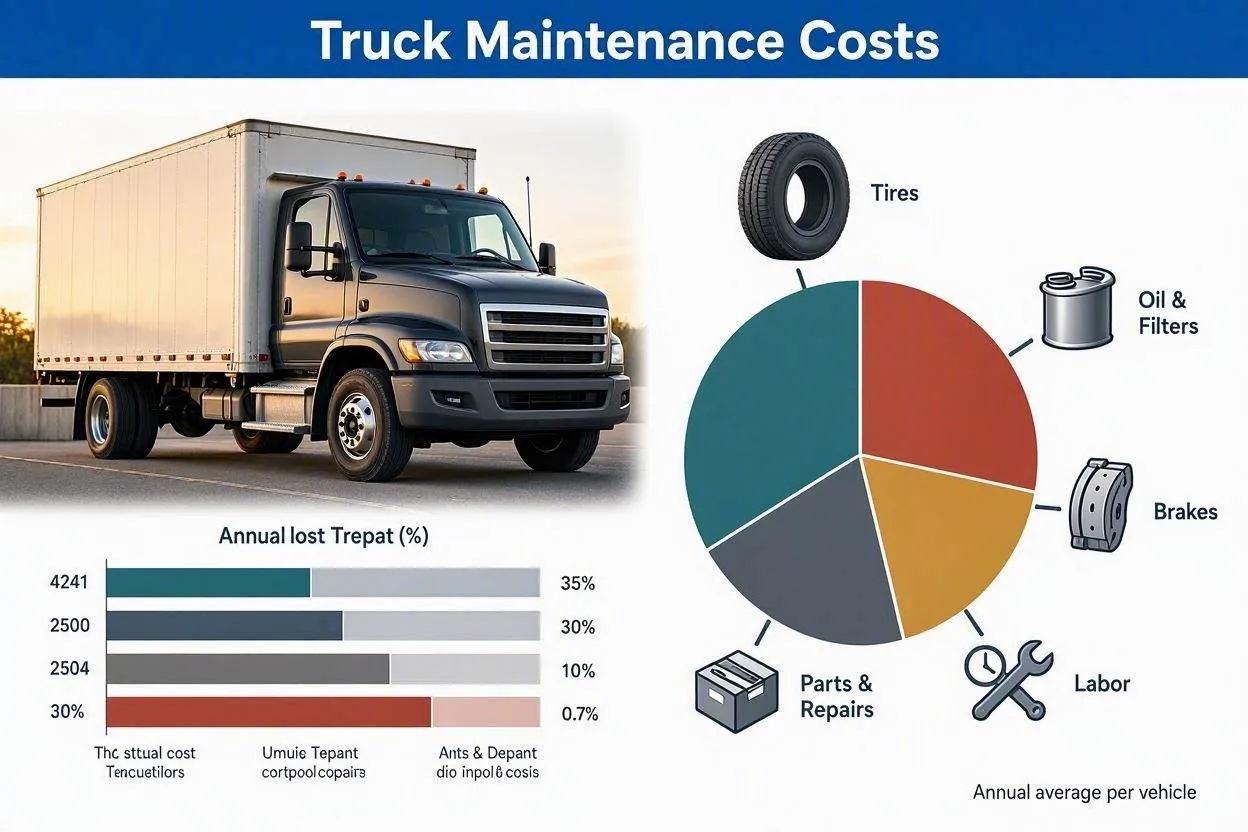
Truck Maintenance Costs 2026: Real Budget Numbers by Age, Mileage & Route
Vehicle maintenance is the second-biggest line item in trucking after fuel, and it’s the one drivers most often underestimate. A truck that looks fine on Monday can need a $6,000 engine repair by Friday. Skip a scheduled service interval to save a few hundred dollars now, and you usually pay for it later at the repair shop, with interest.
This breakdown covers routine service, parts replacement, diagnostic work, and major vehicle repairs, using 2026 figures pulled from repair shop data, technician labor rates, and industry cost studies, including the American Transportation Research Institute’s (ATRI) annual operational cost reports. Every number here reflects US heavy-duty truck repair and maintenance work, not passenger vehicle service.
How much do truck maintenance costs run per year?
Most owner-operators spend between $15,000 and $28,000 a year on maintenance. Severe-duty trucks can push past $35,000. Age, mileage, and route type explain almost all of that spread. A 2-year-old truck running flat interstate miles sits near the bottom. A 12-year-old truck hauling heavy freight through mountain grades sits at the top.
Three factors do most of the work here:
- Truck age. Components wear faster after year seven, and failure rates climb sharply past 500,000 miles.
- Annual mileage. A truck running 120,000 miles a year needs brake jobs, oil changes, and tires far more often than one running 60,000.
- Duty cycle. Stop-and-go city routes chew through brakes and steering components. Long-haul interstate work wears down engines and drivetrains instead.
A truck logging under 80,000 miles a year on flat interstate routes might land around $16,000 annually. The same truck running 130,000 miles through mountain terrain with frequent stops could hit $30,000. Neither figure is wrong; they’re just describing two very different trucks.
How truck age affects maintenance costs
Age is the single biggest driver of maintenance spend. Costs roughly double between a new truck and one past its twelfth year. Newer trucks spend most of their budget on preventive maintenance, oil changes, filters, tire rotations. Older trucks spend theirs on failures.
| Truck Age | Annual Cost Range | Primary Cost Drivers |
| 0–3 years | $12,000–$18,000 | PM services, tires, minor adjustments |
| 4–7 years | $16,000–$22,000 | Brake jobs, clutch wear, cooling system |
| 8–12 years | $20,000–$28,000 | Engine work, transmission, electrical faults |
| 13+ years | $25,000–$35,000 | Major overhauls, frequent breakdowns |
A truck at year 3 might need one brake pad replacement and a routine PM visit. That same platform at year 11, with identical mileage, often needs a transmission rebuild, a new alternator, and updated brake drums. Mechanics who see a truck regularly catch this pattern early and flag it before it turns into a roadside breakdown.
Once a truck crosses eight years of service, it’s worth shifting 10–15% more of the annual budget toward major-component contingency funds instead of routine PM.
What does truck maintenance cost per mile?
Figure on $0.15 to $0.25 per mile for maintenance overall, with repair-specific costs closer to $0.09 to $0.20 per mile. Local delivery routes sit at the low end. Long-haul and heavy-haul operations sit at the high end, because sustained highway speeds and heavier loads wear down engines and drivetrains faster.
Cost per mile matters more than annual totals for one simple reason: it flags problems before they get expensive. A truck running $0.18 per mile in January that climbs to $0.27 by June is telling you something, deferred maintenance, or a component wearing out faster than expected, months before it becomes a breakdown. Fleets that only look at annual totals miss that signal entirely.
A 100,000-mile-per-year truck at $0.20 per mile lands at roughly $20,000 in annual spend. That lines up with the age-based ranges above, which is a good sign; the two methods should confirm each other, not contradict.
How route type changes maintenance costs
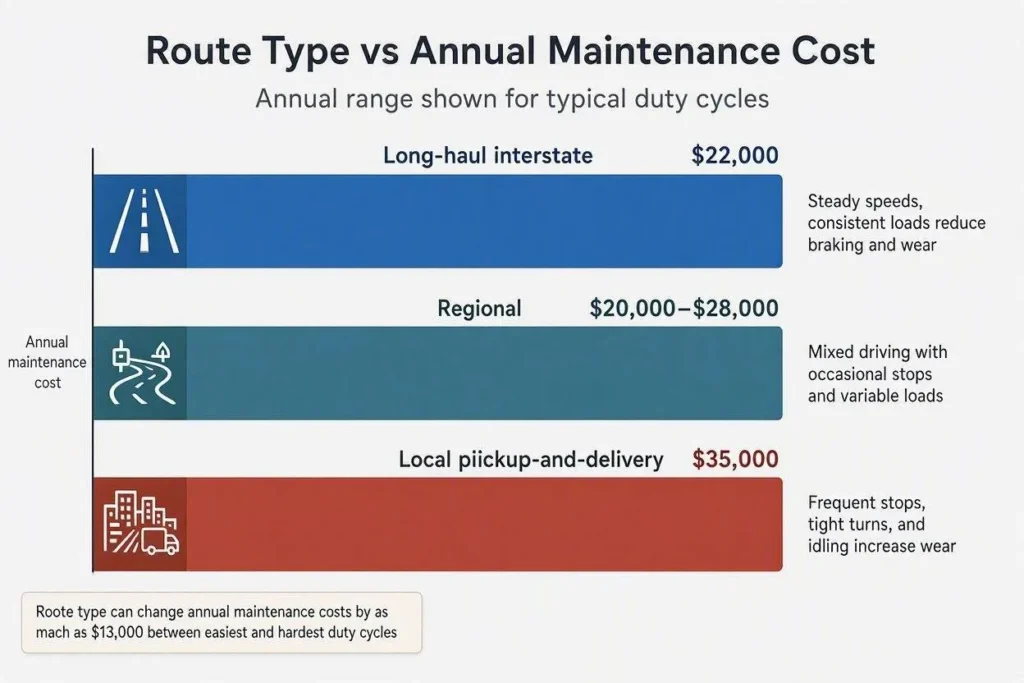
Route type can swing annual maintenance costs by as much as $13,000 between the easiest and hardest duty cycles. Long-haul interstate work causes the least wear, since trucks hold steady speeds without constant braking and acceleration. Local pickup-and-delivery is the roughest on a truck, thanks to repeated stops, tight turns, and idle time.
- Long-haul interstate: $15,000–$22,000, driven by steady speeds and consistent loads
- Regional delivery: $18,000–$26,000, driven by mixed terrain and stop-and-go traffic
- Local pickup/delivery: $20,000–$28,000, driven by constant stops and city driving
- Heavy haul/specialized: $25,000–$35,000, driven by extreme loads and demanding routes
Mountain routes are their own category. A truck pulling 80,000 pounds through repeated grade changes stresses brakes, engines, and drivetrains far more than the same weight on flat ground. Two trucks with identical mileage and age can end up $8,000 apart in maintenance bills purely because of terrain.
What services make up a truck maintenance budget?
A truck maintenance budget breaks down into six service categories, with scheduled maintenance and unscheduled repairs together making up 65–85% of total spend. Tracking these separately, instead of watching one lump number, makes it much easier to spot which repair area is running over.
A typical $20,000 annual maintenance budget looks something like this:
- Scheduled maintenance: 40–50%, covering oil changes, filter replacement, DOT inspections, and planned component service
- Unscheduled repairs: 25–35%, covering breakdowns, roadside repairs, and component failures nobody saw coming
- Tires: roughly $3,000–$4,500, covering new tire purchases, retreading, and alignment service
- Brake system work: roughly $2,500–$3,500, covering brake pads, drums, rotors, and adjustments
- Consumables: 8–12%, covering fluids, filters, belts, and hoses
- Contingency reserve: 5–10%, held back for major overhauls or unexpected repair costs
Fleets that skip the contingency line are the ones that end up scrambling for financing the moment an engine or transmission fails mid-year. Build the reserve in from day one, tied to actual repair history, and that scramble mostly goes away.
What are the most expensive repairs on a semi-truck?
Engine overhauls top the list, running anywhere from $5,000 for limited internal work to more than $40,000 for a full rebuild or replacement. Four categories account for most of the large, unplanned bills:
- Engine overhauls: $5,000 to $40,000+, depending on how much internal damage there is
- Transmission and clutch repairs: several thousand dollars in parts and labor for automated manual transmissions
- Emissions system repairs: gets expensive fast when the diesel particulate filter and selective catalytic reduction system fail together
- Differential and driveline repairs: common in heavy-haul and vocational trucks under sustained high torque
A full engine rebuild at $35,000 often costs more than a down payment on a replacement truck. Once the engine’s opened up for inspection, a qualified diesel technician can usually tell you within minutes whether a rebuild or a replacement makes more sense.
Preventive maintenance vs. unscheduled repairs: the real cost gap
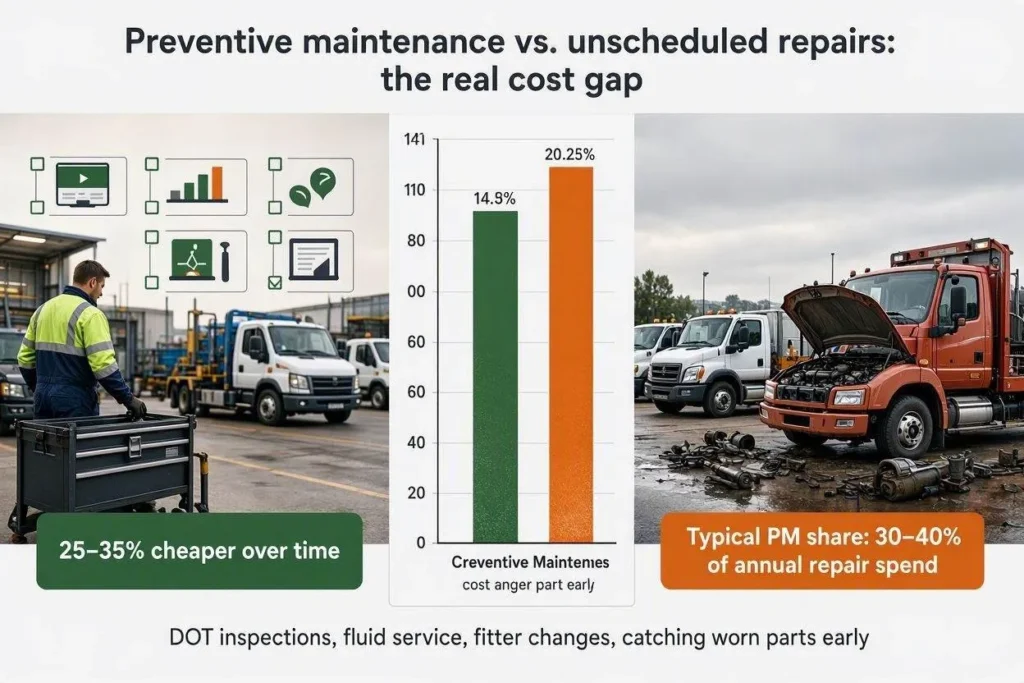
Preventive maintenance runs 25–35% cheaper over time than relying on unscheduled repairs, even though it feels like an added cost in the moment. PM covers DOT inspections, fluid service, filter changes, and catching worn parts early. For fleets that stay disciplined about scheduling, it typically eats up 30–40% of annual repair spend.
Unscheduled repairs cost more for three concrete reasons:
Towing and expedited parts shipping add costs that never appear on a routine service invoice. Emergency labor rates at a repair shop run 50–100% higher than scheduled daytime rates. And downtime during an unplanned breakdown stops revenue while fixed costs keep running.
Operations that hit 70–80% planned maintenance and 20–30% unscheduled repair work report the most stable, predictable maintenance spend year over year. Operations stuck at 50–60% reactive repair work spend more in total, even though their invoice totals sometimes look smaller on any single shop visit.
What hidden costs push maintenance costs higher?
Downtime alone adds $100 to $150 a day beyond the direct repair expense, and it often ends up costing more than the repair bill itself. These are the costs that never show up on a shop invoice, which is exactly why so many maintenance budgets leave them out.
Four hidden costs to track:
- Downtime: lost revenue while the truck sits idle waiting on parts or shop time, separate from the repair cost itself
- Rental trucks or load transfers: costs incurred to keep freight moving during a breakdown
- Administrative time: hours spent coordinating repairs, rescheduling freight, and managing logistics during an outage
- Driver pay during breakdowns: wages that continue even when the truck isn’t earning
A three-day breakdown at $125 a day in downtime adds $375 on top of a repair that might already run $4,000. Multiply that across a dozen breakdowns a year and hidden costs can rival the direct repair total. Fleets that track total cost of ownership, not just invoice totals, catch this pattern early.
How to build an accurate truck maintenance budget
Start with three years of historical repair and service cost data, then adjust for truck age, mileage growth, and parts and labor inflation. Six steps get you a maintenance budget that survives past month four:
- Pull three years of actual repair and maintenance costs by service category.
- Adjust for known increases in parts and shop labor rates for the coming year.
- Factor in fleet changes, new truck acquisitions or retirements.
- Add a 10–20% contingency reserve for major component repairs.
- Segment the budget by category, scheduled service, unscheduled repairs, tires, contingency, rather than one lump number.
- Compare against industry maintenance benchmarks and adjust for the fleet’s specific age and route mix.
If a fleet only has one year of cost history, widen the contingency margin to 15–20% instead of 10% until there’s enough data to tighten the estimate.
How to reduce truck maintenance costs
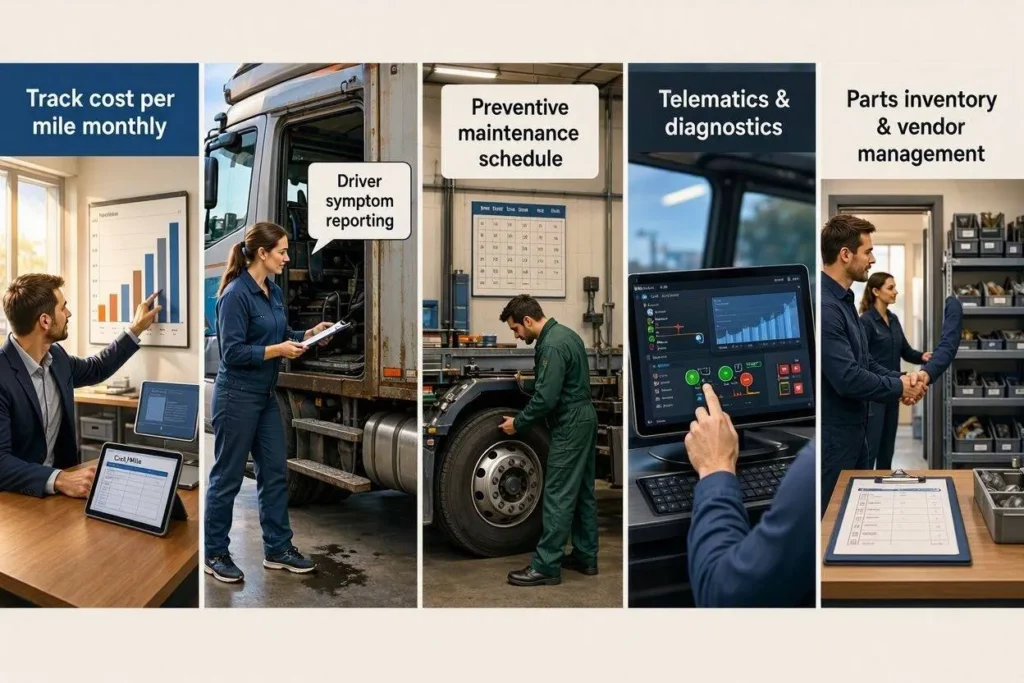
Costs come down when fleets shift from reactive repair to tracked, preventive maintenance, and when drivers get looped in on early problem reporting. Five approaches produce real savings without cutting corners on safety:
- Track cost per mile monthly, not annually, so rising repair trends show up before they become breakdowns.
- Train drivers to report early symptoms, unusual noises, fluid leaks, dashboard warnings, since catching things early does far less damage than letting them run.
- Stick with one repair shop so the mechanics get to know your trucks and catch repeat issues faster.
- Follow FMCSA-aligned inspection schedules to stay compliant and catch worn brake pads, hoses, and belts before they turn into a violation.
- Use diagnostic and predictive maintenance tools to flag wear based on actual sensor data instead of mileage alone.
A driver who reports a coolant leak within a day, instead of a week, often turns a $400 hose repair into what would otherwise become a $6,000 engine job from overheating. That one habit pays for itself many times over across a year.
Conclusion
Truck maintenance costs range from $15,000 to $35,000 a year, and the gap comes down to three things: truck age, annual mileage, and route type. A fleet that tracks cost per mile monthly, keeps a 10–20% contingency reserve, and holds preventive maintenance above 70% of total repair work spends less over five years than one that waits for breakdowns to set the budget. The $375 hose repair caught early beats the $6,000 engine job caught late, every time.
FAQs

Esther Howard
Esther Howard leads TruckingHow’s trucking, commercial driving, and transportation content division. She specializes in CDL training, trucking regulations, fleet operations, truck maintenance, and logistics best practices. With over a decade of experience researching the commercial transportation industry, Esther brings a practical, research-driven approach to driver education, safety standards, and industry regulations. She is the primary author of TruckingHow’s CDL guides, trucking career resources, maintenance tips, and transportation content, helping drivers, fleet owners, and trucking professionals make informed decisions on and off the road
Related Posts