

How to Start a Trucking Company: A Step-by-Step Guide for New Carriers
Trucks moved 11.18 billion tons of freight across the United States in 2023, and every one of those loads needed a carrier willing to take the risk of starting a business. Starting a trucking company means working through a specific sequence: business setup, licensing, insurance, equipment, financing. Each step has its own paperwork and its own deadline. Skip one, and the Federal Motor Carrier Safety Administration (FMCSA) will flag your operation before your first load ever gets dispatched.
This guide walks through that sequence in order, with real dollar figures, timelines, and regulatory codes. No vague estimates, no “it depends” without a number attached.
What Do You Need to Start a Trucking Company?
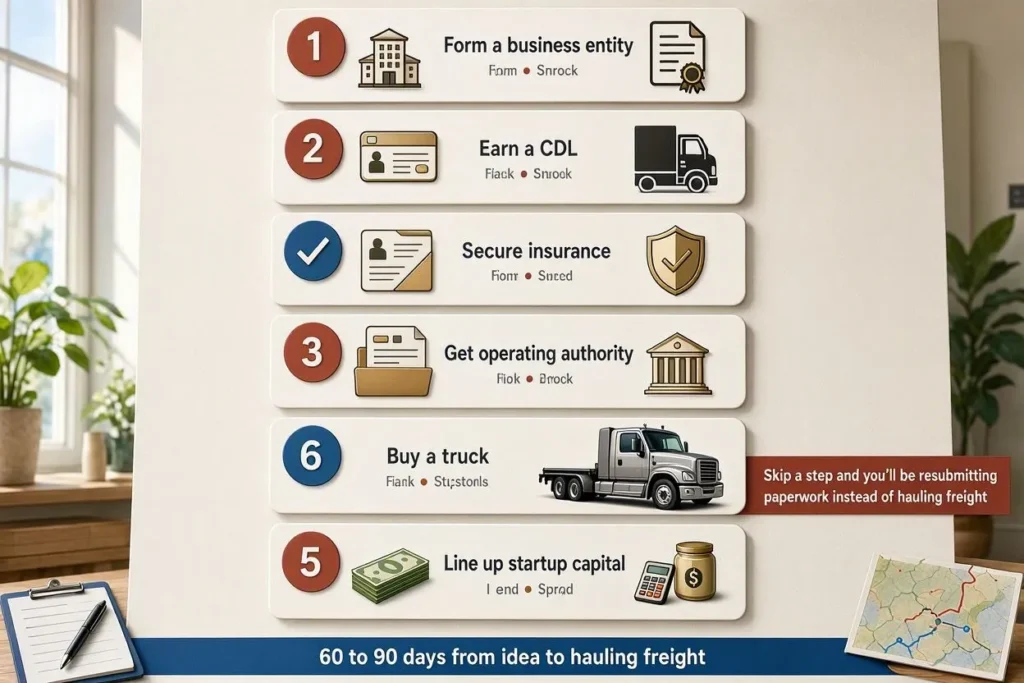
Six things need to happen in order: form a business entity, earn a CDL, secure insurance, get operating authority, buy a truck, and line up startup capital. Skip a step and you’ll be resubmitting paperwork instead of hauling freight, since you can’t get insurance without an entity or authority without insurance on file. Even an experienced driver with $15,000 saved needs 60 to 90 days to get from idea to legally hauling freight, mostly due to FMCSA and state processing delays.
There are two paths in: experienced company drivers already hold a CDL and just build the business layer around it, while newcomers earn a CDL first and then stack the same steps on top. Both land on the same checklist, but the newcomer’s timeline runs 4 to 8 weeks longer because of CDL training.
Do You Need a Business Plan?
Not to get operating authority. The FMCSA doesn’t ask for one. But skip it and you’ll feel the absence the first time you sit across from a lender. Banks, credit unions, and equipment lenders almost always want to see projected costs, the lanes or freight types you plan to run, and how you’ll cover fixed expenses in a slow month before they’ll approve financing.
The Small Business Administration publishes a free business plan template that works fine for a one-truck startup, and OOIDA (the Owner-Operator Independent Drivers Association) offers owner-operator-specific guidance and cost worksheets if you’d rather start from something built for trucking specifically. Either way, the plan doesn’t need to be long. A single page covering startup costs, target freight lanes, and a break-even estimate is usually enough to get a lender’s attention.
How Much Does It Cost to Start a Trucking Company?
Somewhere between $10,000 and $40,000 for an owner-operator with one used truck. A company adding a new Class 8 tractor is looking at $150,000 or more. The gap comes down to one decision: buying used versus financing new.
Here’s where the money actually goes:
- Registering a business entity: $50 to $500, depending on the state
- USDOT and MC number filing fees: $300 total
- Liability and cargo insurance down payment: $2,000 to $5,000
- Truck down payment: $1,000 to $15,000 for financed equipment
- Permits, plates, and IRP registration: $500 to $1,500
- Operating cash reserve: $5,000 to $10,000 minimum
A used Class 8 sleeper truck runs $40,000 to $80,000. A new one costs $150,000 to $200,000. Annual insurance premiums land around $10,000 to $15,000 per truck for a new carrier with no safety history, and that number drops as the company builds a clean record over its first two years.
Take two carriers launching the same month. One buys a 5-year-old truck for $55,000 with $12,000 down, so $18,000 total invested. The other finances a new $175,000 tractor with $15,000 down and carries a monthly payment near $2,400 before a single load gets booked. Both can succeed. But the second carrier needs consistent freight volume from day one just to cover fixed costs, while the first has room to absorb a slow month.
How Do You Choose a Business Structure for Your Trucking Company?
Most new trucking companies form as an LLC. It separates personal assets from business debt while keeping tax filing simpler than a corporation. A sole proprietorship is cheapest but leaves your assets exposed if a claim outruns your insurance; a partnership just splits that exposure between owners; an LLC removes it while still passing profit and loss through to your personal return; and a corporation offers the strongest protection, but double taxation and heavier recordkeeping make it a poor fit for a one-truck startup.
Once you’ve picked a structure, check your name against the U.S. Patent and Trademark Office database, file formation paperwork with the state, and apply for an EIN through the IRS. You’ll need that EIN before you can open a business bank account.
How Do You Get a Commercial Driver’s License (CDL)?
Getting your CDL means passing a knowledge exam, holding a commercial learner’s permit (CLP) for at least 14 days, then passing a skills test that covers a pre-trip inspection, basic maneuvers, and a road test. You’ll need proof of identity, residency, and a Social Security number plus a vision screening to get started, and you must be 18 to drive intrastate or 21 for interstate hauling. Most new drivers spend 3 to 6 weeks in supervised practice after getting their CLP before scheduling the skills test, and total cost, permits, testing fees, and any required training, typically runs $3,000 to $7,000 through a CDL school.
The federal requirements above are the floor, not the whole picture. States add their own wrinkles: some require additional endorsements for certain freight types, some run their own approved-school lists, and skills-test scheduling backlogs vary a lot by state DMV. Check your state’s specific CDL requirements before you assume the federal minimums are all you need.
What Insurance Coverage Does a Trucking Company Need?
Three policies at minimum: primary liability of at least $750,000, cargo insurance of at least $100,000, and physical damage coverage for the truck itself. The $750,000 figure is the federal floor set by the FMCSA, though most freight brokers won’t dispatch loads to a carrier without $1 million in liability coverage. You’ll need proof of this coverage on file before operating authority can be granted, so this step comes before you file for authority, not after.
| Coverage Type | Minimum Required | Who Requires It |
| Primary liability | $750,000 federal floor; $1,000,000 typical broker requirement | FMCSA, freight brokers |
| Cargo insurance | $100,000 | Freight brokers, shippers |
| Physical damage | Set by insurer, based on truck value | Equipment lenders |
A new carrier with no safety record should expect quotes on the higher end of these ranges until 12 to 24 months of clean operating history bring premiums down.
How Do You Get Your Trucking Authority?
File Form OP-1 with the FMCSA, designate a process agent through Form BOC-3, and you’ll receive both a USDOT number and an MC (Motor Carrier) number once approved. The USDOT number applies to any truck with a gross vehicle weight over 10,000 pounds crossing state lines. The MC number is what actually grants for-hire authority to transport regulated commodities.
A process agent accepts legal documents on the carrier’s behalf in every state where the company operates, and every carrier needs one designated before authority activates. Processing takes 20 to 25 days from a complete application, plus a mandatory 10-day waiting period after publication before authority becomes active. State-level registration, including apportioned plates through the International Registration Plan, adds another 2 to 3 weeks depending on the state.
What Licenses and Permits Does a New Trucking Company Need?
Six core registrations beyond operating authority: IRP apportioned plates, an International Fuel Tax Agreement (IFTA) account, Unified Carrier Registration (UCR), a Standard Carrier Alpha Code (SCAC), an electronic logging device (ELD), and Heavy Vehicle Use Tax (HVUT) payment if the truck weighs over 55,000 pounds.
Each one does something different:
- IRP calculates distance-based registration fees for trucks operating across multiple states
- IFTA simplifies fuel tax reporting for carriers running in more than one jurisdiction
- UCR verifies that a carrier’s insurance meets federal minimums in every operating state
- SCAC, issued by the National Motor Freight Traffic Association, identifies the carrier on shipping documents and customs filings
- ELD hardware logs hours of service automatically and has to meet FMCSA technical specs
- HVUT applies annually through IRS Form 2290 for trucks above the 55,000-pound threshold
Miss any one of these and a truck gets placed out of service at a roadside inspection, even if the operating authority itself is completely valid.
Should You Buy or Lease Your First Truck?
Buying outright builds equity and lowers your long-term cost; leasing cuts the upfront cash needed to start, which suits a driver still testing the business. Three lease structures cover most cases: an owner-operator lease keeps you in control of the truck while you handle permits, taxes, and maintenance yourself; a lease-purchase program gets drivers with damaged credit into a truck fast, at a higher interest rate; and a TRAC (terminal rental adjustment clause) lease takes a bigger down payment in exchange for either buying out the balance or splitting the resale profit at lease end.
A driver buying a 3-year-old used sleeper for $65,000 with $10,000 down builds equity from month one, while a lease-purchase on the same truck can run $200 to $400 more per month in interest. Buy once you can absorb that down payment without draining your cash reserve; lease if you’re still proving out freight volume.
How Do You Fund a Trucking Company Startup?
Most new trucking companies fund startup costs through a mix of personal savings, equipment financing, and freight factoring rather than one big loan. Traditional banks often require two years of operating history before approving a business loan, which rules that option out for a brand-new carrier.
Credit unions approve trucking loans more readily than large banks, and specialized trucking lenders exist specifically for equipment financing on new or used trucks. Freight factoring solves a different problem entirely: it converts unpaid invoices into immediate cash by selling them to a factoring company at a discount, typically 1% to 5% of the invoice value. A carrier hauling a $2,000 load who can’t wait the standard 30 days for broker payment might factor that invoice for $1,900 to $1,960 in cash within 24 hours instead.
What Tools Does a New Trucking Company Need?
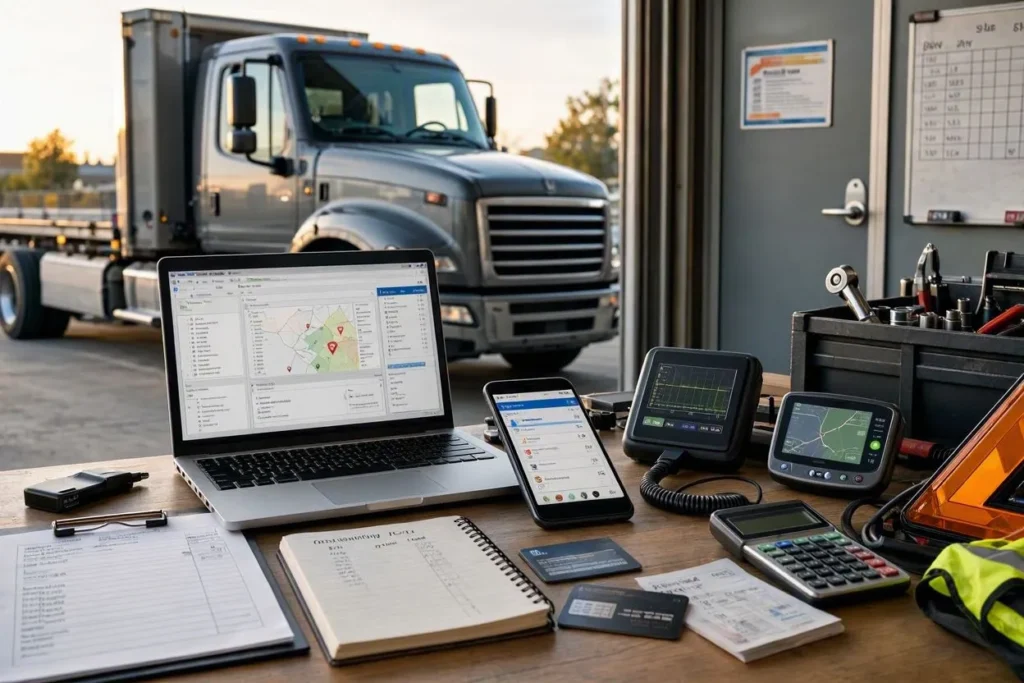
Beyond the truck itself, a handful of tools separate a carrier that runs smoothly from one that’s constantly playing catch-up. A transportation management system (TMS) handles dispatch, load tracking, and paperwork in one place, though a single-truck operation can often get by on a load board’s built-in tools before paying for a standalone TMS. Bookkeeping software like QuickBooks keeps fuel, maintenance, and revenue sorted for tax season and for any lender who asks to see your numbers. A fuel card isn’t optional in practice, since the discounts at partner truck stops usually cover the card’s fee many times over across a year of driving.
Your ELD deserves its own attention. It has to appear on the FMCSA’s registered device list to count as compliant, and beyond that, look for one that integrates with whatever TMS or dispatch software you’re using, since re-entering the same hours-of-service data twice is a waste of time you don’t have.
What Compliance Requirements Apply to New Motor Carriers?
New motor carriers must clear three requirements to keep their authority intact:
- Register every commercial driver in the FMCSA Drug and Alcohol Clearinghouse
- Pass a New Entrant Safety Audit within the first 12 months of receiving authority
- Maintain hours of service (HOS) logs through a certified ELD
Skip any one of these three and you’re putting your operating authority itself at risk.
The Drug and Alcohol Clearinghouse is a federal database of CDL holders’ violations, and carriers must query it before hiring any driver, along with a separate check through the FMCSA’s Pre-Employment Screening Program. The New Entrant Safety Audit reviews your HOS compliance, drug testing program, and maintenance records, and failing it can cost you your authority. HOS rules cap driving at 11 hours within a 14-hour window, followed by a mandatory 10-hour break, all logged automatically by your ELD.
Failing the audit doesn’t mean losing authority immediately, though. The FMCSA gives you a 60-day corrective action plan to fix issues like missing driver files or maintenance gaps. It’s ignoring that plan, not the initial failure, that gets authority revoked.
What Is a CSA Score and Why Does It Matter?
The FMCSA’s Compliance, Safety, Accountability (CSA) program scores every carrier across seven safety categories, called BASICs, using roadside inspection results and crash history. A rising score in any category can trigger more frequent inspections, and a growing number of brokers and shippers check a carrier’s CSA score before assigning freight, treating it as a proxy for reliability.
The good news is a new carrier starts with a clean slate. The bad news is that a handful of avoidable violations, an out-of-date logbook, a missed inspection sticker, can move the needle fast when there’s no history yet to dilute them. Keeping equipment maintained and HOS logs accurate isn’t just about staying compliant; it’s what keeps your CSA score low enough that brokers keep calling.
How Do You Calculate Cost Per Mile for a Trucking Business?
Total fixed and variable costs divided by total miles driven in a given period. This is the single number that tells you whether a load is profitable before a truck ever leaves the yard. Fixed costs include truck payments, insurance, and permits. Variable costs include fuel, maintenance, tolls, and driver pay per mile.
A carrier with $4,500 in monthly fixed costs and $8,000 in monthly variable costs running 10,000 miles that month has a cost per mile of $1.25. Book a load below that rate and you’re losing money before you even account for your own wage. Track cost per mile weekly, not once at startup. That’s what catches fuel price swings and maintenance spikes before they eat into a quarter’s worth of margin.
How Do You Get Loads for a New Trucking Company?
Three channels: online load boards, direct relationships with freight brokers, and contracts negotiated directly with shippers. Load boards work fastest for a brand-new authority with no track record, since brokers post available freight openly without requiring an existing relationship.
Direct broker relationships take longer, usually 3 to 6 months of consistent, on-time delivery before a broker offers dedicated lanes or better rates. Direct shipper contracts pay the highest margin because there’s no broker fee sitting between the carrier and the freight, but shippers typically want proof of at least a year of safety compliance and insurance history before signing. A common and realistic growth path: haul exclusively through load boards for the first 6 months, then shift 30% of volume to direct broker relationships once you’ve built a safety record.
Owner-Operator, Small Fleet, or Broker: Which Model Fits You?
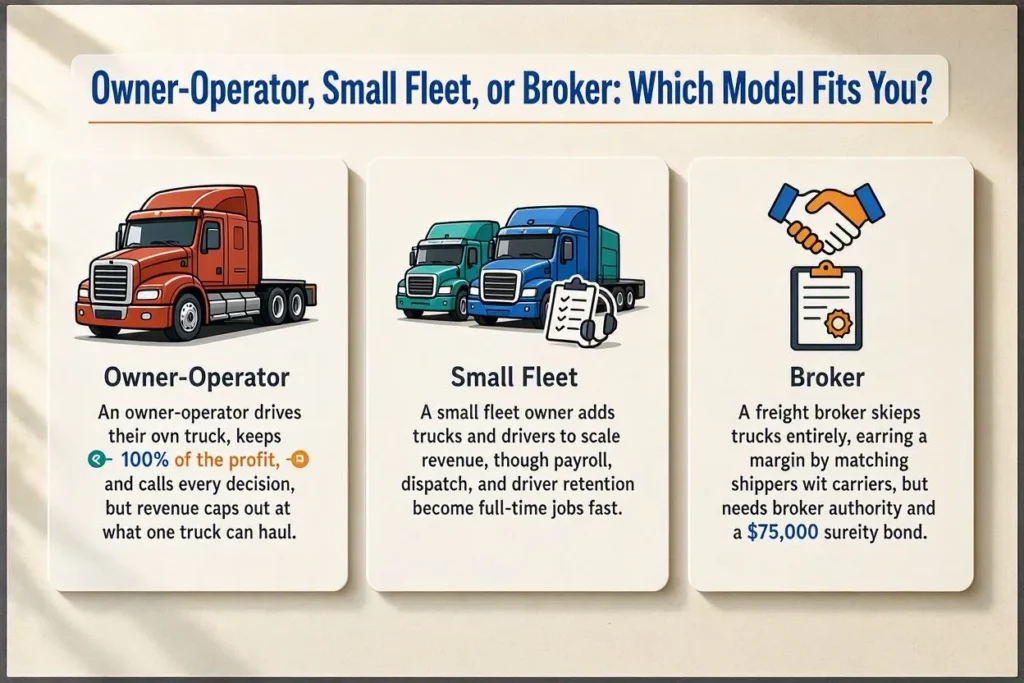
An owner-operator drives their own truck, keeps 100% of the profit, and calls every decision, but revenue caps out at what one truck can haul. A small fleet owner adds trucks and drivers to scale revenue, though payroll, dispatch, and driver retention become full-time jobs fast. A freight broker skips trucks entirely, earning a margin by matching shippers with carriers, but needs broker authority and a $75,000 surety bond instead of motor carrier authority.
There’s a fourth option: leasing with an established carrier. You own the truck but run under their MC number, insurance, and dispatch for a percentage of each load, a lower-risk way to build a safety record before going asset-based and authority-only, the path the rest of this guide assumes.
How Do You Grow a Trucking Company After Launch?
Diversify your customer base so no single client accounts for more than 20% of revenue, then reinvest profit into a second truck once cash flow supports it for 3 consecutive months. Client concentration is the fastest way a small carrier goes under. Losing one account that represents 40% of revenue can shut down operations within weeks.
Building a company website, listing on multiple load boards, and staying visible where shippers search for capacity all widen the funnel for new freight. Fleet management software tracks fuel consumption, maintenance schedules, and driver hours across multiple trucks once a fleet grows past one or two units, catching problems that manual tracking misses. A carrier with 5 or more regular clients, none exceeding that 20% revenue threshold, has built the kind of stability that survives a single account walking away.
A 30/60/90-Day Launch Timeline
All these steps stack up differently depending on where you start, but here’s roughly how they land on a calendar for someone with a CDL already in hand:
- Days 1–15: Form your business entity, get your EIN, open a business bank account, and write your one-page business plan. Start shopping insurance quotes now, since carriers need lead time to underwrite a new business.
- Days 15–30: Bind your liability and cargo insurance, then file Form OP-1 and BOC-3. This is also when most people finalize their truck purchase or lease.
- Days 30–55: Wait out FMCSA processing and the mandatory publication period while your authority activates. Use this window to register for IFTA, apply for IRP plates, set up your ELD, and get your fuel card and bookkeeping tools in place.
- Days 55–90: Authority activates, state registration clears, and you start pulling loads, likely off load boards first. Your New Entrant Safety Audit window opens here and runs for the next 12 months.
A newcomer without a CDL yet should tack another 4 to 8 weeks onto the front of this timeline.
Conclusion
It all comes down to sequencing: entity formation before insurance, insurance before operating authority, authority before a load ever gets booked. A driver who files the OP-1 form with incomplete insurance documentation loses weeks waiting for a resubmission. One who lines up cargo and liability coverage first clears authority in the standard 20 to 25 days. Follow the steps in this guide in order, and you can go from idea to a truck loaded and moving freight under its own authority within a single business quarter.
FAQs

Esther Howard
Esther Howard leads TruckingHow’s trucking, commercial driving, and transportation content division. She specializes in CDL training, trucking regulations, fleet operations, truck maintenance, and logistics best practices. With over a decade of experience researching the commercial transportation industry, Esther brings a practical, research-driven approach to driver education, safety standards, and industry regulations. She is the primary author of TruckingHow’s CDL guides, trucking career resources, maintenance tips, and transportation content, helping drivers, fleet owners, and trucking professionals make informed decisions on and off the road
Related Posts