
Trucking Business Financing: Loan Types, Rates & Qualifying
Trucking business financing covers the loans, credit lines, and cash-advance products that fund trucks and keep a fleet running between broker paychecks. Seven main types exist: SBA (Small Business Administration) loans, equipment financing, business lines of credit, merchant cash advances (MCA), business credit cards, freight factoring, and working capital loans. Rates typically run 2% to 20% APR (Annual Percentage Rate) for secured products, though factoring and MCA deals use factor rates instead. Most lenders want 12 months in business, a credit score above 600, and $50,000+ in annual revenue, but equipment-backed loans loosen those rules since the truck itself acts as collateral.
What Is Trucking Business Financing?
Trucking business financing is the umbrella term for any loan, lease, or credit product built to fund a commercial trucking operation. That covers buying a truck, adding trailers to a fleet, or bridging the 30 to 90-day wait between hauling a load and getting paid by the broker. Owner-operators use it differently than fleet owners do. A single-truck operator might need $15,000 for a used sleeper cab. A 20-truck fleet might draw $500,000 across several products at once.
The term gets used loosely online, and that’s part of the confusion. Some lenders mean equipment loans specifically; others mean working capital, or factoring, or a blended package. None of these products work the same way, so a clear breakdown matters before anyone applies.
How Much Does Trucking Business Financing Cost?
Trucking business financing costs between 2% and 20% APR for secured loans, but merchant cash advances and factoring use factor rates instead, typically 1.09 to 1.5 times the amount borrowed. SBA loans sit at the low end, often 11.25% to 13.25% APR, because the government guarantee reduces lender risk. Equipment loans land in a similar range since the truck backs the debt. Unsecured products cost more. Business lines of credit can run as low as 29.9% APR, and MCAs carry the steepest effective cost of any option here once the factor rate gets annualized.
Fees stack on top of the base rate too. Origination charges, UCC-1 lien filing fees, and early payoff penalties can all shift the real cost of a loan. A borrower comparing two offers should ask for the total repayment amount, not just the headline rate, because two loans with identical APRs can still cost differently once fees enter the picture.
What Are the 7 Types of Trucking Business Financing?
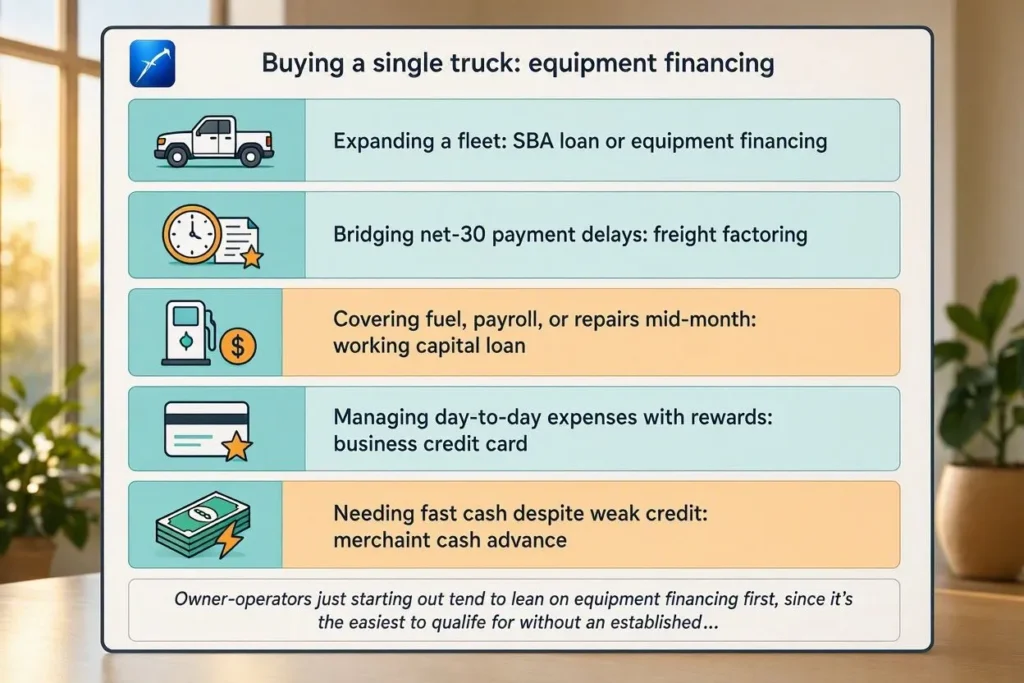
Seven main products make up trucking business financing: SBA loans, equipment financing, business lines of credit, merchant cash advances, business credit cards, freight factoring, and working capital loans. Each serves a distinct purpose, and most trucking companies end up combining two or three of them over time.
| Financing Type | Typical Amount | Typical Rate | Best For |
| SBA Loan | $30,000 – $500,000+ | 11.25% – 13.25% APR | Long-term fleet expansion |
| Equipment Financing | $5,000 – $5,000,000 | 2% – 20% APR | Buying a single truck or trailer |
| Business Line of Credit | $6,000 – $200,000 | As low as 29.9% APR | Ongoing, repeat purchases |
| Merchant Cash Advance | Varies by revenue | 1.09 – 1.5 factor rate | Fast cash despite weak credit |
| Business Credit Card | Set credit limit | 18.74% – 26.74% APR | Day-to-day fuel and maintenance costs |
| Freight Factoring | Based on invoice value | % of invoice (varies) | Bridging net-30/net-60 payment delays |
| Working Capital Loan | $6,000 – $500,000 | Factor rate or fixed fee | Fuel, payroll, and repair gaps |
SBA Loans
SBA loans offer some of the lowest rates available to trucking businesses, but they come with strict paperwork. The CDC/504 program specifically covers equipment purchases, including trucks, and terms can stretch past 10 years. Applicants generally need a credit score of 650 or higher, at least 12 months in business, and $50,000 or more in annual revenue.
Equipment Financing
Equipment financing uses the truck as its own collateral, which makes qualifying easier for newer businesses. Loan amounts commonly range from $5,000 to $5,000,000, with repayment terms of 24 to 60 months. Because the lender can repossess the vehicle if payments stop, rates run lower than unsecured alternatives, though a down payment of 5% to 25% is usually required.
Business Line of Credit
A business line of credit gives access to funds up to a set limit, and interest applies only to what’s drawn. Fleet owners who keep buying trucks tend to like this setup because it skips the hassle of reapplying every time. Amounts run $6,000 to $200,000, and once approved, funds are usually available within 24 hours.
Merchant Cash Advance
A merchant cash advance swaps future revenue for cash today. Lenders here care about bank deposits, not credit scores. This makes MCAs accessible to trucking businesses with weaker credit, but the tradeoff is cost. Factor rates as low as 1.09 still translate into a high effective APR once the short repayment window, sometimes 4 to 12 months, gets factored in.
Business Credit Cards
Business credit cards don’t fund trucks directly, but they smooth out day-to-day expenses like fuel and maintenance. Some cards offer rewards on gas station purchases specifically, which matters given how much fuel eats into a trucking budget. Annual fees vary widely, from $0 to several hundred dollars depending on the rewards structure.
Freight Factoring
Freight factoring sells an unpaid invoice to a factoring company for immediate cash, and the factor collects payment from the broker or shipper directly. This removes the wait tied to net-30 or net-60 payment terms. The factoring company typically takes a percentage of the invoice value as its fee, and rates depend on the shipper’s creditworthiness, not the trucking company’s.
Working Capital Loans
Working capital loans provide a lump sum, from $6,000 to $500,000 in many cases, repaid daily or weekly instead of monthly. Fuel, payroll, insurance, and repairs all draw from this pool. Unlike factoring, the trucking company keeps full control of its customer relationships since no third party collects on outstanding invoices.
How Do You Qualify for Trucking Business Financing?
To qualify for trucking business financing, expect lenders to ask for 12 or more months in business, a credit score above 600, and revenue that holds steady month to month. Those numbers aren’t fixed. They move depending on which product you’re applying for. SBA loans and traditional bank loans set the bar higher, often demanding a 650+ score and $50,000+ in annual revenue, while equipment-backed loans and MCAs work with lower thresholds because the truck or future revenue backs the risk, not the applicant’s credit history alone.
Lenders also check MC (Motor Carrier) and DOT (Department of Transportation) numbers as proof of legitimate operation. A trucking company without either will struggle to get approved anywhere beyond a basic cash advance. Time in business matters more than most owner-operators expect too. A driver who’s been leasing under someone else’s authority for five years but only recently registered their own MC number often gets treated as a brand-new business by underwriters.
Which Trucking Business Financing Option Fits Your Business?
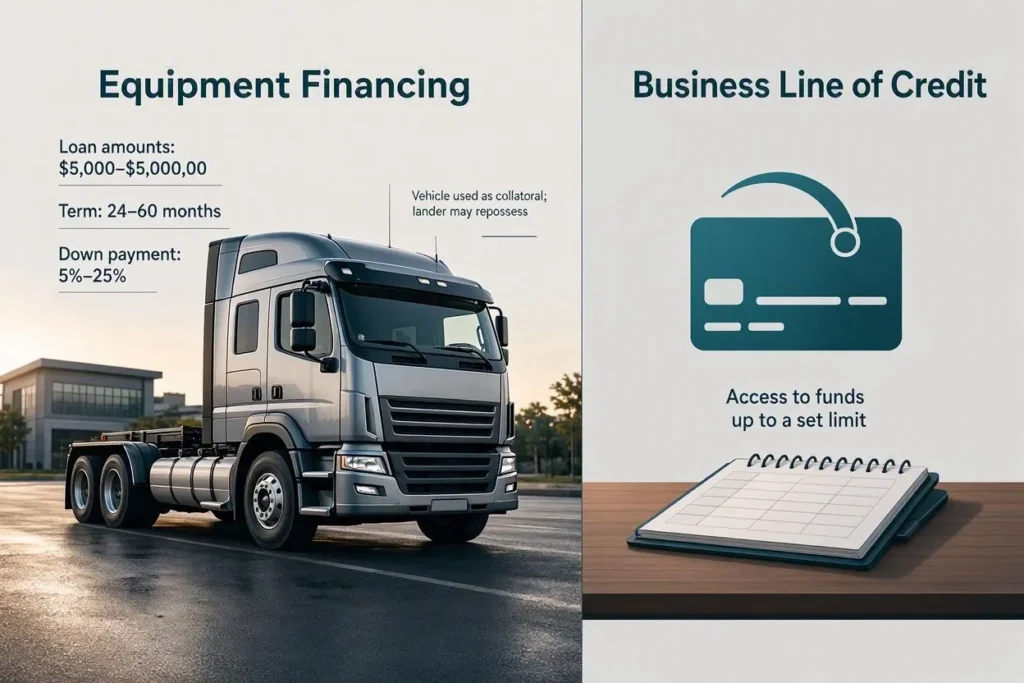
The right trucking business financing option depends on what the money is funding, not on which product advertises the lowest rate. Buying a truck calls for equipment financing or an SBA loan. Covering a cash-flow gap from slow-paying brokers calls for factoring or working capital instead.
- Buying a single truck: equipment financing
- Expanding a fleet: SBA loan or equipment financing
- Bridging net-30 payment delays: freight factoring
- Covering fuel, payroll, or repairs mid-month: working capital loan
- Managing day-to-day expenses with rewards: business credit card
- Needing fast cash despite weak credit: merchant cash advance
Owner-operators just starting out tend to lean on equipment financing first, since it’s the easiest to qualify for without an established revenue history. Established fleets often run two or three products at once, an equipment loan for the trucks and a working capital line for the gaps in between.
What’s the Difference Between Freight Factoring and Working Capital?
Freight factoring sells an invoice for immediate cash and lets the factor collect from the broker, while working capital provides a lump sum the trucking company repays directly without involving a third party. Factoring fits businesses that want to hand off collections entirely; it removes the administrative burden of chasing slow-paying shippers. Working capital fits businesses that want a fixed, predictable amount and prefer keeping their customer relationships private.
Cost structures differ too. Factoring fees scale with invoice volume and the shipper’s credit profile, so a company hauling for a slow-paying broker pays more regardless of its own financial health. Working capital loans, by contrast, price risk based on the trucking company’s own revenue and credit history, which can work in favor of an operator with strong books but unreliable customers.
Can You Get Trucking Business Financing With Bad Credit?
Yes, trucking businesses with bad credit can still get financing, though the options narrow to equipment loans, MCAs, and factoring rather than SBA loans or traditional bank credit. Equipment financing works because the truck itself secures the loan, so a lender cares less about a low FICO score and more about the collateral’s value. Factoring works because approval hinges on the shipper’s credit, not the trucking company’s.
Rates run higher across the board for bad-credit borrowers, and shorter repayment windows are common. A company with a 550 credit score might see a factor rate of 1.3 to 1.5 instead of the 1.09 available to stronger applicants, adding real cost over a full year of hauling.
How Do Fuel Costs and DOT Compliance Affect Financing Needs?
Fuel costs and DOT compliance drive a large share of the working capital that trucking businesses borrow, since both expenses hit before freight payments arrive. Diesel prices swing week to week, and a single fill-up on a long-haul route can run several hundred dollars, sometimes more than $500. Add DOT-required inspections, ELD (Electronic Logging Device) compliance, and FMCSA (Federal Motor Carrier Safety Administration) registration renewals, and the recurring costs add up fast, even before payroll enters the picture.
Fuel cards and working capital loans get paired often for this reason. A fuel card manages the daily spend, while a working capital loan absorbs bigger periodic hits like a DOT inspection failure or an ELD upgrade. Skip either kind of coverage, and smaller operators tend to fall behind on maintenance, which then risks a roadside violation and an even bigger unplanned expense.
What Mistakes Should You Avoid When Financing a Trucking Business?
The most common mistake is choosing a financing product based on rate alone instead of matching it to the actual expense being covered. A trucking company that takes out a 24-month equipment loan to cover a one-week fuel shortfall ends up paying interest on a truck-sized debt for a problem that lasted seven days. The reverse mistake happens too: using short-term MCA funding to buy a truck that should’ve gone through equipment financing from the start.
Four other errors show up repeatedly. Focusing only on the advertised rate while skipping the total-cost comparison costs borrowers the most over time. Applying for several products at once triggers multiple hard credit pulls and can drag down a score right when it matters most. Ignoring the lender’s early payoff penalty structure erases savings that seemed locked in. Failing to register an MC or DOT number before applying limits access to the strongest offers available. Avoiding these keeps the cost of trucking business financing predictable instead of compounding.
Conclusion
Trucking business financing isn’t a single product; it’s a toolkit, and picking the wrong tool for the job is the costliest mistake an operator can make. Match the financing type to the actual need: equipment loans for trucks, factoring or working capital for cash-flow gaps, SBA loans for lower-cost long-term expansion. Credit score requirements, funding speed, and total cost vary enough between these seven options that a five-minute comparison before applying can save thousands over a loan’s lifetime. Get the MC and DOT paperwork in order first, then match the product to the expense, and the financing search gets considerably shorter.
FAQs

Esther Howard
Esther Howard leads TruckingHow’s trucking, commercial driving, and transportation content division. She specializes in CDL training, trucking regulations, fleet operations, truck maintenance, and logistics best practices. With over a decade of experience researching the commercial transportation industry, Esther brings a practical, research-driven approach to driver education, safety standards, and industry regulations. She is the primary author of TruckingHow’s CDL guides, trucking career resources, maintenance tips, and transportation content, helping drivers, fleet owners, and trucking professionals make informed decisions on and off the road
Related Posts