
FMCSA Regulations 2026: The Complete Guide for Truckers and Carriers
Trucking runs on paperwork as much as it runs on diesel. One expired medical certificate or one missed Clearinghouse query can pull a driver off the road, and the rules behind those requirements change more often than most carriers realize. This guide breaks down what FMCSA actually requires in 2026, what changed this year, and how to keep a fleet out of trouble before an inspector ever asks for a logbook.
What Are FMCSA Regulations?
FMCSA regulations are federal safety rules issued by the Federal Motor Carrier Safety Administration that govern commercial trucking and bus operations across the United States. They cover driver qualifications, hours of service, vehicle maintenance, drug testing, and cargo handling. Congress created the FMCSA in 2000 under the Motor Carrier Safety Improvement Act of 1999, splitting truck and bus oversight away from the Federal Highway Administration. The agency’s rules sit in Title 49 of the Code of Federal Regulations, Parts 300 through 399.
A single missed requirement can shut down a truck at a weigh station. In 2025, roadside inspectors placed more than 10,000 commercial vehicles and over 3,300 drivers out of service for FMCSA violations. That’s not an outlier. It’s a baseline. Carriers who treat compliance as a once-a-year checklist item, instead of a daily habit, end up paying for it in downtime and fines.
Who Has to Follow FMCSA Regulations?
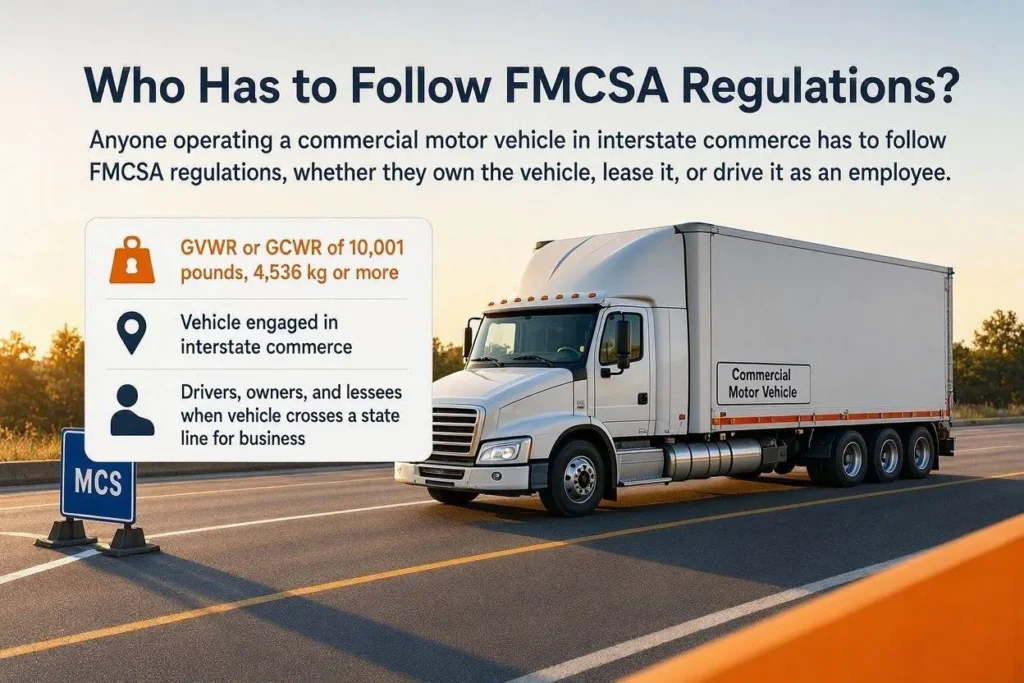
Anyone operating a commercial motor vehicle in interstate commerce has to follow FMCSA regulations, whether they own the vehicle, lease it, or drive it as an employee. The rules apply the moment a vehicle crosses a state line for business purposes, loaded or empty.
Four thresholds trigger FMCSA jurisdiction:
- A gross vehicle weight rating (GVWR) or gross combination weight rating (GCWR) of 10,001 pounds (4,536 kg) or more.
- A vehicle designed to carry 9 to 15 passengers for compensation.
- A vehicle designed to carry 15 or more passengers, paid or not.
- Any vehicle transporting hazardous materials in a quantity requiring placarding.
A dispatcher who schedules driver hours falls under these rules just as much as the person behind the wheel. Mechanics, freight loaders, trainers, and safety managers all carry compliance responsibility too. A repair shop owner who signs off on a defective brake inspection can face the same enforcement action as the carrier operating the truck.
What Are the Main Categories of FMCSA Regulations?
FMCSA regulations fall into six core categories: hours of service, drug and alcohol testing, driver licensing, vehicle maintenance, cargo securement, and driver qualification files. Each one maps to a specific part of 49 CFR, and each one gets enforced separately during roadside inspections and compliance audits.
Hours of Service (HOS) Rules
Hours of service rules limit how long a commercial driver can drive and work before taking mandatory rest. Property-carrying drivers get an 11-hour driving limit after 10 consecutive hours off duty, inside a 14-hour on-duty window that starts the moment any work begins. A 30-minute break is required after 8 cumulative hours of driving.
These limits haven’t changed for 2026, though short-haul drivers still get flexibility under a separate exemption. A driver who logs 9 hours behind the wheel without taking the required break is looking at a violation on the spot, even if total drive time never approaches the 11-hour cap.
Drug and Alcohol Testing Rules
Carriers have to test drivers before employment, after accidents, and randomly throughout the year. FMCSA sets the random testing rate at 50% of the average driver population for controlled substances and 10% for alcohol in 2026, unchanged from prior years.
Owner-operators run into a unique wrinkle here. Because they’re both employer and driver, they have to register in both roles with the Drug & Alcohol Clearinghouse and designate a Consortium/Third-Party Administrator to run their queries. A business with no other employees simply can’t run its own testing program.
Commercial Driver’s License (CDL) Requirements
CDL requirements set the training, testing, and medical standards a driver has to meet to legally operate a commercial vehicle. Every CDL holder needs a valid medical certificate, and as of 2026, that certificate gets submitted digitally through the National Registry of Certified Medical Examiners instead of as a paper copy.
New eligibility rules for non-domiciled CDLs took effect in early 2026, and they carry real weight: FMCSA estimates the changes could pull roughly 200,000 licenses from drivers who no longer meet the updated non-immigrant status requirements. States that don’t adopt the new verification process have to stop issuing affected licenses entirely.
Vehicle Maintenance and Inspection Rules
Carriers have to keep every commercial vehicle in safe operating condition through regular checks and documented repairs. Drivers complete a pre-trip and post-trip inspection every day, logging any defect on a Driver Vehicle Inspection Report.
Brake failures cause more commercial vehicle crashes than any other mechanical issue. New 2026 guidance requires drivers to document brake defects using exact DOT terminology. A vague note like “brakes feel soft” no longer cuts it. Roadside officers are now trained to prefer digital DVIR systems that display a clean 90-day history over paper binders, since paper records slow inspections down and raise the odds of a deeper physical search.
Cargo Securement Rules
Cargo securement rules set minimum standards for tying down, blocking, and bracing freight so it doesn’t shift or fall during transport. Requirements scale with cargo weight and type. A steel coil needs different tie-down points than a stack of lumber.
A driver hauling a 40,000-pound (18,144 kg) load with worn or undersized straps faces an out-of-service order on the spot, no matter how the freight was loaded at origin. Responsibility for securement sits with the driver at the time of inspection, not the shipper who packed the trailer.
Driver Qualification File (DQF) Requirements
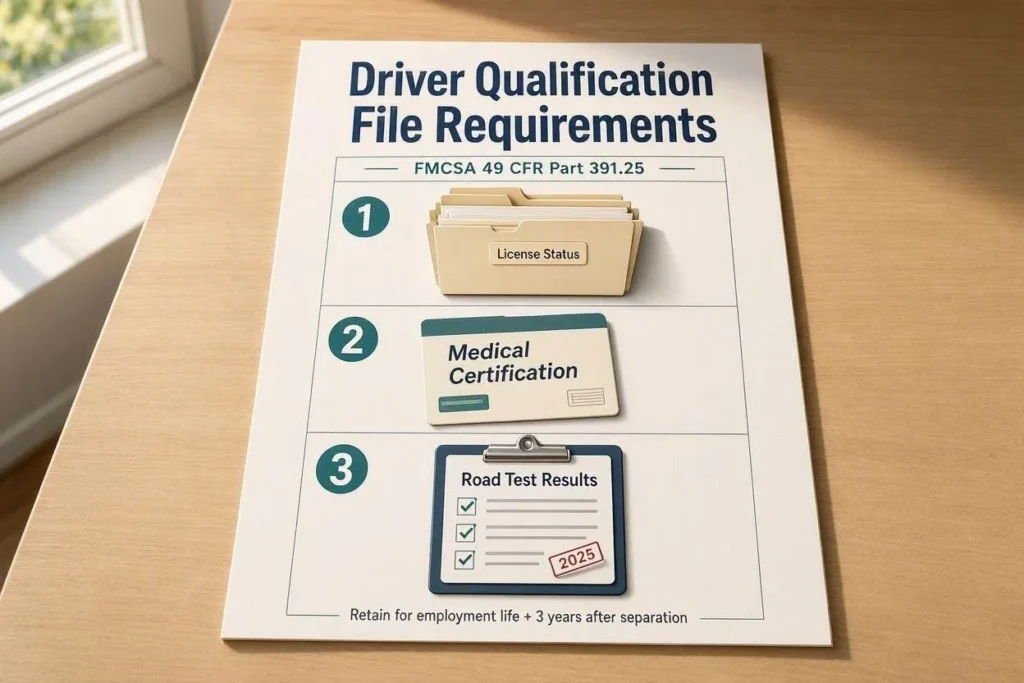
Carriers have to keep documented proof of each driver’s eligibility on file, including license status, medical certification, and road test results. These files stay current for the life of the driver’s employment and for three years after separation.
FMCSA requires an annual motor vehicle record review for every driver under 49 CFR Part 391.25, and incomplete DQFs remain one of the most common findings in federal audits. In 2025 enforcement data, incomplete driver qualification files contributed to a share of the more than 100,000 total violations reported nationwide.
What FMCSA Regulations Changed in 2026?
Three major areas changed for 2026: non-domiciled CDL eligibility, ELD device approval, and the Safety Measurement System scoring methodology. Each one comes with a compliance deadline carriers can’t afford to miss.
Non-domiciled CDL eligibility. Drivers holding non-domiciled CDLs must now show qualifying non-immigrant status, and their license documents have to display the term “non-domicile” instead of “limited” or “temporary.” State agencies verify immigration status directly rather than accepting employer attestation. A fleet employing foreign drivers under the old documentation standard needs to audit those files now, because a lapse here can pull a driver off the road mid-route.
ELD delisting and approved device requirements. Starting January 20, 2026, drivers using non-compliant electronic logging devices can be placed out of service on the spot. FMCSA keeps removing devices from its approved list as it finds technical failures, so a device that passed inspection last year isn’t automatically compliant this year. Fleet managers should check the FMCSA-approved ELD list on a recurring schedule, not just once at purchase.
Safety Measurement System (SMS) updates. FMCSA began overhauling the SMS in 2025, and the changes keep rolling out through 2026. The update consolidates violation codes into fewer categories, simplifies severity weighting, and places heavier emphasis on violations from the most recent 12 months. A carrier with a clean record over the past year should see that reflected faster in its safety score than under the old weighting system.
How Does FMCSA Enforce Regulations?
FMCSA enforces regulations through roadside inspections, compliance reviews, and civil penalties tied to violation severity. Enforcement runs on two tracks: real-time roadside stops and longer-term audits triggered by data patterns.
CSA Scores and Roadside Inspections
Compliance, Safety, Accountability (CSA) scores rank carriers against peers based on inspection and crash history across seven safety categories. A high score in any single category can trigger a full compliance review, even if a carrier’s overall safety record looks strong. State licensing agencies now pull data directly from the Drug & Alcohol Clearinghouse to flag drivers for downgrade, a shift toward proactive enforcement that started gaining traction in 2025.
Civil Penalties and Fines
Fines scale by severity and repeat-offense status. Some 2025 enforcement cases resulted in penalties exceeding $125,000 for a single carrier. Clearinghouse violations alone accounted for more than 7,000 enforcement actions in one recent reporting period, most tied to missed pre-employment or annual limited queries. A carrier facing a first-time paperwork violation typically pays far less than one caught falsifying logs or ignoring an out-of-service order.
How to Stay Compliant with FMCSA Regulations
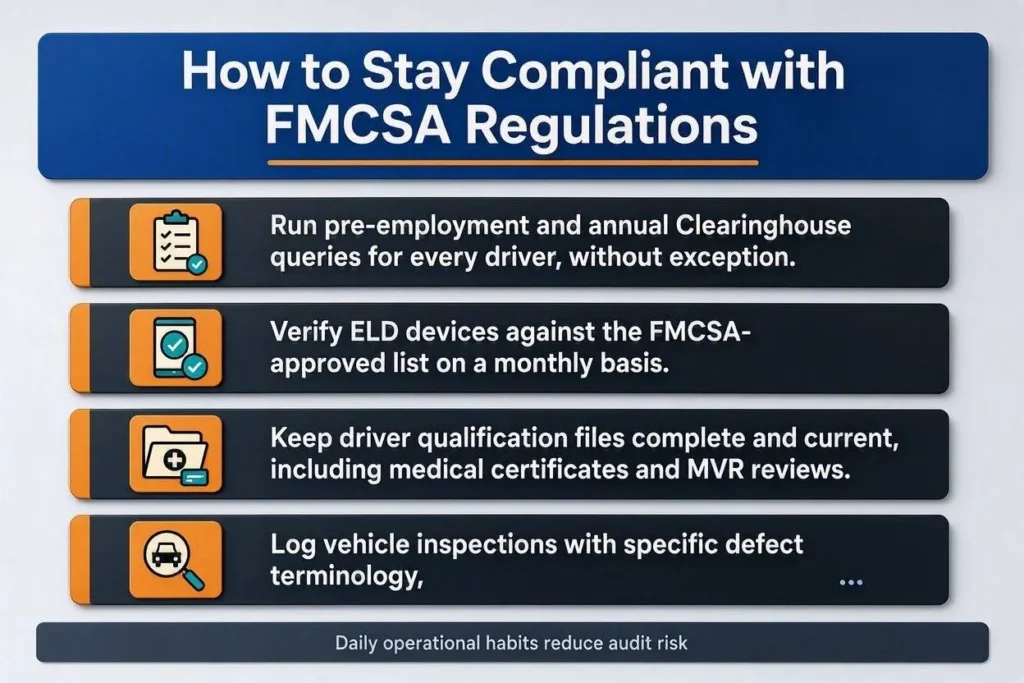
Staying compliant comes down to five recurring practices built into daily operations, not a once-a-year audit:
- Run pre-employment and annual Clearinghouse queries for every driver, without exception.
- Verify ELD devices against the FMCSA-approved list on a monthly basis.
- Keep driver qualification files complete and current, including medical certificates and MVR reviews.
- Log vehicle inspections with specific defect terminology, and skip the vague notes that won’t hold up in an audit.
- Train dispatchers and safety managers on HOS limits, since scheduling errors cause a large share of preventable violations.
A small fleet running five trucks faces the same penalty exposure as a 500-truck carrier for the same violation type. FMCSA doesn’t scale fines down for size. Building these five habits into a weekly routine costs a lot less than one out-of-service event.
Where to Find Official FMCSA Regulations
The full, current text of FMCSA regulations is available free through the Electronic Code of Federal Regulations at ecfr.gov, under Title 49, Subtitle B, Chapter III. FMCSA’s own regulations page links directly to Parts 300–399, Part 40 for drug and alcohol testing, and Parts 100–180 for hazardous materials. Bookmark the eCFR version rather than saving a PDF. The online text updates in real time as rules change, and a printed copy can go stale within months.
Conclusion
FMCSA regulations set the baseline every commercial carrier operates under, and that baseline shifted meaningfully in 2026 with new CDL eligibility rules, tighter ELD enforcement, and a revised SMS scoring model. Carriers who build Clearinghouse queries, DQF reviews, and ELD checks into a weekly routine avoid the fines that hit over 100,000 violations nationwide last year. The rules live at ecfr.gov under 49 CFR Parts 300–399, updated in real time, free to check before every audit.
FAQs

Esther Howard
Esther Howard leads TruckingHow’s trucking, commercial driving, and transportation content division. She specializes in CDL training, trucking regulations, fleet operations, truck maintenance, and logistics best practices. With over a decade of experience researching the commercial transportation industry, Esther brings a practical, research-driven approach to driver education, safety standards, and industry regulations. She is the primary author of TruckingHow’s CDL guides, trucking career resources, maintenance tips, and transportation content, helping drivers, fleet owners, and trucking professionals make informed decisions on and off the road
Related Posts