

Owner Operator vs Company Driver: Which Pays More in 2026?
A company driver takes home more predictable pay. An owner operator has a higher ceiling, but only if expenses stay under control. Run the real numbers and the two paths look a lot closer than they first appear.
A company driver running 120,000 miles a year at $0.62 per mile grosses roughly $74,400 and nets close to $53,000 after taxes, with zero business risk attached. An owner operator running the same miles at $2.20 per loaded mile can gross $264,000. But fuel, insurance, truck payments, and self-employment tax often cut that down to somewhere between $53,000 and $75,000 net. The gap in effort and risk is real. Most years, the gap in take-home pay isn’t.
What Is the Difference Between an Owner Operator and a Company Driver?
An owner operator owns or leases the truck and runs an independent trucking business. A company driver is a W-2 employee driving a truck the carrier owns. That one difference in ownership changes everything downstream: who pays for fuel, who picks the freight, who eats the loss when a load falls through.
An owner operator holds a CDL and typically operates under a carrier’s authority or their own MC number. That means booking loads through load board platforms like DAT One, negotiating rates directly with brokers, and running an LLC or sole proprietorship on the side. A company driver reports to a dispatcher who assigns routes, schedules, and home time, full stop. The carrier pays for the truck, the insurance, the maintenance.
Three things define the split in practice:
- Equipment ownership. The owner operator buys or leases the tractor. The carrier owns it for a company driver.
- Compensation structure. Owner operators earn per-mile or percentage-of-load revenue. Company drivers earn hourly, salaried, or fixed cents-per-mile pay.
- Business risk. Owner operators absorb fuel spikes, breakdowns, and slow freight seasons. Company drivers do not.
How Much Does an Owner Operator Make?
An owner operator’s average gross income sits around $228,575 a year, according to 2026 ZipRecruiter data, with a range from $33,500 to $399,000. Weekly gross pay averages $4,395 nationwide. Those figures look impressive next to a company driver’s paycheck. The net figures tell a different story, and it’s the net figures that actually pay the mortgage.
Owner Operator Gross Pay
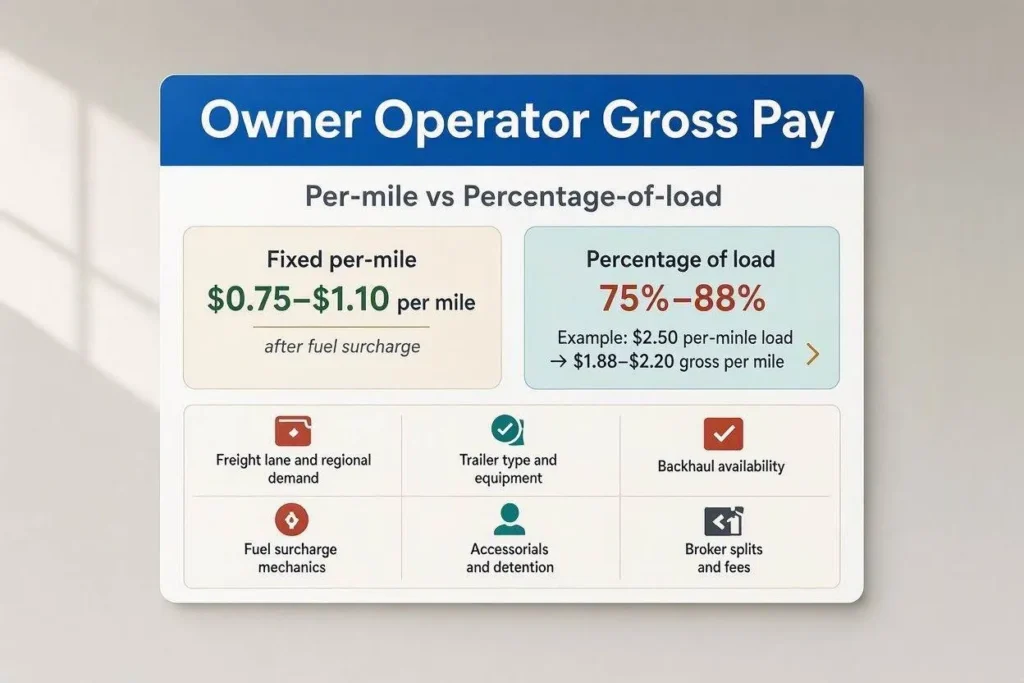
Owner operators typically negotiate one of two pay structures. A fixed per-mile rate pays a flat amount regardless of load value, often between $0.75 and $1.10 per mile after fuel surcharge. A percentage-of-load agreement pays 75% to 88% of the total freight bill, which on a $2.50-per-mile load works out to roughly $1.88 to $2.20 per mile in gross revenue.
Six variables move that gross figure up or down: freight lane and regional demand, trailer type (dry van, flatbed, reefer, hazmat), fuel surcharge terms, deadhead miles between loads, seasonal freight volume, and how well someone actually works a load board.
Owner Operator Net Pay After Expenses
Net pay for an owner operator usually lands between $55,000 and $110,000 a year after business expenses, even when gross revenue runs three times higher than a company driver’s paycheck. Fixed and variable costs eat the difference fast.
A single owner operator running 120,000 miles a year faces costs that typically break down like this: diesel fuel at roughly $0.65 per mile ($78,000), a truck payment or lease at $1,800 to $2,500 a month ($21,600 to $30,000), commercial insurance at $12,000 to $18,000 a year, and maintenance and tires at another $10,000 to $15,000. Add self-employment tax at 15.3% of net earnings and that $264,000 gross figure from earlier can shrink to a take-home close to $53,000, nearly identical to the company driver example above.
How Much Does a Company Driver Make?
A company driver earns an average of $86,500 a year across national carriers as of 2026. Entry-level roles start near $73,500, and top-tier long-haul positions reach $142,000. BLS places the broader heavy truck driver median between $54,000 and $80,000, depending on route type and experience.
Company driver pay comes with the whole paycheck intact. The carrier absorbs fuel, insurance, and maintenance before the driver ever sees a settlement statement. Four pay models show up most often in the industry: cents-per-mile pay ranging from $0.55 to $0.82 depending on experience and freight type, hourly pay for local or regional routes, percentage-of-load pay (less common, mostly flatbed and specialized carriers), and salaried pay for dedicated or team driving positions.
A driver with two years of experience running dedicated freight for a mid-size carrier can expect something in the $73,500 to $86,500 range. Someone with ten-plus years running OTR specialized freight can push past $100,000 without ever filing a business tax return.
What Are the 6 Main Cost Differences Between Owner Operators and Company Drivers?
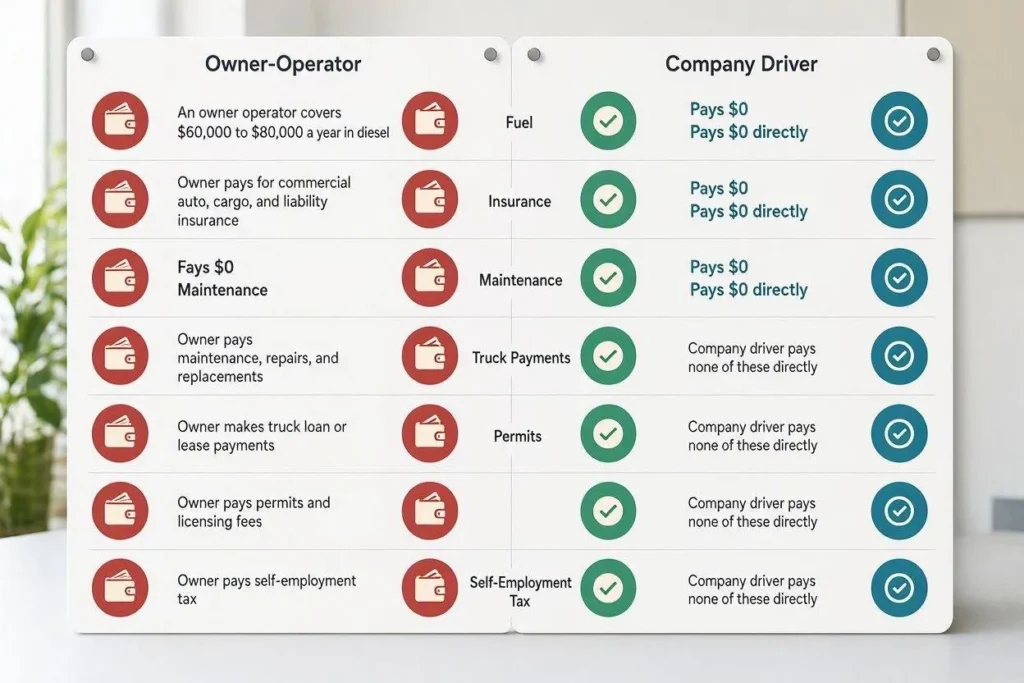
Owner operators pay for fuel, insurance, maintenance, truck payments, permits, and self-employment tax out of pocket. Company drivers pay for none of it directly, and that six-item list is really the whole reason gross pay comparisons mislead new drivers.
- Fuel. An owner operator covers $60,000 to $80,000 a year in diesel. A company driver pays $0.
- Insurance. Commercial auto, cargo, and liability coverage run an owner operator $12,000 to $18,000 annually. The carrier covers it for company drivers.
- Maintenance and tires. Owner operators budget $10,000 to $15,000 a year. The carrier’s shop absorbs this cost for company drivers.
- Truck payment or lease. Owner operators pay $1,800 to $2,500 monthly. Company drivers make no equipment payment at all.
- Permits and compliance fees. IFTA filings, IRP fees, and DOT compliance run an owner operator $2,000 to $4,000 a year.
- Self-employment tax. Owner operators pay 15.3% on net earnings. Company drivers just see standard payroll withholding.
What Are the Pros and Cons of Being an Owner Operator?
Owner operators gain control over routes and schedules, but they absorb every business risk that comes with owning the equipment. The upside and downside sit closer together than most recruiting pitches let on.
Three advantages stand out. Independence tops the list: an owner operator picks loads through a broker or load board and can walk away from routes that don’t pay. Higher gross revenue follows, since per-mile or percentage-based pay outpaces a fixed company wage on paper. Equipment choice matters too. An owner operator picks the truck, the cab configuration, the comfort features that actually matter to them.
Three drawbacks carry roughly equal weight. Startup capital is the first wall most people hit. A reliable used tractor runs $40,000 to $90,000, and a new one can top $150,000. Income volatility comes next; a slow freight season or one bad transmission repair can wipe out a month’s profit without warning. Administrative workload rounds it out. Bookkeeping, IFTA filings, DOT paperwork all eat hours a company driver never has to spend off the clock.
What Are the Pros and Cons of Being a Company Driver?
Company drivers trade earning ceiling for predictability and zero equipment risk. That trade appeals most to drivers early in a CDL career, or to anyone who’d rather not run a business on the side.
Three benefits define the role. Predictable income comes first: a fixed cents-per-mile or salaried rate means the same math every payday. Employer-covered expenses follow, since fuel, insurance, and maintenance never touch a company driver’s paycheck. Career mobility rounds it out. A driver can move from OTR to regional to local dispatch, or shift into a lead driver, trainer, or dispatcher role, without starting a new business to do it.
Two limitations offset those benefits. A lower earning ceiling ranks first, since cents-per-mile pay caps out well below what a well-run owner-operator business can gross. Reduced route control comes second. A dispatcher assigns lanes, home time, and freight type, and there’s little room to turn down a bad run without putting the job at risk.
How Do Taxes Differ for Owner Operators vs Company Drivers?
Owner operators file as self-employed and owe 15.3% self-employment tax on top of federal income tax. Company drivers have payroll taxes withheld automatically from every paycheck. The filing burden shifts entirely based on how someone is classified.
A company driver gets a W-2 at year-end, with Social Security and Medicare taxes already withheld by the carrier. An owner operator gets 1099 income from brokers or carriers and has to set aside 25% to 30% of net profit for quarterly estimated payments. Section 179 of the tax code lets an owner operator deduct the full purchase price of qualifying equipment in the year it’s placed in service, which can knock down a large tax bill in a truck’s first year. A company driver has no equivalent deduction, since the carrier owns the asset, not them.
How Do You Calculate Your Cost Per Mile as an Owner Operator?
Add every fixed and variable expense for a given period, then divide by the miles driven in that same period. Simple formula. The inputs are what take the work.
Start with fixed costs: truck payment, insurance premium, permit fees, totaled for one month. Add variable costs next, including fuel, maintenance, tires, and tolls, using actual receipts rather than estimates. Divide the combined total by the miles driven that month. A driver who spends $9,500 in fixed and variable costs while running 10,000 miles lands at a $0.95 cost per mile. Any rate quoted below that number is a loss the moment the load gets delivered, no matter how good the gross-mile rate looks on the rate confirmation.
Which One Should You Choose?
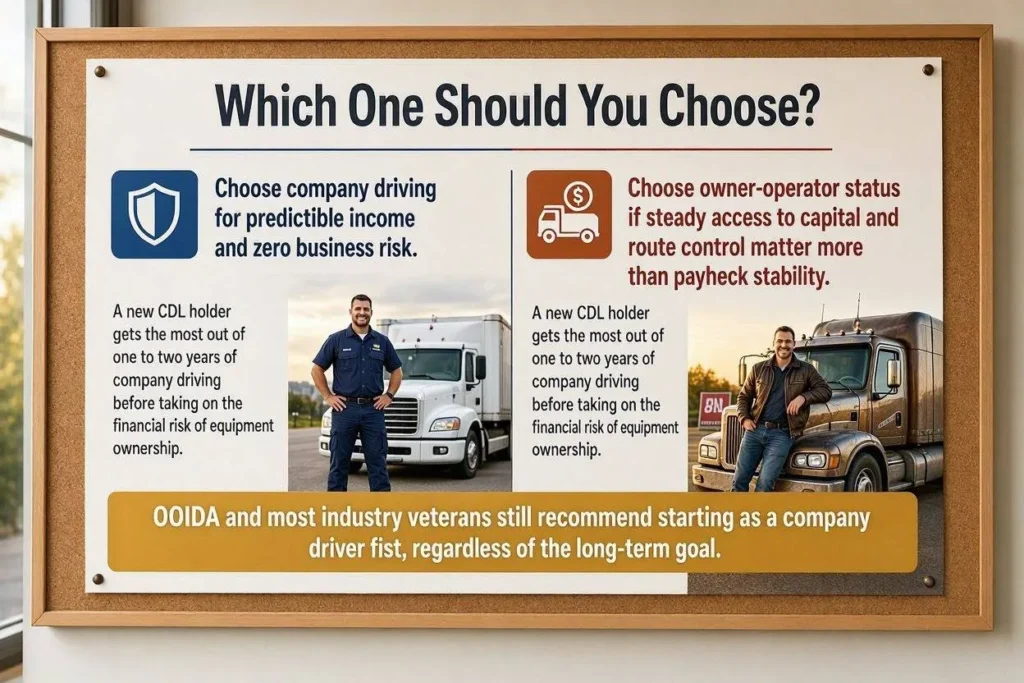
Choose company driving for predictable income and zero business risk. Choose owner-operator status if steady access to capital and route control matter more than paycheck stability. OOIDA and most industry veterans still recommend starting as a company driver first, regardless of the long-term goal.
A new CDL holder gets the most out of one to two years of company driving before taking on the financial risk of equipment ownership. That window builds a clean safety record, teaches load-planning and route efficiency, and builds the credit history needed to finance a first truck. A driver with solid bookkeeping habits, an emergency fund covering three to six months of fixed costs, and a real tolerance for income swings is in decent shape to move into owner-operator status. A driver who values a set schedule, employer-paid benefits, and freedom from spreadsheets over profit margins tends to stay a company driver for a whole career, and there’s nothing lesser about that choice.
Conclusion
A company driver earning $86,500 a year with full benefits and zero equipment risk often nets close to what an owner operator takes home after grossing $264,000. The choice comes down to risk tolerance, available startup capital, and whether route control matters more than paycheck predictability. Run the cost-per-mile math before signing a lease.
FAQs

Esther Howard
Esther Howard leads TruckingHow’s trucking, commercial driving, and transportation content division. She specializes in CDL training, trucking regulations, fleet operations, truck maintenance, and logistics best practices. With over a decade of experience researching the commercial transportation industry, Esther brings a practical, research-driven approach to driver education, safety standards, and industry regulations. She is the primary author of TruckingHow’s CDL guides, trucking career resources, maintenance tips, and transportation content, helping drivers, fleet owners, and trucking professionals make informed decisions on and off the road
Related Posts