How to Become an Owner-Operator: Step-by-Step Guide for 2026
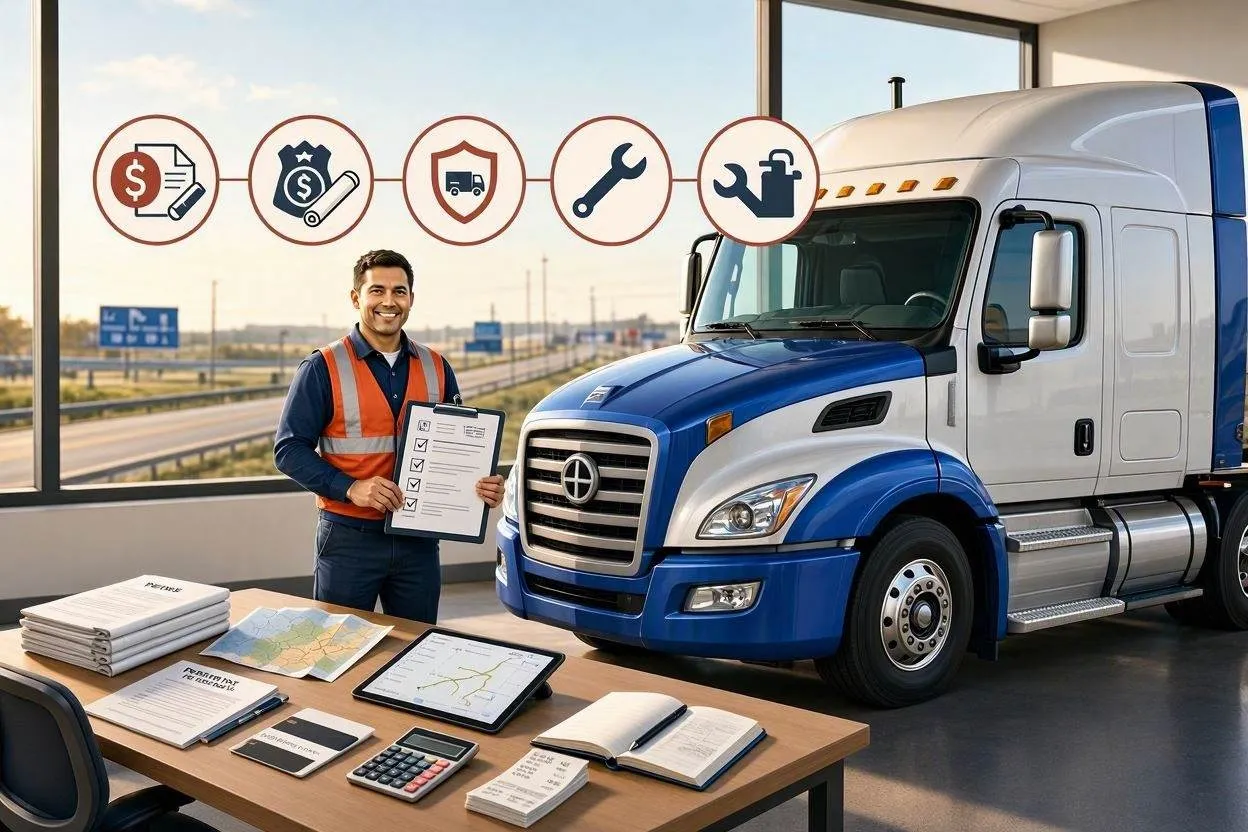
Becoming an owner-operator means checking off a specific list: a commercial driver’s license (CDL), a year or two behind the wheel for a carrier, a registered business, a USDOT number, real insurance, and a truck. Most drivers get through the whole process in 30 to 90 days, faster or slower depending on how quickly financing and authority approval come through. There are nine steps in total, and doing them out of order is the most common reason a first paycheck gets delayed or a new authority runs into trouble.
This guide walks through each requirement in the order it actually needs to happen, with real dollar figures, timeframes, and the regulatory names you’ll run into along the way.
What Is an Owner-Operator?
An owner-operator is a truck driver who owns or leases their truck and runs it as their own business instead of driving for someone else. That means handling your own fuel, maintenance, insurance, and freight sourcing, either under your own operating authority or leased on with an established carrier. About 16% of U.S. truck drivers work independently this way, according to industry driver statistics.
There are two paths here, and they’re pretty different in practice. An owner-operator with authority registers directly with the Federal Motor Carrier Safety Administration (FMCSA) and makes every call themselves, from which loads to take to what to charge for them. An owner-operator without authority leases their truck to a carrier and hauls freight under that carrier’s authority instead, giving up some independence in exchange for built-in freight and a lot less paperwork.
Owner-Operator vs. Company Driver: Key Differences
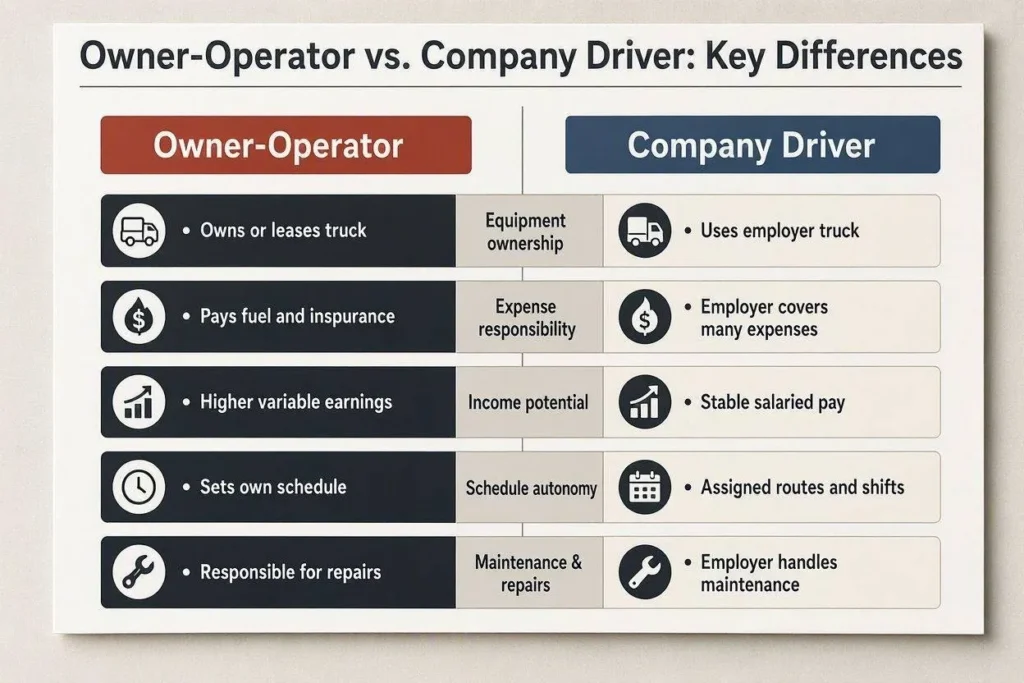
The core difference comes down to ownership. Owner-operators own or lease their equipment and run their own business; company drivers use a truck their employer owns and collects a paycheck either way. Five things separate the two roles in practice:
- Equipment ownership — owner-operators buy or lease their trucks; company drivers use whatever the employer provides.
- Expense responsibility — owner-operators cover fuel, insurance, and repairs out of pocket; carriers absorb those costs for company drivers.
- Freight selection — owner-operators pick their own loads through brokers or load boards; a dispatcher assigns loads to company drivers.
- Earnings structure — owner-operators negotiate a rate per load or per mile; company drivers earn a fixed per-mile wage.
- Administrative load — owner-operators handle their own invoicing, bookkeeping, and compliance; company drivers just drive.
A company driver earning $0.55 a mile on a fixed schedule knows exactly what’s hitting their bank account each week. An owner-operator hauling those same miles might net anywhere from $1.20 to $1.80 a mile after expenses, but that number moves with fuel prices, freight demand, and however much downtime creeps in between loads.
How Much Do Owner-Operators Make?
Owner-operators typically gross $200,000 to $350,000 a year before expenses, and take home $60,000 to $120,000 net after fuel, insurance, maintenance, and truck payments. The ones who manage costs well and keep deadhead miles down can clear $150,000 or more in net income.
Pay tends to come in one of two forms. Flat-rate compensation pays a set amount per load no matter the exact mileage, so a broker might offer $2,500 to move a load from Dallas to Atlanta regardless of the odometer reading. Mileage-based compensation pays a fixed rate per mile, so a 1,000-mile load at $2.20 a mile brings in $2,200 in gross revenue. Either way, fuel, insurance, and maintenance reserves chip away at that number, which is exactly why tracking cost per mile (CPM) matters a lot more than watching gross revenue alone.
How to Become an Owner-Operator: 9 Steps
Get your CDL, build driving experience, choose a business model, write a business plan, register your business, secure your USDOT number and authority, buy or lease a truck, get insurance, and start finding freight, roughly in that order. Each step leans on the one before it, so jumping ahead usually just means backtracking later.
1. Get Your Commercial Driver’s License (CDL)
Getting a CDL means passing a medical exam, completing entry-level driver training (ELDT), and clearing both a written knowledge test and a road skills test. There are three CDL classes: Class A covers combination vehicles over 26,000 pounds (11,793 kg), like tractor-trailers; Class B covers single heavy vehicles such as straight trucks and buses; Class C covers smaller vehicles hauling hazardous materials or passengers.
You’ll need a commercial learner’s permit (CLP) first, which lets you drive under the supervision of a licensed CDL holder while training. If you plan to haul hazardous materials, tankers, or multiple trailers, you’ll need extra endorsements, each with its own knowledge test through the FMCSA. Most training programs take six months or less, mixing classroom time with supervised driving.
2. Gain Driving Experience
Most successful owner-operators spend a year or two driving for a carrier before going out on their own. That time teaches route planning, load securing, hours-of-service (HOS) management, and, maybe most importantly, what fuel actually costs on real routes rather than in a spreadsheet.
A driver who jumps straight from CDL school into independent operation often underprices loads simply because they haven’t yet learned their true cost per mile. Company driving experience tends to catch that mistake before it costs real money.
3. Choose Your Business Model
Three models to weigh here: leasing to a carrier, running under your own authority, or a lease-purchase agreement. Leasing to a carrier means you own or finance the truck but operate under that carrier’s authority, which brings built-in freight access and a lot less compliance paperwork. Your own authority means full control over loads and rates, but full responsibility for insurance, compliance, and finding freight yourself. A lease-purchase agreement lets you lease with the option to buy at the end, which lowers upfront costs but demands a close read of the interest rates and contract terms before signing.
Most first-timers start by leasing to a carrier since it cuts both startup risk and the learning curve, then move to their own authority once they’ve built up cash reserves and freight relationships.
4. Write a Business Plan
A trucking business plan should cover your target freight type, startup budget, monthly operating expenses, and break-even point. Lenders and equipment financers will ask to see it before approving anything, so treat it as an actual working document, not paperwork to get through.
Keep one-time startup costs separate from recurring monthly costs. One-time costs include the truck down payment, licensing fees, and ELD setup; monthly costs include fuel, insurance premiums, truck payments, and maintenance reserves. Once you know your total monthly expenses, divide by expected miles per month to find the minimum rate per mile you need just to stay in the black.
5. Register Your Business
Registering means choosing a business structure, registering your business name with your state, and getting an Employer Identification Number (EIN) from the IRS. Most owner-operators land on either a sole proprietorship or a limited liability company (LLC).
A sole proprietorship is easy to set up and skips a separate business tax return, but it leaves your personal assets exposed if the business gets sued or can’t pay a debt. An LLC separates business and personal liability, so your house, savings, and personal vehicle stay protected from business claims, though it comes with more paperwork and self-employment tax to manage. Once you’ve picked a structure, open a dedicated business bank account. Keeping personal and business money separate makes tax season considerably less painful.
6. Apply for Your USDOT Number and Operating Authority
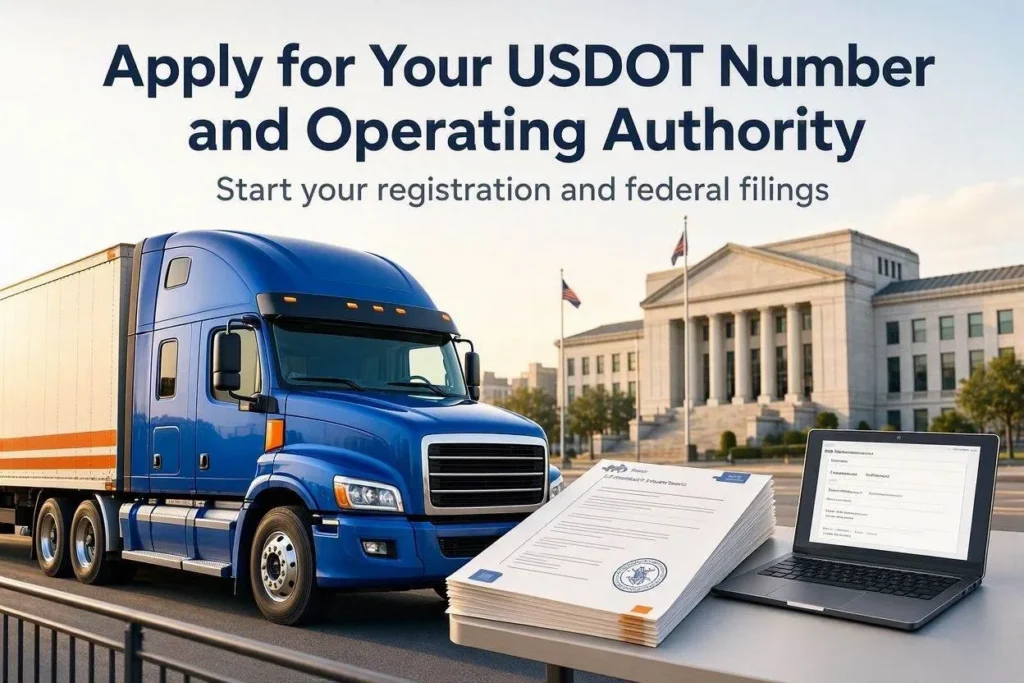
You’ll apply for a USDOT number through the FMCSA’s Unified Registration System, and it typically takes up to 30 days to process. The number identifies you as a carrier in interstate commerce and tracks your safety and inspection history from that point forward.
If you’re running under your own authority rather than leasing to a carrier, you’ll also need operating authority, historically tied to an MC (motor carrier) number. The FMCSA has been phasing out standalone MC numbers, though the underlying authority requirement hasn’t gone anywhere. Along with your DOT number, plan on completing Unified Carrier Registration (UCR) if you cross state lines, registering for the International Registration Plan (IRP) if you’ll travel through multiple states, and filing International Fuel Tax Agreement (IFTA) reports to cover fuel taxes owed to each state you drive through.
7. Buy or Lease a Truck
Buying costs more upfront but builds equity over time; leasing lowers that initial cost but leaves you with nothing to show for it at the end of the term. A used semi through a reputable dealer is often the more practical entry point for first-time owner-operators, since it comes with a lower monthly payment and, often, a warranty still attached.
Weigh four things before deciding: purchase price versus monthly payment, maintenance history and inspection reports, fuel efficiency, and whether a sleeper cab or day cab actually fits your routes. A driver running regional routes under 500 miles (805 km) a day rarely needs a sleeper cab. A long-haul driver covering 2,000-plus miles (3,219 km) a week almost always does.
8. Get Insurance and Complete Compliance Filings
Owner-operators running under their own authority need at least $750,000 in liability coverage, though most brokers and shippers actually require $1,000,000 or more. On top of primary liability, you’ll typically need cargo insurance to cover the freight you’re hauling, physical damage coverage for the truck itself, and bobtail or non-trucking liability for miles driven without a load.
Premiums tend to run higher in your first year since you don’t have a safety and claims history yet, so it’s worth comparing quotes from at least three trucking-specific insurers before you commit to one. Alongside insurance, install an FMCSA-registered electronic logging device (ELD) to track hours of service, enroll in a DOT-approved drug and alcohol testing consortium if you’re driving under your own authority, and keep a driver qualification file with your CDL copy, medical certificate, and safety history on hand. Auditors ask for these without warning, so don’t wait until they do to pull them together.
9. Find Freight and Start Hauling
Owner-operators generally find freight through load boards, freight brokers, direct shipper relationships, or carrier dispatch if they’re leased on. A load board lists available freight by lane, weight, and rate, so you can filter down to loads that actually match your equipment and preferred routes.
Before taking any load, run the numbers: revenue against fuel cost, tolls, deadhead miles, and delivery timeline. A load that pays well per mile can still lose you money once you factor in the empty miles it takes to reach the pickup point. Once you’ve hauled the load, you can submit paperwork for payment through the broker directly, or use invoice factoring to get paid within 24 hours instead of waiting the usual 15 to 30 days a broker’s pay cycle takes.
How Long Does It Take to Become an Owner-Operator?
If you already hold a CDL and have industry experience, you can become an owner-operator in 30 to 60 days as long as financing and insurance move quickly. Drivers applying for their own operating authority should plan on 60 to 90 days instead, since business registration, DOT and MC authority approval, insurance filings, and equipment inspections all run in sequence rather than at the same time.
Delays usually trace back to one of three things: financing taking longer than expected, insurance underwriters asking for more driving history documentation, or a pre-purchase inspection turning up repairs that need fixing before the sale closes. Building in a two-week buffer past your target launch date is enough to absorb most of that without pushing back your first scheduled load.
Common Mistakes New Owner-Operators Make
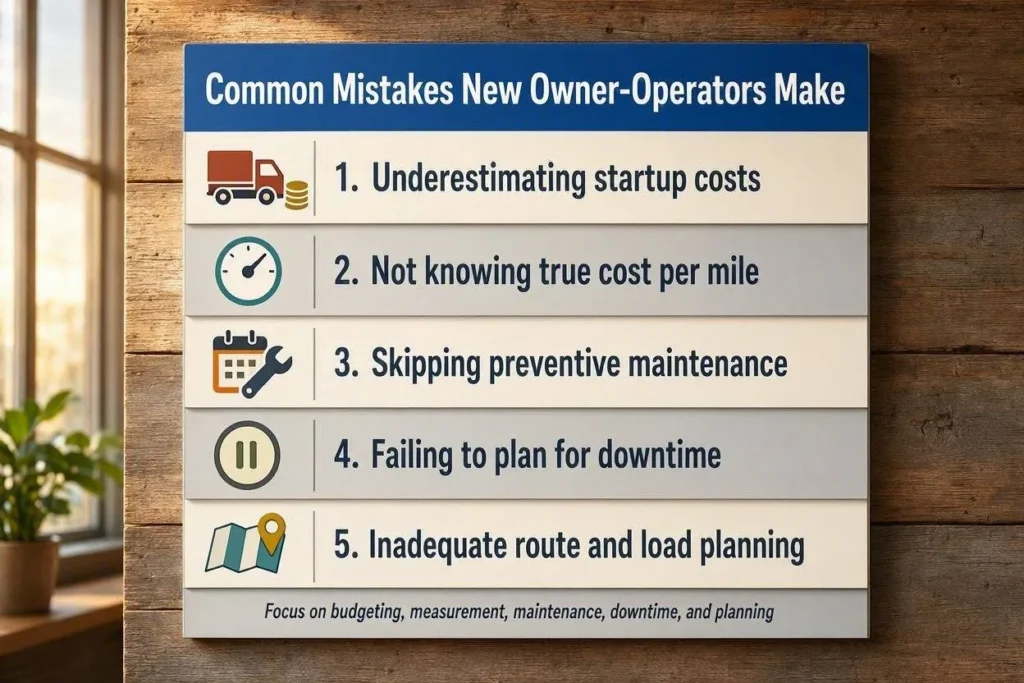
Underestimating startup costs, not knowing their true cost per mile, skipping preventive maintenance, and failing to plan for downtime. These four show up constantly among first-year owner-operators, along with one more:
- Underestimating startup costs — new operators budget for the truck payment but forget insurance, permits, fuel advances, and maintenance reserves, and cash flow tightens within a few months.
- Not knowing cost per mile — without a clear CPM figure, there’s no real way to tell if a load is profitable, and cheap freight can keep the wheels turning while quietly draining the business.
- Skipping preventive maintenance — putting off oil changes and tire rotations saves money in the short term but leads to bigger repair bills and unplanned downtime down the road.
- Failing to plan for downtime — freight markets fluctuate and broker payments run 15 to 30 days behind, so an operator with no emergency fund feels real financial stress during a slow month.
- Choosing equipment on price alone — a truck picked for its low sticker price rather than its maintenance history or warranty often ends up costing more in repairs than it saved upfront.
A driver who sets aside three months of operating expenses before their first load rarely gets forced out of business by one slow month or one major repair. That reserve, more than any single business decision, tends to be what separates owner-operators who last five years from the ones who quit within one.
Conclusion
Becoming an owner-operator means moving through a fixed sequence: CDL, driving experience, business registration, USDOT authority, insurance, equipment, freight. Skip a step, and the delay shows up later as a denied load, a compliance flag, or an insurance gap you didn’t see coming. Follow the sequence in order, keep three months of expenses in reserve, and track your cost per mile from day one, and you’re in about as good a position as anyone to still be running your own authority five years from now.
FAQs

Esther Howard
Esther Howard leads TruckingHow’s trucking, commercial driving, and transportation content division. She specializes in CDL training, trucking regulations, fleet operations, truck maintenance, and logistics best practices. With over a decade of experience researching the commercial transportation industry, Esther brings a practical, research-driven approach to driver education, safety standards, and industry regulations. She is the primary author of TruckingHow’s CDL guides, trucking career resources, maintenance tips, and transportation content, helping drivers, fleet owners, and trucking professionals make informed decisions on and off the road
Related Posts