
Best Trucking Companies for Beginners in 2026: A Complete Guide
A new CDL rarely comes with a clear next step. Job boards list hundreds of openings, recruiters promise six-figure first years, and every carrier claims to be the best fit for a rookie. In reality, pay structure, training length, and contract terms vary enough between companies that two “entry-level” offers can lead to very different first-year outcomes.
Here’s what actually matters when you’re comparing carriers in 2026: who’s hiring beginners, what they pay, how long training takes, and which red flags to check before you sign anything.
What Are the Best Trucking Companies for Beginners?
Nine carriers stand out for 2026: Werner Enterprises, Schneider National, Prime Inc., C.R. England, CRST, Maverick Transportation, Roehl Transport, Swift Transportation, and J.B. Hunt Transport. Each hires drivers with zero experience, runs a structured onboarding program, and pays new hires a competitive mileage or weekly rate. They differ in freight type, home-time schedule, and training length, so the right pick depends on what you actually value: fast home time, a specific type of freight, or the highest starting pay you can find.
A rookie fresh out of CDL school gets bombarded with recruiting ads promising “$90K first year” or “no experience needed.” Some of that is real. Some of it hides a six-month contract, forced dispatch, or a per diem trick that quietly shrinks your take-home pay. Picking a good carrier means checking training quality, safety scores, and contract terms before you sign.
How Do You Choose a Trucking Company as a Beginner?

Compare five things: training quality, freight type, home time, pay structure, and safety rating. Rank them by what matters most to you personally, then hold three or four carriers up against that list.
Freight type changes your daily life on the road more than people expect. A driver hauling refrigerated freight for Prime Inc. keeps a tighter delivery schedule than one hauling flatbed steel for Maverick, where load securement and weather delays add real unpredictability. Home time swings just as widely. Roehl Transport gets more than half its drivers home weekly, while a national OTR fleet might mean 14 days out and 3 days home.
What Factors Matter Most for New Drivers?
Four things: paid training length, mentorship during the first 90 days, contract terms, and starting pay per mile. Skip the contract-terms check and you risk owing your former employer thousands in tuition reimbursement if you quit before hitting the required mileage or time commitment.
- Training length ranges from 3 weeks (Swift) to 10-plus weeks (C.R. England), depending on the freight specialization.
- Mentorship period. A trainer riding along for 200 to 300 hours measurably reduces first-year accident rates.
- Contract terms. Some carriers require 40,000 solo miles, roughly 5 to 6 months, before you can leave without repaying tuition.
- Starting pay. New drivers typically earn 45 to 60 cents per mile (CPM) or $700 to $1,000 a week to start.
Which Trucking Companies Hire Beginners in 2026?
Werner Enterprises runs one of the five largest fleets in the country and keeps its average truck age near 2.5 years. New drivers get collision-mitigation technology, 24-hour maintenance support, and a dedicated-route option paying $75,000 to $85,000 a year. There’s also a veteran-focused hiring track with extra onboarding support for former service members.
Schneider National operates dedicated, regional, and OTR divisions, so a beginner can switch freight types without changing employers. Its training program pairs new drivers with a mentor for the first several weeks, which shortens the learning curve on parking, backing, and trip planning.
Prime Inc. trains new drivers across refrigerated, tanker, and flatbed divisions, so if you’re not sure which freight specialty fits you, you can sample more than one before committing. Its in-house driving school also cuts the upfront tuition cost compared to going through an independent CDL school first.
C.R. England has trained CDL graduates for decades and runs multiple freight divisions across all 48 contiguous states. It donates a meal to a food-insecure child for every completed delivery, a program that’s now passed 3 million meals donated. Veterans and military spouses get an adjusted starting pay tier.
CRST built its name on team-driving placements, a format that roughly doubles a truck’s daily mileage by keeping one driver resting while the other drives. New drivers who choose team driving typically log more weekly miles than solo OTR drivers in year one, which raises early earning potential.
Maverick Transportation specializes in flatbed and specialized freight, which means tarping, chaining, and load securement skills that dry van driving simply doesn’t teach. If you want flatbed experience from day one instead of transferring in later, Maverick’s dedicated flatbed training track is the more direct path.
Roehl Transport pays address-to-address practical route mileage, a method the company says calculates 5 to 8 percent more miles per load than standard zip-code-based pay. As of July 2026, Roehl drivers with at least a year on the job average $1,400 a week ($72,800 annually), and the top half average $1,580 a week ($82,160 annually). Training runs in three paid phases: four days of onboarding, 19 to 26 days riding with a trainer, then 30 to 60 days solo before full route assignment.
Swift Transportation hires drivers with no professional experience and keeps its fleet in the 2- to 3-year age range, which cuts breakdown risk for someone still learning pre-trip inspections. Swift’s benefits include dental and prescription coverage starting day one for most new hires.
J.B. Hunt Transport runs dedicated, regional, and OTR positions under one roof, and roughly one in five employees is a military veteran. New drivers get a 401(k) match and full health coverage right after standard onboarding, with no extra waiting window some competitors impose.
How Much Do Beginner Truck Drivers Get Paid?
Somewhere between $700 and $1,580 a week in 2026, depending on carrier, freight type, and pay structure. Mileage-based pay usually starts at 45 to 60 CPM; weekly-guarantee models run $700 to $1,200.
Pay structure matters more than the number in the ad. A carrier advertising “up to $90,000 first year” is almost always describing a top-10-percent performer working every legal hour, not a typical new hire. Roehl’s July 2026 numbers give a clearer picture: $1,400 weekly average after one year, with the top half of drivers hitting $1,580. Stevens Transport’s first-year drivers can reach $60,000 annually while logging 2,800 to 3,000 miles a week. When you’re comparing offers, ask each recruiter for the median pay at six months and twelve months, not the ceiling figure they put in the ad.
What Training Options Exist for New CDL Drivers?
You’re choosing between company-sponsored training and an independent CDL school, and the choice affects upfront cost and post-graduation flexibility in opposite directions. Tight on savings? Company-sponsored training usually makes more sense. Want maximum freedom to pick an employer after you graduate? Go independent.
Company-sponsored training, offered by carriers like Roehl and Prime, lowers or eliminates upfront tuition and leads straight into a job. The tradeoff is a service commitment. Roehl’s agreement asks for 40,000 solo paid miles, roughly 5 to 6 months, before you can leave without repaying the training cost.
Independent CDL schools, including Roadmaster Drivers School and Truck Driver Institute (TDI), charge tuition upfront but leave you free to apply anywhere afterward. TDI reports an 86 percent job-placement rate for graduates and offers up to $7,000 in tuition assistance through partner carriers like US Xpress.
How Can You Spot a CDL Mill Before You Sign?
Three warning signs: training that wraps up in under two weeks, instructor credentials that are vague or missing entirely, and pressure to sign a contract before you’ve seen the full pay structure. A legitimate program will hand over its curriculum length, instructor certifications, and FMCSA registration number without you having to ask.
Ask any recruiter for the school’s FMCSA training-provider ID and check it against the FMCSA’s Training Provider Registry. A program that won’t share that number, or that promises a CDL “in three days,” should worry you immediately. Genuine ELDT-compliant programs take a minimum of several weeks and include both classroom and behind-the-wheel hours tracked in the FMCSA registry system.
Where Can You Verify a Trucking Company’s Safety Record?
Use the FMCSA’s SAFER system at safer.fmcsa.dot.gov and search the carrier’s US DOT number. It shows crash history, out-of-service violation rates, and overall safety rating, none of which show up in a recruiting brochure.
A below-average safety score usually points to older equipment, higher driver turnover, or inconsistent maintenance, and all three raise first-year accident risk for someone still building road experience. The check takes under five minutes and costs nothing. It’s one of the highest-value five minutes you’ll spend before accepting an offer.
What Programs Exist for Veterans and Women in Trucking?
Veterans and women entering trucking in 2026 have access to carrier-specific pay adjustments, mentorship networks, and the Women In Trucking (WIT) Association’s scholarship and mentorship programs. C.R. England, US Xpress, and J.B. Hunt each offer adjusted starting pay tiers for veterans, and WIT pairs new female drivers with mentors already active in the industry.
Roehl Transport and Werner Enterprises both list military-transition support on their recruiting pages, covering CDL conversion for drivers with prior military driving experience. If you qualify for veteran benefits, ask recruiters directly whether a signing bonus or pay adjustment applies. It’s not always on the main careers page.

What Is a Lease-Purchase Program, and Should Beginners Avoid It?
A lease-purchase program lets you lease a truck from the carrier with payments going toward eventual ownership. Beginners should steer clear of this during year one. Weekly lease payments, fuel costs, and maintenance all land on you, and that’s a lot of financial risk for someone without an established mileage history to fall back on.
Owner-operator and lease-purchase positions make more sense after you’ve logged 12 months of steady company-driver miles and have a real sense of what you actually earn week to week. Sign a lease-purchase contract before you understand fuel-cost swings and seasonal freight slowdowns, and you can end the year owing money instead of building equity in a truck.
Checklist: How to Compare Trucking Companies for Beginners
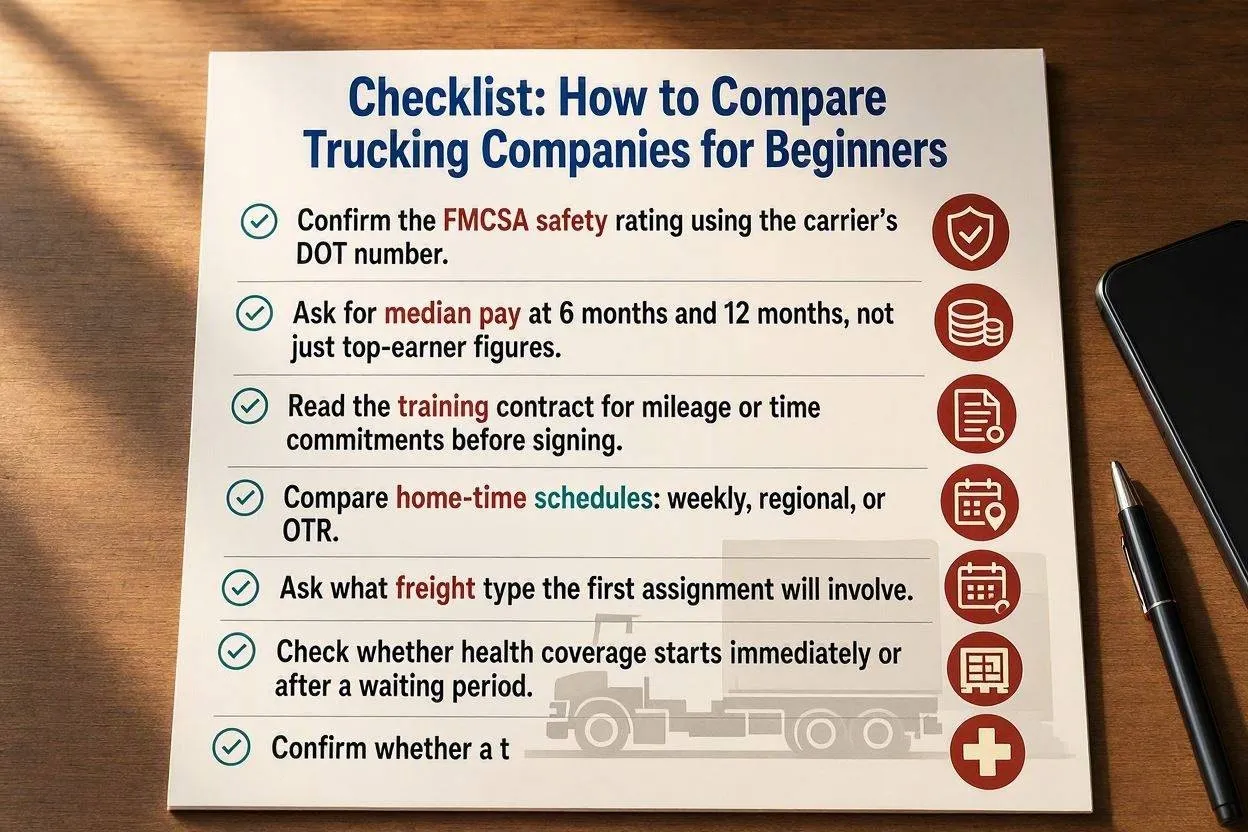
- Confirm the FMCSA safety rating using the carrier’s DOT number.
- Ask for median pay at 6 months and 12 months, not just top-earner figures.
- Read the training contract for mileage or time commitments before signing.
- Compare home-time schedules: weekly, regional, or OTR.
- Ask what freight type the first assignment will involve.
- Check whether health coverage starts immediately or after a waiting period.
- Confirm whether a trainer or mentor rides along during the first weeks.
- Verify the school’s ELDT compliance and FMCSA Training Provider Registry listing.
Conclusion
Choosing among the best trucking companies for beginners comes down to matching training structure, pay format, and home-time schedule to what you actually want, not chasing the biggest number in an ad. Werner, Schneider, Prime, C.R. England, CRST, Maverick, Roehl, Swift, and J.B. Hunt all hire beginners in 2026, and each publishes different pay data, training timelines, and freight specialties worth checking against the FMCSA’s SAFER system before you sign anything. Run the DOT-number safety check, read the mileage commitment in the training contract, and ask recruiters for six-month pay medians. Walk in with real numbers, not recruiting-ad promises.
Frequently Asked Questions

Esther Howard
Esther Howard leads TruckingHow’s trucking, commercial driving, and transportation content division. She specializes in CDL training, trucking regulations, fleet operations, truck maintenance, and logistics best practices. With over a decade of experience researching the commercial transportation industry, Esther brings a practical, research-driven approach to driver education, safety standards, and industry regulations. She is the primary author of TruckingHow’s CDL guides, trucking career resources, maintenance tips, and transportation content, helping drivers, fleet owners, and trucking professionals make informed decisions on and off the road
Related Posts